
Low Light Imaging Market Report 2026
Global Outlook – By Technology ( Complementary Metal-Oxide Semiconductor (CMOS), Charge-Coupled Device (CCD)), By Application ( Photography, Monitoring, Inspection And Detection, Security And Surveillance), By Vertical ( Consumer Electronics, Automotive, Medical And Life Sciences, Military And Defense, Industrial, Commercial And Residential Infrastructure) – Market Size, Trends, Strategies, and Forecast to 2030
Low Light Imaging Market Overview
• Low Light Imaging market size has reached to $16.58 billion in 2025 • Expected to grow to $28.68 billion in 2030 at a compound annual growth rate (CAGR) of 11.6% • Growth Driver: ADAS Integration Drives Demand For Low-Light Imaging Solutions • Market Trend: Advancement Of HDR Low-Light Imaging Sensors In Low Light Imaging • Asia-Pacific was the largest region and fastest growing region.What Is Covered Under Low Light Imaging Market?
Low-light imaging refers to night vision imaging or night vision cameras. Low-light imaging has been used in numerous scientific domains, including astronomy, fluorescence, and luminescence applications. The main low-light imaging technologies include complementary metal-oxide semiconductor (CMOS) and charge-coupled device (CCD). Complementary metal-oxide semiconductor (CMOS) refers to the semiconductor technology that is employed in integrated circuits (ICs), commonly referred to as chips or microchips. The different applications of low-light imaging include photography, monitoring, inspection and detection and security and surveillance used by verticals including consumer electronics, automotive, medical and life sciences, military and defense and industrial, commercial and residential infrastructure.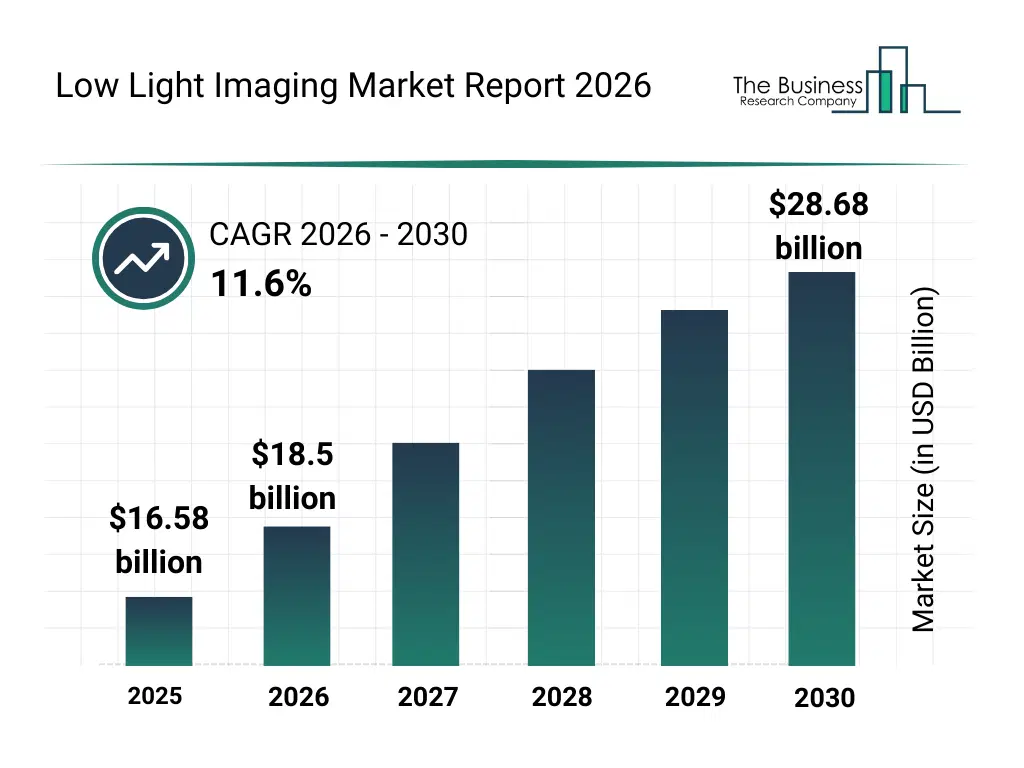
What Is The Low Light Imaging Market Size 2026 And Growth Rate?
The low light imaging market size has grown rapidly in recent years. It will grow from $16.58 billion in 2025 to $18.5 billion in 2026 at a compound annual growth rate (CAGR) of 11.6%. The growth in the historic period can be attributed to growth in surveillance and security applications, early adoption in scientific imaging, increased use in astronomy and fluorescence studies, reliance on ccd and early cmos sensors, expansion in industrial and automotive night vision technologies.What Is The Low Light Imaging Market Growth Forecast?
The low light imaging market size is expected to see rapid growth in the next few years. It will grow to $28.68 billion in 2030 at a compound annual growth rate (CAGR) of 11.6%. The growth in the forecast period can be attributed to rising demand for advanced cmos and bsi sensors, increasing use in autonomous vehicles and smart infrastructure, expansion of medical and life sciences imaging, growth in defense-related night vision technologies, development of high-sensitivity imaging platforms. Major trends in the forecast period include development of smart low-light imaging platforms, advancement of AI-enhanced night vision solutions, expansion of digitally connected imaging systems, integration of intelligent autonomous detection technologies, adoption of high-performance image processing systems.
Global Low Light Imaging Market Segmentation
1) By Technology: Complementary Metal-Oxide Semiconductor (CMOS), Charge-Coupled Device (CCD) 2) By Application: Photography, Monitoring, Inspection And Detection, Security And Surveillance 3) By Vertical: Consumer Electronics, Automotive, Medical And Life Sciences, Military And Defense, Industrial, Commercial And Residential Infrastructure Subsegments: 1) By Complementary Metal-Oxide Semiconductor (CMOS): Standard CMOS Sensors, Backside-Illuminated (BSI) CMOS Sensors, Global Shutter CMOS Sensors 2) By Charge-Coupled Device (CCD): Full-Frame CCD Sensors, Interline Transfer CCD Sensors, Scientific CCD SensorsWhat Is The Driver Of The Low Light Imaging Market?
The rapid adoption of advanced driver assistance systems (ADAS) for automobiles is expected to boost the growth of the low-light imaging market going forward. Advanced driver-assistance systems (ADAS) refer to electronic components in vehicles that support the driver by utilizing cutting-edge technologies. Adoption of advanced driver assistance systems (ADAS) for automobiles is rising due to increasing demand for enhanced vehicle safety and accident prevention. Low-light imaging is used in advanced driver assistance systems (ADAS) to enhance vehicle visibility and object detection in dark or low-visibility conditions. For instance, in February 2023, according to the Compass IoT, an Australia-based startup that leverages connected vehicle data to enhance road safety and urban planning, Australia currently has more than 1 million connected vehicles, and this figure is projected to increase tenfold by 2030. Therefore, the rapid adoption of advanced driver assistance systems (ADAS) for automobiles is driving the growth of the low-light imaging market.Key Players In The Global Low Light Imaging Market
Major companies operating in the low light imaging market are Sony Group, Samsung Electronics, Omnivision Technologies, STMicroelectronics Inc, Teledyne FLIR LLC, on Semiconductor, Panasonic Holdings Corporation, Hamamatsu Photonics, ROHM CO. Ltd., Photonis Technologies Sas, Pixart Imaging, Pixelplus, Ruixin Microelectronics Co. Ltd., Canon Inc., Fairchild Imaging Systems, BAE System, Cobham Limited, Honeywell International Inc., L3Harris Technologies Inc., Raytheon Technologies Corporation, Thales Group, Appareo, Himax Technologies Inc., Sharp Corporation
This chart is for illustrative purposes; the full report includes a detailed competitor analysis and comprehensive overview of the top 10 companies in the market.
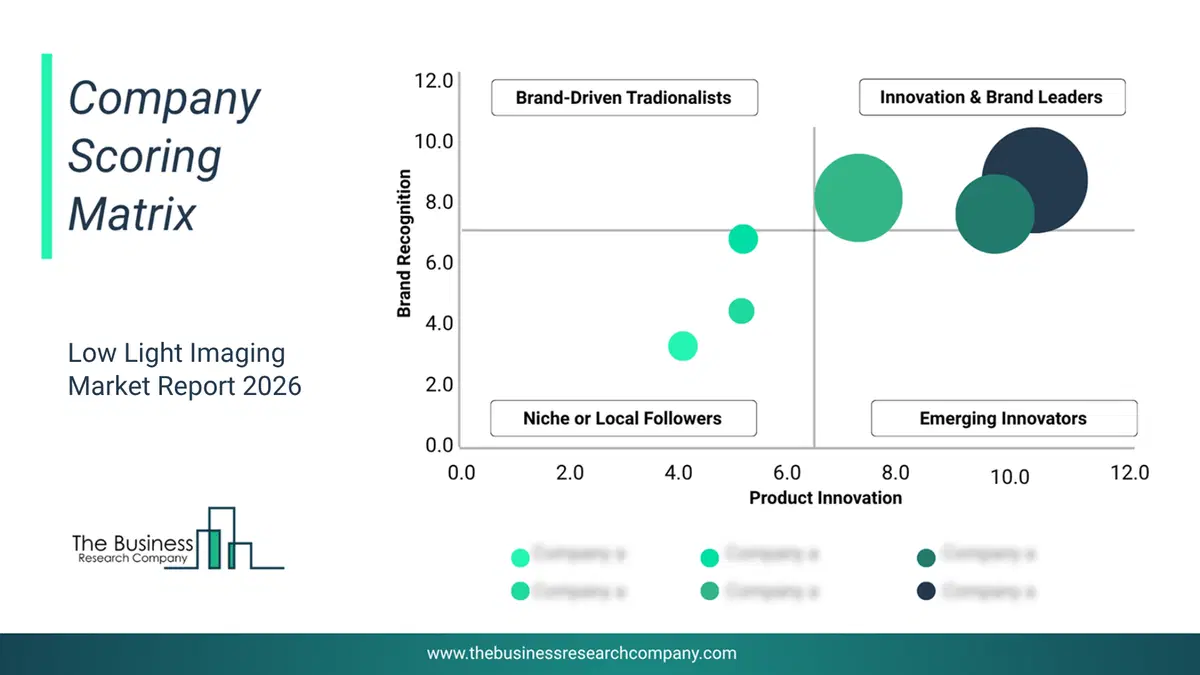
This chart maps companies by product innovation and brand strength, with bubble size indicating relative revenue, helping identify market leaders, challengers, and niche players. This is an illustrative chart; the full report provides a complete and accurate competitive analysis.
Global Low Light Imaging Market Trends and Insights
Major companies operating in the Low Light Imaging market are focusing on developing innovative products, such as HDR low-light USB cameras (high-dynamic-range imaging devices designed to capture clear images in minimal lighting by combining advanced sensor technology and flicker mitigation), to gain a competitive advantage. For instance, in July 2024, e con Systems, an India-based embedded vision company, launched the See3CAM_CU31, a 3 MP HDR low-light USB camera featuring up to 120 dB HDR, LED flicker mitigation, and industrial-temperature operation from –40 °C to 85 °C. This trend underscores the expanding demand for imaging solutions capable of delivering reliable performance in dark or variable lighting conditions across sectors such as surveillance, transportation and robotics; however, adoption may be constrained by higher cost and integration complexity with legacy systems.What Are Latest Mergers And Acquisitions In The Low Light Imaging Market?
In July 2023, LightPath Technologies Inc., a US-based manufacturer and integrator of proprietary optical and infrared technologies, acquired Visimid Technologies for an undisclosed amount. The acquisition aims to enhance LightPath's infrared imaging capabilities for defense and commercial applications through the acquisition of Visimid, leveraging its expertise in thermal imaging and night vision. This integration will enable LightPath to create tailored solutions for Department of Defense contractors and industrial clients. Visimid Technologies is a US-based provider of thermal imaging, and night vision imaging.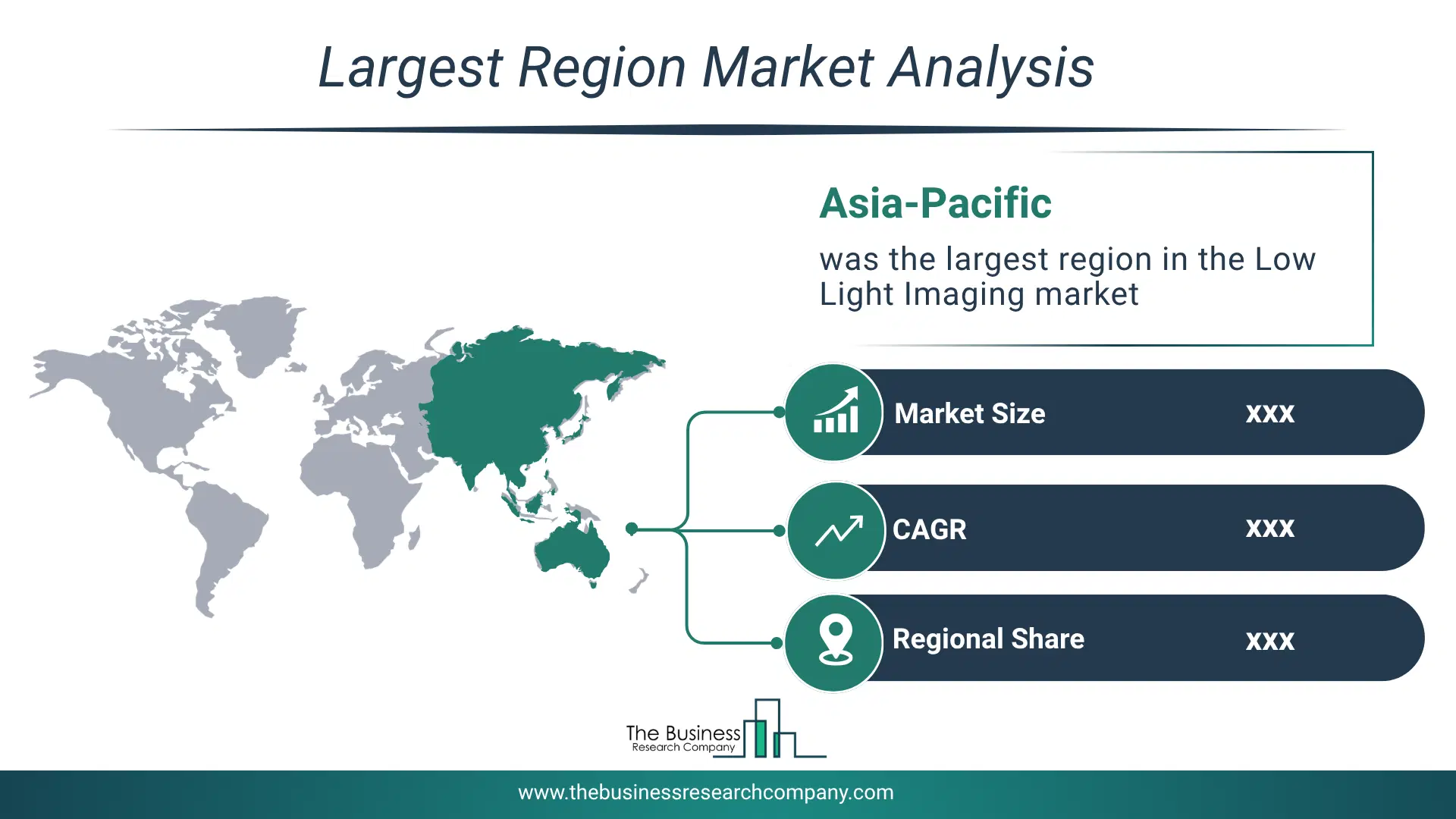
Regional Outlook
Asia-Pacific was the largest region in the low-light imaging market in 2025. Asia-Pacific is expected to be the fastest-growing region in the low light imaging market during the forecast period. The regions covered in this market report are Asia-Pacific, South East Asia, Western Europe, Eastern Europe, North America, South America, Middle East, Africa. The countries covered in this market report are Australia, Brazil, China, France, Germany, India, Indonesia, Japan, Taiwan, Russia, South Korea, UK, USA, Canada, Italy, Spain.What Defines the Low Light Imaging Market?
The low-light imaging market consists of sales of EM-CCD cameras, high-resolution monochrome (HR-M) cameras, and high-speed monochrome (HR-M) cameras. Values in this market are ‘factory gate’ values, that is the value of goods sold by the manufacturers or creators of the goods, whether to other entities (including downstream manufacturers, wholesalers, distributors, and retailers) or directly to end customers. The value of goods in this market includes related services sold by the creators of the goods.How is Market Value Defined and Measured?
The market value is defined as the revenues that enterprises gain from the sale of goods and/or services within the specified market and geography through sales, grants, or donations in terms of the currency (in USD unless otherwise specified). The revenues for a specified geography are consumption values that are revenues generated by organizations in the specified geography within the market, irrespective of where they are produced. It does not include revenues from resales along the supply chain, either further along the supply chain or as part of other products.
This chart presents market attractiveness based on a quantitative evaluation of growth, competition, strategic alignment, and risk, offering a clear view of opportunity areas for decision-making. This chart is for illustrative purposes; the full report contains the complete analysis.

This chart highlights the Total Addressable Market (TAM) by estimating the maximum revenue opportunity using an assumption-driven approach, supporting strategic planning and opportunity sizing across markets. The chart is illustrative; the full report provides a more comprehensive analysis.
What Key Data and Analysis Are Included in the Low Light Imaging Market Report 2026?
The low light imaging market research report is one of a series of new reports from The Business Research Company that provides market statistics, including industry global market size, regional shares, competitors with the market share, detailed market segments, market trends and opportunities, and any further data you may need to thrive in the low light imaging industry. The market research report delivers a complete perspective of everything you need, with an in-depth analysis of the current and future state of the industry.Low Light Imaging Market Report Forecast Analysis
| Report Attribute | Details |
|---|---|
| Market Size Value In 2026 | $18.5 billion |
| Revenue Forecast In 2030 | $28.68 billion |
| Growth Rate | CAGR of 11.6% from 2026 to 2030 |
| Base Year For Estimation | 2025 |
| Actual Estimates/Historical Data | 2020-2025 |
| Forecast Period | 2026 - 2030 |
| Market Representation | Revenue in USD Billion and CAGR from 2026 to 2030 |
| Segments Covered | Technology, Application, Vertical |
| Regional Scope | Asia-Pacific, Western Europe, Eastern Europe, North America, South America, Middle East, Africa |
| Country Scope | The countries covered in the report are Australia, Brazil, China, France, Germany, India, Indonesia, Japan, Taiwan, Russia, South Korea, UK, USA, Canada, Italy, Spain. |
| Key Companies Profiled | Sony Group, Samsung Electronics, Omnivision Technologies, STMicroelectronics Inc, Teledyne FLIR LLC, on Semiconductor, Panasonic Holdings Corporation, Hamamatsu Photonics, ROHM CO. Ltd., Photonis Technologies Sas, Pixart Imaging, Pixelplus, Ruixin Microelectronics Co. Ltd., Canon Inc., Fairchild Imaging Systems, BAE System, Cobham Limited, Honeywell International Inc., L3Harris Technologies Inc., Raytheon Technologies Corporation, Thales Group, Appareo, Himax Technologies Inc., Sharp Corporation |
| Customization Scope | Request for Customization |
| Pricing And Purchase Options | Explore Purchase Options |