
Low-Orbit Satellite Constellation Market Report 2026
Global Outlook – By Component (Satellite, Ground Station, Launch Services, Other Components), By Application (Commercial, Defense, Government, Other Applications), By End-User (Telecommunications, Aerospace And Defense, Maritime, Other End Users) – Market Size, Trends, Strategies, and Forecast to 2030
Low-Orbit Satellite Constellation Market Overview
• Low-Orbit Satellite Constellation market size has reached to $5.5 billion in 2025 • Expected to grow to $11.31 billion in 2030 at a compound annual growth rate (CAGR) of 15.4% • Growth Driver: Increasing Need For High-Speed Internet Connectivity Fueling The Growth Of The Market Due To Expanding Mobile Network Penetration And Demand For Real-Time Communication • Market Trend: Advancements In LEO Satellite Constellations Enabling Global Connectivity And Autonomous Communication • North America was the largest region in 2025.What Is Covered Under Low-Orbit Satellite Constellation Market?
A low-orbit satellite constellation is a network of satellites operating in low Earth orbit (LEO), typically at altitudes between 500 to 2,000 kilometers. These satellites work together to provide continuous, global coverage. These satellites work together in a planned arrangement, often spread across several orbital planes, to provide continuous or near-continuous coverage of large areas of the earth. The main components of low-orbit satellite constellation include satellites, ground stations, launch services, and others. Satellites refer to artificial objects placed into orbit around Earth to perform various tasks such as communication, observation, navigation, and scientific research. These constellations serve a wide range of applications, including commercial, defense, government, and others with end-users spanning across sectors such as telecommunications, aerospace and defense, maritime, and others.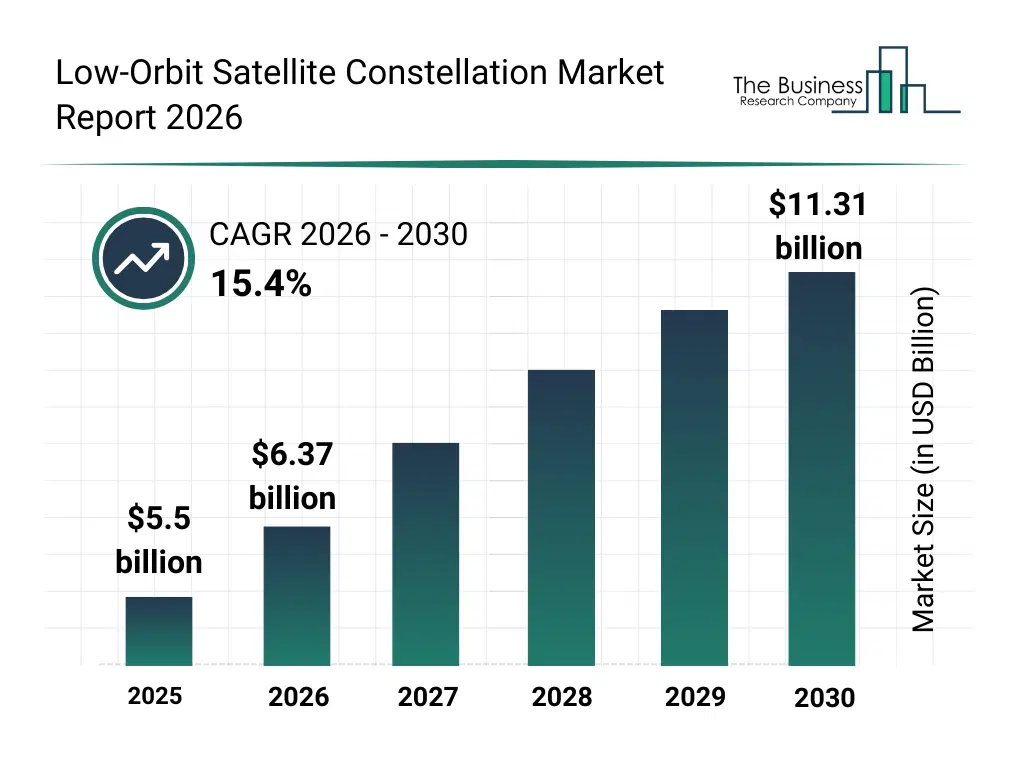
What Is The Low-Orbit Satellite Constellation Market Size and Share 2026?
The low-orbit satellite constellation market size has grown rapidly in recent years. It will grow from $5.5 billion in 2025 to $6.37 billion in 2026 at a compound annual growth rate (CAGR) of 15.8%. The growth in the historic period can be attributed to early deployment of low-earth orbit satellites for global communication experiments, advancements in miniaturized satellite buses enabling large-scale constellations, increasing adoption of vsat and remote connectivity services, development of reusable launch vehicles reducing launch costs, rising demand for low-latency communication solutions across commercial sectors.What Is The Low-Orbit Satellite Constellation Market Growth Forecast?
The low-orbit satellite constellation market size is expected to see rapid growth in the next few years. It will grow to $11.31 billion in 2030 at a compound annual growth rate (CAGR) of 15.4%. The growth in the forecast period can be attributed to expansion of mega-constellation projects for global broadband coverage, increasing demand for user terminals and antennas optimized for leo networks, growth in real-time tracking and iot connectivity applications, technological advancements in propulsion and communication payloads improving constellation performance, rising investment in launch capacity to support rapid constellation deployment. Major trends in the forecast period include rapid expansion of commercial leo broadband networks, growth in miniaturized satellite technologies, increasing demand for real-time earth observation and monitoring, rising investment in reusable and cost-efficient launch systems, integration of inter-satellite links for continuous global coverage.
Global Low-Orbit Satellite Constellation Market Segmentation
1) By Component: Satellite, Ground Station, Launch Services, Other Components 2) By Application: Commercial, Defense, Government, Other Applications 3) By End-User: Telecommunications, Aerospace And Defense, Maritime, Other End Users Subsegments: 1) By Satellite: Communication Satellites, Earth Observation Satellites, Navigation Satellites, Imaging Satellites, Scientific or Research Satellites, Technology Demonstration Satellites, CubeSats or NanoSats 2) By Ground Station: Telemetry, Tracking and Command Systems, Antenna Systems, Network Control Centers, Data Reception and Processing Units, Ground-Based Infrastructure Software, Remote Ground Terminals 3) By Launch Services: Dedicated Launch Vehicles, Rideshare Launch Services, Small Satellite Launch Vehicles, Reusable Launch Systems, Launch Integration Services 4) By Other Components: Onboard Propulsion Systems, Power Systems, Communication Payloads, Thermal Control Systems, Attitude and Orbit Control Systems, Satellite Bus Platforms, Inter-satellite Link SystemsWhat Is Driver Of The Low-Orbit Satellite Constellation Market?
The increasing need for high-speed internet connectivity is expected to propel the growth of the low-orbit satellite constellation market going forward. Internet connectivity refers to the ability of devices to access and communicate over the internet through various networks and technologies. The increasing penetration of internet connectivity is primarily due to the expansion of mobile networks, which enable wider and more affordable access to online services, especially in remote and underserved areas. High-speed internet connectivity enhances low-orbit satellite constellations by enabling rapid data transmission and low-latency communication. It supports real-time applications, expands coverage to remote areas, and improves the overall efficiency of global connectivity solutions. For instance, in 2023, according to the International Telecommunication Union, a Switzerland-based organization of the United Nations, the number of internet users rose from 5.1 billion (64% penetration) in 2022 to 5.4 billion (67% penetration) in 2023. Therefore, the increasing need for high-speed internet connectivity is driving the growth of the low-orbit satellite constellation industry.Key Players In The Global Low-Orbit Satellite Constellation Market
Major companies operating in the low-orbit satellite constellation market are Airbus SE, Lockheed Martin Corporation, Northrop Grumman Corporation, BAE Systems plc, Thales Group, L3Harris Technologies Inc., Leonardo S.p.A., SpaceX, OneWeb Communications Ltd., Surrey Satellite Technology Ltd, E-Space Inc., Kymeta Corporation, EnduroSat S.à r.l., GomSpace A/S, Muon Space Inc., NanoAvionics Corp, Starlink Satellite Communications Private Limited, Loft Orbital Solutions Inc., Astrocast SA, HawkEye 360 Inc.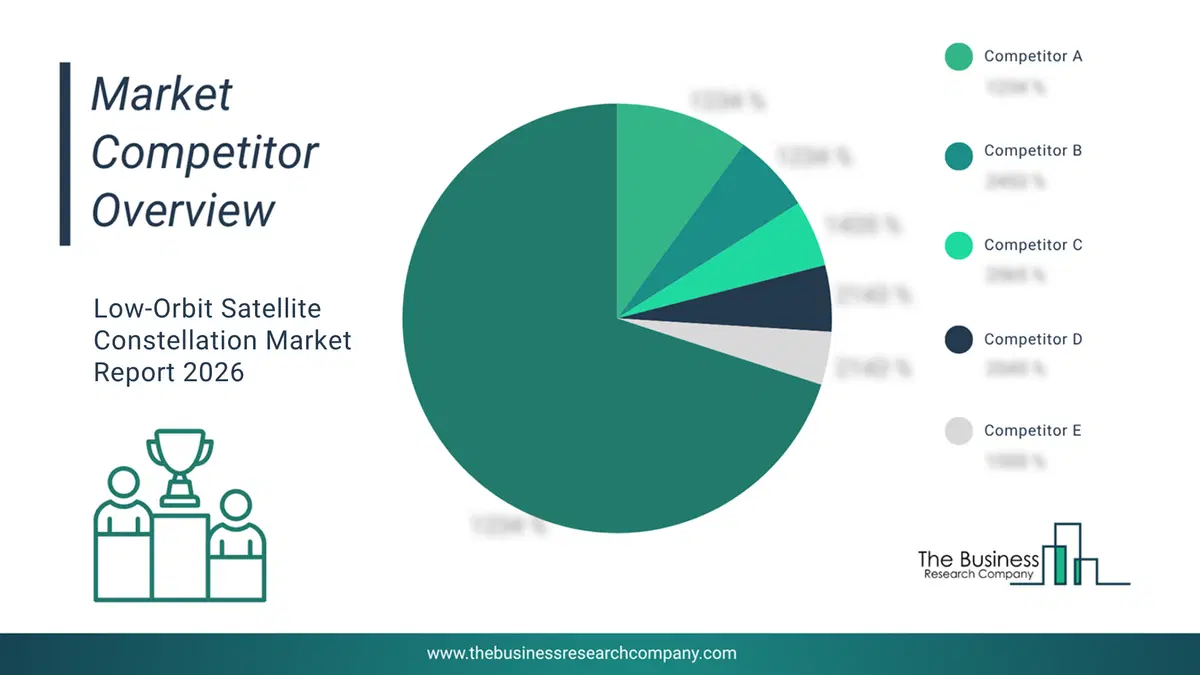
This chart is for illustrative purposes; the full report includes a detailed competitor analysis and comprehensive overview of the top 10 companies in the market.
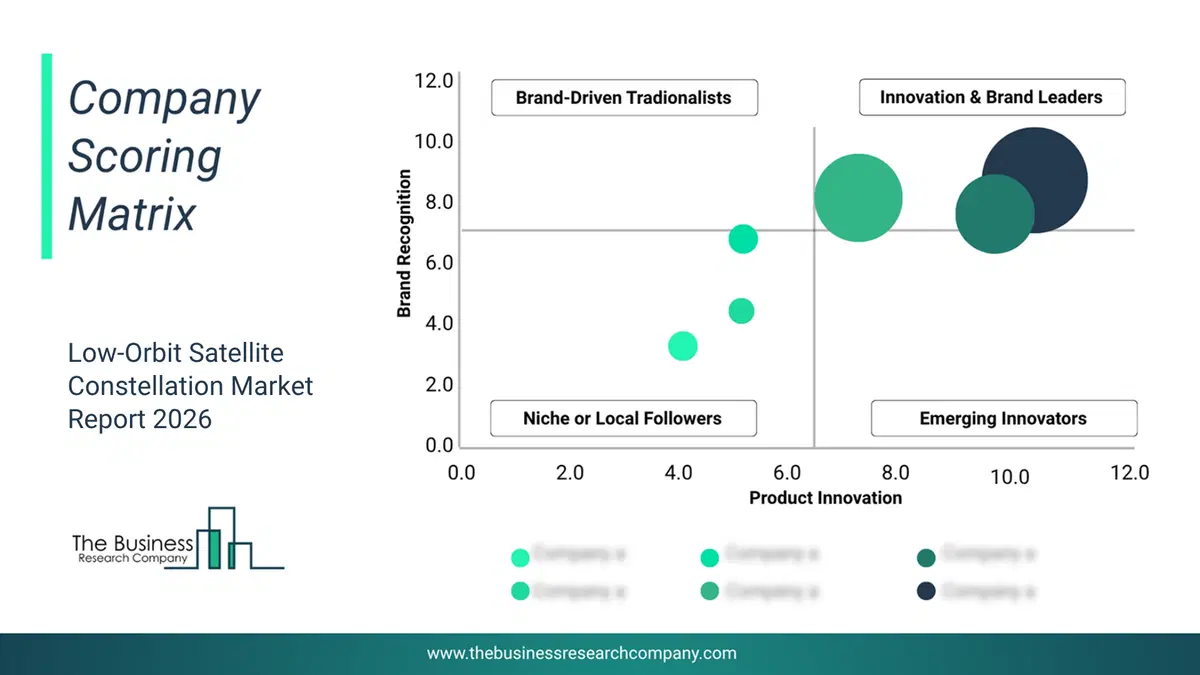
This chart maps companies by product innovation and brand strength, with bubble size indicating relative revenue, helping identify market leaders, challengers, and niche players. This is an illustrative chart; the full report provides a complete and accurate competitive analysis.
Global Low-Orbit Satellite Constellation Market Trends and Insights
Major companies operating in the Low-Orbit Satellite Constellation market are focusing on developing innovative solutions, such as low Earth orbit (LEO) satellite constellations with Vehicle-2-Everything (V2X) connectivity, to meet the rising demand for global real-time communication, autonomous driving support, and seamless IoT integration. The LEO satellites are satellites that operate at altitudes between 300 and 2,000 kilometers, offering significantly lower latency and higher data transfer speeds compared to traditional geostationary satellites, which are positioned much farther from Earth. For instance, in September 2024, Geespace, a China-based satellite technology company, launched 10 LEO satellites as part of its ‘Geely Future Mobility Constellation’ (GEESATCOM) from the Taiyuan Satellite Launch Center. These satellites are designed to provide 24/7 global communication coverage, currently reaching 90% of the Earth’s surface, and support applications such as autonomous driving, smart connectivity, and mid-to-low-speed satellite services. The constellation leverages a phased deployment strategy, with Phase One targeting 72 satellites to serve over 200 million users worldwide, while future phases will enable direct-to-cell communication and high-speed broadband. This launch marks the first time a Chinese commercial aerospace company has offered global LEO satellite communication services, positioning Geespace as a key competitor to systems like SpaceX’s Starlink.What Are Latest Mergers And Acquisitions In The Low-Orbit Satellite Constellation Market? BlackSky Acquires LeoStella To Boost AI Satellite Constellation
In November 2024, BlackSky Technology Inc., a US-based geospatial intelligence company, acquired LeoStella LLC for an undisclosed amount. With this acquisition, BlackSky aims to streamline its Gen-3 satellite production by vertically integrating its supply chain, boosting control over design-to-launch, and expanding capacity to 40 satellites per year for faster deployment of its AI-powered constellation. LeoStella LLC is a US-based small satellite manufacturing company involved in building satellites for low-orbit satellite constellations.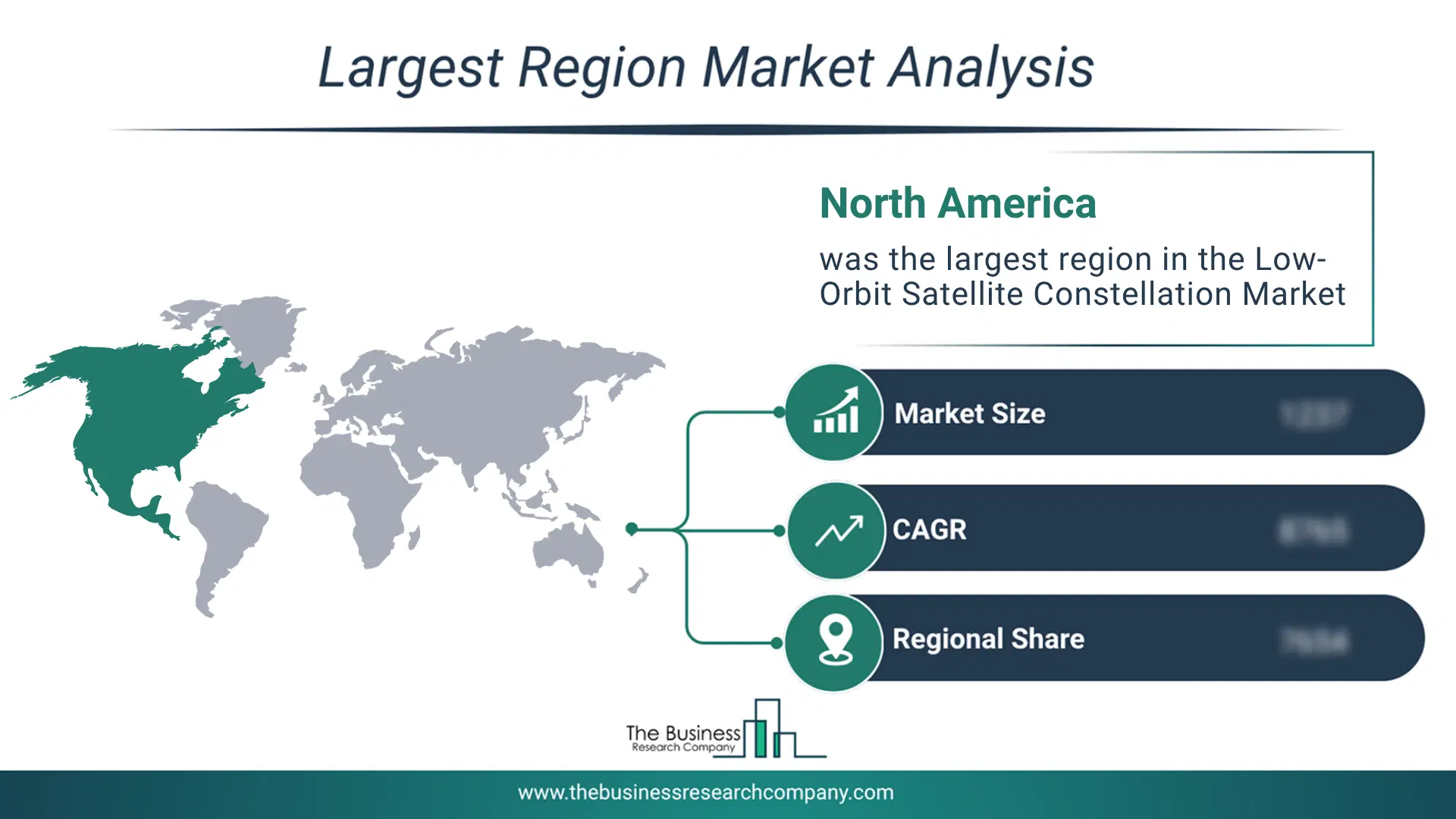
Regional Insights
North America was the largest region in the low-orbit satellite constellation market in 2025. The regions covered in this market report are Asia-Pacific, South East Asia, Western Europe, Eastern Europe, North America, South America, Middle East, Africa. The countries covered in this market report are Australia, Brazil, China, France, Germany, India, Indonesia, Japan, Taiwan, Russia, South Korea, UK, USA, Canada, Italy, SpainWhat Defines the Low-Orbit Satellite Constellation Market?
The low-orbit satellite constellation market consists of revenues earned by entities by providing services such as high-speed broadband internet, low latency communications, real-time tracking and monitoring, remote diagnostics, voice and data connectivity, and very small aperture terminal (VSAT) services. The market value includes the value of related goods sold by the service provider or included within the service offering. The low-orbit satellite constellation market also includes sales of antennas, user terminals, modems, satellite phones, launch vehicles, satellite buses, onboard transponders, propulsion systems, and communication payloads. Values in this market are ‘factory gate’ values, that is the value of goods sold by the manufacturers or creators of the goods, whether to other entities (including downstream manufacturers, wholesalers, distributors and retailers) or directly to end customers. The value of goods in this market includes related services sold by the creators of the goods.How is Market Value Defined and Measured?
The market value is defined as the revenues that enterprises gain from the sale of goods and/or services within the specified market and geography through sales, grants, or donations in terms of the currency (in USD unless otherwise specified). The revenues for a specified geography are consumption values that are revenues generated by organizations in the specified geography within the market, irrespective of where they are produced. It does not include revenues from resales along the supply chain, either further along the supply chain or as part of other products.
This chart presents market attractiveness based on a quantitative evaluation of growth, competition, strategic alignment, and risk, offering a clear view of opportunity areas for decision-making. This chart is for illustrative purposes; the full report contains the complete analysis.

This chart highlights the Total Addressable Market (TAM) by estimating the maximum revenue opportunity using an assumption-driven approach, supporting strategic planning and opportunity sizing across markets. The chart is illustrative; the full report provides a more comprehensive analysis.
What Key Data and Analysis Are Included in the Low-Orbit Satellite Constellation Market Report 2026?
The low-orbit satellite constellation market research report is one of a series of new reports from The Business Research Company that provides market statistics, including industry global market size, regional shares, competitors with the market share, detailed market segments, market trends and opportunities, and any further data you may need to thrive in the low-orbit satellite constellation industry. The market research report delivers a complete perspective of everything you need, with an in-depth analysis of the current and future state of the industry.Low-Orbit Satellite Constellation Market Report Forecast Analysis
| Report Attribute | Details |
|---|---|
| Market Size Value In 2026 | $6.37 billion |
| Revenue Forecast In 2030 | $11.31 billion |
| Growth Rate | CAGR of 15.4% from 2026 to 2030 |
| Base Year For Estimation | 2025 |
| Actual Estimates/Historical Data | 2020-2025 |
| Forecast Period | 2026 - 2030 |
| Market Representation | Revenue in USD Billion and CAGR from 2026 to 2030 |
| Segments Covered | Component, Application, End-User |
| Regional Scope | Asia-Pacific, Western Europe, Eastern Europe, North America, South America, Middle East, Africa |
| Country Scope | The countries covered in the low-orbit satellite constellation market report are Australia, Brazil, China, France, Germany, India, Indonesia, Japan, Taiwan, Russia, South Korea, UK, USA, Canada, Italy, Spain |
| Key Companies Profiled | Airbus SE, Lockheed Martin Corporation, Northrop Grumman Corporation, BAE Systems plc, Thales Group, L3Harris Technologies Inc., Leonardo S.p.A., SpaceX, OneWeb Communications Ltd., Surrey Satellite Technology Ltd, E‑Space Inc., Kymeta Corporation, EnduroSat S.à r.l., GomSpace A/S, Muon Space Inc., NanoAvionics Corp, Starlink Satellite Communications Private Limited, Loft Orbital Solutions Inc., Astrocast SA, HawkEye 360 Inc. |
| Customization Scope | Request for Customization |
| Pricing And Purchase Options | Explore Purchase Options |