
Low Vision And Blind Aids Products Market Report 2026
Global Outlook – By Product Type (Optical Aids, Non-Optical Aids, Electronic Aids, Assistive Software, Wearable Technology), By Age Group (Children, Adults, Seniors, Teenagers, Middle-Aged), By Distribution Channel (Online Stores, Retail Pharmacies, Specialized Medical And Assistive Device Retailers, Specialty Stores, Direct Sales), By Application (Blind School, Disabled Persons Federation And Hospital, Enterprises And Social Organizations), By End-User (Individuals, Healthcare Professionals, Educational Institutions, Community Organizations, Government Agencies) – Market Size, Trends, Strategies, and Forecast to 2030
Low Vision And Blind Aids Products Market Overview
• Low Vision And Blind Aids Products market size has reached to $3.32 billion in 2025 • Expected to grow to $5.46 billion in 2030 at a compound annual growth rate (CAGR) of 10.4% • Growth Driver: The Increasing Prevalence Of Eye Diseases Is Fueling The Growth Of The Market Due To Rising Vision Impairment And Demand For Assistive Solutions • Market Trend: AI-Powered Wearable Vision Aids Enhance Independence For The Visually Impaired • North America was the largest region in 2025 and Asia-Pacific is the fastest growing region.What Is Covered Under Low Vision And Blind Aids Products Market?
Low vision and blind aid products are specialized assistive devices designed to support individuals with partial or complete vision loss. These tools use optical, tactile, or auditory technologies to enhance visual function, mobility, communication, and daily living. Low vision and blind aid products help improve the quality of life and foster greater independence for people with visual impairments. The main product types of low vision and blind aid products are optical aids, non-optical aids, electronic aids, assistive software, and wearable technology. Optical aids use magnification tools like lenses and glasses to enhance remaining vision for tasks such as reading, writing, and seeing distant objects. They are utilized by various age groups, such as children, adults, seniors, teenagers, and middle-aged people, and are distributed through various distribution channels, including online stores, retail pharmacies, supermarkets or hypermarkets, specialty stores, and direct sales. It is applicable in several applications, such as blind schools, disabled persons federations and hospitals, enterprises, and social organizations, and is used by various end users, including individuals, healthcare professionals, educational institutions, community organizations, and government agencies.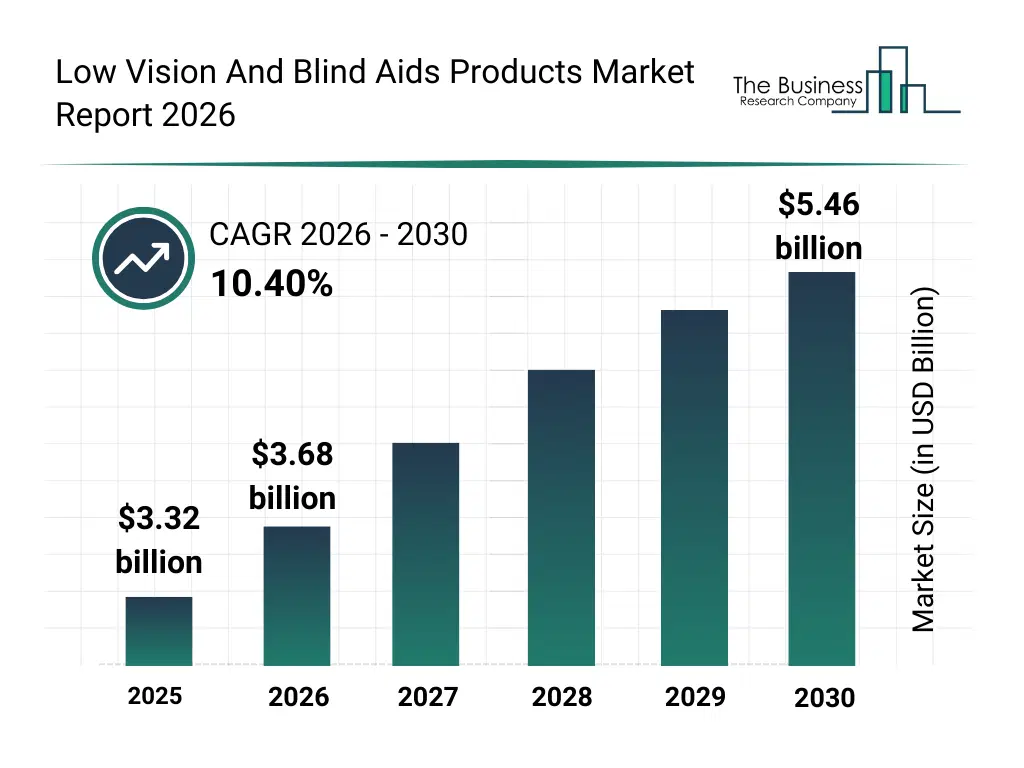
What Is The Low Vision And Blind Aids Products Market Size and Share 2026?
The low vision and blind aids products market size has grown rapidly in recent years. It will grow from $3.32 billion in 2025 to $3.68 billion in 2026 at a compound annual growth rate (CAGR) of 10.8%. The growth in the historic period can be attributed to growing prevalence of visual impairments, rising awareness of low vision aids, increasing government initiatives for disabled persons, technological advancements in optical devices, early adoption by educational institutions.What Is The Low Vision And Blind Aids Products Market Growth Forecast?
The low vision and blind aids products market size is expected to see rapid growth in the next few years. It will grow to $5.46 billion in 2030 at a compound annual growth rate (CAGR) of 10.4%. The growth in the forecast period can be attributed to integration of ai in vision aids, expansion of wearable technology, increasing demand for portable electronic aids, growth of online distribution channels, rising focus on inclusive education and employment opportunities. Major trends in the forecast period include personalized vision enhancement devices, voice-activated assistive solutions, mobile accessibility integration, smart navigation aids for indoor & outdoor mobility, affordable and inclusive low-vision technology.
Global Low Vision And Blind Aids Products Market Segmentation
1) By Product Type: Optical Aids, Non-Optical Aids, Electronic Aids, Assistive Software, Wearable Technology 2) By Age Group: Children, Adults, Seniors, Teenagers, Middle-Aged 3) By Distribution Channel: Online Stores, Retail Pharmacies, Specialized Medical And Assistive Device Retailers, Specialty Stores, Direct Sales 4) By Application: Blind School, Disabled Persons Federation And Hospital, Enterprises And Social Organizations 5) By End-User: Individuals, Healthcare Professionals, Educational Institutions, Community Organizations, Government Agencies Subsegments: 1) By Optical Aids: Magnifying Glasses, Telescopic Glasses, Spectacle-Mounted Magnifiers, Handheld Magnifiers, Stand Magnifiers 2) By Non-Optical Aids: Braille Books, Large Print Materials, Tactile Graphics, Signature Guides, Writing Templates 3) By Electronic Aids: Video Magnifiers, Digital Readers, Screen Enlargers, Electronic Braille Displays, Talking Devices 4) By Assistive Software: Screen Readers, Screen Magnification Software, Text-To-Speech Software, Optical Character Recognition (OCR) Tools, Navigation And Mapping Software 5) By Wearable Technology: Smart Glasses, Artificial Intelligence (AI)-Powered Vision Aids, Wearable Cameras, Voice-Enabled Smart Devices, Haptic Feedback WearablesWhat Is The Driver Of The Low Vision And Blind Aids Products Market?
The increasing prevalence of eye diseases is expected to drive the growth of the low vision and blind aids products market in the future. Eye diseases are disorders that affect the eyes' structure or function, potentially causing impaired vision or blindness. The rise in eye diseases is due to excessive screen time, which leads to eye strain and a faster onset of vision issues. Low vision and blind aids products assist people with eye diseases by maximizing residual vision or offering non-visual alternatives for accessing information. These tools enhance daily functioning, mobility, and independence for individuals with permanent vision impairment. For instance, in May 2024, according to the Centers for Disease Control and Prevention (CDC), a US-based federal agency, over 90 million Americans over 40 currently experience vision problems. By 2050, vision impairment and blindness in the U.S. are projected to increase by 150%, with cases of diabetic retinopathy rising by 72%, cataracts by 87%, and glaucoma and macular degeneration expected to double. Therefore, the increasing prevalence of eye diseases drives the growth of the low vision and blind aid products market.Key Players In The Global Low Vision And Blind Aids Products Market
Major companies operating in the low vision and blind aids products market are Eschenbach Optik GmbH, Tobii Dynavox, OrCam Inc., Vispero, HumanWare, Freedom Scientific, MaxiAids, Enhanced Vision, Dolphin Computer Access, Zoomax, IRIS Vision, SELVAS Healthcare Inc., LS&S LLC, LVI Low Vision International, VisionAid, Eurobraille, HHW Care Products India Private Limited, Nippon Telesoft Co. Ltd., Help Tech GmbH & Co. KG, eSight Corporation, Vuzix Corporation, Aira Tech Corp.
This chart is for illustrative purposes; the full report includes a detailed competitor analysis and comprehensive overview of the top 10 companies in the market.
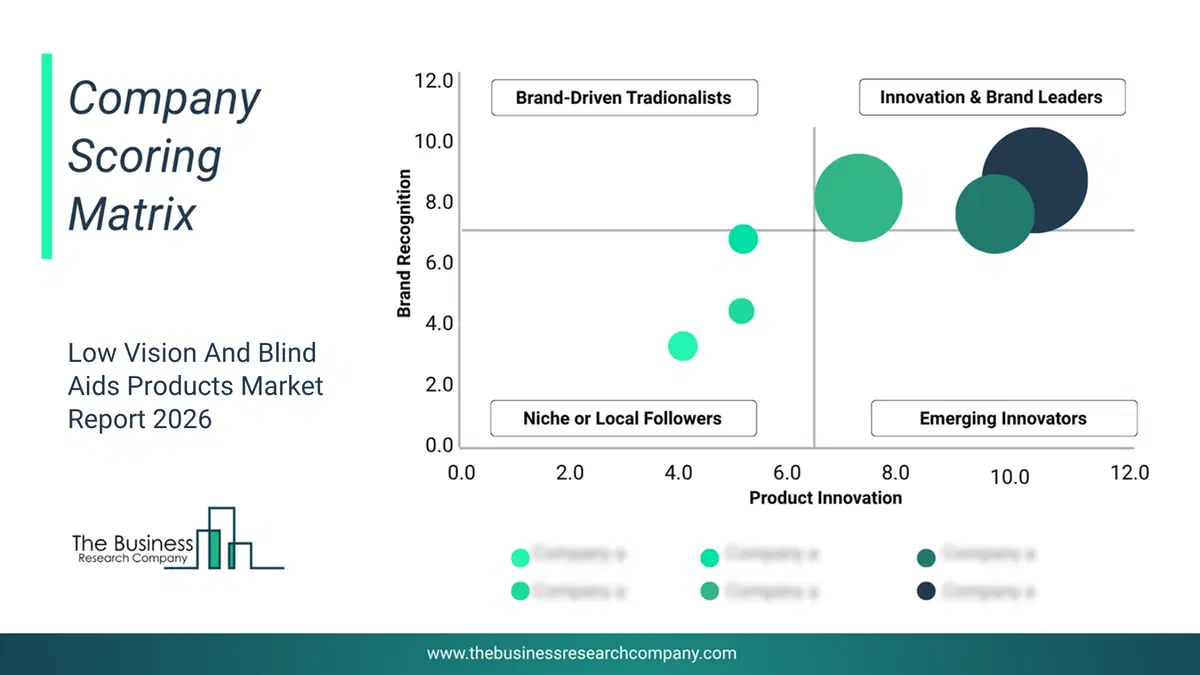
This chart maps companies by product innovation and brand strength, with bubble size indicating relative revenue, helping identify market leaders, challengers, and niche players. This is an illustrative chart; the full report provides a complete and accurate competitive analysis.
Global Low Vision And Blind Aids Products Market Trends and Insights
Major companies operating in the low vision and blind aids products market are focusing on developing advanced products such as AI-powered wearable vision aids to improve functional independence and quality of life for individuals affected by retinal disorders and vision loss. An AI-powered wearable vision aid is a smart, head-mounted device that integrates artificial intelligence with vision-enhancement technologies to help visually impaired individuals interpret visual information, perform everyday tasks, and navigate their environments more independently. For instance, in August 2024, Eyedaptic, a US-based provider of vision-enhancement solutions, launched EYE6 with Ivy, a new AI-powered visual assistant for individuals with age-related macular degeneration and other retinal disorders. The EYE6 integrates advanced multimodal generative artificial intelligence and large language model capabilities to assist users by reading text, identifying objects, and interpreting surroundings across diverse settings in 99 languages. Designed for individuals with age-related macular degeneration and other retinal disorders, the lightweight smart glasses combine high-definition visual augmentation with an interactive AI assistant to support greater independence and everyday task management.What Are Latest Mergers And Acquisitions In The Low Vision And Blind Aids Products Market?
In January 2024, Gentex Corporation, a US-based electronics and technology company, acquired eSight for an undisclosed amount. This deal aims to leverage Gentex’s advanced electro-optical engineering and manufacturing capabilities to enhance eSight’s wearable vision-enhancement technology, making it more compact, cost-effective, and accessible for individuals with low vision. eSight is a Canada-based vision enhancement technology provider that helps people with visual impairments.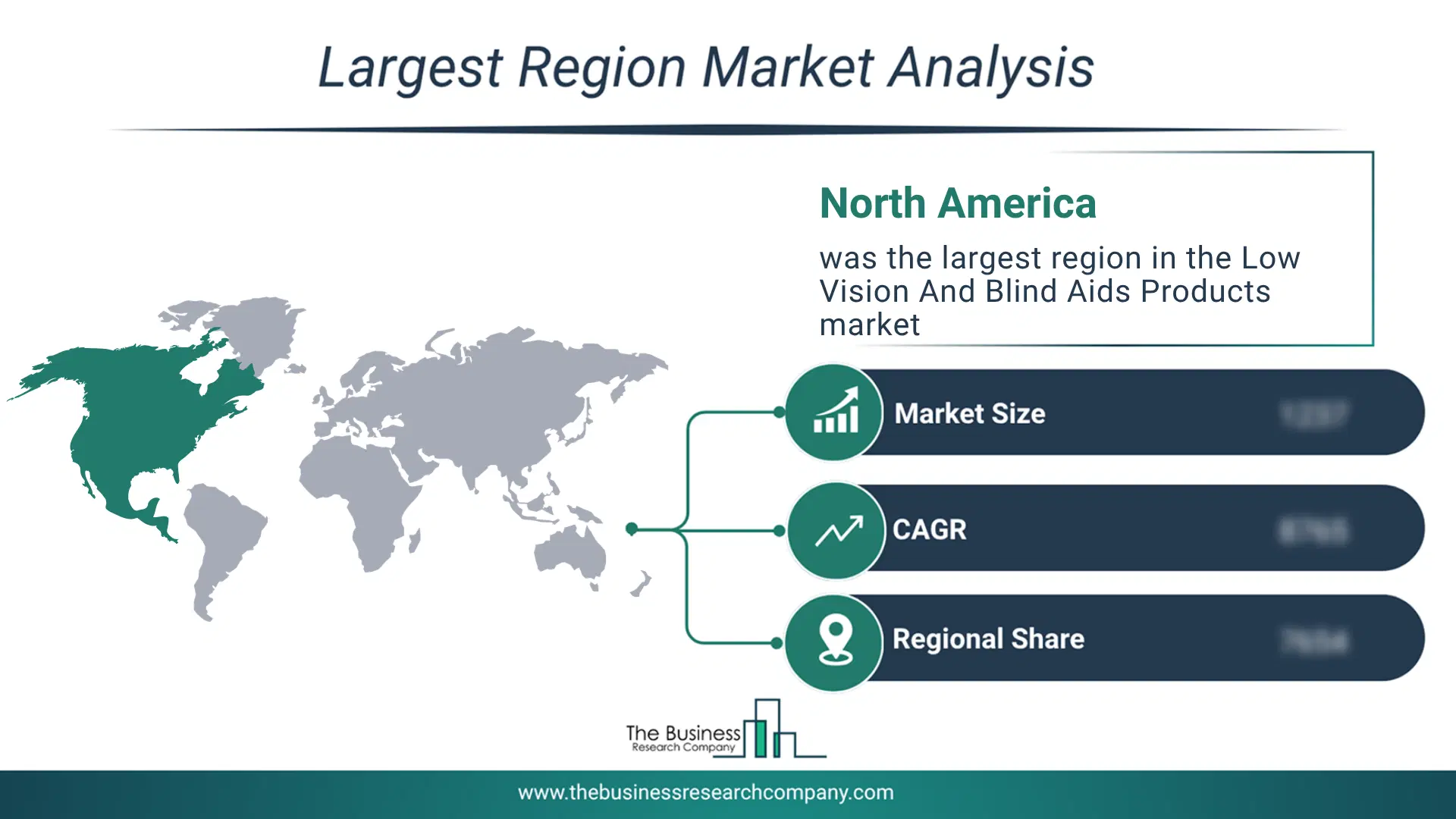
Regional Outlook
North America was the largest region in the low vision and blind aids products market in 2025. Asia-Pacific is expected to be the fastest-growing region in the forecast period. The regions covered in this market report are Asia-Pacific, South East Asia, Western Europe, Eastern Europe, North America, South America, Middle East, Africa. The countries covered in this market report are Australia, Brazil, China, France, Germany, India, Indonesia, Japan, Taiwan, Russia, South Korea, UK, USA, Canada, Italy, SpainWhat Defines the Low Vision And Blind Aids Products Market?
The low vision and blind aids products market consists of sales of screen readers, wearable visual aids, speech-based navigation tools, tactile graphics devices, electronic canes, optical character recognition devices, and audio book players. Values in this market are ‘factory gate’ values, that is the value of goods sold by the manufacturers or creators of the goods, whether to other entities (including downstream manufacturers, wholesalers, distributors and retailers) or directly to end customers. The value of goods in this market includes related services sold by the creators of the goods.How is Market Value Defined and Measured?
The market value is defined as the revenues that enterprises gain from the sale of goods and/or services within the specified market and geography through sales, grants, or donations in terms of the currency (in USD unless otherwise specified). The revenues for a specified geography are consumption values that are revenues generated by organizations in the specified geography within the market, irrespective of where they are produced. It does not include revenues from resales along the supply chain, either further along the supply chain or as part of other products.
This chart presents market attractiveness based on a quantitative evaluation of growth, competition, strategic alignment, and risk, offering a clear view of opportunity areas for decision-making. This chart is for illustrative purposes; the full report contains the complete analysis.

This chart highlights the Total Addressable Market (TAM) by estimating the maximum revenue opportunity using an assumption-driven approach, supporting strategic planning and opportunity sizing across markets. The chart is illustrative; the full report provides a more comprehensive analysis.
What Key Data and Analysis Are Included in the Low Vision And Blind Aids Products Market Report 2026?
The low vision and blind aids products market research report is one of a series of new reports from The Business Research Company that provides market statistics, including industry global market size, regional shares, competitors with the market share, detailed market segments, market trends and opportunities, and any further data you may need to thrive in the low vision and blind aids products industry. The market research report delivers a complete perspective of everything you need, with an in-depth analysis of the current and future state of the industry.Low Vision And Blind Aids Products Market Report Forecast Analysis
| Report Attribute | Details |
|---|---|
| Market Size Value In 2026 | $3.68 billion |
| Revenue Forecast In 2030 | $5.46 billion |
| Growth Rate | CAGR of 10.4% from 2026 to 2030 |
| Base Year For Estimation | 2025 |
| Actual Estimates/Historical Data | 2020-2025 |
| Forecast Period | 2026 - 2030 |
| Market Representation | Revenue in USD Billion and CAGR from 2026 to 2030 |
| Segments Covered | Product Type, Age Group, Distribution Channel, Application, End-User |
| Regional Scope | Asia-Pacific, Western Europe, Eastern Europe, North America, South America, Middle East, Africa |
| Country Scope | The countries covered in the report are Australia, Brazil, China, France, Germany, India, Indonesia, Japan, Taiwan, Russia, South Korea, UK, USA, Canada, Italy, Spain. |
| Key Companies Profiled | Eschenbach Optik GmbH, Tobii Dynavox, OrCam Inc., Vispero, HumanWare, Freedom Scientific, MaxiAids, Enhanced Vision, Dolphin Computer Access, Zoomax, IRIS Vision, SELVAS Healthcare Inc., LS&S LLC, LVI Low Vision International, VisionAid, Eurobraille, HHW Care Products India Private Limited, Nippon Telesoft Co. Ltd., Help Tech GmbH & Co. KG, eSight Corporation, Vuzix Corporation, Aira Tech Corp. |
| Customization Scope | Request for Customization |
| Pricing And Purchase Options | Explore Purchase Options |