
Low Vision Electronic Glasses Market Report 2026
Global Outlook – By Product Type (Wearable Glasses, Smart Glasses, Augmented Reality Glasses, Night Vision Glasses), By Technology (Optical Technology, Digital Technology, Adaptive Technology, Artificial Intelligence Integrated Technology), By Application (Personal Use, Professional Use), By Distribution Channel (Online Retail, Offline Retail, Direct Sales, Healthcare Providers), By End-User (Individuals With Visual Impairments, Healthcare Institutions, Educational Institutions, Occupational Rehabilitation Centers) – Market Size, Trends, Strategies, and Forecast to 2030
Low Vision Electronic Glasses Market Overview
• Low Vision Electronic Glasses market size has reached to $0.97 billion in 2025 • Expected to grow to $1.66 billion in 2030 at a compound annual growth rate (CAGR) of 11.3% • Growth Driver: The Increasing Prevalence Of Visual Impairments Drives The Growth Of The Market Due To Age-Related Eye Conditions • Market Trend: Artificial Intelligence Integration Redefines Visual Independence For The Visually Impaired • North America was the largest region in 2025 and Asia-Pacific is the fastest growing region.What Is Covered Under Low Vision Electronic Glasses Market?
Low vision electronic glasses are wearable assistive devices that use a combination of cameras, displays, and digital processing to enhance visual input for individuals with impaired vision. These glasses magnify and improve the contrast of the environment or text in real time, helping users perform daily tasks more independently. The main product types of low-vision electronic glasses are wearable glasses, smart glasses, augmented reality glasses, and night vision glasses. Wearable glasses refer to electronic or smart eyewear devices worn, such as traditional glasses that enhance or augment vision, display information, or provide other functionalities such as magnification, real-time data, or visual assistance. These utilize a range of technologies such as optical, digital, adaptive, and artificial intelligence-integrated technologies. They are designed for both personal and professional applications and are distributed through various channels, including online and offline retail, direct sales, and healthcare providers. The key end users of these devices include individuals with visual impairments, healthcare institutions, educational institutions, and occupational rehabilitation centers.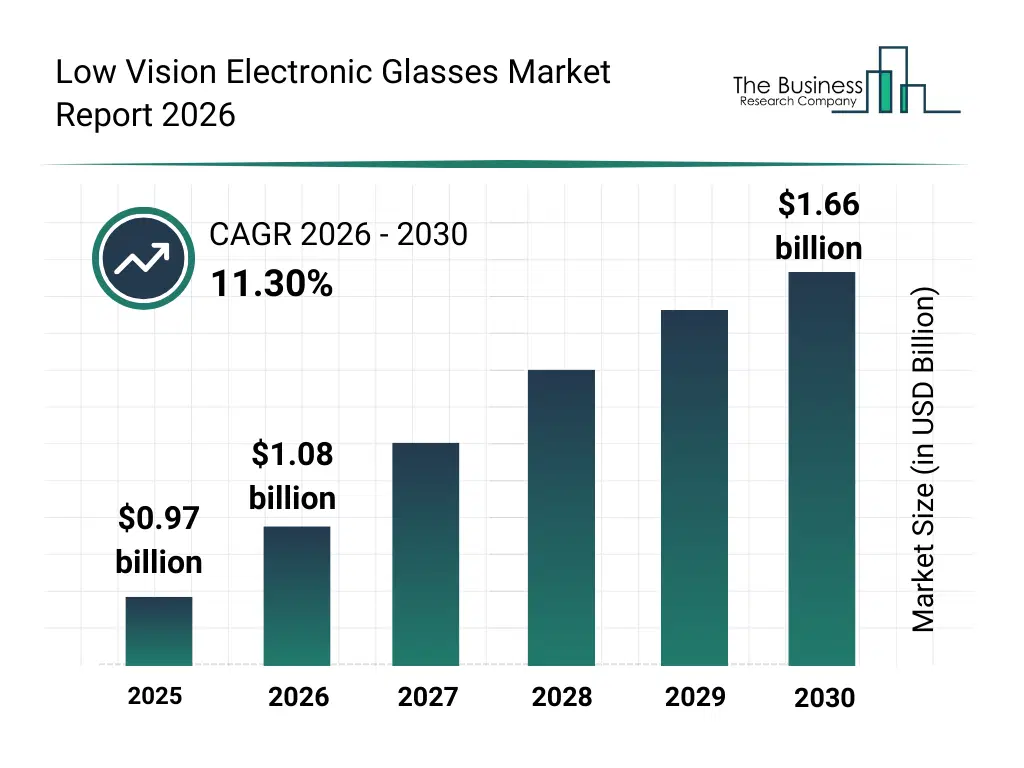
What Is The Low Vision Electronic Glasses Market Size and Share 2026?
The low vision electronic glasses market size has grown rapidly in recent years. It will grow from $0.97 billion in 2025 to $1.08 billion in 2026 at a compound annual growth rate (CAGR) of 11.6%. The growth in the historic period can be attributed to rising prevalence of visual impairments, technological limitations in traditional optical aids, high cost of early devices, limited awareness of low vision aids, lack of trained professionals.What Is The Low Vision Electronic Glasses Market Growth Forecast?
The low vision electronic glasses market size is expected to see rapid growth in the next few years. It will grow to $1.66 billion in 2030 at a compound annual growth rate (CAGR) of 11.3%. The growth in the forecast period can be attributed to advancements in ai-driven vision enhancement, integration with ar/vr for immersive experience, reduction in device cost due to mass production, increasing adoption among aging population, growing focus on independent living for visually impaired. Major trends in the forecast period include miniaturization of devices, real-time image enhancement, wearable comfort and ergonomics, voice and gesture control integration, personalized vision assistance.
Global Low Vision Electronic Glasses Market Segmentation
1) By Product Type: Wearable Glasses, Smart Glasses, Augmented Reality Glasses, Night Vision Glasses 2) By Technology: Optical Technology, Digital Technology, Adaptive Technology, Artificial Intelligence Integrated Technology 3) By Application: Personal Use, Professional Use 4) By Distribution Channel: Online Retail, Offline Retail, Direct Sales, Healthcare Providers 5) By End-User: Individuals With Visual Impairments, Healthcare Institutions, Educational Institutions, Occupational Rehabilitation Centers Subsegments: 1) By Wearable Glasses: Head-Mounted Low Vision Glasses, Clip-on Assistive Glasses, Full-Frame Digital Glasses 2) By Smart Glasses: Voice-Controlled Smart Glasses, Bluetooth-Enabled Visual Aid Glasses, Integrated Camera Smart Glasses 3) By Augmented Reality Glasses: Augmented Reality Glasses For Object Recognition, Augmented Reality Navigation Assistance Glasses, Augmented Reality Text-to-Speech Glasses 4) By Night Vision Glasses: Infrared-Based Vision Glasses, Thermal Imaging Glasses for Low Vision, Low-Light Enhancement GlassesWhat Is The Driver Of The Low Vision Electronic Glasses Market?
The increasing prevalence of visual impairments is expected to propel the growth of the low vision electronic glasses market going forward. Visual impairments refer to a significant loss of vision that cannot be fully corrected with glasses, contact lenses, medication, or surgery, and that affects a person’s ability to perform everyday tasks. The rising prevalence of visual impairments is primarily due to aging populations, as the risk of eye conditions such as cataracts, glaucoma, and macular degeneration rises significantly with age. Low-vision electronic glasses help individuals with visual impairments by enhancing remaining vision through magnification, contrast adjustment, and real-time image processing, enabling greater independence in daily activities. For instance, in August 2023, according to the World Health Organization, a Switzerland-based specialized agency of the United Nations for health, globally, at least 2.2 billion people have a near or distance vision impairment. However, it is estimated that only 36% of people with distance vision impairment caused by refractive errors and just 17% of those with vision impairment due to cataracts have received appropriate treatment. Therefore, the increasing prevalence of visual impairments is driving the growth of the low vision electronic glasses industry.Key Players In The Global Low Vision Electronic Glasses Market
Major companies operating in the low vision electronic glasses market are OrCam Technologies Ltd., Enhanced Vision Systems Inc., Vuzix Corporation, Zoomax Technology Co. Ltd., IrisVision Global Inc., Acesight, Ceciaa SAS, Envision Technologies BV, Eyedaptic Inc., GiveVision Ltd., NuEyes Technologies Inc., OXSIGHT Ltd., Vision Buddy Inc., eSight Corporation, Everysight Labs Ltd., Nreal Technology Ltd., Rokid Corporation, Avegant Corporation, Magic Leap Inc., Lenovo Smart Glasses Division, Sony Smart Vision Systems, Epson Smart Glasses Division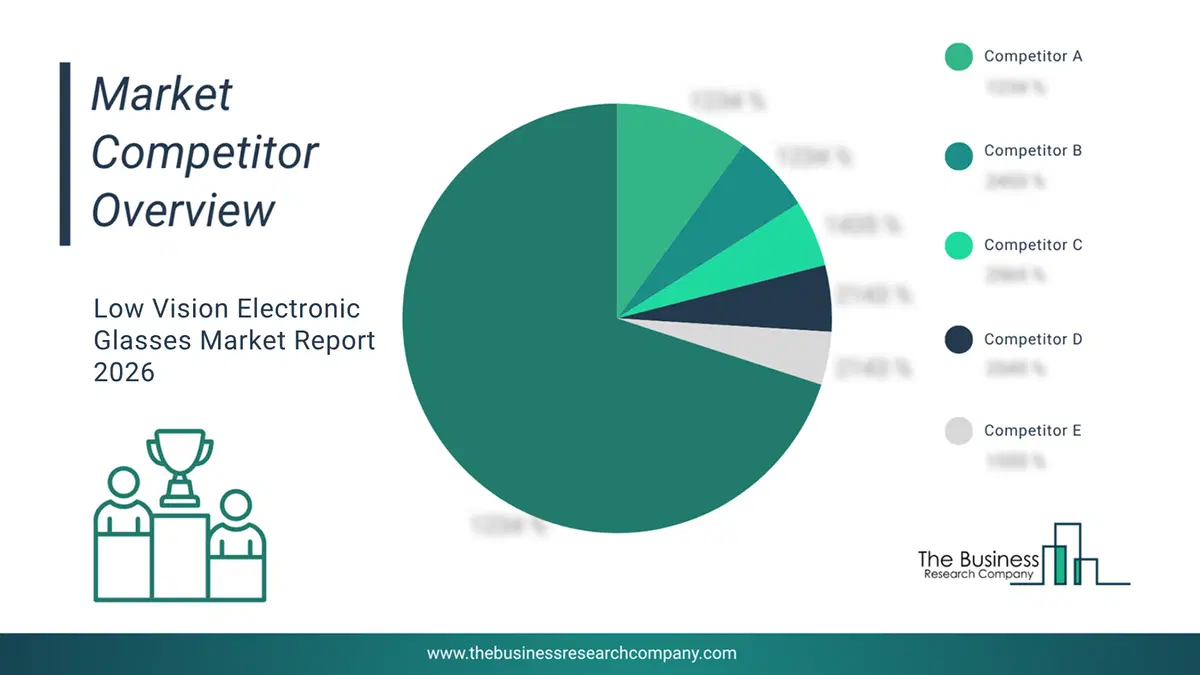
This chart is for illustrative purposes; the full report includes a detailed competitor analysis and comprehensive overview of the top 10 companies in the market.
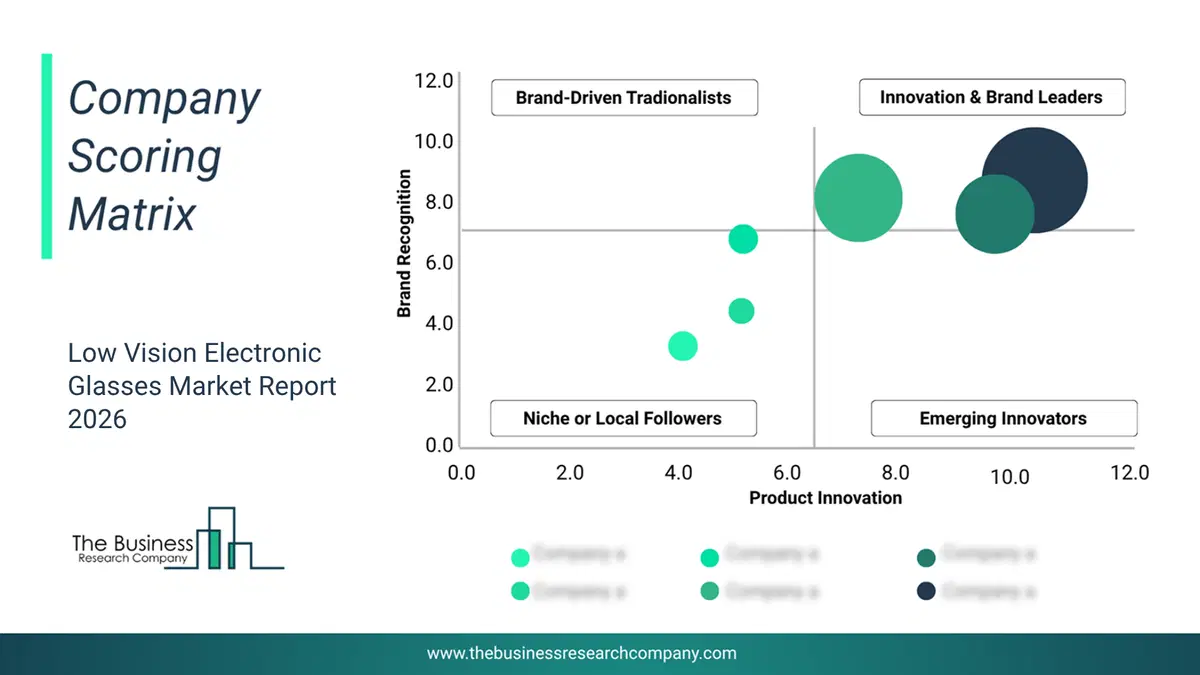
This chart maps companies by product innovation and brand strength, with bubble size indicating relative revenue, helping identify market leaders, challengers, and niche players. This is an illustrative chart; the full report provides a complete and accurate competitive analysis.
Global Low Vision Electronic Glasses Market Trends and Insights
Major companies operating in the low vision electronic glasses market are focusing on developing innovative solutions, such as artificial intelligence-powered smart glasses, to enhance visual clarity and independence for individuals with visual impairments. Artificial intelligence-powered smart glasses are wearable devices that use artificial intelligence to enhance vision by recognizing objects, reading text aloud, and adjusting images in real time to assist people with visual impairments. For instance, in August 2024, Eyedaptic Inc., a US-based vision technology company, launched EYE6 smart glasses, an advanced wearable device created to support individuals with central vision loss. These smart glasses utilize a combination of augmented reality and AI-driven vision enhancement to deliver real-time image optimization, enhancing visual clarity and contrast for users. These glasses features include a lightweight and discreet design, hands-free functionality, a multilingual visual assistant supporting 99 languages, and capabilities such as text reading, environmental description, and assistance with everyday activities.What Are Latest Mergers And Acquisitions In The Low Vision Electronic Glasses Market?
In January 2024, Gentex Corporation, a US-based fire protection company, acquired eSight for an undisclosed amount. With this acquisition, Gentex aims to advance and scale the development of high-performance, affordable electronic eyewear for the visually impaired by leveraging its expertise in electro-optical technology and manufacturing. eSight Corporation is a Canada-based company that specializes in electronic glasses for individuals with low vision.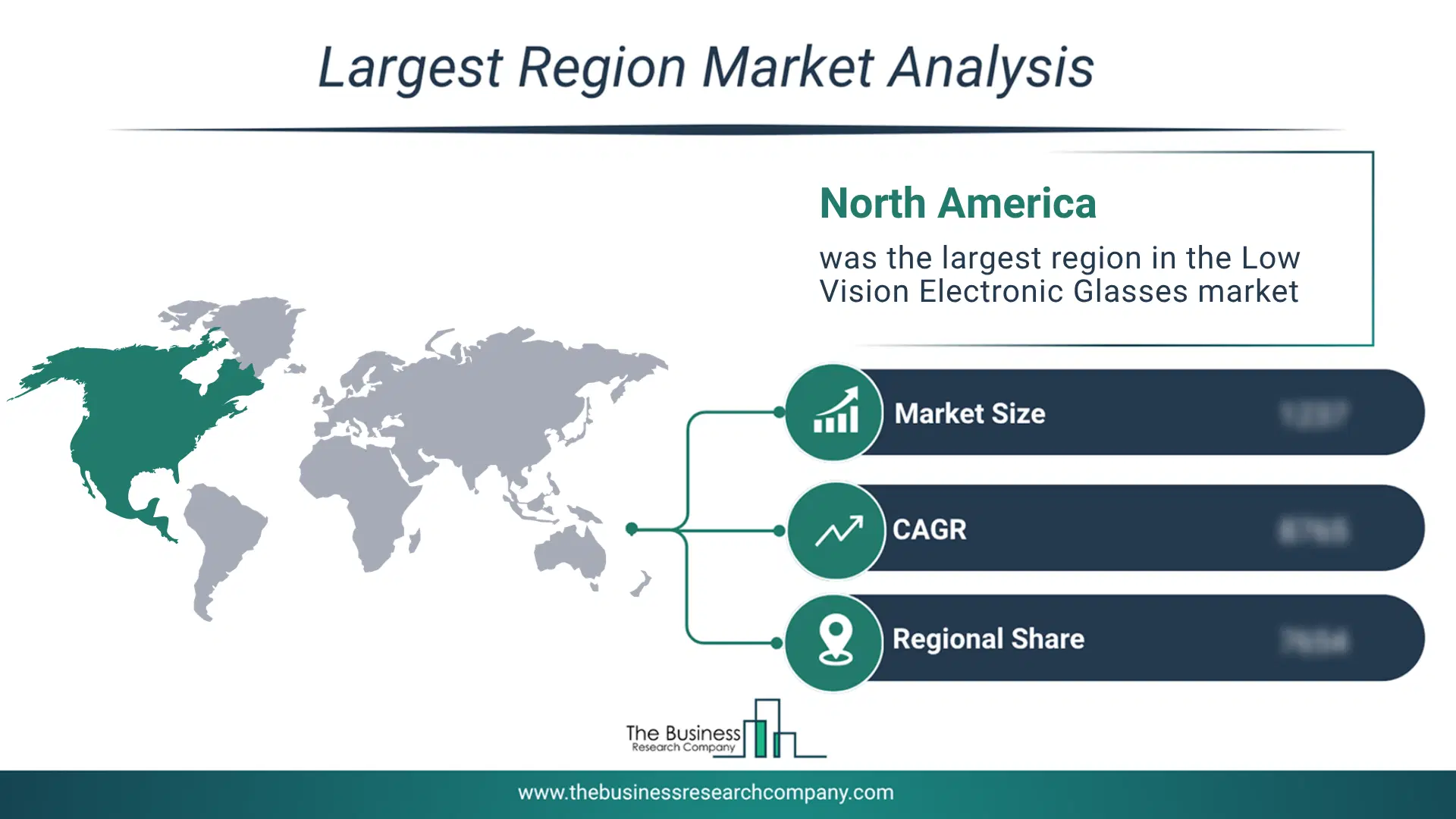
Regional Outlook
North America was the largest region in the low vision electronic glasses market in 2025. Asia-Pacific is expected to be the fastest-growing region in the forecast period. The regions covered in this market report are Asia-Pacific, South East Asia, Western Europe, Eastern Europe, North America, South America, Middle East, Africa. The countries covered in this market report are Australia, Brazil, China, France, Germany, India, Indonesia, Japan, Taiwan, Russia, South Korea, UK, USA, Canada, Italy, SpainWhat Defines the Low Vision Electronic Glasses Market?
The low vision electronic glasses market consists of revenues earned by entities by providing services such as customization and fitting services, training and user support, maintenance and repair services, telehealth and remote monitoring integration, and educational and rehabilitation programs. The market value includes the value of related goods sold by the service provider or included within the service offering. The low vision electronic glasses market also includes sales of smart magnifying glasses, wearable electronic vision aids, head-mounted digital viewers, camera-based reading devices, and portable video magnifiers. Values in this market are ‘factory gate’ values, that is, the value of goods sold by the manufacturers or creators of the goods, whether to other entities (including downstream manufacturers, wholesalers, distributors, and retailers) or directly to end customers. The value of goods in this market includes related services sold by the creators of the goods.How is Market Value Defined and Measured?
The market value is defined as the revenues that enterprises gain from the sale of goods and/or services within the specified market and geography through sales, grants, or donations in terms of the currency (in USD unless otherwise specified). The revenues for a specified geography are consumption values that are revenues generated by organizations in the specified geography within the market, irrespective of where they are produced. It does not include revenues from resales along the supply chain, either further along the supply chain or as part of other products.
This chart presents market attractiveness based on a quantitative evaluation of growth, competition, strategic alignment, and risk, offering a clear view of opportunity areas for decision-making. This chart is for illustrative purposes; the full report contains the complete analysis.

This chart highlights the Total Addressable Market (TAM) by estimating the maximum revenue opportunity using an assumption-driven approach, supporting strategic planning and opportunity sizing across markets. The chart is illustrative; the full report provides a more comprehensive analysis.
What Key Data and Analysis Are Included in the Low Vision Electronic Glasses Market Report 2026?
The low vision electronic glasses market research report is one of a series of new reports from The Business Research Company that provides market statistics, including industry global market size, regional shares, competitors with the market share, detailed market segments, market trends and opportunities, and any further data you may need to thrive in the low vision electronic glasses industry. The market research report delivers a complete perspective of everything you need, with an in-depth analysis of the current and future state of the industry.Low Vision Electronic Glasses Market Report Forecast Analysis
| Report Attribute | Details |
|---|---|
| Market Size Value In 2026 | $1.08 billion |
| Revenue Forecast In 2030 | $1.66 billion |
| Growth Rate | CAGR of 11.3% from 2026 to 2030 |
| Base Year For Estimation | 2025 |
| Actual Estimates/Historical Data | 2020-2025 |
| Forecast Period | 2026 - 2030 |
| Market Representation | Revenue in USD Billion and CAGR from 2026 to 2030 |
| Segments Covered | Product Type, Technology, Application, Distribution Channel, End-User |
| Regional Scope | Asia-Pacific, Western Europe, Eastern Europe, North America, South America, Middle East, Africa |
| Country Scope | The countries covered in the report are Australia, Brazil, China, France, Germany, India, Indonesia, Japan, Taiwan, Russia, South Korea, UK, USA, Canada, Italy, Spain. |
| Key Companies Profiled | OrCam Technologies Ltd., Enhanced Vision Systems Inc., Vuzix Corporation, Zoomax Technology Co. Ltd., IrisVision Global Inc., Acesight, Ceciaa SAS, Envision Technologies BV, Eyedaptic Inc., GiveVision Ltd., NuEyes Technologies Inc., OXSIGHT Ltd., Vision Buddy Inc., eSight Corporation, Everysight Labs Ltd., Nreal Technology Ltd., Rokid Corporation, Avegant Corporation, Magic Leap Inc., Lenovo Smart Glasses Division, Sony Smart Vision Systems, Epson Smart Glasses Division |
| Customization Scope | Request for Customization |
| Pricing And Purchase Options | Explore Purchase Options |