
Lubricating Oil Refining Market Report 2026
Global Outlook – By Product Type (Mineral Oils, Synthetic Oils, Biolubricants, Semi-synthetic Oils), By Viscosity Grade (Low Viscosity, Medium Viscosity, High Viscosity), By Additive Type (Detergents, Antioxidants, Anti-wear Additives, Viscosity Index Improvers, Corrosion Inhibitors), By Application (Automotive Oils, Industrial Oils, Specialty High-Performance Oils, Marine Oils, Specialty Oils) – Market Size, Trends, Strategies, and Forecast to 2030
Lubricating Oil Refining Market Overview
• Lubricating Oil Refining market size has reached to $19.5 billion in 2025 • Expected to grow to $26.5 billion in 2030 at a compound annual growth rate (CAGR) of 6.3% • Growth Driver: Increasing Demand For Cleaner Fuels Driving The Growth Of The Market Due To Focus On Reducing Emissions And Enhancing Fuel Quality • Market Trend: Advancements In Re-Refining Technology Drive Shift To High-Performance Base Oils • North America was the largest region in 2025.What Is Covered Under Lubricating Oil Refining Market?
Lubricating oil refining refers to the process of transforming crude or used oils into high-quality base oils that can be used in the production of lubricants. This process often involves refining, filtering, and purifying oils to remove impurities and enhance their performance for various industrial and automotive applications. The main product types of lubricating oil refining are mineral oils, synthetic oils, bio lubricants, and semi-synthetic oils. Mineral oils are refined petroleum-based liquids derived from crude oil, commonly used as lubricants, coolants, and insulating fluids in various industrial and automotive applications. They come in different viscosity grades such as low viscosity, medium viscosity, and high viscosity. They also contain various additives, including detergents, antioxidants, anti-wear additives, viscosity index improvers, and corrosion inhibitors. These oils are used in many applications, including automotive oils, industrial oils, aerospace oils, marine oils, and specialty oils.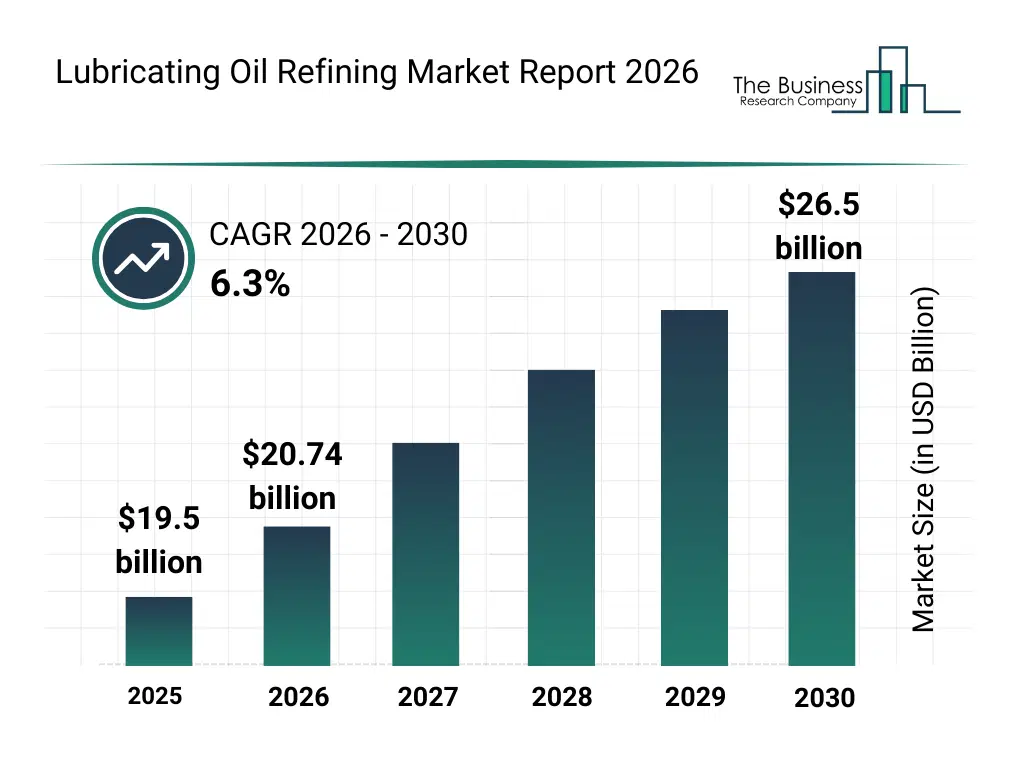
What Is The Lubricating Oil Refining Market Size and Share 2026?
The lubricating oil refining market size has grown strongly in recent years. It will grow from $19.5 billion in 2025 to $20.74 billion in 2026 at a compound annual growth rate (CAGR) of 6.3%. The growth in the historic period can be attributed to growth of automotive lubricant demand, expansion of industrial machinery usage, reliance on mineral base oils, investments in refinery infrastructure, growth of transportation sector.What Is The Lubricating Oil Refining Market Growth Forecast?
The lubricating oil refining market size is expected to see strong growth in the next few years. It will grow to $26.5 billion in 2030 at a compound annual growth rate (CAGR) of 6.3%. The growth in the forecast period can be attributed to demand for low viscosity lubricants, growth of electric and hybrid vehicles, expansion of industrial automation, adoption of sustainable lubricants, investments in advanced refining technologies. Major trends in the forecast period include rising demand for high purity base oils, shift toward synthetic and bio-based lubricants, modernization of lubricant refining units, growth of re-refining and used oil processing, increasing focus on performance additives.
Global Lubricating Oil Refining Market Segmentation
1) By Product Type: Mineral Oils, Synthetic Oils, Biolubricants, Semi-synthetic Oils 2) By Viscosity Grade: Low Viscosity, Medium Viscosity, High Viscosity 3) By Additive Type: Detergents, Antioxidants, Anti-wear Additives, Viscosity Index Improvers, Corrosion Inhibitors 4) By Application: Automotive Oils, Industrial Oils, Specialty High-Performance Oils, Marine Oils, Specialty Oils Subsegments: 1) By Mineral Oils: Paraffinic Mineral Oils, Naphthenic Mineral Oils, Limited-Use Process Oils 2) By Synthetic Oils: Polyalphaolefins (PAO), Polyalkylene Glycols (PAG), Esters, Silicones 3) By Biolubricants: Vegetable Oil-Based Lubricants, Bio-Based Industrial Lubricants, Synthetic Ester-Based Biolubricants 4) By Semi-Synthetic Oils: Low-Synthetic Content Blends, High-Synthetic Content Blends, Ester-Enhanced Semi-Synthetic OilsWhat Is The Driver Of The Lubricating Oil Refining Market?
The increasing demand for cleaner fuels is expected to propel the growth of the lubricating oil refining market going forward. Cleaner fuels refer to energy sources that produce fewer pollutants and greenhouse gas emissions compared to conventional fossil fuels. The demand for cleaner fuels is rising as they help reduce air pollution, lowering greenhouse gas emissions, and mitigating climate change, ultimately contributing to a healthier and more sustainable environment. Lubricating oil refining helps produce cleaner fuels by removing impurities, sulfur, and unwanted compounds, enhancing fuel efficiency, and improving engine performance. For instance, in July 2025, according to the International Energy Agency (IEA), a France-based autonomous intergovernmental organization, biofuel production reaches over 10 EJ by 2030 in the NZE Scenario, requiring an average growth of around 11% per year. Therefore, the increasing demand for cleaner fuels is driving the growth of the lubricating oil refining industry.Key Players In The Global Lubricating Oil Refining Market
Major companies operating in the lubricating oil refining market are Sinopec Group, PetroChina Company Limited, ExxonMobil Corporation, Shell plc, TotalEnergies SE, British Petroleum, Chevron Corporation, Idemitsu Kosan Co. Ltd., Lukoil, Neste Oyj, Fuchs SE, AVISTA OIL AG, Valvoline Inc., Heritage-Crystal Clean Inc., Gulf Oil, Motul S.A., Pentas Flora, AVISTA Green, Hyrax Oil, SK Lubricants Co. Ltd., Indian Oil Corporation Limited, Petro-Canada Lubricants Inc., Calumet Specialty Products Partners L.P., Nynas AB
This chart is for illustrative purposes; the full report includes a detailed competitor analysis and comprehensive overview of the top 10 companies in the market.
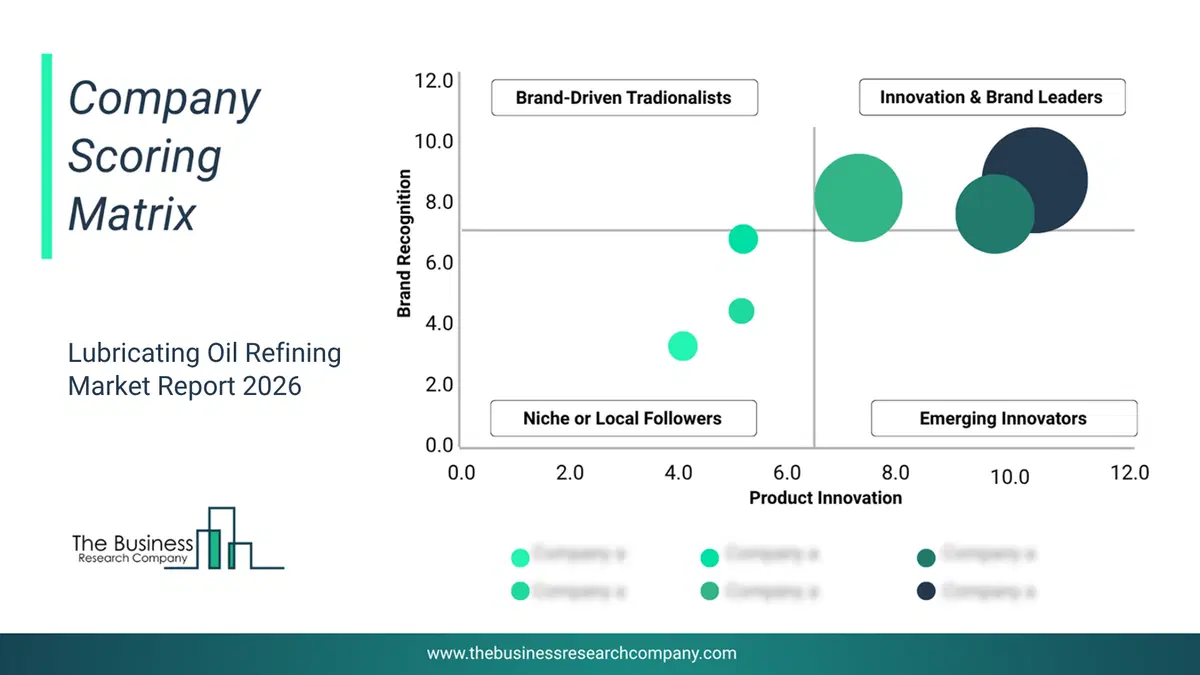
This chart maps companies by product innovation and brand strength, with bubble size indicating relative revenue, helping identify market leaders, challengers, and niche players. This is an illustrative chart; the full report provides a complete and accurate competitive analysis.
Global Lubricating Oil Refining Market Trends and Insights
Major companies operating in the lubricating oil refining market are focusing on advancements in technology, such as advanced re-refining technologies, to enhance efficiency, improve product quality, and reduce environmental impact by refining used oils into high-performance base oils. Advanced re-refining technologies are innovative processes that clean and recycle used lubricating oils, removing contaminants and restoring them to high-quality base oils for reuse. For instance, in September 2024, Pentas Flora, a Malaysia-based waste management company, launched re-refined Group II N150 base oil, aligning with industry trends toward higher-performance, premium-grade base oils. The shift was driven by the lubricant industry’s demand for better fuel economy, extended drain intervals, lower emissions, and improved performance. Pentas Flora’s re-refining process involves distillation, solvent extraction, and lube polishing, enabling it to produce higher-quality, low-sulfur base oils that meet Group II and III specifications.What Are Latest Mergers And Acquisitions In The Lubricating Oil Refining Market?
In July 2024, TotalEnergies SE, a France-based petroleum business company, acquired Str Tecoil Oy for an undisclosed amount. With this acquisition, TotalEnergies aims to expand the use of re-refined base oils (RRBOs) in lubricant production, enhance sustainability, reduce the carbon footprint of lubricants, and meet growing demand for high-performance, eco-friendly products by leveraging Tecoil’s expertise in used oil regeneration. Str Tecoil Oy is a Finland-based Finnish oil re-refining company that specializes in recycling used lubricating oils.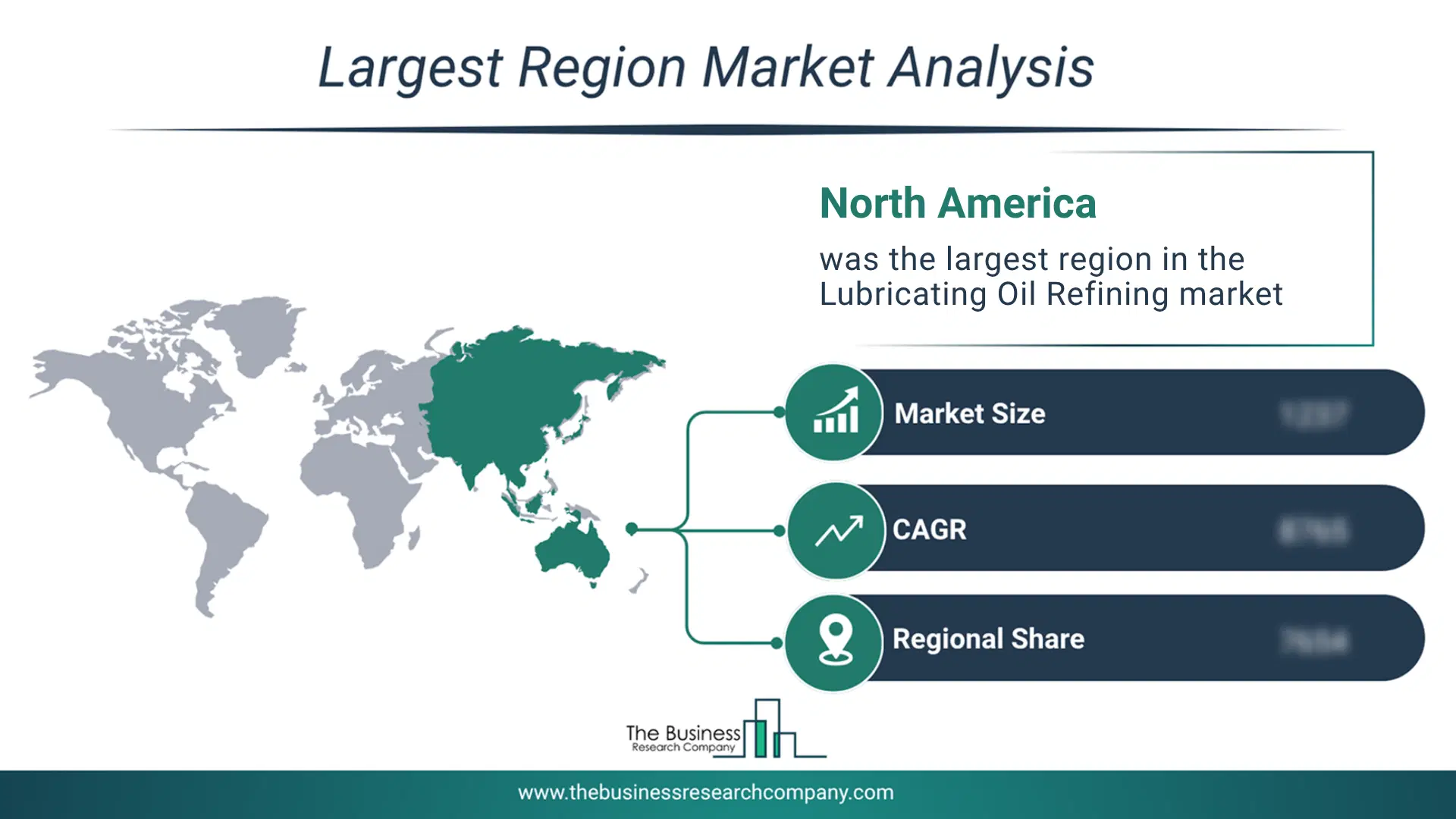
Regional Outlook
North America was the largest region in the lubricating oil refining market in 2025. The regions covered in this market report are Asia-Pacific, South East Asia, Western Europe, Eastern Europe, North America, South America, Middle East, Africa. The countries covered in this market report are Australia, Brazil, China, France, Germany, India, Indonesia, Japan, Taiwan, Russia, South Korea, UK, USA, Canada, Italy, SpainWhat Defines the Lubricating Oil Refining Market?
The lubricating oil refining market consists of sales of re-refined lubricants, grease-based lubricants, base oils, and finished lubricants. Values in this market are ‘factory gate’ values, that is, the value of goods sold by the manufacturers or creators of the goods, whether to other entities (including downstream manufacturers, wholesalers, distributors, and retailers) or directly to end customers. The value of goods in this market includes related services sold by the creators of the goods.How is Market Value Defined and Measured?
The market value is defined as the revenues that enterprises gain from the sale of goods and/or services within the specified market and geography through sales, grants, or donations in terms of the currency (in USD unless otherwise specified). The revenues for a specified geography are consumption values that are revenues generated by organizations in the specified geography within the market, irrespective of where they are produced. It does not include revenues from resales along the supply chain, either further along the supply chain or as part of other products.
This chart presents market attractiveness based on a quantitative evaluation of growth, competition, strategic alignment, and risk, offering a clear view of opportunity areas for decision-making. This chart is for illustrative purposes; the full report contains the complete analysis.

This chart highlights the Total Addressable Market (TAM) by estimating the maximum revenue opportunity using an assumption-driven approach, supporting strategic planning and opportunity sizing across markets. The chart is illustrative; the full report provides a more comprehensive analysis.
What Key Data and Analysis Are Included in the Lubricating Oil Refining Market Report 2026?
The lubricating oil refining market research report is one of a series of new reports from The Business Research Company that provides market statistics, including industry global market size, regional shares, competitors with the market share, detailed market segments, market trends and opportunities, and any further data you may need to thrive in the lubricating oil refining industry. The market research report delivers a complete perspective of everything you need, with an in-depth analysis of the current and future state of the industry.Lubricating Oil Refining Market Report Forecast Analysis
| Report Attribute | Details |
|---|---|
| Market Size Value In 2026 | $20.74 billion |
| Revenue Forecast In 2030 | $26.5 billion |
| Growth Rate | CAGR of 6.3% from 2026 to 2030 |
| Base Year For Estimation | 2025 |
| Actual Estimates/Historical Data | 2020-2025 |
| Forecast Period | 2026 - 2030 |
| Market Representation | Revenue in USD Billion and CAGR from 2026 to 2030 |
| Segments Covered | Product Type, Viscosity Grade, Additive Type, Application |
| Regional Scope | Asia-Pacific, Western Europe, Eastern Europe, North America, South America, Middle East, Africa |
| Country Scope | The countries covered in the report are Australia, Brazil, China, France, Germany, India, Indonesia, Japan, Taiwan, Russia, South Korea, UK, USA, Canada, Italy, Spain. |
| Key Companies Profiled | Sinopec Group, PetroChina Company Limited, ExxonMobil Corporation, Shell plc, TotalEnergies SE, British Petroleum, Chevron Corporation, Idemitsu Kosan Co. Ltd., Lukoil, Neste Oyj, Fuchs SE, AVISTA OIL AG, Valvoline Inc., Heritage-Crystal Clean Inc., Gulf Oil, Motul S.A., Pentas Flora, AVISTA Green, Hyrax Oil, SK Lubricants Co. Ltd., Indian Oil Corporation Limited, Petro-Canada Lubricants Inc., Calumet Specialty Products Partners L.P., Nynas AB |
| Customization Scope | Request for Customization |
| Pricing And Purchase Options | Explore Purchase Options |