
Lubricious Medical Device Coatings Market Report 2026
Global Outlook – By Coating Material (Hydrophilic Coatings, Silicone Based Coatings, Polytetrafluoroethylene Coatings, Other Specialty Coatings), By Coating Technology (Dip Coating, Spray Coating, Plasma Surface Treatment And Coating, Ultraviolet Curing Processes, Other Coating Technologies), By Application (Guidewires, Catheters, Surgical Instruments, Drug Delivery Systems, Implantable Devices), By End User (Original Equipment Manufacturers, Contract Manufacturers, Component Suppliers) – Market Size, Trends, Strategies, and Forecast to 2030
Lubricious Medical Device Coatings Market Overview
• Lubricious Medical Device Coatings market size has reached to $1.83 billion in 2025 • Expected to grow to $2.89 billion in 2030 at a compound annual growth rate (CAGR) of 9.6% • Growth Driver: Increasing Adoption Of Minimally Invasive Surgical Procedures Fueling The Growth Of The Market Due To Rising Demand For Low-Friction Interventional Medical Devices • Market Trend: Development Of Advanced Hydrophilic Coating Technologies For Enhanced Lubricity And Device Performance • North America was the largest region in 2025 and Asia-Pacific is the fastest growing region.What Is Covered Under Lubricious Medical Device Coatings Market?
Lubricious medical device coatings refer to specialized low-friction surface coatings applied to medical devices to reduce friction and improve smoothness during insertion, navigation, and withdrawal within the body. These coatings enhance device maneuverability, minimize tissue trauma, and improve patient comfort during minimally invasive procedures. The main coating materials of lubricious medical device coatings include hydrophilic coatings, silicone based coatings, polytetrafluoroethylene coatings, and other specialty coatings. Hydrophilic coatings refer to surface coatings that attract and retain water, creating a lubricious layer that reduces friction and facilitates the movement of medical devices during minimally invasive procedures. These coatings are applied using dip coating, spray coating, plasma surface treatment and coating, ultraviolet curing processes, and other coating technologies. The key applications include guidewires, catheters, surgical instruments, drug delivery systems, and implantable devices, while the end-users include original equipment manufacturers, contract manufacturers, and component suppliers.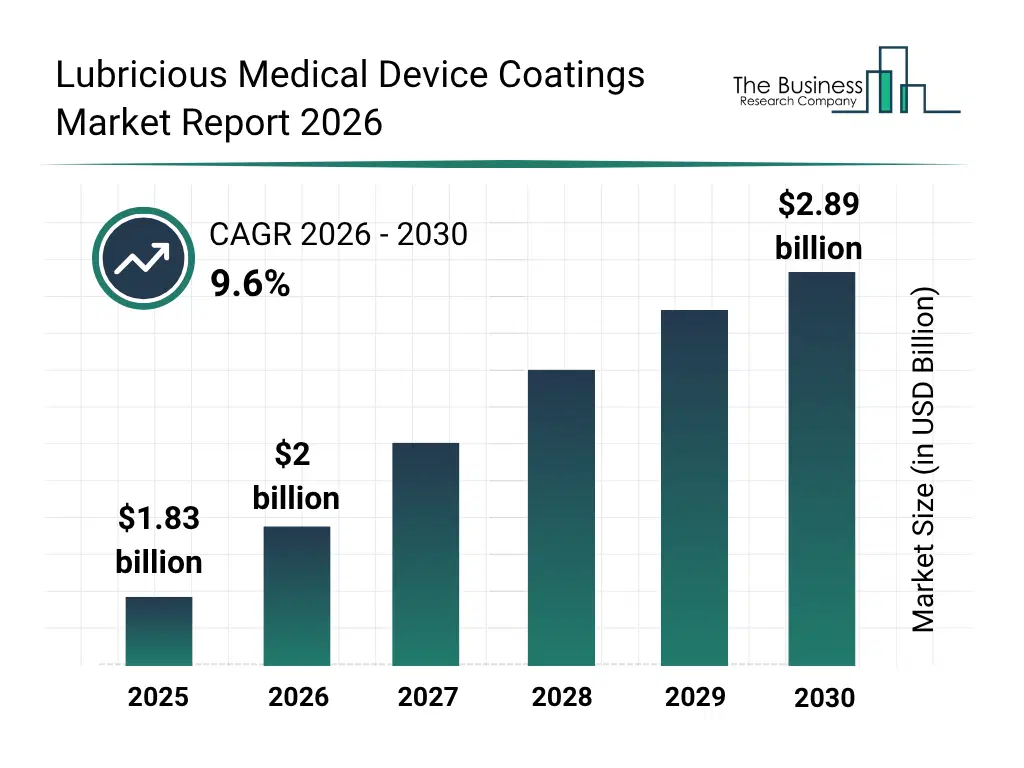
What Is The Lubricious Medical Device Coatings Market Size and Share 2026?
The lubricious medical device coatings market size has grown strongly in recent years. It will grow from $1.83 billion in 2025 to $2 billion in 2026 at a compound annual growth rate (CAGR) of 9.3%. The growth in the historic period can be attributed to rising adoption of minimally invasive procedures, increasing use of catheter-based medical devices, growing demand for improved device maneuverability, rising focus on reducing procedure-related tissue trauma, increasing demand for enhanced patient comfort.What Is The Lubricious Medical Device Coatings Market Growth Forecast?
The lubricious medical device coatings market size is expected to see strong growth in the next few years. It will grow to $2.89 billion in 2030 at a compound annual growth rate (CAGR) of 9.6%. The growth in the forecast period can be attributed to growing demand for advanced lubricious coatings for complex medical devices, increasing adoption of next-generation hydrophilic coating technologies, rising demand for longer-lasting coating performance, growing use of lubricious coatings in advanced interventional procedures, increasing development of multifunctional medical device surfaces. Major trends in the forecast period include increasing adoption of ultra-low friction medical device coatings, growing demand for durable lubricious coating formulations, rising use of hydrophilic coating technologies for minimally invasive devices, increasing demand for coatings that minimize tissue trauma, growing development of biocompatible and highly lubricious surface treatments.
Global Lubricious Medical Device Coatings Market Segmentation
1) By Coating Material: Hydrophilic Coatings, Silicone Based Coatings, Polytetrafluoroethylene Coatings, Other Specialty Coatings 2) By Coating Technology: Dip Coating, Spray Coating, Plasma Surface Treatment And Coating, Ultraviolet Curing Processes, Other Coating Technologies 3) By Application: Guidewires, Catheters, Surgical Instruments, Drug Delivery Systems, Implantable Devices 4) By End User: Original Equipment Manufacturers, Contract Manufacturers, Component Suppliers Subsegments: 1) By Hydrophilic Coatings: Polyvinylpyrrolidone Coatings, Polyacrylamide Coatings, Polyurethane Hydrophilic Coatings, Polyethylene Glycol Coatings 2) By Silicone Based Coatings: Silicone Elastomer Coatings, Silicone Oil Coatings, Silicone Resin Coatings 3) By Polytetrafluoroethylene Coatings: Virgin Polytetrafluoroethylene Coatings, Filled Polytetrafluoroethylene Coatings, Modified Polytetrafluoroethylene Coatings 4) By Other Specialty Coatings: Fluorinated Ethylene Propylene Coatings, Diamond Like Carbon Coatings, Ceramic CoatingsWhat Is The Driver Of The Lubricious Medical Device Coatings Market?
The increasing adoption of minimally invasive surgical procedures is expected to propel the growth of the lubricious medical device coatings market going forward. Minimally invasive surgical procedures are medical interventions performed through small incisions or natural body openings using specialized instruments and imaging technologies to reduce patient trauma, pain, and recovery time. The adoption of minimally invasive surgical procedures is increasing due to the rising prevalence of chronic diseases requiring interventional treatments, prompting healthcare providers to favor less invasive approaches with improved clinical outcomes. Lubricious medical device coatings support minimally invasive surgical procedures by reducing friction between medical devices and body tissues during insertion and navigation. They improve device maneuverability, reduce tissue trauma, and enhance procedural efficiency and patient comfort. For instance, in June 2024, according to the American Society of Plastic Surgeons, a US-based professional medical organization, minimally invasive procedures increased by 7%, from 25.4 million procedures in 2022 to 27.2 million procedures in 2023. Therefore, the increasing adoption of minimally invasive surgical procedures is driving the growth of the lubricious medical device coatings industry.Key Players In The Global Lubricious Medical Device Coatings Market
Major companies operating in the lubricious medical device coatings market are Medtronic plc, Becton Dickinson and Company, DuPont de Nemours Inc, Teleflex Incorporated, Wacker Chemie AG, Cook Group Incorporated, The Lubrizol Corporation, Integer Holdings Corporation, Merit Medical Systems Inc, Freudenberg Medical LLC, Nordson Corporation, Koninklijke DSM N.V., Specialty Coating Systems Inc, Covalon Technologies Ltd, Precision Coating Company LLC, Biocoat Incorporated, Foster Corporation, Hydromer Inc, Harland Medical Systems Inc, AST Products Inc, Surface Solutions Group LLC, Aculon Inc, Formacoat LLC, Applied Medical Coatings LLC
This chart is for illustrative purposes; the full report includes a detailed competitor analysis and comprehensive overview of the top 10 companies in the market.
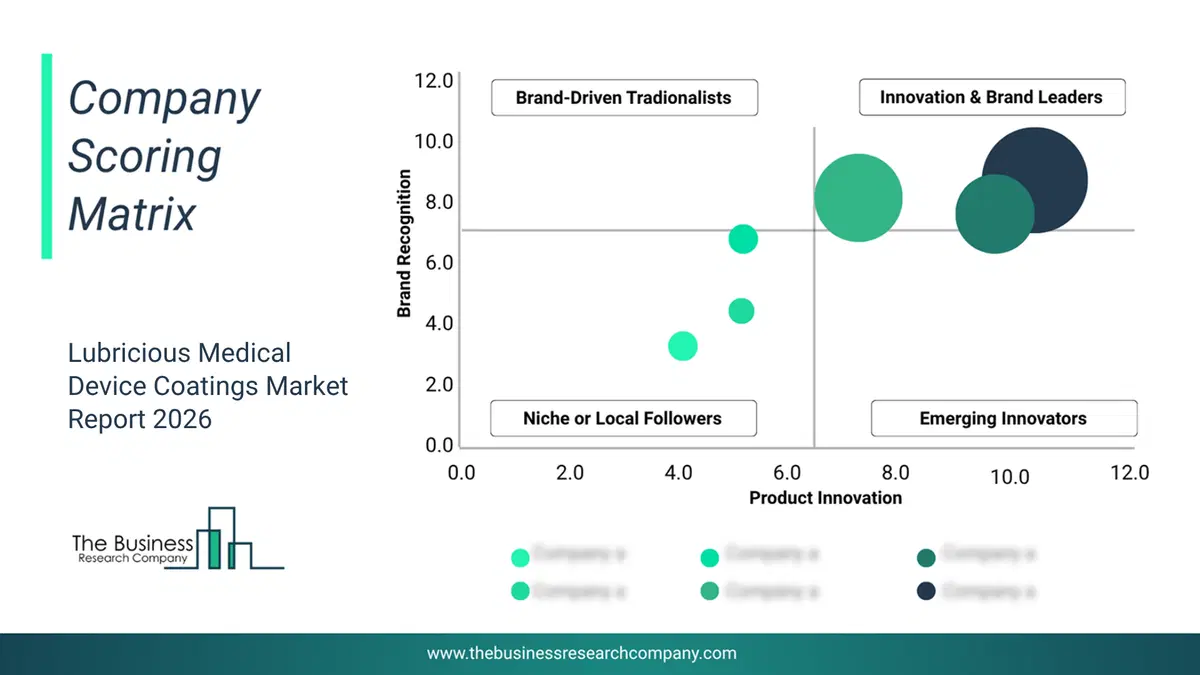
This chart maps companies by product innovation and brand strength, with bubble size indicating relative revenue, helping identify market leaders, challengers, and niche players. This is an illustrative chart; the full report provides a complete and accurate competitive analysis.
Global Lubricious Medical Device Coatings Market Trends and Insights
Major companies operating in the lubricious medical device coatings market are focusing on the development of hydrophilic coating technologies that offer enhanced lubricity, durability, and biocompatibility for complex medical device applications. Hydrophilic coating technology provides low-friction surfaces while maintaining coating integrity during device insertion, navigation, and withdrawal, thereby improving device performance during minimally invasive procedures. For instance, in October 2023, Surmodics Inc., a US-based medical device coating technology company, launched Preside hydrophilic coating technology, designed to provide high lubricity and durability for a broader range of complex medical device applications. The technology complements Surmodics’ existing Serene hydrophilic coatings by providing a low-friction, low-particulate-generation surface that can enhance distal access in neurovascular applications and improve device crossing in challenging coronary lesions and chronic total occlusions.What Are Latest Mergers And Acquisitions In The Lubricious Medical Device Coatings Market?
In November 2025, GTCR LLC, a US-based private equity firm, completed the acquisition of Surmodics Inc. for $627 million. The acquisition strengthens GTCR’s position in the medical device coatings market by combining Surmodics’ hydrophilic and other advanced coating technologies with Biocoat’s existing coating capabilities, expanding its ability to serve complex interventional medical device applications. Surmodics Inc. is a US-based medical device coating technology company.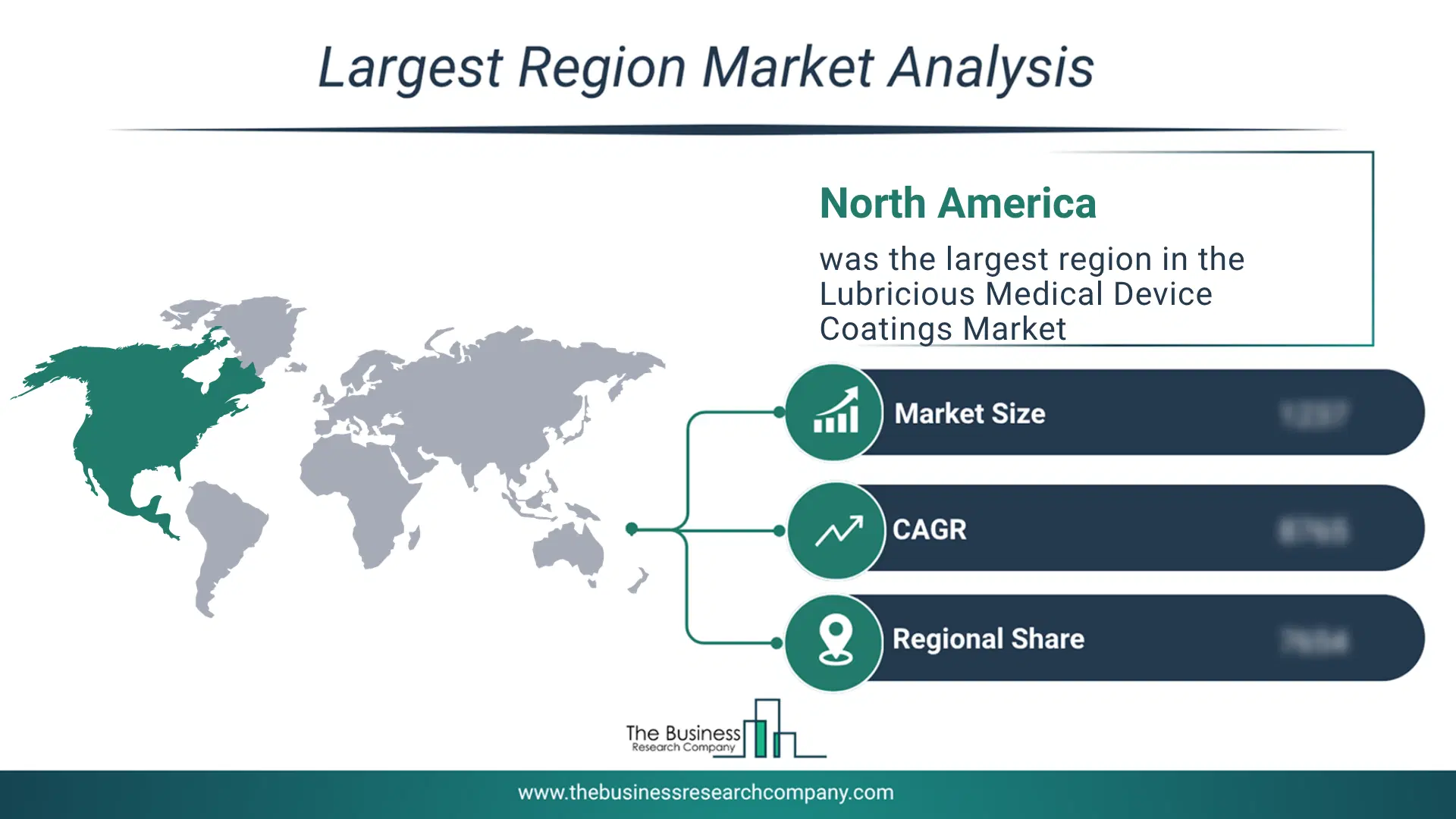
Regional Insights
North America was the largest region in the lubricious medical device coatings market in 2025. Asia-Pacific is expected to be the fastest-growing region in the forecast period. The regions covered in this market report are Asia-Pacific, South East Asia, Western Europe, Eastern Europe, North America, South America, Middle East, Africa. The countries covered in this market report are Australia, Brazil, China, France, Germany, India, Indonesia, Japan, Taiwan, Russia, South Korea, UK, USA, Canada, Italy, Spain.What Defines the Lubricious Medical Device Coatings Market?
The lubricious medical device coatings market consists of sales of hyaluronic acid-based coatings, phosphorylcholine-based coatings and fluoropolymer-based coatings. Values in this market are ‘factory gate’ values, that is, the value of goods sold by the manufacturers or creators of the goods, whether to other entities (including downstream manufacturers, wholesalers, distributors, and retailers) or directly to end customers. The value of goods in this market includes related services sold by the creators of the goods.How is Market Value Defined and Measured?
The market value is defined as the revenues that enterprises gain from the sale of goods and/or services within the specified market and geography through sales, grants, or donations in terms of the currency (in USD unless otherwise specified). The revenues for a specified geography are consumption values that are revenues generated by organizations in the specified geography within the market, irrespective of where they are produced. It does not include revenues from resales along the supply chain, either further along the supply chain or as part of other products.
This chart presents market attractiveness based on a quantitative evaluation of growth, competition, strategic alignment, and risk, offering a clear view of opportunity areas for decision-making. This chart is for illustrative purposes; the full report contains the complete analysis.

This chart highlights the Total Addressable Market (TAM) by estimating the maximum revenue opportunity using an assumption-driven approach, supporting strategic planning and opportunity sizing across markets. The chart is illustrative; the full report provides a more comprehensive analysis.
What Key Data and Analysis Are Included in the Lubricious Medical Device Coatings Market Report 2026?
The lubricious medical device coatings market research report is one of a series of new reports from The Business Research Company that provides market statistics, including industry global market size, regional shares, competitors with the market share, detailed market segments, market trends and opportunities, and any further data you may need to thrive in the lubricious medical device coatings industry. The market research report delivers a complete perspective of everything you need, with an in-depth analysis of the current and future state of the industry.Lubricious Medical Device Coatings Market Report Forecast Analysis
| Report Attribute | Details |
|---|---|
| Market Size Value In 2026 | $2 billion |
| Revenue Forecast In 2030 | $2.89 billion |
| Growth Rate | CAGR of 9.6% from 2026 to 2030 |
| Base Year For Estimation | 2025 |
| Actual Estimates/Historical Data | 2020-2025 |
| Forecast Period | 2026 - 2030 |
| Market Representation | Revenue in USD Billion and CAGR from 2026 to 2030 |
| Segments Covered | Coating Material, Coating Technology, Application, End User |
| Regional Scope | Asia-Pacific, Western Europe, Eastern Europe, North America, South America, Middle East, Africa |
| Country Scope | The countries covered in the report are Australia, Brazil, China, France, Germany, India, Indonesia, Japan, Taiwan, Russia, South Korea, UK, USA, Canada, Italy, Spain. |
| Key Companies Profiled | Medtronic plc, Becton Dickinson and Company, DuPont de Nemours Inc, Teleflex Incorporated, Wacker Chemie AG, Cook Group Incorporated, The Lubrizol Corporation, Integer Holdings Corporation, Merit Medical Systems Inc, Freudenberg Medical LLC, Nordson Corporation, Koninklijke DSM N.V., Specialty Coating Systems Inc, Covalon Technologies Ltd, Precision Coating Company LLC, Biocoat Incorporated, Foster Corporation, Hydromer Inc, Harland Medical Systems Inc, AST Products Inc, Surface Solutions Group LLC, Aculon Inc, Formacoat LLC, Applied Medical Coatings LLC |
| Customization Scope | Request for Customization |
| Pricing And Purchase Options | Explore Purchase Options |