
Lucentis (Ranibizumab) Market Report 2026
Epidemiology, Pipeline Analysis, Market Insights & Forecasts
Lucentis (Ranibizumab) Market Overview
• The Lucentis (Ranibizumab) market growth in the historic period has been driven by clinical success in macular degeneration, rising diabetic retinopathy cases • Market expansion is supported by growth in retinal disease prevalence, increasing access to eye care services • Growth Driver: Rising Prevalence Of Eye-Related Disorders Fuels Growth In The Lucentis (Ranibizumab) Market • Market Trend: Affordable Alternative To Lucentis For Retinal Diseases • North America was the largest region in 2025 and Asia-Pacific is the fastest growing region.What Is Covered Under Lucentis (Ranibizumab) Market?
Lucentis (ranibizumab) is a prescription medication used to treat various eye disorders, those involving abnormal blood vessel growth in the retina. It is a recombinant monoclonal antibody fragment designed to inhibit vascular endothelial growth factor (VEGF), a protein that promotes the formation of abnormal blood vessels. The main types in the lucentis (ranibizumab) market are single-use prefilled syringe and single-use glass vial. Single-use prefilled syringe refers to a medical device that comes prefilled with a specific dose of medication, ready for immediate administration. The various applications include age-related macular degeneration, diabetic retinopathy, retinal vein occlusion, myopic choroidal neovascularization, and uveitis, and several end-users encompass hospitals, clinics, ambulatory surgical centers, and others.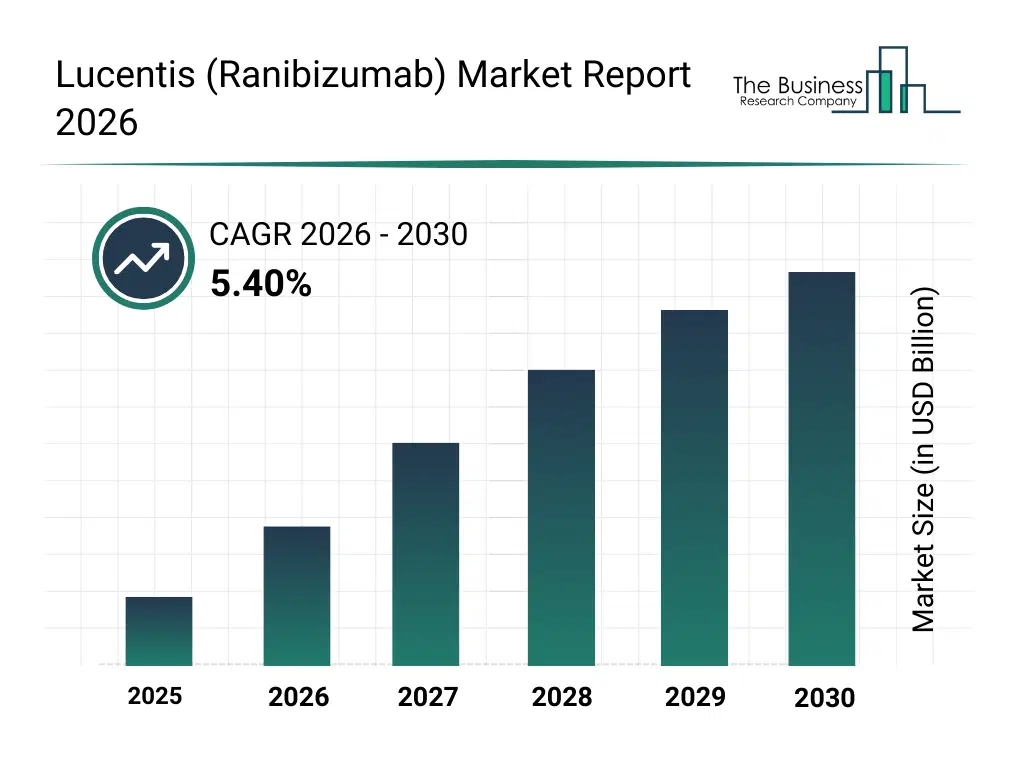
What Is The Lucentis (Ranibizumab) Market Size and Share 2026?
The lucentis (ranibizumab) market size has grown strongly in recent years. It will grow from $3.74 million in 2025 to $3.96 million in 2026 at a compound annual growth rate (CAGR) of 5.7%. The growth in the historic period can be attributed to clinical success in macular degeneration, rising diabetic retinopathy cases, aging population, ophthalmologist adoption, regulatory approvals in eye care.What Is The Lucentis (Ranibizumab) Market Growth Forecast?
The lucentis (ranibizumab) market size is expected to see strong growth in the next few years. It will grow to $4.87 million in 2030 at a compound annual growth rate (CAGR) of 5.4%. The growth in the forecast period can be attributed to growth in retinal disease prevalence, increasing access to eye care services, expansion of biosimilar competition, rising awareness of early diagnosis, technological advances in injection delivery. Major trends in the forecast period include sustained use of anti vegf therapies, rising treatment of retinal vascular disorders, growing preference for intravitreal injections, expansion of ophthalmology specialty clinics, increased focus on vision preservation.
Global Lucentis (Ranibizumab) Market Segmentation
1) By Type: Single-use Prefilled Syringe, Single-use Glass Vial 2) By Application: Age-related Macular Degeneration, Diabetic Retinopathy, Retinal Vein Occlusion, Myopic Choroidal Neovascularization, Uveitis 3) By End-User: Hospitals, Clinics, Ambulatory Surgical Centers, Other End-UsersWhat Are The Drivers Of The Lucentis (Ranibizumab) Market?
The rising prevalence of eye-related disorders is expected to drive the growth of the Lucentis (ranibizumab) market going forward. Eye-related disorders refer to a wide range of conditions or diseases that affect the eyes and impair their ability to function properly. The rising prevalence of eye-related disorders are due to aging, genetic predisposition, poor lifestyle choices such as smoking and diet, and environmental factors such as prolonged sun exposure or digital screen use. Lucentis works by inhibiting vascular endothelial growth factor (VEGF), a protein responsible for abnormal blood vessel growth and leakage in the retina, which is a key cause of conditions like age-related macular degeneration (AMD) and diabetic macular edema (DME). For instance, in 2024, according to the National Eye Institute, a US-based government agency, 2.2 million Americans will be blind by 2030. Thus, rising prevalence of eye-related disorders is driving the growth of the Lucentis (ranibizumab) industry. The rise in healthcare spending is expected to propel the growth of the lucentis (ranibizumab) market going forward. Healthcare spending refers to the total financial resources allocated by individuals, governments, private insurers, and other entities towards the provision of healthcare services and products. The rise in healthcare spending is attributed to aging population, advancements in medical technology, rising prevalence of chronic diseases, and increased demand for healthcare services. Healthcare spending provides accessibility and availability of lucentis (ranibizumab) by supporting its widespread use in treating retinal diseases such as age-related macular degeneration and diabetic macular edema, ensuring that healthcare systems can allocate resources for its reimbursement, coverage, and distribution, which ultimately improves patient outcomes and reduces the long-term burden of vision loss. For instance, in May 2024, according to the Office for National Statistics, a UK-based government department, between 2022 and 2023, healthcare spending in the UK increased by 5.6% compared with growth of 0.9% in 2022. The UK healthcare expenditure in UK healthcare expenditure was around $317.63 billion (£292 billion) in 2023. Therefore, rise in healthcare spending is driving the growth of the lucentis (ranibizumab) industry.Key Players In The Global Lucentis (Ranibizumab) Market
Major companies operating in the lucentis (ranibizumab) market are F.Hoffmann-La Roche Ltd, Novartis AGGlobal Lucentis (Ranibizumab) Market Trends and Insights
Major companies operating in the Lucentis (ranibizumab) market are focusing on developing biosimilars to provide more affordable alternatives to the original branded product. Biosimilars are biologic medical products that are highly similar to an already approved reference biologic in terms of structure, efficacy, and safety, with no clinically meaningful differences. For instance, in April 2024, Formycon AG, a Germany-based biotechnology company, and Bioeq AG, a Switzerland-based biotechnology company, launched their biosimilar version of Lucentis (ranibizumab), known as FYB201, in Canada and Switzerland. Health Canada granted marketing authorization for the biosimilar under the name Ranopto, while Swiss Medic approved it under the name Ranivisio. The approval and subsequent launch of FYB201 aim to provide more affordable treatment options for patients suffering from retinal diseases. It works by inhibiting vascular endothelial growth factor A (VEGF-A), a protein that promotes abnormal blood vessel growth in the retina, which can lead to swelling, leakage, and vision impairment.Regional Insights
North America was the largest region in the lucentis (ranibizumab) market in 2025. Asia-Pacific is expected to be the fastest-growing region in the forecast period. The regions covered in this market report are Asia-Pacific, Western Europe, Eastern Europe, North America, South America, Middle East, Africa. The countries covered in this market report are Australia, India, China, South Korea, Japan, UK, France, Germany, USA, Canada.What Defines the Lucentis (Ranibizumab) Market?
The lucentis (ranibizumab) market consists of sales of lucentis intravitreal injection and lucentis for biosimilars. Values in this market are ‘factory gate’ values, that is the value of goods sold by the manufacturers or creators of the goods, whether to other entities (including downstream manufacturers, wholesalers, distributors and retailers) or directly to end customers. The value of goods in this market includes related services sold by the creators of the goods.How is Market Value Defined and Measured?
The market value is defined as the revenues that enterprises gain from the sale of goods and/or services within the specified market and geography through sales, grants, or donations in terms of the currency (in USD unless otherwise specified). The revenues for a specified geography are consumption values that are revenues generated by organizations in the specified geography within the market, irrespective of where they are produced. It does not include revenues from resales along the supply chain, either further along the supply chain or as part of other products.What Key Data and Analysis Are Included in the Lucentis (Ranibizumab) Market Report 2026?
The lucentis (ranibizumab) market research report is one of a series of new reports from The Business Research Company that provides market statistics, including industry global market size, regional shares, competitors with the market share, detailed market segments, market trends and opportunities, and any further data you may need to thrive in the lucentis (ranibizumab) industry. The market research report delivers a complete perspective of everything you need, with an in-depth analysis of the current and future state of the industry.Lucentis (Ranibizumab) Market Report Forecast Analysis
| Report Attribute | Details |
|---|---|
| Market Size Value In 2026 | $ billion |
| Revenue Forecast In 2035 | $ billion |
| Growth Rate | CAGR of 5.7% from 2026 to 2035 |
| Base Year For Estimation | 2025 |
| Actual Estimates/Historical Data | 2020-2025 |
| Forecast Period | 2026 - 2030 - 2035 |
| Market Representation | Revenue in USD Billion and CAGR from 2026 to 2035 |
| Segments Covered | Type, Application, End-User |
| Regional Scope | Asia-Pacific, Western Europe, Eastern Europe, North America, South America, Middle East, Africa |
| Country Scope | The countries covered in the report are Australia, Brazil, China, France, Germany, India, ... |
| Key Companies Profiled | F.Hoffmann-La Roche Ltd, Novartis AG |
| Customization Scope | Request for Customization |
| Pricing And Purchase Options | Explore Purchase Options |