
Contact Us
  Search
The Business Research Company Logo
Lunar Exploration Technology Global Market Opportunities And Strategies To 2035
Published :June 2026
Pages :239
Format :PDF
Delivery Time :2-3 Business Days
Why 2-3 days? We update the report with the latest data and news before delivery. Let us know if you need us to expedite.
Report Price :$4,490.00

Lunar Exploration Technology Global Market Opportunities And Strategies To 2035

By Technology Type (Propulsion Systems, Landing Systems, Navigation And Guidance, Communication Systems, Power Systems, Robotics And Automation, Scientific Instruments, Other Technology Types), By Application (Manned Missions, Unmanned Missions, Lunar Rovers, Lunar Landers, Lunar Orbiters, Other Applications), By End-User (Government Space Agencies, Commercial Space Companies, Research Institutes, Other End-Users), And By Region, Opportunities And Strategies – Global Forecast To 2035

Lunar Exploration Market Definition

Lunar exploration technology refers to the systems, equipment and scientific tools developed to support missions to the Moon for research, resource assessment and long-term human presence. The primary purpose of lunar exploration technology is to enable safe, sustainable and scientifically valuable exploration of the Moon. The lunar exploration technology market consists of sales by entities (organizations, sole traders, or partnerships) of technologies and services enabling Moon missions. It includes lunar landers, rovers, habitats, navigation systems, communication networks, life-support systems, power units and surface analysis instruments designed to operate in extreme lunar conditions.
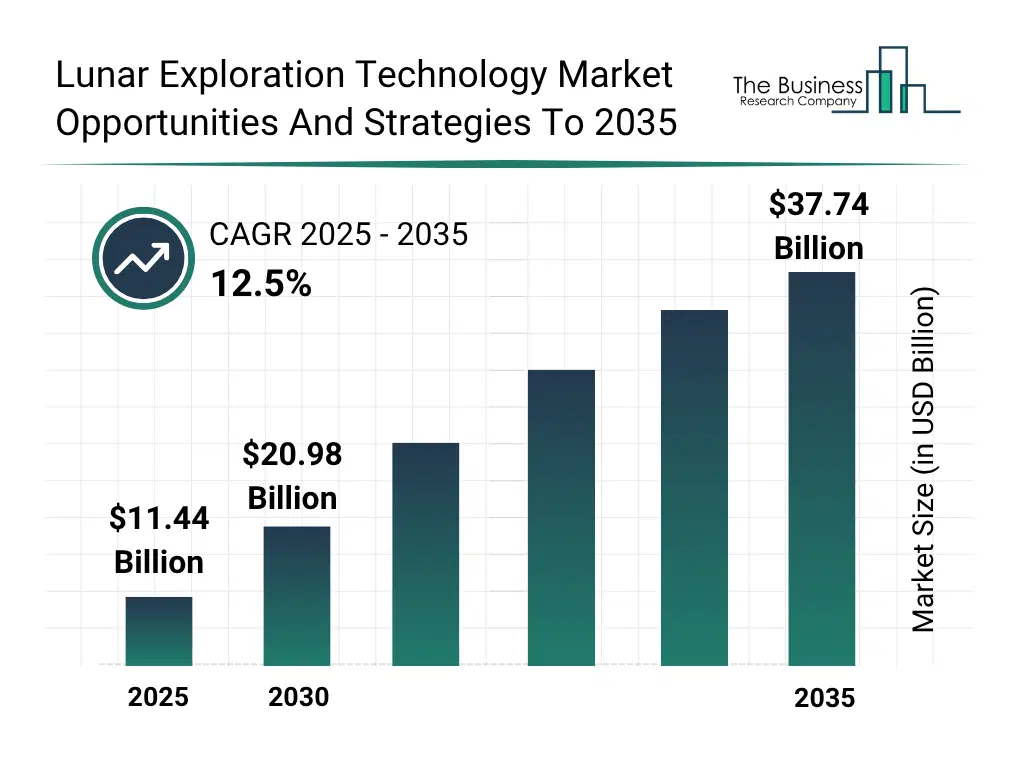
Lunar Exploration Technology Global Market Opportunities And Strategies To 2035 Market Size and growth rate 2026 to 2030: Graph

Lunar Exploration Market Size

The global lunar exploration technology market reached a value of nearly $11,435.9 million in 2025, having grown at a compound annual growth rate (CAGR) of 13.6% since 2020. The market is expected to grow from $11,435.9 million in 2025 to $20,984.9 million in 2030 at a rate of 12.9%. The market is then expected to grow at a CAGR of 12.5% from 2030 and reach $37,742.7 million in 2035. Growth in the historic period resulted from growth of commercial space investment, development of space-as-a-service business models, rising government space budgets for lunar missions and growth of private sector space contracts. Factors that negatively affected growth in the historic period were limited launch windows and high mission development costs. Going forward, advancements in reusable launch vehicles, improvements in lunar landing systems, establishment of sustained lunar surface infrastructure and long-term budget commitments for moon-to-mars programs will drive the growth. Factors that could hinder the growth of the lunar exploration technology market in the future include payload mass constraints, extreme lunar environmental conditions and impact of trade wars and tariffs.
Research Expert

Book your 30 minutes free consultation with our research experts

Lunar Exploration Market Segmentation

The lunar exploration market is segmented by technology type, by application and by end-user.

By Technology Type –
The lunar exploration market is segmented by technology type into:
    • a) Propulsion Systems
    • b) Landing Systems
    • c) Navigation And Guidance
    • d) Communication Systems
    • e) Power Systems
    • f) Robotics And Automation
    • g) Scientific Instruments
    • h) Other Technology Types
The propulsion systems market was the largest segment of the lunar exploration technology market segmented by technology type, accounting for 24.6% or $2,817.6 million of the total in 2025. Going forward, the communication systems segment is expected to be the fastest-growing segment in the lunar exploration technology market segmented by technology type, at a CAGR of 15.7% during 2025-2030.

By Application –
The lunar exploration market is segmented by application into:
    • a) Manned Missions
    • b) Unmanned Missions
    • c) Lunar Rovers
    • d) Lunar Landers
    • e) Lunar Orbiters
    • f) Other Applications
    • g) Scientific Instruments
    • h) Other Technology Types
The unmanned missions was the largest segment of the lunar exploration technology market segmented by application, accounting for 36.4% or $4,168.1 million of the total in 2025. Going forward, the unmanned missions segment is expected to be the fastest-growing segment in the lunar exploration technology market segmented by application, at a CAGR of 14.4% during 2025-2030.

By End-User –
The lunar exploration market is segmented by end-user into:
    • a) Government Space Agencies
    • b) Commercial Space Companies
    • c) Research Institutes
    • d) Other End-Users
The government space agencies market was the largest segment of the lunar exploration technology market segmented by end-user, accounting for 62.2% or $7,110.5 million of the total in 2025. Going forward, the commercial space companies segment is expected to be the fastest-growing segment in the lunar exploration technology market segmented by end-user, at a CAGR of 19.1% during 2025-2030.

By Application –

By Geography - The lunar exploration market is segmented by geography into:
      o Asia Pacific
      • China
      • India
      • Japan
      • Australia
      • Indonesia
      • South Korea
      o North America
      • USA
      • Canada
      o South America
      • Brazil
      o Western Europe
      • France
      • Germany
      • UK
      • Italy
      • Spain
      o Eastern Europe
      • Russia
      o Middle East
      o Africa
North America was the largest region in the lunar exploration technology market, accounting for 42.6% or $4,874.4 million of the total in 2025. It was followed by Asia Pacific, Western Europe and then the other regions. Going forward, the fastest-growing regions in the lunar exploration technology market will be Western Europe and Africa where growth will be at CAGRs of 16.3% and 14.5% respectively. These will be followed by Asia pacific and South America where the markets are expected to grow at CAGRs of 14.0% and 11.8% respectively.

Lunar Exploration Market Competitive Landscape

Major Competitors are:

  • National Aeronautics and Space Administration (NASA)
  • Space Exploration Technologies Corp. (SpaceX)
  • Blue Origin LLC
  • Lockheed Martin Corporation
  • The Boeing Company
  • Other Competitors Include:

  • Teledyne Brown Engineering Inc.
  • Special Aerospace Services Ltd.
  • ispace Inc.
  • GITAI Japan Inc.
  • The Exploration Company GmbH
  • Indian Space Research Organisation
  • Spartan Space
  • NEUROSPACE GmbH
  • Thales Alenia Space
  • GMV
  • Telespazio
  • Sierra Nevada Corporation
  • Astrolab Inc.
  • Astrobotic Technology Inc.
  • Lunar Outpost Inc.
  • CisLunar Industries Inc.
  • Envisions Space Technology SA
  • INVAP
  • VENG
  • Israel Aerospace Industries
  • Elbit Systems
  • Turkish Aerospace Industries
  • Dragonfly Aerospace
  • Cube Space
  • New Space Systems
  • SCS Space
  • Simera Sense
  • Lunar Exploration Market Drivers

    The key drivers of the lunar exploration market include: Long-Term Budget Commitments For Moon-To-Mars Programs During the forecast period, long-term budget commitments for Moon-to-Mars programs are expected to drive the growth of the lunar exploration technology market. Lunar exploration technology acts as a proving ground for systems, infrastructure and mission operations that are directly reusable for Moon-to-Mars programs, reducing uncertainty and spreading development costs over multiple missions. Continuous lunar missions enable phased investment, hardware reuse and incremental testing, which supports structured long-term budget commitments instead of one-time high-risk spending. NASA’s FY2026 budget request outlines sustained multi-year funding commitments for Moon-to-Mars programs, with continued support for transportation systems, exploration infrastructure and mission development through the end of the decade. It reinforces long-term investment in lunar missions and Mars preparation capabilities, ensuring continuity of Artemis and related deep space exploration efforts and long-term budget commitments for Moon-to-Mars programs may drive the growth of the Lunar Exploration Technology. The long-term budget commitments for moon-to-mars programs growth contribution during the forecast period in 2025 is 2.0%.

    Lunar Exploration Market Restraints

    The key restraints on the lunar exploration market include: Veterinary Skepticism The veterinary skepticism is expected to restrict the growth of the lunar exploration technology market, during the forecast period. Many veterinarians remain cautious about recommending raw diets due to concerns over nutritional imbalances and potential health risks, which limits their endorsement to pet owners. Since pet owners heavily rely on veterinary advice, this skepticism often leads to decreased consumer confidence and hesitation in adopting raw food. Additionally, worries about bacterial contamination and zoonotic diseases contribute to negative perceptions around the safety and hygiene of raw diets. As a result, the lack of strong support from veterinary professionals slows mainstream acceptance, hindering the overall growth of the raw pet food market despite rising consumer interest. Growth affected by veterinary skepticism across regions during the forecast period in 2024 is -2.00%.

    Need data on a specific region in this market?

    Opportunities And Recommendations In The Lunar Exploration Market

    Opportunities – The top opportunities in the lunar exploration technology market segmented by technology type will arise in the propulsion systems segment, which will gain $2,116.0 million of global annual sales by 2030. The top opportunities in the lunar exploration technology market segmented by application will arise in the unmanned mission segment, which will gain $3,991.0 million of global annual sales by 2030. The top opportunities in the lunar exploration technology market segmented by end-user will arise in the government space agencies segment, which will gain $5,001.1 million of global annual sales by 2030. The lunar exploration technology market size will gain the most in the USA at $2,978.5 million. Recommendations- To take advantage of the opportunities, The Business Research Company recommends the lunar exploration technology companies to focus on expanding radiation monitoring capabilities to strengthen lunar mission reliability, focus on strategic collaborations to build scalable lunar communication infrastructure, focus on international partnerships to expand lunar seismic exploration capabilities, focus on communication systems to capture high-growth lunar connectivity demand, focus on strategic channel expansion through partnerships and regional integration, focus on value-aligned tiered pricing for lunar exploration solutions, focus on building credibility and institutional trust, focus on structured multi-channel communication strategy, focus on commercial space companies segment for accelerated growth, focus on unmanned missions segment for scalable growth.
    Chat with us