
Contact Us
  Search
The Business Research Company Logo
Luxury Skincare Global Market Opportunities And Strategies To 2035
Published :July 2026
Pages :371
Format :PDF
Delivery Time :2-3 Business Days
Why 2-3 days? We update the report with the latest data and news before delivery. Let us know if you need us to expedite.
Report Price :$4,490.00

Luxury Skincare Global Market Opportunities And Strategies To 2035

By Types (Facial Care, Body Care), By Distribution Channel (Specialty Stores, Online Stores, Other Distribution Channels), By Applications (For Men, For Women, Unisex), And By Region, Opportunities And Strategies – Global Forecast To 2035

Luxury Skincare Market Definition

Luxury skincare refers to premium skincare products formulated with high-quality ingredients, advanced technologies and exclusive branding to enhance skin health, appearance and overall wellness. These products are designed to provide specialized skincare benefits such as hydration, anti-aging, skin brightening, repair and protection. The luxury skincare market consists of sales by entities (organizations, sole traders and partnerships) of luxury skincare that are used by affluent consumers, beauty-conscious individuals and professional users who seek superior product performance, premium experiences and personalized skincare solutions. These products are used as part of daily skincare routines, professional beauty treatments and wellness regimens across both residential and commercial settings. Luxury skincare products are often positioned as aspirational lifestyle products associated with prestige, exclusivity and self-care.
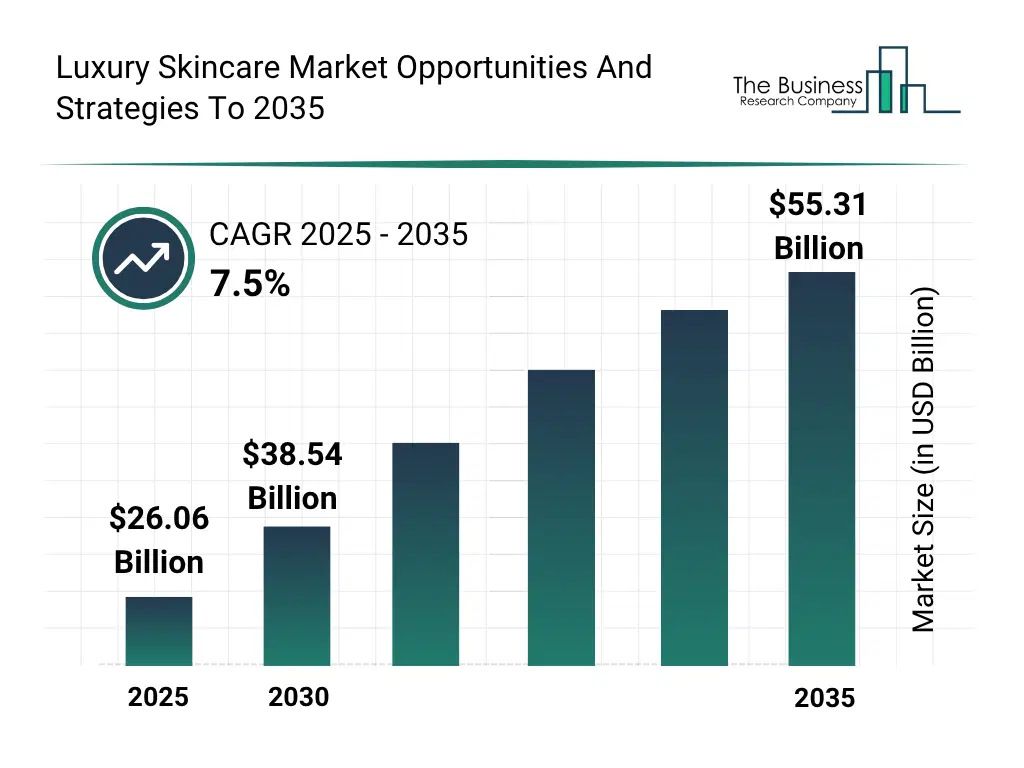
Luxury Skincare Global Market Opportunities And Strategies To 2035 Market Size and growth rate 2026 to 2030: Graph

Luxury Skincare Market Size

The global luxury skincare market reached a value of nearly $26,059.1 million in 2025, having grown at a compound annual growth rate (CAGR) of 8.3% since 2020. The market is expected to grow from $26,059.1 million in 2025 to $38,544.0 million in 2030 at a rate of 8.1%. The market is then expected to grow at a CAGR of 7.5% from 2030 and reach $55,312.5 million in 2035. Growth in the historic period resulted from increasing preference for natural and organic ingredients, rising consumer interest in luxury wellness and holistic beauty, increasing demand for anti-aging solutions and growth of e-commerce. Factors that negatively affected growth in the historic period were high product pricing limiting mass adoption and intense competition from affordable premium alternatives. Going forward, increasing consumer spending on premium beauty and skincare products, influence of social media and celebrity endorsements, expansion of premium beauty services in medical spas and aesthetic clinics and expansion of experiential luxury beauty retail concepts will drive the growth. Factors that could hinder the growth of the luxury skincare market in the future include economic uncertainty and reduced discretionary spending, counterfeit and grey market products and trade war and tariffs.
Research Expert

Book your 30 minutes free consultation with our research experts

Luxury Skincare Market Segmentation

The luxury skincare market is segmented by types, by distribution channel and by application.

By Type –
The luxury skincare market is segmented by type into:
    • a) Facial Care
    • b) Body Care
The facial care was the largest segment of the luxury skincare market segmented by types, accounting for 72.7% or $18,954.4 million of the total in 2025. Going forward, the body care segment is expected to be the fastest-growing segment in the luxury skincare market segmented by types, at a CAGR of 8.8% during 2025-2030.

By Distribution Channel –
The luxury skincare market is segmented by distribution channel into:
    • a) Specialty Stores
    • b) Online Stores
    • c) Other Distribution Channels
The specialty stores market was the largest segment of the luxury skincare market segmented by distribution channel, accounting for 40.9% or $10,655.9 million of the total in 2025. Going forward, the online stores segment is expected to be the fastest-growing segment in the luxury skincare market segmented by distribution channel, at a CAGR of 12.7% during 2025-2030.

By Application –
The luxury skincare market is segmented by application into:
  1. a) Men
  2. b) For Women
  3. c) Unisex
The for women market was the largest segment of the luxury skincare market segmented by applications, accounting for 61.1% or $15,925.3 million of the total in 2025. Going forward, the unisex segment is expected to be the fastest-growing segment in the luxury skincare market segmented by applications, at a CAGR of 10.8% during 2025-2030.

By Geography - The luxury skincare market is segmented by geography into:
      o Asia Pacific
      • China
      • India
      • Japan
      • Australia
      • Taiwan
      • South Korea
      o South East Asia
      • Indonesia
      o North America
      • USA
      • Canada
      o South America
      • Brazil
      o Western Europe
      • France
      • Germany
      • UK
      • Italy
      • Spain
      o Eastern Europe
      • Russia
      o Middle East
      o Africa
North America was the largest region in the luxury skincare market, accounting for 35.16% or $9,161.4 million of the total in 2025. It was followed by Asia Pacific, Western Europe and then the other regions. Going forward, the fastest-growing regions in the luxury skincare market will be Asia Pacific and Africa where growth will be at CAGRs of 9.62% and 8.00% respectively. These will be followed by Eastern Europe and South America where the markets are expected to grow at CAGRs of 7.99% and 7.88% respectively.

Luxury Skincare Market Drivers

The key drivers of the luxury skincare market include: Increasing Consumer Spending On Premium Beauty And Skincare Products During the forecast period, the increasing consumer spending on premium beauty and skincare products is expected to propel the growth of the luxury skincare market. Increasing disposable incomes, evolving beauty standards, and greater awareness of advanced skincare solutions are encouraging consumers to invest in high-quality and specialized products. Demand for anti-aging creams, serums, organic formulations, and dermatologist-backed skincare solutions is growing, particularly among urban and affluent consumers. In addition, the influence of social media, celebrity endorsements, and beauty influencers is accelerating consumer preference for luxury skincare brands. The expansion of e-commerce platforms and premium retail channels is further improving product accessibility and supporting market growth globally. The increasing consumer spending on premium beauty and skincare products growth contribution during the forecast period in 2026 is 2.0%.

Luxury Skincare Market Restraints

The key restraints on the luxury skincare market include: Economic Uncertainty And Reduced Discretionary Spending Economic uncertainty and reduced discretionary spending is expected to hinder the growth of the luxury skincare market in forecast period. Rising inflation, economic slowdowns, and financial instability are encouraging consumers to prioritize essential expenditures over premium beauty and skincare products. As luxury skincare products are typically high-priced, consumers may shift toward affordable alternatives or reduce spending on non-essential personal care items during uncertain economic conditions. In addition, fluctuations in consumer confidence and purchasing power can negatively impact demand for premium skincare brands. Luxury skincare companies may also face challenges related to declining retail sales, lower customer retention, and increased competition from mass-market and value-based skincare products. Growth affected by economic uncertainty and reduced discretionary spending during the forecast period in 2026 is -2.0%.

Luxury Skincare Market Competitive Landscape

Major Competitors are:

  • The Estée Lauder Companies Inc.
  • LVMH Beauty
  • L'Oréal GmbH
  • Chanel S.A.
  • Shiseido Co. Ltd.
  • Other Competitors Include:

  • Amorepacific Corporation
  • Beiersdorf AG
  • Procter & Gamble Company
  • Clarins
  • Mary Kay Inc.
  • Aesop
  • Grown Alchemist
  • Kora Organics
  • Jurlique
  • Kao Corporation
  • Coty Inc.
  • Mamonde
  • Hanyul
  • Juvaly
  • Naruko
  • Neogence
  • Sensist
  • My Beauty Diary
  • For Beloved One
  • 23.5°N
  • SK-II
  • TIA’M
  • Christian Dior SE
  • Sisley S.A.
  • Lancôme Paris
  • Natura Bissé International S.A.
  • Henkel AG & Co. KGaA
  • Céla
  • Cellcosmet
  • Tata Harper Skincare
  • Sunday Riley Modern Skincare LLC
  • DECIEM
  • Graydon Skincare
  • Three Ships Beauty
  • F. Miller
  • Sidia
  • Skinfix
  • ILIA Beauty
  • Drunk Elephant
  • Augustinus Bader GmbH & Co. KG
  • Kate Somerville
  • Chantecaille
  • Guerlain S.A.
  • Tatcha LLC
  • Need data on a specific region in this market?

    Opportunities And Recommendations In The Luxury Skincare Market

    Opportunities – The top opportunities in the luxury skincare market segmented by types will arise in the facial care segment, which will gain $8,777.6 million of global annual sales by 2030. The top opportunities in the luxury skincare market segmented by distribution channel will arise in the online stores segment, which will gain $7,494.2 million of global annual sales by 2030. The top opportunities in the luxury skincare market segmented by applications will arise in the for women segment, which will gain $6,065.9 million of global annual sales by 2030. The luxury skincare market size will gain the most in the USA at $3,796.3 million. Recommendations- To take advantage of the opportunities, The Business Research Company recommends the luxury skincare companies to focus on premium direct-to-consumer growth and omnichannel expansion, focus on strategic retail partnerships and premium market expansion, focus on omnichannel expansion in emerging luxury beauty markets, focus on heritage-based premium k-beauty expansion and product differentiation, focus on biotechnology-driven anti-aging innovation and premium ingredient differentiation, focus on premium body care portfolio expansion, expand in emerging markets, continue to focus on developed markets, focus on value-based premium pricing and tiered product architecture, focus on accelerating online store expansion and digital luxury commerce and focus on expanding gender-neutral luxury skincare portfolios.
    Chat with us