

Machine Vision Global Market Opportunities And Strategies To 2035
By Product (PC-Based, Smart Camera-Based, Other Products), By Offering (Hardware, Software, Service), By Deployment Type (General Machine Vision Systems, Robotic Cell), By Application (Quality Assurance And Inspection, Positioning And Guidance, Measurement, Identification, Predictive Maintenance), By End User (Automotive, Pharmaceuticals And Chemicals, Electronics And Semiconductors, Pulp And Paper, Printing And Labeling, Food And Beverage, Postal And Logistics, Other End-Users), And By Region, Opportunities And Strategies – Global Forecast To 2035
Mission Vision Market Definition
Machine vision refers to the use of imaging-based automatic inspection and analysis technology that enables industrial equipment to 'see' and interpret visual information. By combining cameras, lenses, processors, lighting, software and AI-based algorithms, machine vision systems perform tasks such as quality assurance, inspection, measurement, identification, positioning and guidance across manufacturing and other industrial environments. The machine vision market consists of revenues earned by entities (organizations, sole traders and partnerships) by providing PC-based, smart camera-based and other machine vision products, along with associated hardware, software and services used for general machine vision systems and robotic cell deployments. The market includes solutions for applications such as quality assurance and inspection, positioning and guidance, measurement, identification and predictive maintenance across end-user industries including automotive, pharmaceuticals and chemicals, electronics and semiconductors, pulp and paper, printing and labeling, food and beverage and postal and logistics.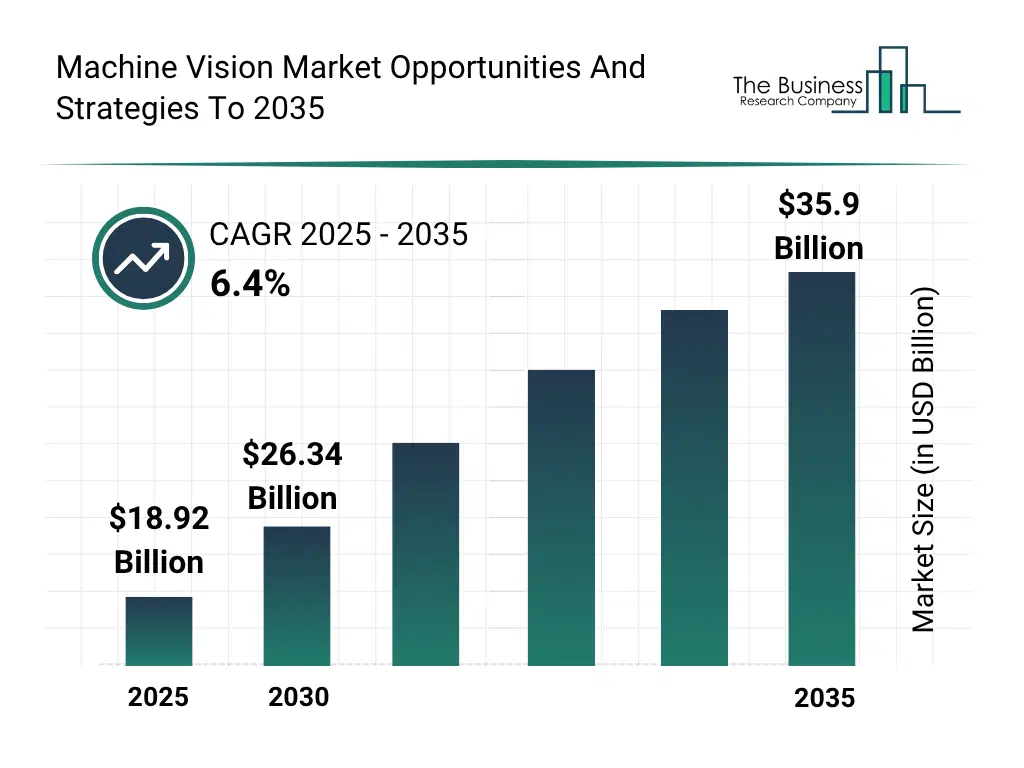
Mission Vision Market Size
The global machine vision market reached a value of nearly $18,920.9 million in 2025, having grown at a compound annual growth rate (CAGR) of 5.6% since 2020. The market is expected to grow from $18,920.9 million in 2025 to $26,339.7 million in 2030 at a rate of 6.8%. The market is then expected to grow at a CAGR of 6.4% from 2030 and reach $35,898.4 million in 2035. Growth in the historic period resulted from growing adoption of industry 4.0 and smart manufacturing practices, increasing adoption in automotive industry, rise in demand for zero-defect manufacturing and shortage of labor. Factors that negatively affected growth in the historic period were high initial investment costs and data privacy, security and cybersecurity risks. Going forward, rising industrial automation, increasing deep learning and AI integration, rise of edge computing and smart cameras and increasing semiconductor and electronics manufacturing will drive the growth. Factors that could hinder the growth of the machine vision market in the future include integration challenges with existing manufacturing systems and legacy technologies, limitations in handling unstructured environments or variable lighting conditions and impact of trade wars and tariffs.
Mission Vision Market Segmentation
The machine vision market is segmented by product, by offering, by deployment type, by application and by end user.By Product –
The machine vision market is segmented by product into:
- a) PC-Based
- b) Smart Camera-Based
- c) Other Products
By Offering –
The machine vision market is segmented by offering into:
- a) Hardware
- b) Software
- c) Service
By Deployment Type –
The machine vision market is segmented by deployment type into:
- a) General Machine Vision Systems
- b) Robotic Cell
By Application –
The machine vision market is segmented by application into:
- a) Quality Assurance And Inspection
- b) Positioning And Guidance
- c) Measurement
- d) Identification
- e) Predictive Maintenance
By End User –
The machine vision market is segmented by end user into:
- a) Automotive
- b) Pharmaceuticals And Chemicals
- c) Electronics And Semiconductors
- d) Pulp And Paper
- e) Printing And Labeling
- f) Food And Beverage
- g) Postal And Logistics
- h) Other End-Users
By Geography - The machine vision market is segmented by geography into:
- China
- India
- Japan
- Taiwan
- Australia
- South Korea
- Indonesia
- USA
- Canada
- Brazil
- France
- Germany
- UK
- Italy
- Spain
- Russia
-
o Asia Pacific
o Africa