

Machine Vision Software Market Report 2026
Global Outlook – By Technology (Personal Computer-Based Machine Vision, Smart Camera-Based Machine Vision, Embedded Machine Vision), By Application (Quality Control And Inspection, Robotics And Automation, Packaging And Labeling, Surface Inspection, Security And Surveillance, Other Applications), By End Use (Manufacturing, Automotive, Electronics And Semiconductor, Healthcare, Transportation And Logistics, Retail And Consumer Electronics, Banking And Finance, Other End Users) – Market Size, Trends, Strategies, and Forecast to 2030
Machine Vision Software Market Overview
• Machine Vision Software market size has reached to $2.08 billion in 2025 • Expected to grow to $5.01 billion in 2030 at a compound annual growth rate (CAGR) of 19.2% • Growth Driver: The Role Of Quality Inspection In Expanding The Machine Vision Software Market • Market Trend: Advancements In Fixed-Mount Barcode Reader Technology Enhancing Automation And Operational Efficiency • North America was the largest region in 2025 and Asia-Pacific is the fastest growing region.What Is Covered Under Machine Vision Software Market?
Machine vision software refers to programs and algorithms used to analyse, interpret, and make decisions based on visual data from cameras and other imaging devices. It enables machines to see and understand their surroundings, allowing for automated inspection, measurement, and control in various industries. The main technologies of machine vision software are personal computer-based machine vision, smart camera-based machine vision, and embedded machine vision. Personal computer-based machine vision refers to the use of a computer, typically a PC, to process and analyse images captured by cameras or image acquisition boards. It is used in quality control and inspection, robotics and automation, packaging and labelling, surface inspection, security and surveillance, and other applications by manufacturing, automotive, electronics and semiconductor, healthcare, transportation and logistics, retail and consumer electronics, banking and finance, and other end users.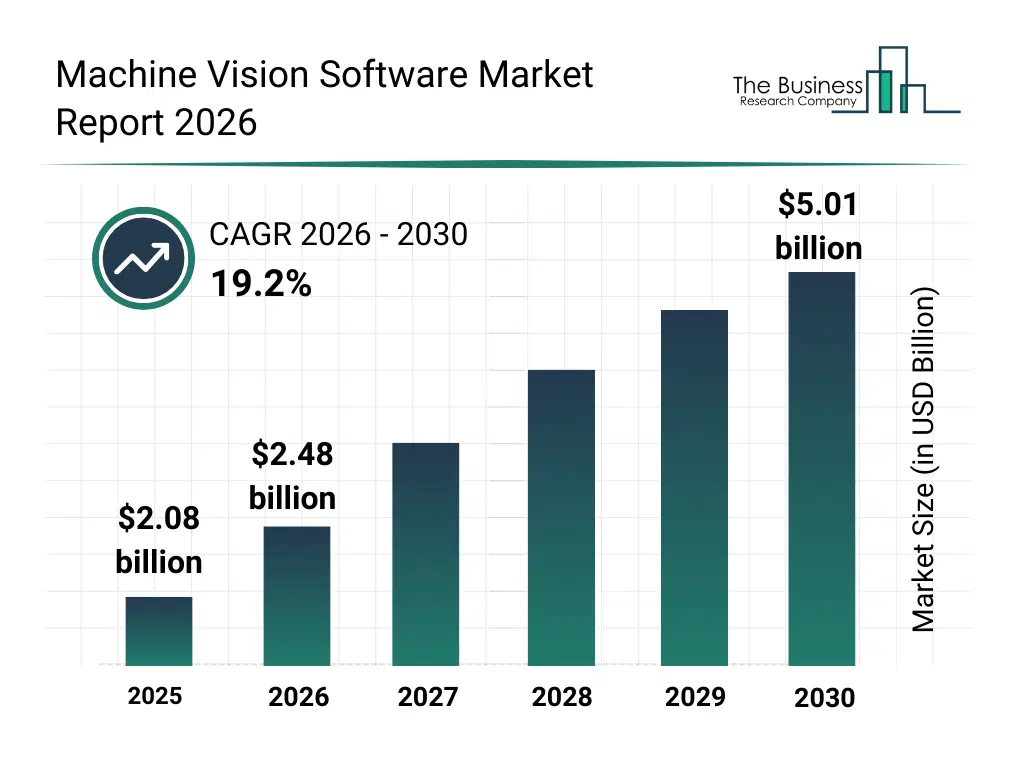
What Is The Machine Vision Software Market Size and Share 2026?
The machine vision software market size has grown rapidly in recent years. It will grow from $2.08 billion in 2025 to $2.48 billion in 2026 at a compound annual growth rate (CAGR) of 19.1%. The growth in the historic period can be attributed to manual inspection processes, limited software integration, low adoption in manufacturing, high cost of imaging hardware, lack of real-time processing.What Is The Machine Vision Software Market Growth Forecast?
The machine vision software market size is expected to see rapid growth in the next few years. It will grow to $5.01 billion in 2030 at a compound annual growth rate (CAGR) of 19.2%. The growth in the forecast period can be attributed to AI-enabled vision systems, robotics automation adoption, growth in smart factories, surface inspection demand, expansion of security surveillance solutions. Major trends in the forecast period include automated quality control, real-time image analysis, intelligent robotics integration, surface inspection optimization, smart surveillance analytics.
Global Machine Vision Software Market Segmentation
1) By Technology: Personal Computer-Based Machine Vision, Smart Camera-Based Machine Vision, Embedded Machine Vision 2) By Application: Quality Control And Inspection, Robotics And Automation, Packaging And Labeling, Surface Inspection, Security And Surveillance, Other Applications 3) By End Use: Manufacturing, Automotive, Electronics And Semiconductor, Healthcare, Transportation And Logistics, Retail And Consumer Electronics, Banking And Finance, Other End Users Subsegments: 1) By Personal Computer-Based Machine Vision: Software Solutions, Imaging Hardware Integration, Processing Power Optimization 2) By Smart Camera-Based Machine Vision: Integrated Software Solutions, Onboard Processing Capabilities, Communication Interfaces 3) By Embedded Machine Vision: Custom Hardware Solutions, Compact Software Frameworks, Real-Time Processing CapabilitiesWhat Is The Driver Of The Machine Vision Software Market?
The increasing demand for quality inspection is expected to propel the growth of the machine vision software market going forward. Quality inspection involves the systematic examination and assessment of products or processes to meet predefined standards and specifications, guaranteeing consistency, reliability, and compliance with regulatory requirements. Machine vision software enhances quality inspection by providing automated and precise analysis of products or processes through image processing and pattern recognition algorithms, enabling faster and more accurate detection of defects or deviations. This facilitates improved quality control measures, reducing errors and ensuring higher product quality standards across industries. For instance, in September 2024, according to the International Federation of Robotics, a Germany-based professional non-profit organisation, sales of industrial robots in the UK hit a record high in 2023, with 3,830 units installed. This marks a significant increase of 51% compared to the previous year. Therefore, the increasing demand for quality inspection is driving the growth of the machine vision software industry.Key Players In The Global Machine Vision Software Market
Major companies operating in the machine vision software market are Alphabet Inc.; Microsoft Inc.; Intel Corporation; Texas Instruments Incorporated; Atlas Copco AB; Keyence Corporation; Omron Microscan Systems Inc.; Teledyne Technologies; Zebra Technologies Corporation; FLIR Systems Inc.; TKH Group; National Instrument Corporation; Cognex Corporation; Datalogic S.p.A.; Baumer Holding AG; Basler AG; Key Technology Inc.; Sick AG; Vitronic GmbH; Isra Vision AG; Stemmer Imaging AG; Matrox Imaging; Allied Vision Technologies GmbH; Qualitas Technologies Pvt. Ltd.; MVTec Software GmbH
This chart is for illustrative purposes; the full report includes a detailed competitor analysis and comprehensive overview of the top 10 companies in the market.
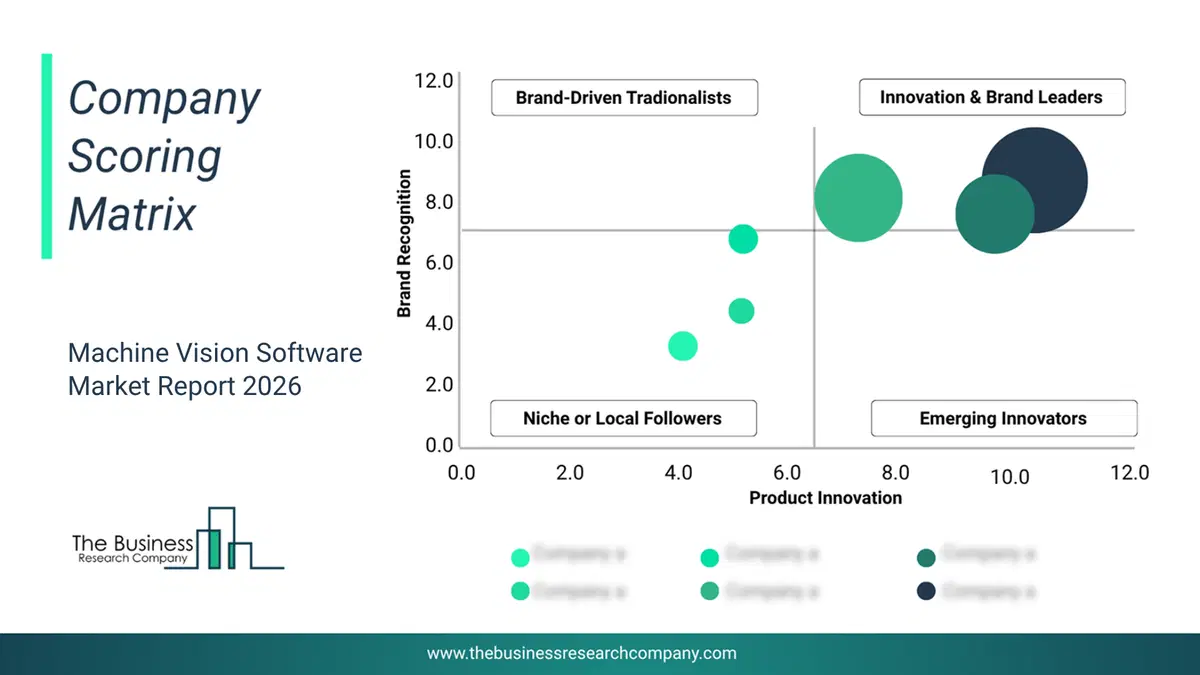
This chart maps companies by product innovation and brand strength, with bubble size indicating relative revenue, helping identify market leaders, challengers, and niche players. This is an illustrative chart; the full report provides a complete and accurate competitive analysis.
Global Machine Vision Software Market Trends and Insights
Major companies operating in the machine vision software market are focusing on developing advanced solutions, such as fixed-mount barcode reader technology, to enhance automation efficiency, improve accuracy, and accelerate operations in industrial and logistics environments. Fixed-mount barcode reader technology refers to scanning systems that are permanently installed in fixed positions such as on conveyor belts, inspection tunnels, or workstations designed to read 1D, 2D, and Direct-Part Mark (DPM) codes with high reliability in high-volume settings. For instance, in September 2023, Cognex Corporation, a US-based manufacturer of machine vision systems, launched the DataMan 380 fixed-mount barcode reader, which leverages high-resolution images and integrated artificial intelligence (AI) to accelerate throughput across logistics and manufacturing applications. Designed with a wide field of view that simplifies deployment and operations, the DataMan 380 delivers superior performance, with one unit outperforming an array of conventional readers.What Are Latest Mergers And Acquisitions In The Machine Vision Software Market?
In October 2024, Exaktera, a US-based company that develops and manufactures optical measurement engineering systems, acquired iiM GmbH for an undisclosed amount. As a result of the acquisition, iiM’s technical expertise and complementary product range will strengthen Exaktera's ability to provide top-tier LED solutions and expand its engineering capabilities in optical measurement. iiM GmbH is a Germany-based developer of LEDs for machine vision lighting.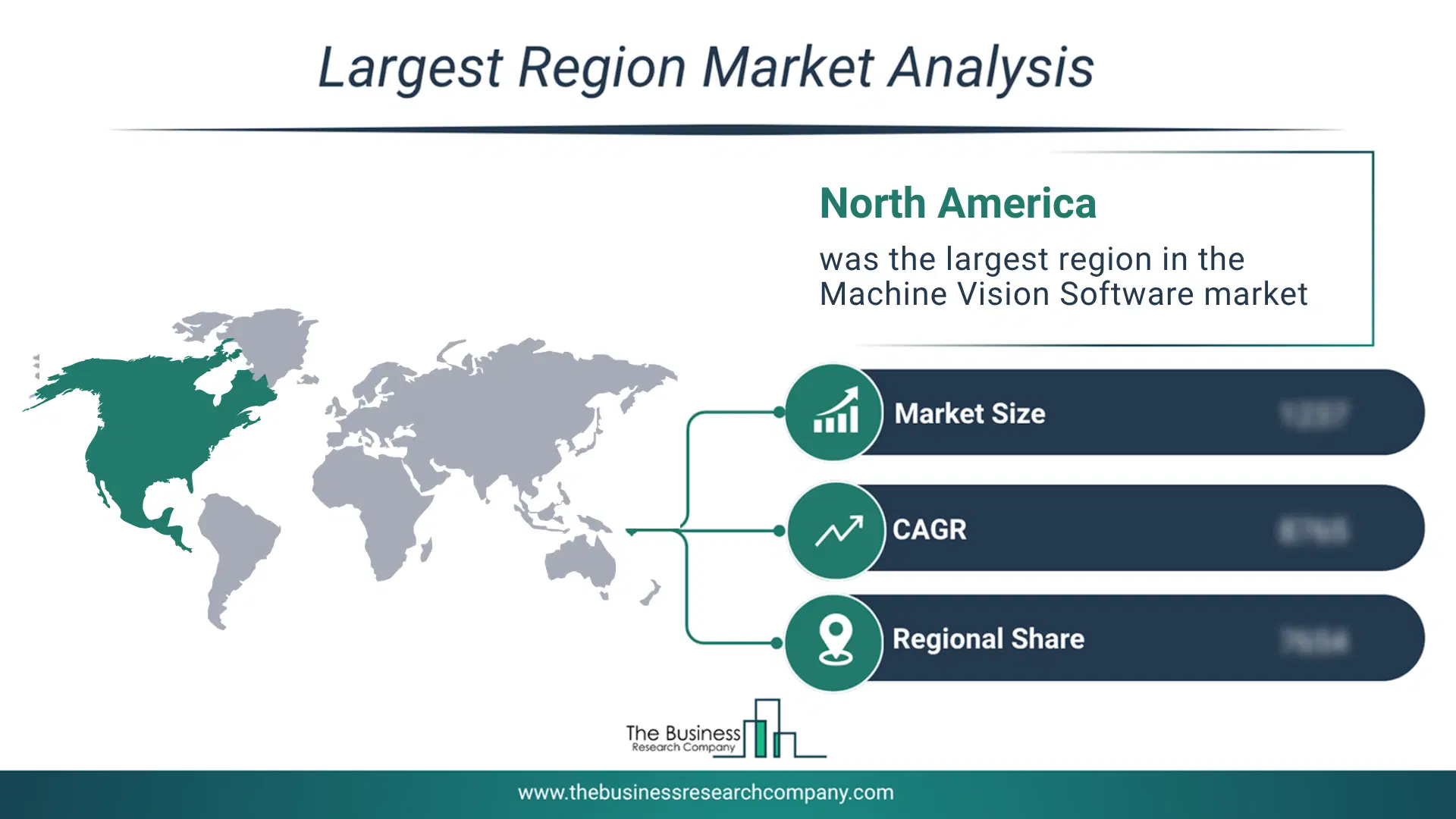
Regional Insights
North America was the largest region in the machine vision software market in 2025. Asia-Pacific is expected to be the fastest-growing region in the forecast period. The regions covered in this market report are Asia-Pacific, South East Asia, Western Europe, Eastern Europe, North America, South America, Middle East, Africa. The countries covered in this market report are Australia, Brazil, China, France, Germany, India, Indonesia, Japan, Taiwan, Russia, South Korea, UK, USA, Canada, Italy, SpainWhat Defines the Machine Vision Software Market?
The machine vision software market includes revenues earned by entities by providing services such as software licenses, subscriptions, and customization and integration services. The market value includes the value of related goods sold by the service provider or included within the service offering. The machine vision software market also includes sales of cameras, frame grabbers, lenses, lighting, processors, memory, interfaces, controllers, and robotic arms. Values in this market are ‘factory gate’ values, that is the value of goods sold by the manufacturers or creators of the goods, whether to other entities (including downstream manufacturers, wholesalers, distributors and retailers) or directly to end customers. The value of goods in this market includes related services sold by the creators of the goods.How is Market Value Defined and Measured?
The market value is defined as the revenues that enterprises gain from the sale of goods and/or services within the specified market and geography through sales, grants, or donations in terms of the currency (in USD unless otherwise specified). The revenues for a specified geography are consumption values that are revenues generated by organizations in the specified geography within the market, irrespective of where they are produced. It does not include revenues from resales along the supply chain, either further along the supply chain or as part of other products.
This chart presents market attractiveness based on a quantitative evaluation of growth, competition, strategic alignment, and risk, offering a clear view of opportunity areas for decision-making. This chart is for illustrative purposes; the full report contains the complete analysis.

This chart highlights the Total Addressable Market (TAM) by estimating the maximum revenue opportunity using an assumption-driven approach, supporting strategic planning and opportunity sizing across markets. The chart is illustrative; the full report provides a more comprehensive analysis.
What Key Data and Analysis Are Included in the Machine Vision Software Market Report 2026?
The machine vision software market research report is one of a series of new reports from The Business Research Company that provides market statistics, including industry global market size, regional shares, competitors with the market share, detailed market segments, market trends and opportunities, and any further data you may need to thrive in the machine vision software industry. The market research report delivers a complete perspective of everything you need, with an in-depth analysis of the current and future state of the industry.Machine Vision Software Market Report Forecast Analysis
| Report Attribute | Details |
|---|---|
| Market Size Value In 2026 | $2.48 billion |
| Revenue Forecast In 2030 | $5.01 billion |
| Growth Rate | CAGR of 19.2% from 2026 to 2030 |
| Base Year For Estimation | 2025 |
| Actual Estimates/Historical Data | 2020-2025 |
| Forecast Period | 2026 - 2030 |
| Market Representation | Revenue in USD Billion and CAGR from 2026 to 2030 |
| Segments Covered | Technology, Application, End Use |
| Regional Scope | Asia-Pacific, Western Europe, Eastern Europe, North America, South America, Middle East, Africa |
| Country Scope | The Countries Covered In This Market Report Are Australia, Brazil, China, France, Germany, India, Indonesia, Japan, Taiwan, Russia, South Korea, Uk, Usa, Canada, Italy, Spain. |
| Key Companies Profiled | Alphabet Inc., Microsoft Inc., Intel Corporation, Texas Instruments Incorporated, Atlas Copco AB, Keyence Corporation, Omron Microscan Systems Inc., Teledyne Technologies, Zebra Technologies Corporation, FLIR Systems Inc., TKH Group, National Instrument Corporation, Cognex Corporation, Datalogic S.p.A., Baumer Holding AG, Basler AG, Key Technology Inc., Sick AG, Vitronic GmbH, Isra Vision AG, Stemmer Imaging AG, Matrox Imaging, Allied Vision Technologies GmbH, Qualitas Technologies Pvt. Ltd., MVTec Software GmbH |
| Customization Scope | Request for Customization |
| Pricing And Purchase Options | Explore Purchase Options |