
Magnesium Oxide Nanopowder Market Report 2026
Global Outlook – By Type (99% Magnesium Oxide Nanopowder, 99.9% Magnesium Oxide Nanopowder, 99.99% Magnesium Oxide Nanopowder, 99.999% Magnesium Oxide Nanopowder), By Application (Refractory Materials, Electric Insulation, Fire Retardant), By End-User Industry (Metallurgy, Construction, Oil And Gas, Automotive, Electrical And Electronics, Other End-User Industries) – Market Size, Trends, Strategies, and Forecast to 2030
Magnesium Oxide Nanopowder Market Overview
• Magnesium Oxide Nanopowder market size has reached to $3.55 billion in 2025 • Expected to grow to $5.5 billion in 2030 at a compound annual growth rate (CAGR) of 9.3% • Growth Driver: Surging Demand For Electronic Products Fuels Growth In The Magnesium Oxide Nanopowder Market • Asia-Pacific was the largest region and fastest growing region.What Is Covered Under Magnesium Oxide Nanopowder Market?
Magnesium oxide nanopowder is a fine white powder composed of magnesium and oxygen atoms. Magnesium oxide nanopowder has a very high melting point and low heat capacity, which makes it a suitable candidate for insulation applications. It is also used as an efficient catalyst in chemical reactions and as a flame-retardant additive in polymers to enhance fire safety. The main types of magnesium oxide nanopowders are 99% magnesium oxide nanopowder, 99.9% magnesium oxide nanopowder, 99.99% magnesium oxide nanopowder and 99.999% magnesium oxide nanopowder. 99% magnesium oxide nanopowder refers to a fine white powder with a purity of 99% and it is used as a fire retardant in the chemical fiber and plastics industries to reduce the flammability of materials and prevent the spread of fire. These are used in several applications, including refractory materials, electric insulation, magnetic devices, fuel additives and fire retardants and are used by various end-user industries, such as metallurgy, construction, oil and gas, automotive, electrical and electronics and others.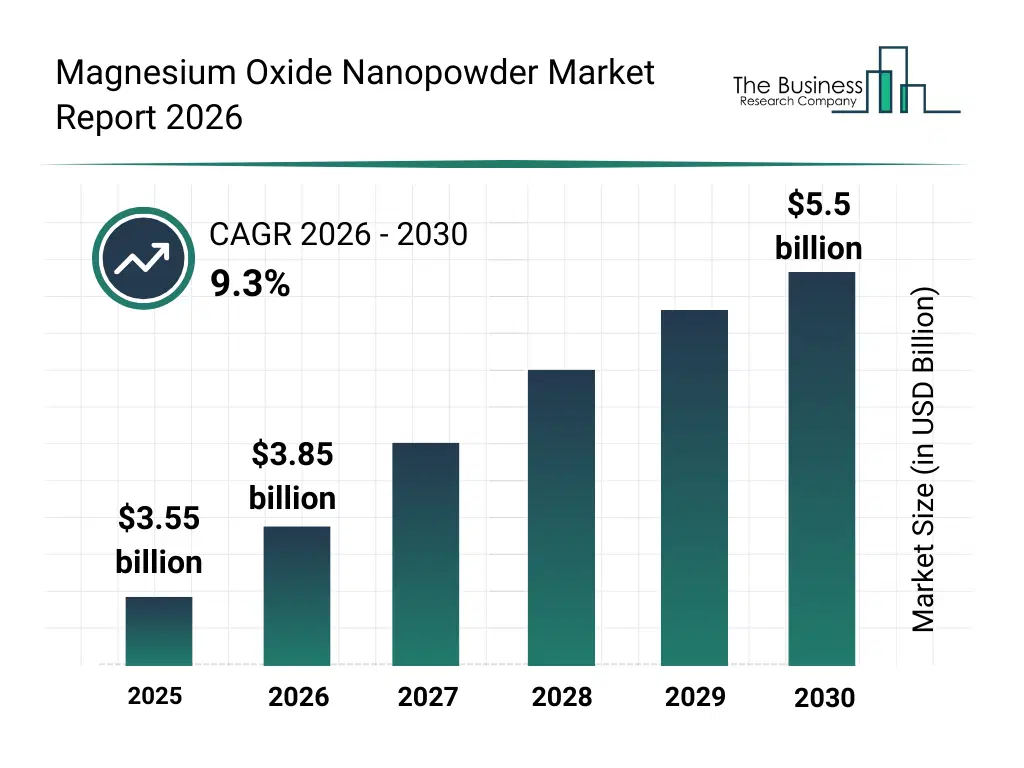
What Is The Magnesium Oxide Nanopowder Market Size and Share 2026?
The magnesium oxide nanopowder market size has grown strongly in recent years. It will grow from $3.55 billion in 2025 to $3.85 billion in 2026 at a compound annual growth rate (CAGR) of 8.4%. The growth in the historic period can be attributed to industrial insulation demand, growth in refractory materials, use in metallurgical processes, expansion of construction activities, adoption in chemical catalysis.What Is The Magnesium Oxide Nanopowder Market Growth Forecast?
The magnesium oxide nanopowder market size is expected to see strong growth in the next few years. It will grow to $5.5 billion in 2030 at a compound annual growth rate (CAGR) of 9.3%. The growth in the forecast period can be attributed to electric vehicle insulation demand, growth in electronics manufacturing, stricter fire safety standards, advanced material research, expansion of energy storage systems. Major trends in the forecast period include rising demand for high purity nanopowders, increased use in fire retardant applications, growth in advanced insulation materials, expansion of catalytic applications, focus on particle size control.
Global Magnesium Oxide Nanopowder Market Segmentation
1) By Type: 99% Magnesium Oxide Nanopowder, 99.9% Magnesium Oxide Nanopowder, 99.99% Magnesium Oxide Nanopowder, 99.999% Magnesium Oxide Nanopowder 2) By Application: Refractory Materials, Electric Insulation, Fire Retardant 3) By End-User Industry: Metallurgy, Construction, Oil And Gas, Automotive, Electrical And Electronics, Other End-User IndustriesWhat Are The Drivers Of The Magnesium Oxide Nanopowder Market?
Increasing demand for electronic products is expected to propel the growth of the magnesium oxide nanopowder market going forward. Electronic products are devices that utilize electronic circuits and components to perform specific functions or tasks. Magnesium oxide nanopowders are extensively used in coatings for electronic devices to improve their durability and resistance to wear and tear. For instance, in May 2023, according to the Japan Electronics and Information Technology Industries Association, a Japan-based trade association, in May 2023, Japan's electronic equipment production amounted to 771,457 million yen (approximately USD 5.6 billion). The output of consumer electronics rose to 32,099 million yen (around USD 233 million), an increase from 25,268 million yen (about USD 183 million) recorded in May 2022. Therefore, increasing demand for electronic products is driving the growth of the magnesium oxide nanopowder industry. The increasing demand for CO2 emission reduction is expected to propel the growth of the magnesium oxide nanopowder market going forward. CO2 emission reduction refers to minimizing greenhouse gas (GHG) emissions generated by an individual, organization, or country. Magnesium oxide nanopowder can be used as an adsorbent for CO2 due to its unique properties, such as its appropriate surface area and porosity. Additionally, magnesium oxide can react with CO2 and water in the engine plume or atmosphere to produce magnesium carbonate or magnesium bicarbonate, which can help reduce CO2 emissions from aviation. For instance, in April 2024, the U.S. Energy Information Administration (EIA) reported that energy-related CO2 emissions in the U.S. dropped by 3% in 2023, equating to a reduction of 134 million metric tons (MMt). This decline was largely driven by the electric power sector, which contributed to a 7% decrease in emissions, making up 85% of the overall reduction. Therefore, increasing demand for CO2 emission reduction is driving the growth of the magnesium oxide nanopowder industry. The increasing demand for personal care products is expected to propel the growth of the magnesium oxide nanopowder market going forward. A personal care product refers to a group of self-care items used for personal hygiene, cleaning and grooming. They include shampoos, conditioners, toothpaste, creams, cosmetics and home items. Magnesium oxide nanopowder can be used as a polishing agent in personal care products such as toothpaste and skin care products and it can also be used as an adhesive in personal care products such as hair care products. For instance, in September 2024, according to the Bureau of Labor Statistics, a US-based government agency, spending on personal care products and services increased by 9.7% from 2022 to 2023, while their share of total annual expenditures remained steady at 1.2% in both years. Therefore, the increasing demand for personal care products is driving the growth of the magnesium oxide nanopowder industry.Key Players In The Global Magnesium Oxide Nanopowder Market
Major companies operating in the magnesium oxide nanopowder market are American Elements, SkySpring Nanomaterials Inc., Nanografi Co. Inc., Nanostructured & Amorphous Materials Inc., Nanoshel LLC, US Research Nanomaterials Inc., Inframat Corporation, Baikowski SAS, Nanophase Technologies Corporation, Showa Denko Materials Co., Ltd., Sakai Chemical Industry Co., Ltd., Iolitec Ionic Liquids Technologies GmbH, Tekna Advanced Materials Inc., PlasmaChem GmbH, Nexceris LLC, Umicore, Merck KGaA, Evonik Industries AG, Tosoh Corporation, JGC Catalysts and Chemicals Ltd., Hefei Kejing Materials Technology Co., Ltd., Nanjing XFNANO Materials Tech Co. Ltd.
This chart is for illustrative purposes; the full report includes a detailed competitor analysis and comprehensive overview of the top 10 companies in the market.
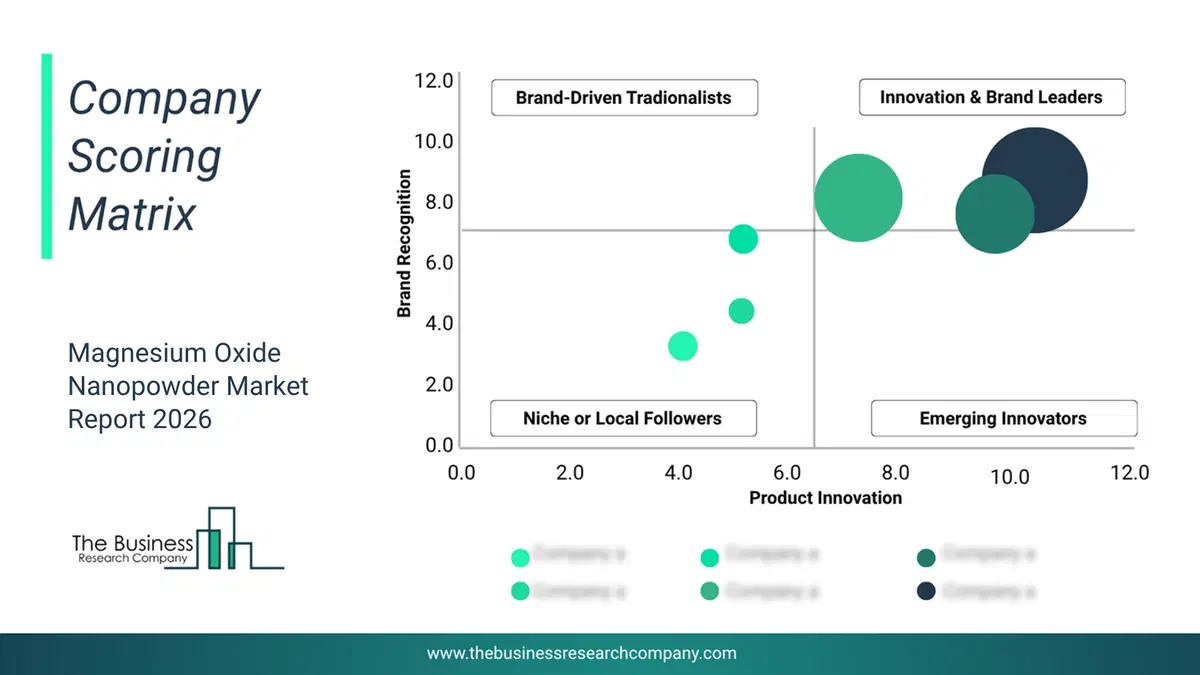
This chart maps companies by product innovation and brand strength, with bubble size indicating relative revenue, helping identify market leaders, challengers, and niche players. This is an illustrative chart; the full report provides a complete and accurate competitive analysis.
Regional Insights
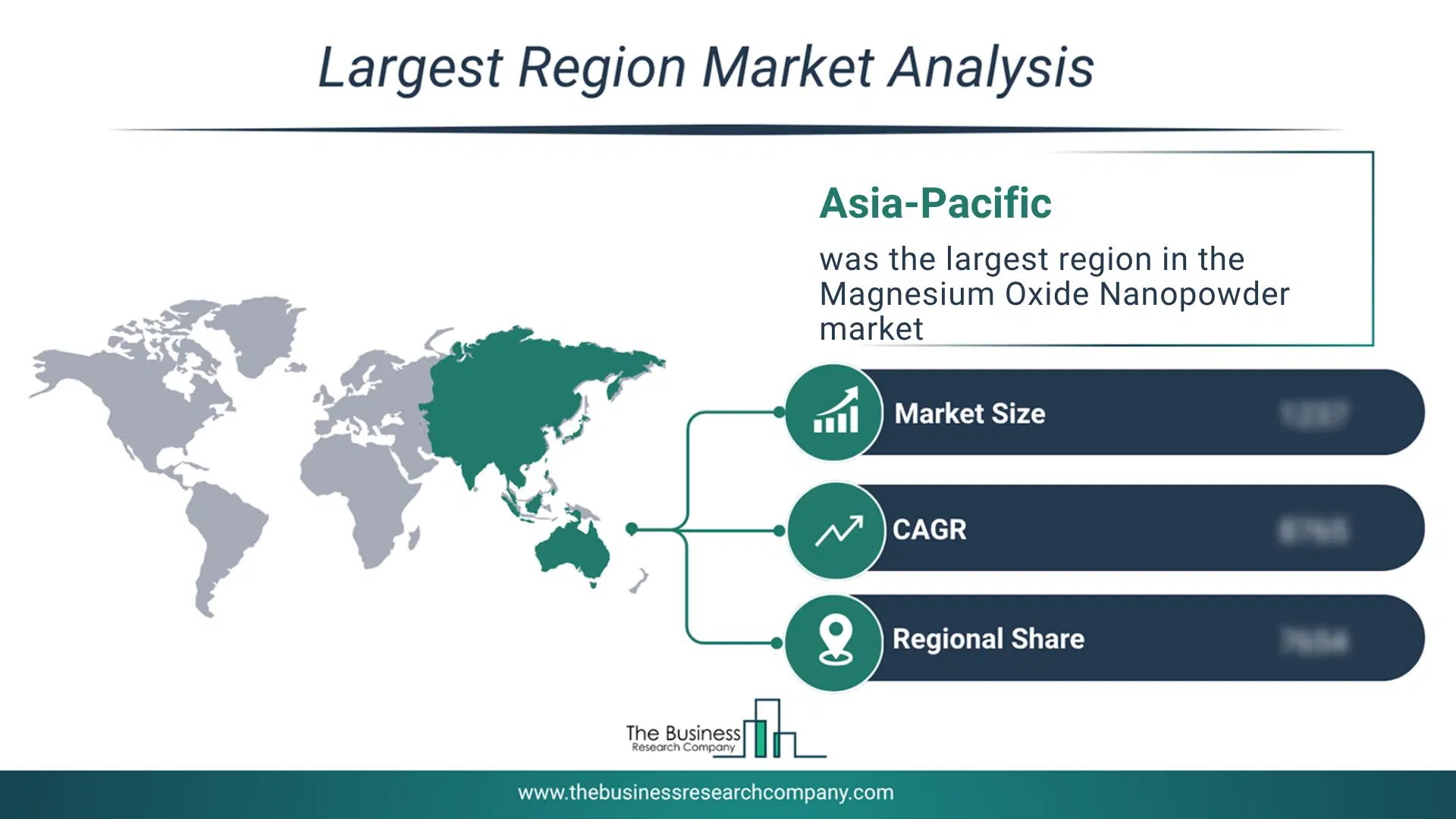
Asia-Pacific was the largest region in the magnesium oxide nanopowder market in 2025. It is expected to be the fastest-growing region in the forecast period. The regions covered in this market report are Asia-Pacific, South East Asia, Western Europe, Eastern Europe, North America, South America, Middle East, Africa The countries covered in this market report are Australia, Brazil, China, France, Germany, India, Indonesia, Japan, Taiwan, Russia, South Korea, UK, USA, Canada, Italy, SpainWhat Defines the Magnesium Oxide Nanopowder Market?
The magnesium oxide nanopowder market consists of sales of catalysts, advanced ceramics, coating materials and painting materials. Values in this market are ‘factory gate’ values, that is, the value of goods sold by the manufacturers or creators of the goods, whether to other entities (including downstream manufacturers, wholesalers, distributors and retailers) or directly to end customers. The value of goods in this market includes related services sold by the creators of the goods.How is Market Value Defined and Measured?
The market value is defined as the revenues that enterprises gain from the sale of goods and/or services within the specified market and geography through sales, grants, or donations in terms of the currency (in USD unless otherwise specified). The revenues for a specified geography are consumption values that are revenues generated by organizations in the specified geography within the market, irrespective of where they are produced. It does not include revenues from resales along the supply chain, either further along the supply chain or as part of other products.
This chart presents market attractiveness based on a quantitative evaluation of growth, competition, strategic alignment, and risk, offering a clear view of opportunity areas for decision-making. This chart is for illustrative purposes; the full report contains the complete analysis.

This chart highlights the Total Addressable Market (TAM) by estimating the maximum revenue opportunity using an assumption-driven approach, supporting strategic planning and opportunity sizing across markets. The chart is illustrative; the full report provides a more comprehensive analysis.
What Key Data and Analysis Are Included in the Magnesium Oxide Nanopowder Market Report 2026?
The magnesium oxide nanopowder market research report is one of a series of new reports from The Business Research Company that provides market statistics, including industry global market size, regional shares, competitors with the market share, detailed market segments, market trends and opportunities, and any further data you may need to thrive in the magnesium oxide nanopowder industry. The market research report delivers a complete perspective of everything you need, with an in-depth analysis of the current and future state of the industry.Magnesium Oxide Nanopowder Market Report Forecast Analysis
| Report Attribute | Details |
|---|---|
| Market Size Value In 2026 | $3.85 billion |
| Revenue Forecast In 2030 | $5.5 billion |
| Growth Rate | CAGR of 8.4% from 2026 to 2030 |
| Base Year For Estimation | 2025 |
| Actual Estimates/Historical Data | 2020-2025 |
| Forecast Period | 2026 - 2030 |
| Market Representation | Revenue in USD Billion and CAGR from 2026 to 2030 |
| Segments Covered | Type, Application, End-User Industry |
| Regional Scope | Asia-Pacific, Western Europe, Eastern Europe, North America, South America, Middle East, Africa |
| Country Scope | The countries covered in this market report are Australia, Brazil, China, France, Germany, India, Indonesia, Japan, Taiwan, Russia, South Korea, UK, USA, Canada, Italy, Spain |
| Key Companies Profiled | American Elements, SkySpring Nanomaterials Inc., Nanografi Co. Inc., Nanostructured & Amorphous Materials Inc., Nanoshel LLC, US Research Nanomaterials Inc., Inframat Corporation, Baikowski SAS, Nanophase Technologies Corporation, Showa Denko Materials Co., Ltd., Sakai Chemical Industry Co., Ltd., Iolitec Ionic Liquids Technologies GmbH, Tekna Advanced Materials Inc., PlasmaChem GmbH, Nexceris LLC, Umicore, Merck KGaA, Evonik Industries AG, Tosoh Corporation, JGC Catalysts and Chemicals Ltd., Hefei Kejing Materials Technology Co., Ltd., Nanjing XFNANO Materials Tech Co. Ltd. |
| Customization Scope | Request for Customization |
| Pricing And Purchase Options | Explore Purchase Options |