
Magnetic Sensor Market Report 2026
Global Outlook – By Type ( Hall Effect Sensors, Magnetoresistive Sensors, Squid Sensors, Flux Gate Sensors), By Range ( Low Field Sensors (<1 Microgauss), Earth Field Sensors (1 Microgauss–10 Gauss), Bias Magnetic Field Sensors (>10 Gauss)), By Application ( Speed Sensor, Detection Or Non-Destructive Testing(NDT), Position Sensor, Navigation And Electronic Compass, Flow Rate Sensor ), By End User ( Automotive, Aerospace And Defense, Industrial, Consumer Electronics, Banking, Financial Services, And Insurance (BFSI), Other End Users) – Market Size, Trends, Strategies, and Forecast to 2030
Magnetic Sensor Market Overview
• Magnetic Sensor market size has reached to $4.07 billion in 2025 • Expected to grow to $5.68 billion in 2030 at a compound annual growth rate (CAGR) of 6.9% • Growth Driver: Rising IoT Adoption Fueling Growth In The Magnetic Sensor Market • Market Trend: Innovative Advancements In Magnetic Sensor Technology • Asia-Pacific was the largest region in 2025.What Is Covered Under Magnetic Sensor Market?
A magnetic sensor is a device that converts the magnitude and variations of a magnetic field into electric signals. Magnetic sensors are frequently used in security and military applications such as detecting, distinguishing, and localizing ferromagnetic and conducting objects, and antitheft systems. They can also be used to detect the magnitude of magnetism and geomagnetism caused by a magnet or current. The main types of magnetic sensors are hall effect sensors, magnetoresistive sensors, squid sensors and flux gate sensors. A hall effect sensor is an electronic device that detects the Hall effect and converts its findings into electronic data. The various ranges involved are low field sensors (<1 microgauss), earth field sensors (1 microgauss–10 gauss) and bias magnetic field sensors (>10 gausses) that are used for speed sensor, detection or non-destructive testing (NDT), position sensor, navigation and electronic compass, flow rate sensor applications by automotive, aerospace and defense, industrial, consumer electronics, banking, financial services, and insurance (BFSI), and other end users.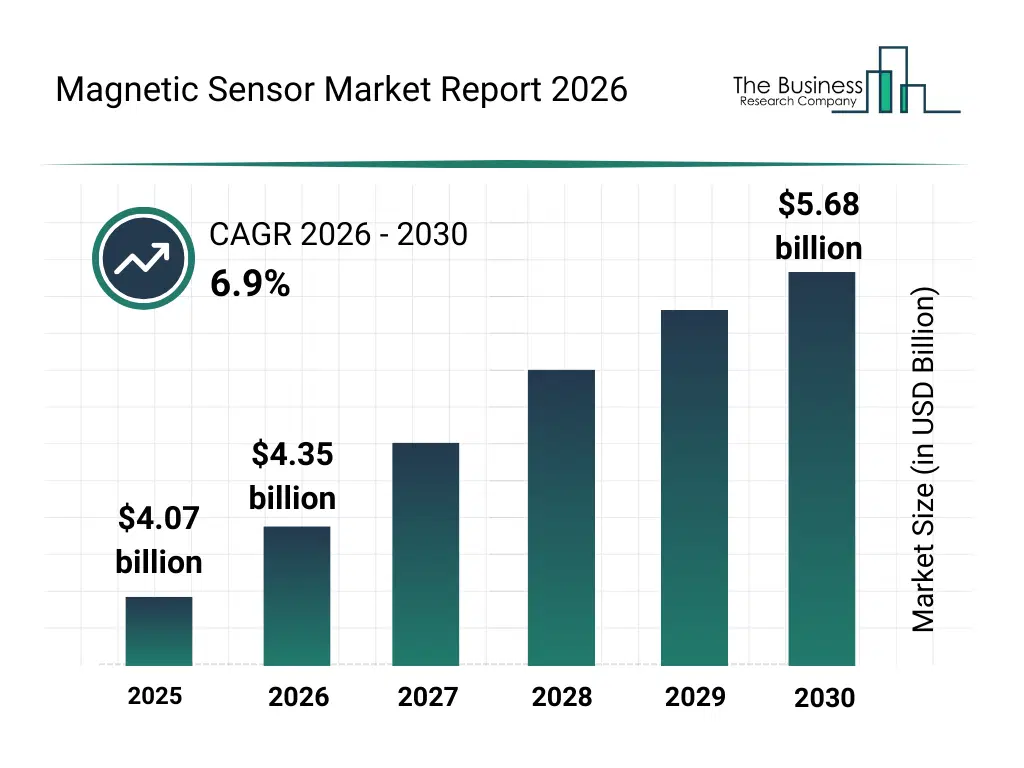
What Is The Magnetic Sensor Market Size 2026 And Growth Rate?
The magnetic sensor market size has grown strongly in recent years. It will grow from $4.07 billion in 2025 to $4.35 billion in 2026 at a compound annual growth rate (CAGR) of 6.9%. The growth in the historic period can be attributed to growth in automotive sensing applications, early use in security and military detection, increasing adoption in geomagnetic measurement, reliance on hall effect and magnetoresistive technologies, expansion of industrial monitoring systems.What Is The Magnetic Sensor Market Growth Forecast?
The magnetic sensor market size is expected to see strong growth in the next few years. It will grow to $5.68 billion in 2030 at a compound annual growth rate (CAGR) of 6.9%. The growth in the forecast period can be attributed to rising demand for tmr and advanced magnetoresistive sensors, increasing adoption in navigation and electronic compasses, growth in ndt and inspection applications, expansion in automotive adas systems, development of high-sensitivity magnetic field sensing technologies. Major trends in the forecast period include adoption of intelligent magnetic field measurement systems, integration of IoT-connected magnetic sensors, advancement of AI-enhanced magnetism detection platforms, development of automated industrial magnetic monitoring, expansion of digitally controlled sensor architectures.
Global Magnetic Sensor Market Segmentation
1) By Type: Hall Effect Sensors, Magnetoresistive Sensors, Squid Sensors, Flux Gate Sensors 2) By Range: Low Field Sensors (<1 Microgauss), Earth Field Sensors (1 Microgauss–10 Gauss), Bias Magnetic Field Sensors (>10 Gauss) 3) By Application: Speed Sensor, Detection Or Non-Destructive Testing(NDT), Position Sensor, Navigation And Electronic Compass, Flow Rate Sensor 4) By End User: Automotive, Aerospace And Defense, Industrial, Consumer Electronics, Banking, Financial Services, And Insurance (BFSI), Other End Users Subsegments: 1) By Hall Effect Sensors: Linear Hall Effect Sensors, Latch Hall Effect Sensors, Rotary Hall Effect Sensors 2) By Magnetoresistive Sensors: Anisotropic Magnetoresistive (AMR) Sensors, Giant Magnetoresistive (GMR) Sensors, Tunnel Magnetoresistive (TMR) Sensors 3) By SQUID Sensors: DC SQUIDs (Direct Current Superconducting Quantum Interference Devices), RF SQUIDs (Radio Frequency Superconducting Quantum Interference Devices) 4) By Flux Gate Sensors: 2D Flux Gate Sensors, 3D Flux Gate SensorsWhat Is The Driver Of The Magnetic Sensor Market?
The increasing number of IoT-linked devices is expected to propel the growth of the magnetic sensor market going forward. IoT-linked devices are nonstandard computing devices that connect wirelessly to a network and transmit data. Magnetic sensors are essential components in many IoT-linked devices, playing a crucial role in detecting and measuring magnetic fields, making them versatile tools for various tasks. For instance, according to IoT Analytics, a Germany-based provider of strategic business intelligence for IoT, the total number of connected IoT devices globally reached 16.6 billion by the end of 2023 (a growth of roughly 15% over 2022) and is expected to grow by about 13% to 18.8 billion by the end of 2024. Therefore, the increasing number of IoT-linked devices is driving the growth of the magnetic sensor industry.Key Players In The Global Magnetic Sensor Market
Major companies operating in the magnetic sensor market are TE Connectivity Ltd., NXP Semiconductors N.V, Texas Instruments Incorporated, STMicroelectronics N.V., Melexis NV, Infineon Technologies AG, TDK Corporation, Allegro MicroSystems LLC, Asahi Kasei Corporation, Honeywell International Inc., NVE Corporation, AMS AG, Robert Bosch GmbH, Kohshin Electric Corporation, Micronas Semiconductor Holding AG, Sensitec GmbH, Murata Manufacturing Co. Ltd., Baumer Ltd., Elmos Semiconductor AG, Analog Devices Inc., Crocus Technology, Omron Corporation, Diodes Incorporated, Silicon Labs Inc., Pepperl+Fuchs International GmbH
This chart is for illustrative purposes; the full report includes a detailed competitor analysis and comprehensive overview of the top 10 companies in the market.
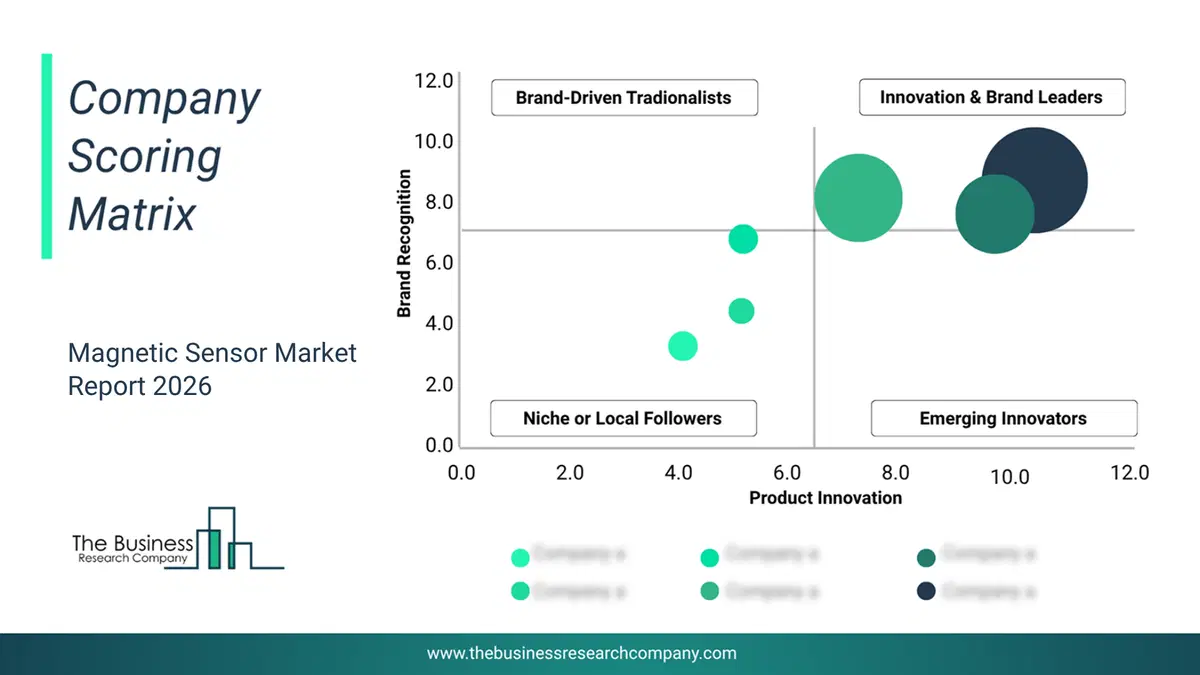
This chart maps companies by product innovation and brand strength, with bubble size indicating relative revenue, helping identify market leaders, challengers, and niche players. This is an illustrative chart; the full report provides a complete and accurate competitive analysis.
Global Magnetic Sensor Market Trends and Insights
Major companies operating in the magnetic sensor market are focused on developing innovative products, such as linear magnetic field sensors, to gain a competitive edge in the market. Linear magnetic field sensors are transducers that detect and measure the strength and direction of a magnetic field. For instance, in May 2023, Multidimension Technology Co Ltd., a China-based provider of magnetic sensors, launched TMR265x Programmable TMR Linear Sensors. They are uniquely designed sensors for high-speed current sensing applications in power electronics and offer a 2MHz bandwidth, making them ideal for monitoring currents in silicon-carbide (SiC) and gallium-nitride (GaN) power switches. The TMR2625x sensors also offer excellent temperature stability and can be programmed to provide a customizable sensitivity and measurement range of up to ±1000 Gauss.What Are Latest Mergers And Acquisitions In The Magnetic Sensor Market?
In August 2023, Allegro MicroSystems Inc., a US-based provider of advanced semiconductor technology and application-specific algorithms, acquired Crocus Technology for $420 million. With this acquisition, Allegro is expected to strengthen and accelerate its innovation in TMR sensing technology and expand its sales into new markets. Crocus Technology is a US-based manufacturer of integrated magnetic field sensors.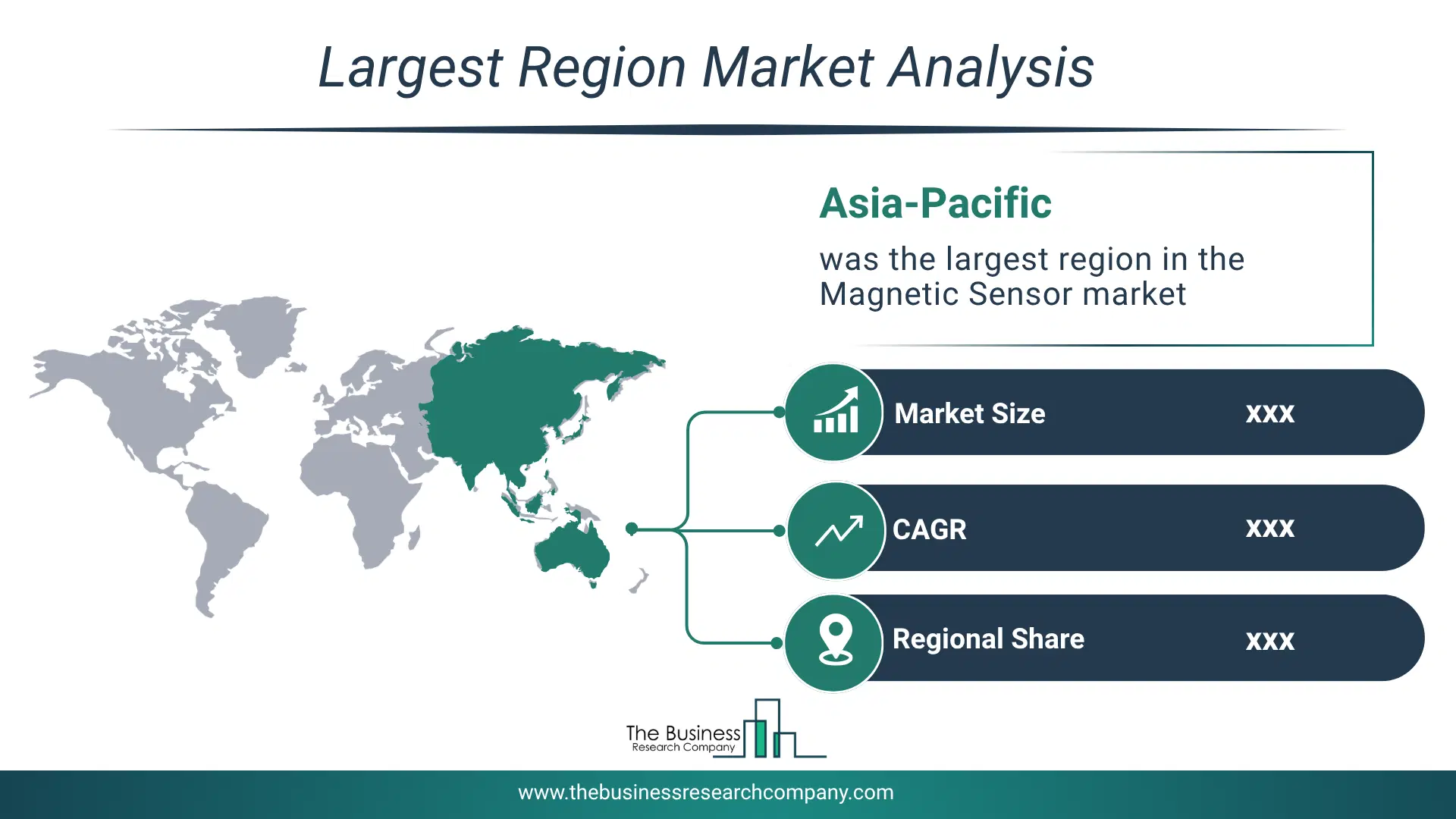
Regional Outlook
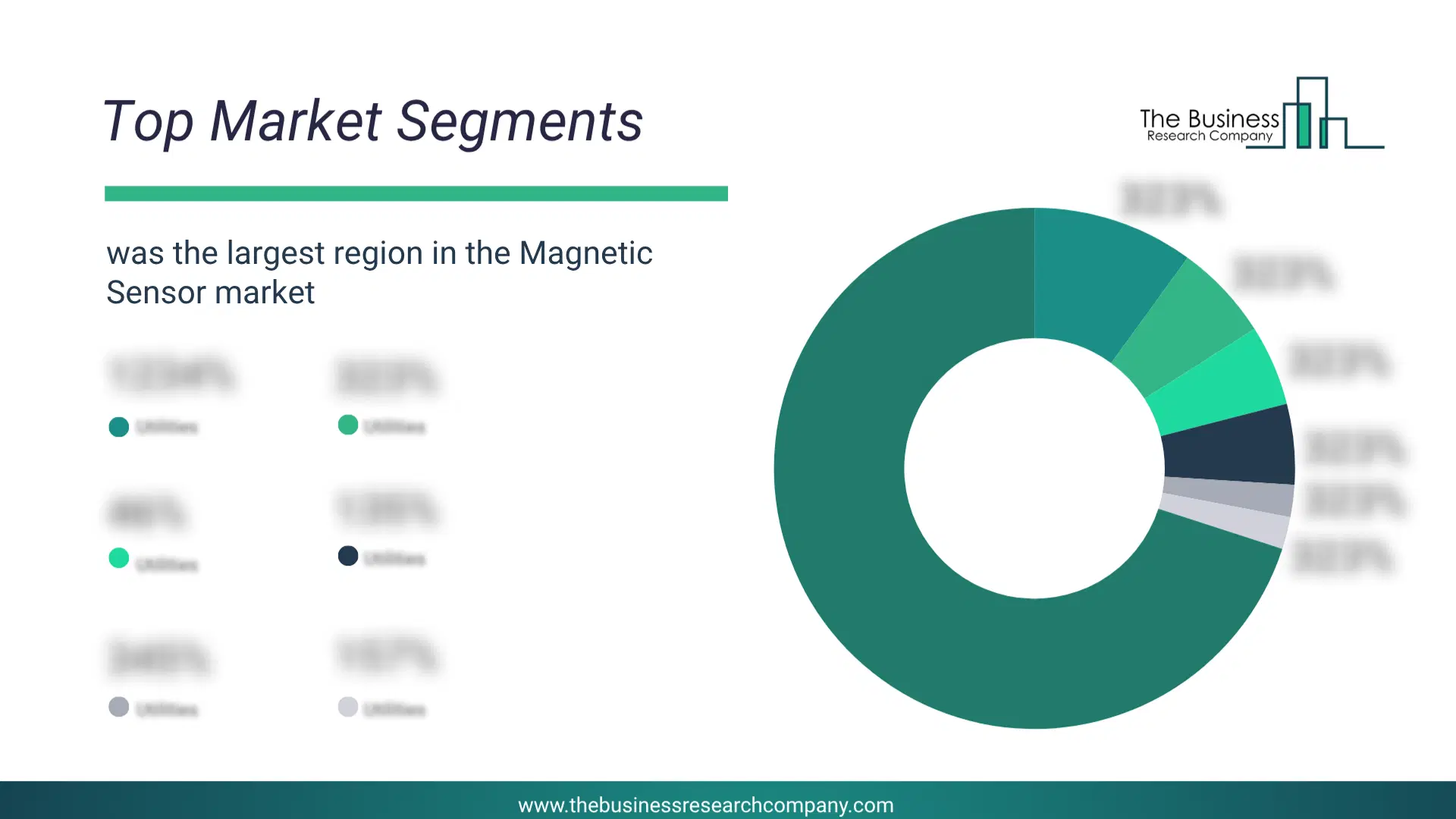
Asia-Pacific was the largest region in the magnetic sensor market in 2025. The regions covered in this market report are Asia-Pacific, South East Asia, Western Europe, Eastern Europe, North America, South America, Middle East, Africa. The countries covered in this market report are Australia, Brazil, China, France, Germany, India, Indonesia, Japan, Taiwan, Russia, South Korea, UK, USA, Canada, Italy, Spain.What Defines the Magnetic Sensor Market?
The magnetic sensor market consists of sales of hall sensors, semiconducting magneto resistors, ferromagnetic magneto resistors, superconducting quantum interference devices (SQUID), resonant sensors, and induction magnetometers. Values in this market are ‘factory gate’ values, that is the value of goods sold by the manufacturers or creators of the goods, whether to other entities (including downstream manufacturers, wholesalers, distributors, and retailers) or directly to end customers. The value of goods in this market includes related services sold by the creators of the goods.How is Market Value Defined and Measured?
The market value is defined as the revenues that enterprises gain from the sale of goods and/or services within the specified market and geography through sales, grants, or donations in terms of the currency (in USD unless otherwise specified). The revenues for a specified geography are consumption values that are revenues generated by organizations in the specified geography within the market, irrespective of where they are produced. It does not include revenues from resales along the supply chain, either further along the supply chain or as part of other products.
This chart presents market attractiveness based on a quantitative evaluation of growth, competition, strategic alignment, and risk, offering a clear view of opportunity areas for decision-making. This chart is for illustrative purposes; the full report contains the complete analysis.

This chart highlights the Total Addressable Market (TAM) by estimating the maximum revenue opportunity using an assumption-driven approach, supporting strategic planning and opportunity sizing across markets. The chart is illustrative; the full report provides a more comprehensive analysis.
What Key Data and Analysis Are Included in the Magnetic Sensor Market Report 2026?
The magnetic sensor market research report is one of a series of new reports from The Business Research Company that provides market statistics, including industry global market size, regional shares, competitors with the market share, detailed market segments, market trends and opportunities, and any further data you may need to thrive in the magnetic sensor industry. The market research report delivers a complete perspective of everything you need, with an in-depth analysis of the current and future state of the industry.Magnetic Sensor Market Report Forecast Analysis
| Report Attribute | Details |
|---|---|
| Market Size Value In 2026 | $4.35 billion |
| Revenue Forecast In 2030 | $5.68 billion |
| Growth Rate | CAGR of 6.9% from 2026 to 2030 |
| Base Year For Estimation | 2025 |
| Actual Estimates/Historical Data | 2020-2025 |
| Forecast Period | 2026 - 2030 |
| Market Representation | Revenue in USD Billion and CAGR from 2026 to 2030 |
| Segments Covered | Type, Range, Application, End User |
| Regional Scope | Asia-Pacific, Western Europe, Eastern Europe, North America, South America, Middle East, Africa |
| Country Scope | The countries covered in the report are Australia, Brazil, China, France, Germany, India, Indonesia, Japan, Taiwan, Russia, South Korea, UK, USA, Canada, Italy, Spain. |
| Key Companies Profiled | TE Connectivity Ltd., NXP Semiconductors N.V, Texas Instruments Incorporated, STMicroelectronics N.V., Melexis NV, Infineon Technologies AG, TDK Corporation, Allegro MicroSystems LLC, Asahi Kasei Corporation, Honeywell International Inc., NVE Corporation, AMS AG, Robert Bosch GmbH, Kohshin Electric Corporation, Micronas Semiconductor Holding AG, Sensitec GmbH, Murata Manufacturing Co. Ltd., Baumer Ltd., Elmos Semiconductor AG, Analog Devices Inc., Crocus Technology, Omron Corporation, Diodes Incorporated, Silicon Labs Inc., Pepperl+Fuchs International GmbH |
| Customization Scope | Request for Customization |
| Pricing And Purchase Options | Explore Purchase Options |