

Contact Us
  Search
The Business Research Company Logo
Male Infertility Market 2025
Published :September 2025
Pages :332
Format :PDF
Delivery Time :2-3 Business Days
Why 2-3 days? We update the report with the latest data and news before delivery. Let us know if you need us to expedite.
Report Price :$4,490.00

Male Infertility Market 2025

By Treatment Type (Medication, Surgery, Assisted Reproductive Technology) , By Test Type (Sperm Agglutination, Deoxyribonucleic Acid Fragmentation Technique, Oxidative Stress Analysis, Computer Assisted Semen Analysis, Sperm Penetration Assay, Other Test Types) , By End-User (Hospitals And Clinics, Fertility Centers, Research Institutes, Other End-Users) ) ), And By Region, Opportunities And Strategies – Global Forecast To 2035
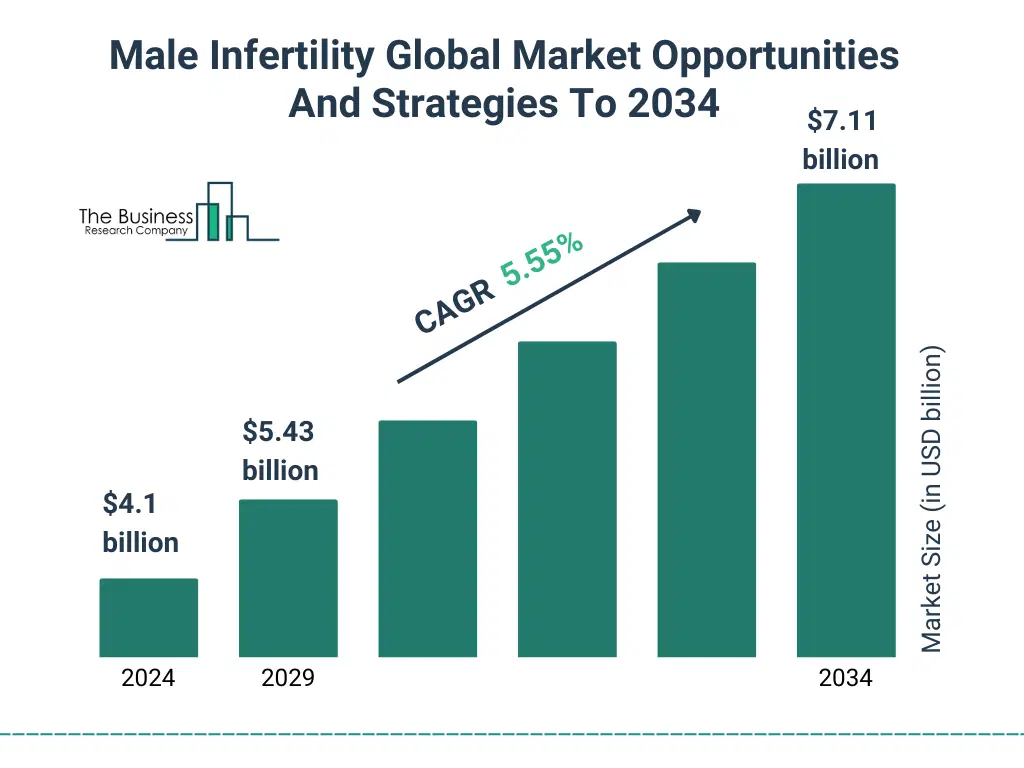
Male Infertility Global Market Opportunities And Strategies To 2034 Market Size and growth rate 2025 to 2029: Graph

Male Infertility Market Definition

Male infertility is a medical condition in which a man has a reduced ability or inability to cause pregnancy in a fertile female partner. It is commonly caused by issues such as low sperm count, poor sperm motility, abnormal sperm shape, hormonal imbalances, genetic defects, or blockages in the reproductive tract. The primary purpose of addressing male infertility is to identify and treat the underlying causes to improve the chances of natural conception or assist with reproduction through medical interventions. The male infertility market consists of sales, by entities (organizations, sole traders and partnerships), of male infertility that are used by individuals or couples seeking to conceive, its treatment is sought whenever conception challenges arise, which can be at any age but most commonly in men 30–50 years old.
Research Expert

Book your 30 minutes free consultation with our research experts

Male Infertility Market Size

The global male infertility market reached a value of nearly $4,103.03 million in 2024, having grown at a compound annual growth rate (CAGR) of 4.19% since 2019. The market is expected to grow from $4,103.03 million in 2024 to $5,427.76 million in 2029 at a rate of 5.76%. The market is then expected to grow at a CAGR of 5.55% from 2029 and reach $7,109.72 million in 2034. Growth in the historic period resulted from the impact of delayed parenthood, rise in medical tourism, rise in environmental and occupational hazards and rising investments in R&D and fertility biotech. Factors that negatively affected growth in the historic period were high cost of treatment and limited insurance coverage. Going forward, the growth in fertility clinics and reproductive health services, government initiatives, increasing stress levels and increasing incidence of lifestyle disorders will drive the growth. Factor that could hinder the growth of the male infertility market in the future include regulatory and ethical issues, social stigma and lack of awareness and impact of trade war and tariff.

Male Infertility Market Drivers

The key drivers of the male infertility market include: Growth In Fertility Clinics And Reproductive Health Services During forecast period, the growth in fertility clinics and reproductive health services are expected to propel the growth of the male infertility market. As awareness of male reproductive health issues increases, more individuals and couples are seeking specialized care, leading to a higher demand for diagnostic and treatment options. Fertility clinics are broadening their service offerings to include advanced male infertility solutions, such as semen analysis, hormonal testing, and sperm enhancement technologies. This growing infrastructure, combined with improved access to care and greater societal acceptance of male infertility as a medical condition, is expected to fuel market development and create new opportunities for healthcare providers and diagnostic companies. Therefore, the growth in fertility clinics and reproductive health services will drive the growth of the male infertility market. The growth in fertility clinics and reproductive health services growth contribution during the forecast period in 2024 is 1.50%.

Male Infertility Market Restraints

The key restraints on the male infertility market include: Social Stigma And Lack of Awareness During forecast period, social stigma and lack of awareness is expected to hinder the growth of the male infertility market. Many men feel embarrassment or shame when addressing fertility issues, which often leads to delays in seeking medical evaluation or treatment. Additionally, limited public education and discussion around male infertility contribute to underdiagnosis and underutilization of available services and technologies. This cultural barrier not only reduces patient engagement but also affects market penetration for companies offering male-focused fertility solutions. Addressing these challenges through awareness campaigns and education is crucial for unlocking the market’s full growth potential. Therefore, social stigma and lack of awareness may hinder the growth of the male infertility market. Growth affected by social stigma and lack of awareness during the forecast period in 2024 is -2.11%.

Need data on a specific region in this market?

Opportunities And Recommendations In The Male Infertility Market

Opportunities – The top opportunities in the male infertility markets segmented by treatment type will arise in the assisted reproductive technology segment, which will gain $695.16 million of global annual sales by 2029. The top opportunities in the male infertility markets segmented by test type will arise in the deoxyribonucleic acid fragmentation technique segment, which will gain $409.37 million of global annual sales by 2029. The top opportunities in the male infertility markets segmented by end-user will arise in the fertility centers segment, which will gain $643.79 million of global annual sales by 2029. The male infertility market size will gain the most in the USA at $300.86 million. Recommendations- To take advantage of the opportunities, The Business Research Company recommends the male infertility companies to focus on strategic investment to advance diagnostic and therapeutic innovation, focus on at-home fertility testing to expand access and drive differentiation, focus on assisted reproductive technology to capture high-growth market share, focus on oxidative stress analysis to maximize growth potential, expand in emerging markets, continue to focus on developed markets, provide competitively priced offerings, continue to use B2B promotions, focus on strategic partnerships to broaden access and support early male fertility evaluation and focus on fertility centers to accelerate market penetration.
Chat with us