
Malt Diastase Market Report 2026
Global Outlook – By Enzyme Type (Beta-Amylase, Glucoamylase, Protease, Xylanase, Other Types), By Product Type (Powder, Liquid, Granules), By Application (Pharmaceuticals, Food And Beverage, Animal Feed, Other Applications), By Distribution Channel (Online Stores, Supermarkets Or Hypermarkets, Specialty Stores, Other Distribution Channels), By End-User (Large Scale Industries, Small And Medium Enterprises, Individual Consumers, Other End-Users) – Market Size, Trends, Strategies, and Forecast to 2030
Malt Diastase Market Overview
• Malt Diastase market size has reached to $1.46 billion in 2025 • Expected to grow to $2.06 billion in 2030 at a compound annual growth rate (CAGR) of 7.1% • Growth Driver: The Rising Prevalence Of Digestive Disorders Driving The Growth Of The Malt Diastase Market Due To High Digestive Health Issues • Market Trend: Innovative Malt Boosts Enzyme Activity And Brewing Efficiency For High-Alcohol Yields • North America was the largest region in 2025.What Is Covered Under Malt Diastase Market?
Malt diastase refers to an enzyme obtained from malted barley or other grains that catalyzes the breakdown of starch into maltose and other simple sugars. It is commonly used in digestive supplements to support the digestion of carbohydrates. The main types of malt diastase are beta-amylase, glucoamylase, protease, xylanase, and others. Beta-amylase is an enzyme that breaks down starch into maltose by cleaving the second alpha-1,4-glycosidic bond from the non-reducing end of the starch molecule. Malt diastase products are offered in powder, liquid, and granule forms. These products are used across multiple applications, such as pharmaceuticals, food and beverages, animal feed, and others, and distributed through online stores, supermarkets or hypermarkets, specialty stores, and other retail outlets. The end users of malt diastase range from large-scale industries and small to medium enterprises to individual consumers and others.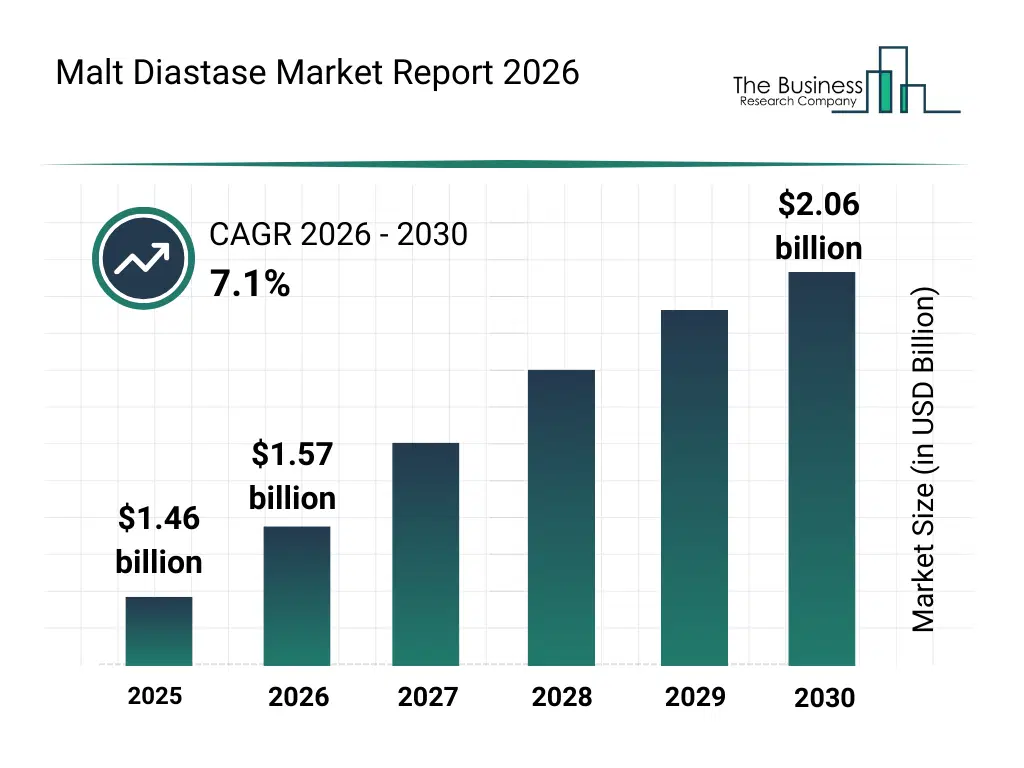
What Is The Malt Diastase Market Size and Share 2026?
The malt diastase market size has grown strongly in recent years. It will grow from $1.46 billion in 2025 to $1.57 billion in 2026 at a compound annual growth rate (CAGR) of 7.4%. The growth in the historic period can be attributed to increasing prevalence of digestive disorders, expansion of dietary supplement consumption, growth in enzyme applications in food processing, rising use of enzymes in animal nutrition, availability of malt-derived enzymes.What Is The Malt Diastase Market Growth Forecast?
The malt diastase market size is expected to see strong growth in the next few years. It will grow to $2.06 billion in 2030 at a compound annual growth rate (CAGR) of 7.1%. The growth in the forecast period can be attributed to increasing demand for plant-based and microbial enzymes, rising innovation in enzyme formulation technologies, expansion of functional food markets, growing animal feed efficiency requirements, increasing regulatory approvals for enzyme supplements. Major trends in the forecast period include increasing use of digestive enzyme supplements, rising demand for enzyme-based food processing aids, growing adoption in animal feed applications, expansion of powder and liquid enzyme formats, enhanced focus on enzyme stability and potency.
Global Malt Diastase Market Segmentation
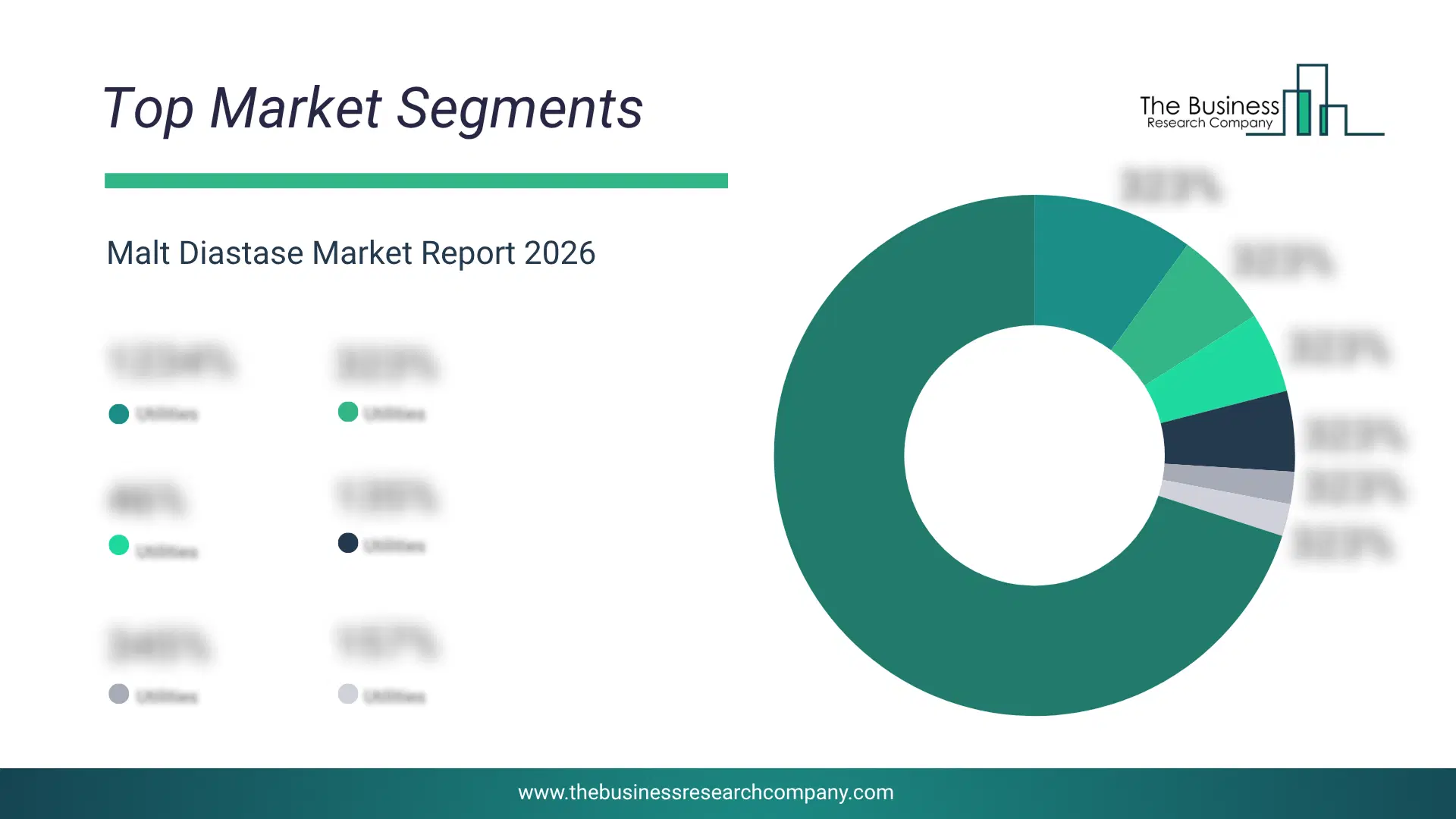
1) By Enzyme Type: Beta-Amylase, Glucoamylase, Protease, Xylanase, Other Types 2) By Product Type: Powder, Liquid, Granules 3) By Application: Pharmaceuticals, Food And Beverage, Animal Feed, Other Applications 4) By Distribution Channel: Online Stores, Supermarkets Or Hypermarkets, Specialty Stores, Other Distribution Channels 5) By End-User: Large Scale Industries, Small And Medium Enterprises, Individual Consumers, Other End-Users Subsegments: 1) By Alpha-Amylase: Microbial Alpha-Amylase, Fungal Alpha-Amylase, Bacterial Alpha-Amylase 2) By Beta-Amylase: Plant Beta-Amylase, Microbial Beta-Amylase 3) By Glucoamylase: Fungal Glucoamylase, Yeast Glucoamylase, Bacterial Glucoamylase 4) By Protease: Alkaline Protease, Neutral Protease, Acid Protease 5) By Xylanase: Bacterial Xylanase, Fungal Xylanase 6) By Other Types: Glutaminase, Lipase, CellulaseWhat Is The Driver Of The Malt Diastase Market?
The rising prevalence of digestive disorders is expected to propel the growth of the malt diastase market going forward. Digestive disorders refer to a group of conditions that affect the gastrointestinal (GI) tract, including the esophagus, stomach, intestines, liver, pancreas, and gallbladder, causing symptoms such as abdominal pain, bloating, constipation, diarrhea, heartburn, or nausea. The rising prevalence of digestive disorders is primarily due to unhealthy dietary habits, such as high consumption of processed foods, low fiber intake, excessive sugar and fat, and irregular eating patterns, which disrupt gut health and impair digestion. Malt diastase helps digestive disorders by breaking down complex carbohydrates into simpler sugars, thereby improving nutrient absorption and relieving symptoms such as bloating and indigestion. For instance, in December 2023, according to the IBD Registry, a UK-based non-profit organization, the number of people with inflammatory bowel disease (IBD) joining the IBD Registry surpassed 5,300, marking an increase of over 3,000 compared to 2022. Therefore, the rising prevalence of digestive disorders is driving the growth of the malt diastase industry.Key Players In The Global Malt Diastase Market
Major companies operating in the malt diastase market are Malt Products Corporation, DuPont de Nemours Inc., Avantor Inc., Novonesis Inc., Lallemand Inc., Briess Malt And Ingredients Co., Advanced Enzyme Technologies Ltd., AB Enzymes GmbH, Novozymes A/S, Amano Enzyme Inc., Spectrum Chemical Manufacturing Corp., Muntons plc, Philip Harris Limited, Weyermann Malting Company, Nutraceuticals International Group Inc., SUNSON Industry Group Co. Ltd., Halcyon Proteins Pty Ltd., Infinitabiotech Inc., Sunson Industry Group Co. Ltd., Velnex Medicare Pvt. Ltd.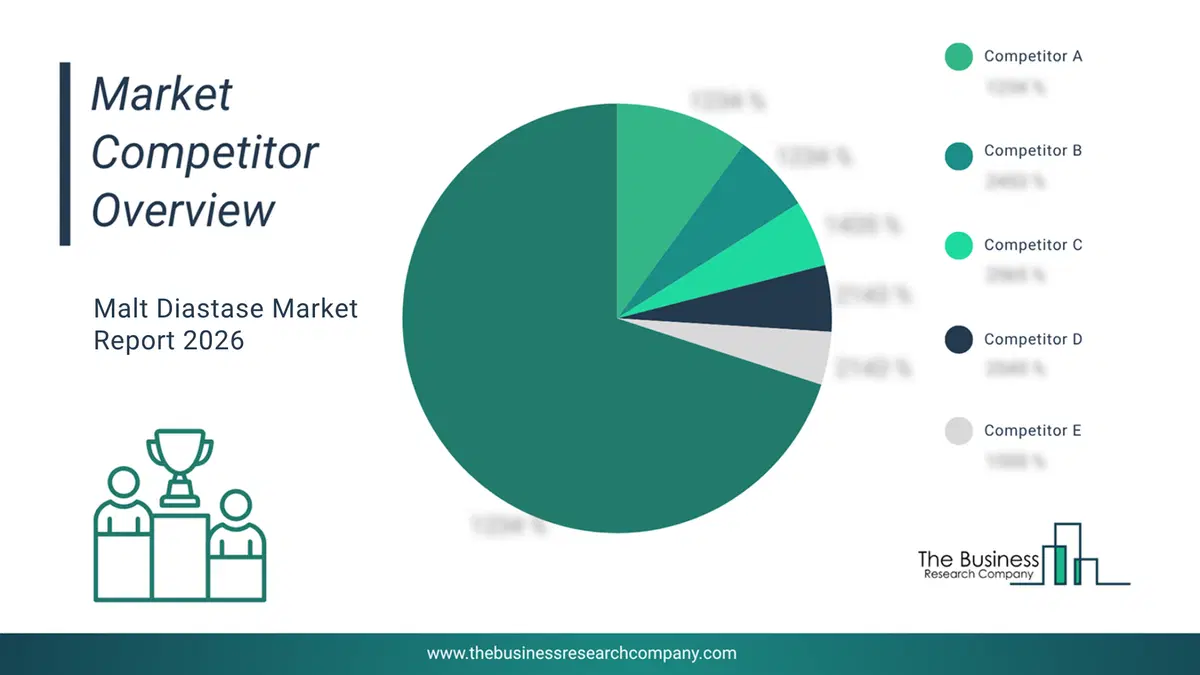
This chart is for illustrative purposes; the full report includes a detailed competitor analysis and comprehensive overview of the top 10 companies in the market.
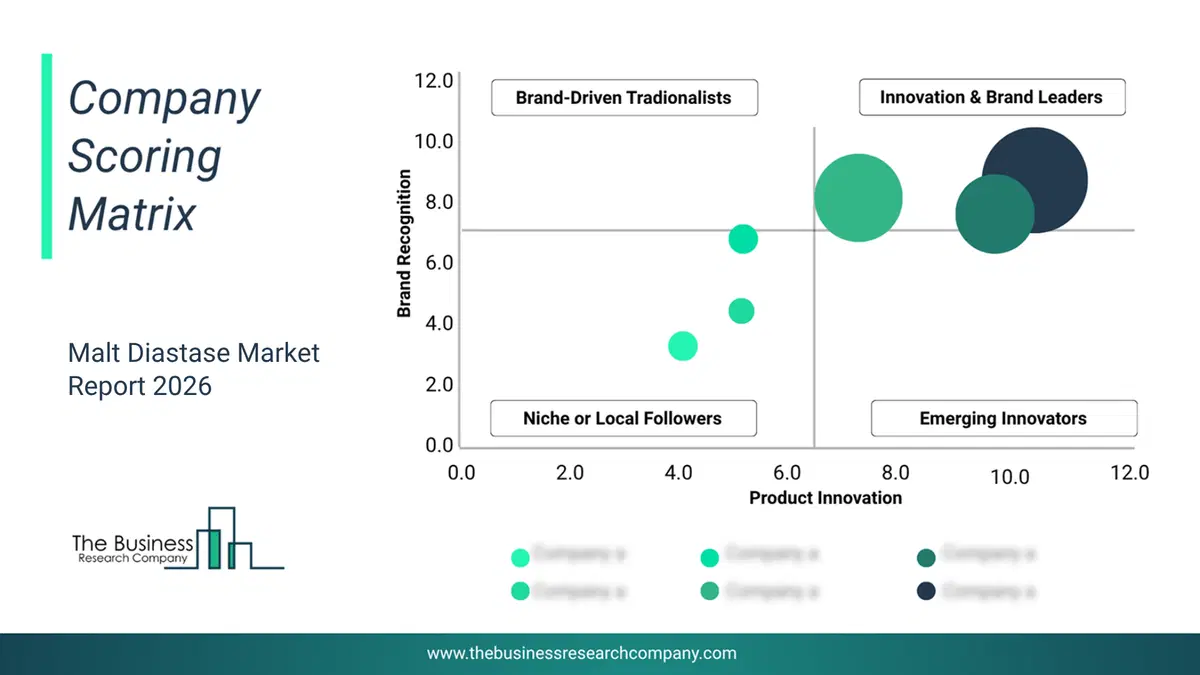
This chart maps companies by product innovation and brand strength, with bubble size indicating relative revenue, helping identify market leaders, challengers, and niche players. This is an illustrative chart; the full report provides a complete and accurate competitive analysis.
Global Malt Diastase Market Trends and Insights
Major companies operating in the malt diastase market are focusing on developing innovative products, such as MMC pot still malt, to enhance enzyme activity and improve brewing efficiency. MMC Pot Still Malt refers to a type of malt used in distillation, specifically crafted for its enhanced enzymatic activity, which helps in optimizing the conversion of starches to sugars during the brewing or distillation process. For instance, in August 2024, Malteurop Groupe S.A., a France-based beverage company, introduced MMC Pot Still Malt for all-malt or high-malt distillation processes. This malt is produced from specially selected barley varieties known for their high alcohol yield, offering approximately 1,000 liters of whisky at 40° per ton. It is designed for the production of 100% pure malt whisky. The malt retains protein content and enzymatic activity, providing abundant fermentable sugars, which ensures consistently high spirit yield (>400 L/t/h).What Are Latest Mergers And Acquisitions In The Malt Diastase Market?
In January 2024, Novozymes A/S, a Denmark-based biotechnology firm, merged with Chr. Hansen Holding A/S to form a new company called Novonesis, with the goal of accelerating the transition to a climate-friendly bioeconomy. This merger aims to harness the combined expertise of both companies in biotechnology and bioscience, driving innovation and growth in sustainable solutions. The focus is on enhancing product offerings and accelerating advancements across key industries such as agriculture, food, and healthcare. Chr. Hansen Holding A/S is a Denmark-based bioscience company specializing in natural ingredients and microbial solutions.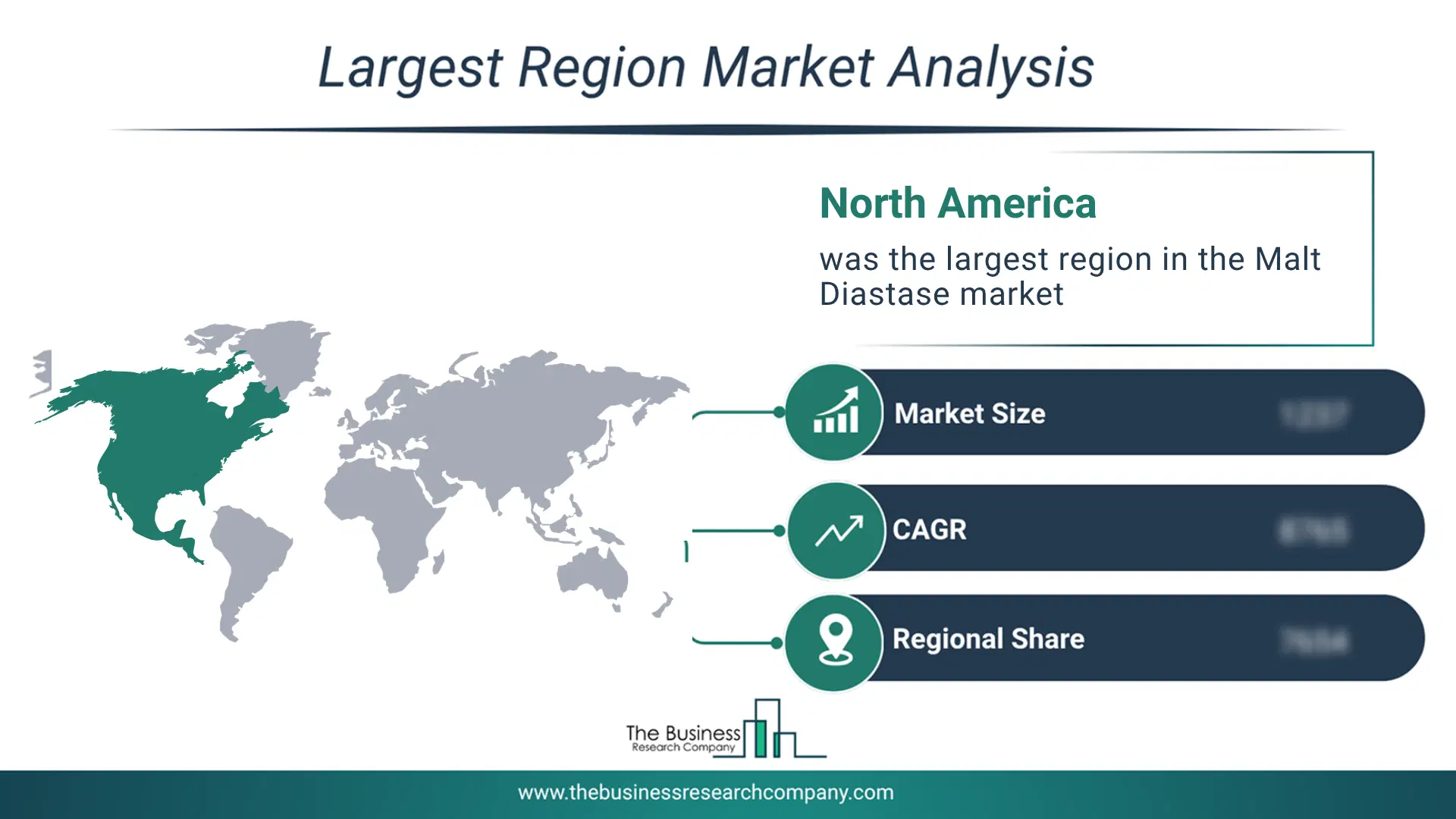
Regional Outlook
North America was the largest region in the malt diastase market in 2025. The regions covered in this market report are Asia-Pacific, South East Asia, Western Europe, Eastern Europe, North America, South America, Middle East and Africa. The countries covered in this market report are Australia, Brazil, China, France, Germany, India, Indonesia, Japan, Taiwan, Russia, South Korea, UK, USA, Italy, Spain, CanadaWhat Defines the Malt Diastase Market?
The malt diastase market consists of sales of products including digestive enzyme supplements, baking enzyme blends, brewing aids, and animal feed additives. Values in this market are ‘factory gate’ values, that is, the value of goods sold by the manufacturers or creators of the goods, whether to other entities (including downstream manufacturers, wholesalers, distributors, and retailers) or directly to end customers. The value of goods in this market includes related services sold by the creators of the goods.How is Market Value Defined and Measured?
The market value is defined as the revenues that enterprises gain from the sale of goods and/or services within the specified market and geography through sales, grants, or donations in terms of the currency (in USD unless otherwise specified). The revenues for a specified geography are consumption values that are revenues generated by organizations in the specified geography within the market, irrespective of where they are produced. It does not include revenues from resales along the supply chain, either further along the supply chain or as part of other products.
This chart presents market attractiveness based on a quantitative evaluation of growth, competition, strategic alignment, and risk, offering a clear view of opportunity areas for decision-making. This chart is for illustrative purposes; the full report contains the complete analysis.

This chart highlights the Total Addressable Market (TAM) by estimating the maximum revenue opportunity using an assumption-driven approach, supporting strategic planning and opportunity sizing across markets. The chart is illustrative; the full report provides a more comprehensive analysis.
What Key Data and Analysis Are Included in the Malt Diastase Market Report 2026?
The malt diastase market research report is one of a series of new reports from The Business Research Company that provides market statistics, including industry global market size, regional shares, competitors with the market share, detailed market segments, market trends and opportunities, and any further data you may need to thrive in the malt diastase industry. The market research report delivers a complete perspective of everything you need, with an in-depth analysis of the current and future state of the industry.Malt Diastase Market Report Forecast Analysis
| Report Attribute | Details |
|---|---|
| Market Size Value In 2026 | $1.57 billion |
| Revenue Forecast In 2030 | $2.06 billion |
| Growth Rate | CAGR of 7.4% from 2026 to 2030 |
| Base Year For Estimation | 2025 |
| Actual Estimates/Historical Data | 2020-2025 |
| Forecast Period | 2026 - 2030 |
| Market Representation | Revenue in USD Billion and CAGR from 2026 to 2030 |
| Segments Covered | Enzyme Type, Product Type, Application, Distribution Channel, End-User |
| Regional Scope | Asia-Pacific, Western Europe, Eastern Europe, North America, South America, Middle East, Africa |
| Country Scope | The countries covered in the report are Australia, Brazil, China, France, Germany, India, Indonesia, Japan, Taiwan, Russia, South Korea, UK, USA, Canada, Italy, Spain. |
| Key Companies Profiled | Malt Products Corporation, DuPont de Nemours Inc., Avantor Inc., Novonesis Inc., Lallemand Inc., Briess Malt And Ingredients Co., Advanced Enzyme Technologies Ltd., AB Enzymes GmbH, Novozymes A/S, Amano Enzyme Inc., Spectrum Chemical Manufacturing Corp., Muntons plc, Philip Harris Limited, Weyermann Malting Company, Nutraceuticals International Group Inc., SUNSON Industry Group Co. Ltd., Halcyon Proteins Pty Ltd., Infinitabiotech Inc., Sunson Industry Group Co. Ltd., Velnex Medicare Pvt. Ltd. |
| Customization Scope | Request for Customization |
| Pricing And Purchase Options | Explore Purchase Options |