
Malt Ingredients Market Report 2026
Global Outlook – By Type (Dry Malt, Liquid Malt, Malt Flour, Other Types), By Raw Material (Barley, Wheat, Rye), By Application (Brewing (Beer & Craft Beer), Distilling (Whisky & Spirits), Non-Alcoholic Malt Beverages) – Market Size, Trends, Strategies, and Forecast to 2030
Malt Ingredients Market Overview
• Malt Ingredients market size has reached to $24.15 billion in 2025 • Expected to grow to $32.06 billion in 2030 at a compound annual growth rate (CAGR) of 5.9% • Growth Driver: The Surging Demand For Beer Propels Growth In The Malt Ingredients Market • Market Trend: Advanced Crop Breeding Enables Nutrient-Rich And High-Performance Ingredients • Western Europe was the largest region in 2025.What Is Covered Under Malt Ingredients Market?
The malt ingredients refer to the products made of malt, which is a grain, usually barley, that has been dried after being soaked in water until it begins to sprout. Malt ingredients can be solid or liquid in form. Malt ingredients are primarily used to create alcoholic beverages like beer and whisky. The main types of malt ingredients are dry malt, liquid malt, malt flour, and others. Dry malt refers to a moisture-free wort, which is an aqueous extract from grain that is meant to be fermented into beer by yeast. The raw materials used in the production of malt ingredients include barley, wheat, rye, maize, rice, and oats. They are used in brewing, distilling, cereals, bakery, beverages (non-alcoholic), and confectionery applications.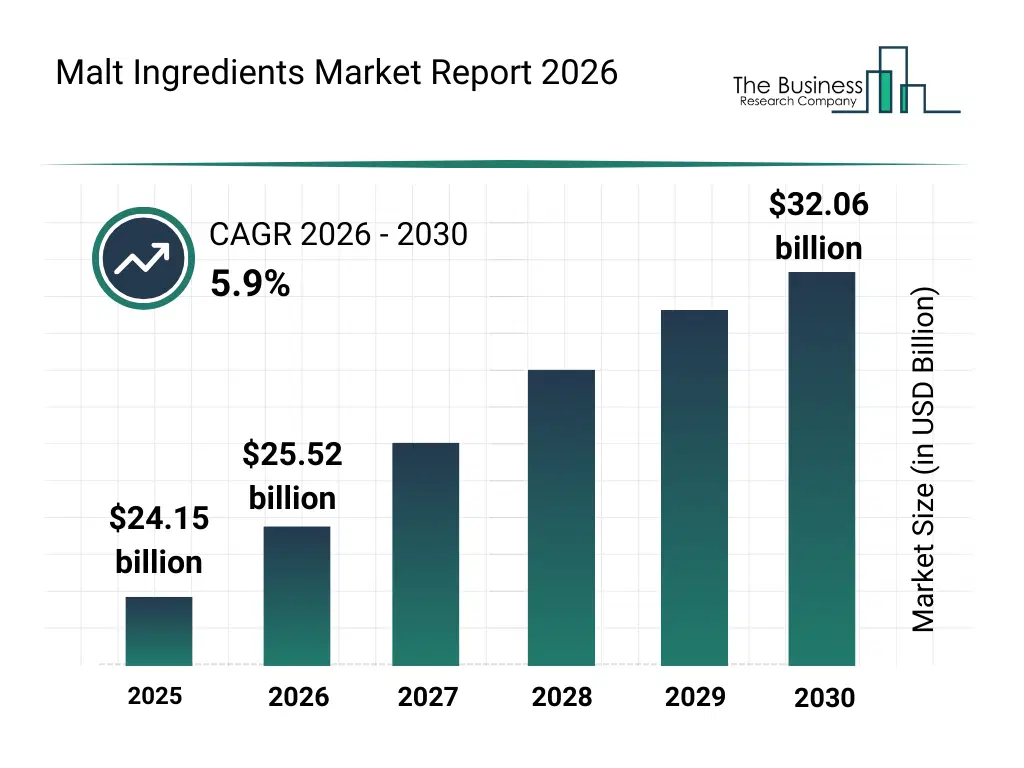
What Is The Malt Ingredients Market Size and Share 2026?
The malt ingredients market size has grown strongly in recent years. It will grow from $24.15 billion in 2025 to $25.52 billion in 2026 at a compound annual growth rate (CAGR) of 5.6%. The growth in the historic period can be attributed to expansion of global beer production, growth of distilling industries, rising consumption of malt-based foods, availability of diverse grain raw materials, improvements in malting technologies.What Is The Malt Ingredients Market Growth Forecast?
The malt ingredients market size is expected to see strong growth in the next few years. It will grow to $32.06 billion in 2030 at a compound annual growth rate (CAGR) of 5.9%. The growth in the forecast period can be attributed to increasing demand for craft and premium alcoholic beverages, rising use of malt in functional foods, expansion of non-alcoholic malt drinks, growing investments in sustainable malting practices, increasing innovation in specialty malt varieties. Major trends in the forecast period include increasing demand for specialty and craft malts, rising use of malt ingredients in non-alcoholic beverages, expansion of microbrewery applications, growing focus on flavor customization, enhanced investment in malt processing efficiency.
Global Malt Ingredients Market Segmentation
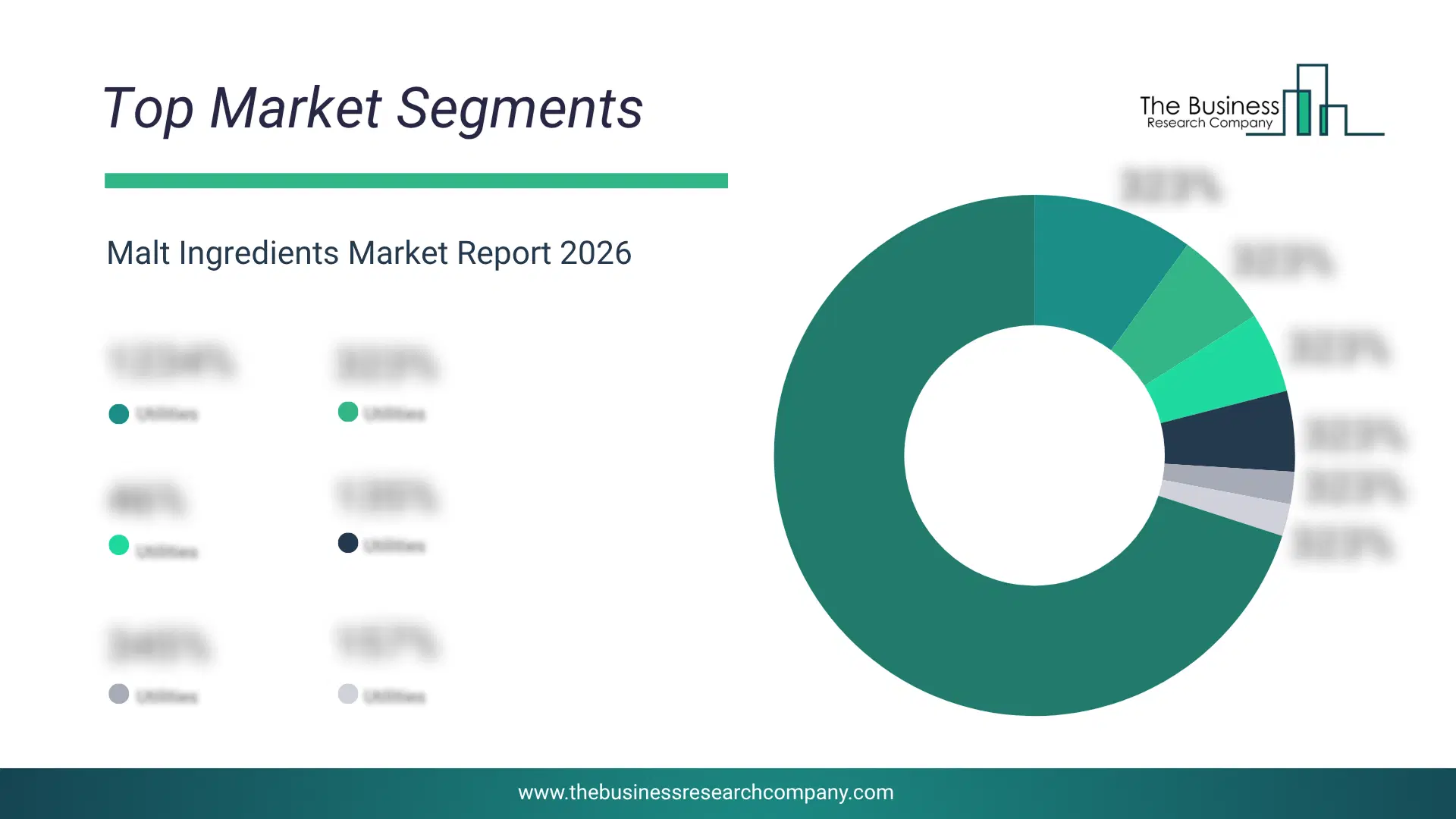
1) By Type: Dry Malt, Liquid Malt, Malt Flour, Other Types 2) By Raw Material: Barley, Wheat, Rye 3) By Application: Brewing (Beer & Craft Beer), Distilling (Whisky & Spirits), Non-Alcoholic Malt Beverages Subsegments: 1) By Dry Malt: Malted Barley, Malted Wheat 2) By Liquid Malt: Liquid Malt Extract (LME), Malt Syrup 3) By Malt Flour: Diastatic Malt Flour, Non-Diastatic Malt Flour 4) By Other Types: Malt Extracts, Specialty MaltsWhat Is The Driver Of The Malt Ingredients Market?
The increasing demand for beer is driving the malt ingredients market. Beer is a carbonated, fermented alcoholic drink with less than 5% alcohol concentration that is frequently brewed from malted cereal grains (mainly barley) and flavored with hops. Increased disposable income and consumer preferences are leading to an increase in beer consumption across the globe. Malt ingredients give color, flavor, and foam to the beer, provide the sugars for fermentation, and contribute to the health aspect of the beer. For instance, in April 2024, according to BeverageDaily.com, a UK-based online website, in 2023, small and independent brewers collectively produced 23.4 million barrels of beer. Craft beer's share of the total market increased to 13.3%, up from 13.1% in 2022 (by volume). Therefore, increasing demand for beer is expected to boost demand for malt ingredients during the forecast period.Key Players In The Global Malt Ingredients Market
Major companies operating in the malt ingredients market are Deltamalt, Cargill Malt, GrainCorp Limited, Duerr Malzfabrik GmbH & Co KG, Dobele Malz GmbH & Co KG, Honeywell Specialty Grains LLC, IREKS GmbH, Grupo Huerga y CIA S.L., Haas Malz GmbH & Co KG, Gerkens Malt BV, Muntons PLC, Gambrinus Malterie NV, Malteurop Group S.A., Barmalt S.A., Briess Malt & Ingredients Company, Imperial Malt Ltd., Dingemans BV, Crisp Malt Limited, Frey Malz GmbH & Co KG, Farmos Oyj, Eiselt Malz GmbH & Co KG, Ernest Grain Ltd., Minnaar International BV, Neville Maltings Ltd., Permalz GmbH & Co KG, Provital Malt France, Rehorst GmbH & Co KG, Soufflet Malt Europe SAS, Viking Malt Inc., Weyermann Malz GmbH & Co KG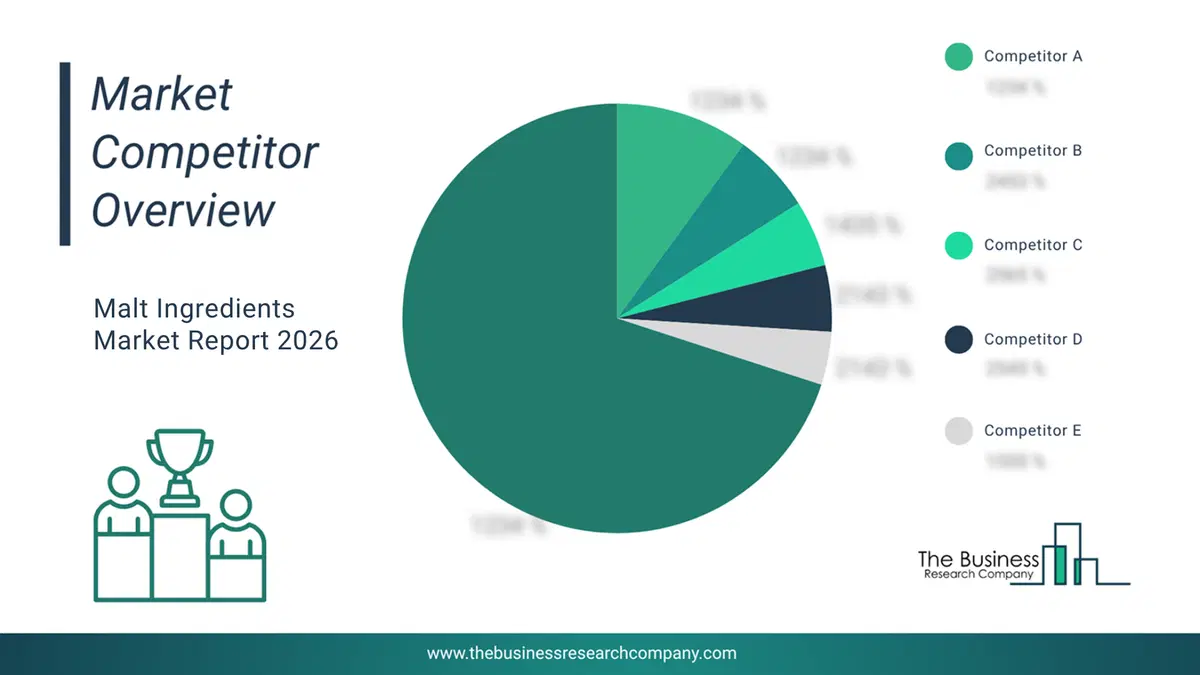
This chart is for illustrative purposes; the full report includes a detailed competitor analysis and comprehensive overview of the top 10 companies in the market.
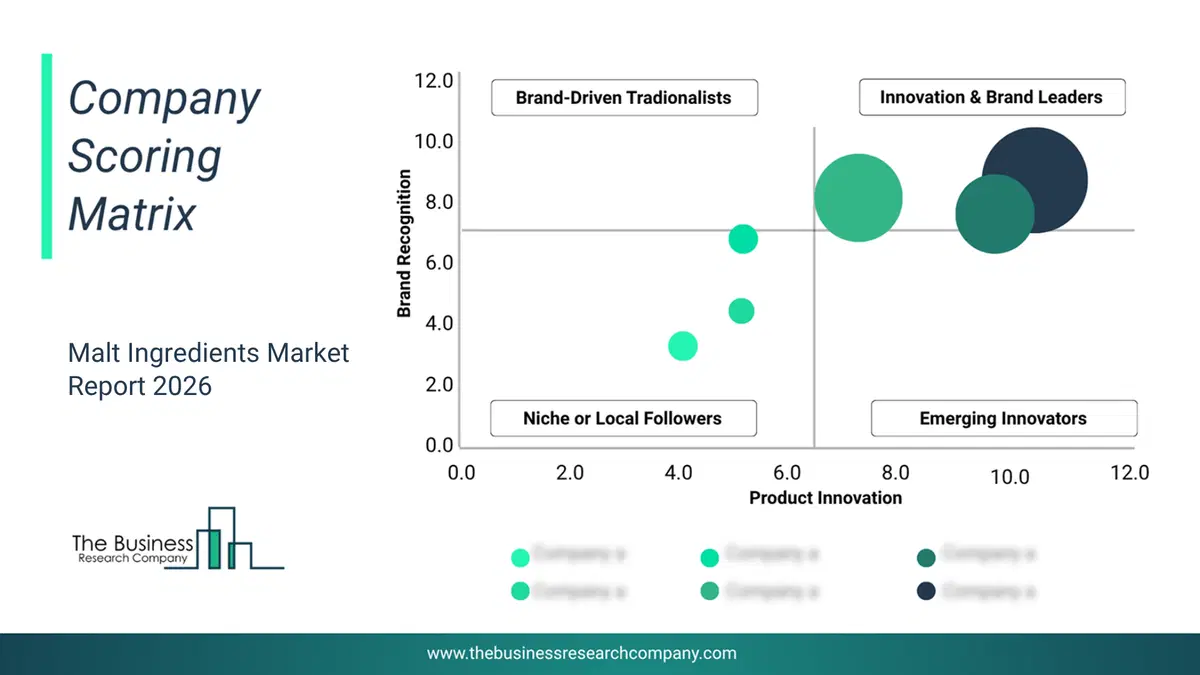
This chart maps companies by product innovation and brand strength, with bubble size indicating relative revenue, helping identify market leaders, challengers, and niche players. This is an illustrative chart; the full report provides a complete and accurate competitive analysis.
Global Malt Ingredients Market Trends and Insights
Major companies operating in the malt ingredients market are focusing on diversification through specialty malts made from non-traditional grains, such as hybrid cereals, to reduce reliance on conventional barley, improve climate resilience in raw material sourcing, and offer innovative taste and functional benefits to beverage and food manufacturers. Hybrid cereals are crops developed by cross-breeding two different cereal species to combine desirable traits such as higher yield, nutritional value, and climate resilience. In the malt ingredients industry, hybrid cereals help by improving raw-material sustainability, enhancing enzymatic performance, and enabling the development of malts with unique flavor and functional properties beyond traditional barley-based malts. For instance, in 2023, Boortmalt, a Belgium-based malting company, launched the Atlantis Malt Series, a new line of malts based entirely on Tritordeum, a naturally bred, non-GMO hybrid of durum wheat and wild barley. Tritordeum-based malt offers high enzymatic power and high extract yield, low beta-glucan content, and a record-high lutein level (≈ 10× that of wheat), resulting in a unique nutty, biscuity, and honey-like flavor and an amber-to-golden hue. These traits make it a versatile ingredient not only for brewing but also for distilling and other food applications, appealing to producers and consumers seeking functional, distinctive, and sustainable malt solutions.What Are Latest Mergers And Acquisitions In The Malt Ingredients Market?
In May 2025, LD Carlson Company, a US-based company, partnered with the Malting Company of Ireland (MCI) for an undisclosed amount. Through this collaboration, LD Carlson aims to expand the availability of MCI’s traditional Irish malts in the U.S. craft brewing market, giving brewers access to authentic, sustainably sourced Irish malt varieties. The Malting Company of Ireland (MCI) is an Ireland-based company producing high-quality brewing and distilling malts sourced from over 600 cooperative growers across Ireland.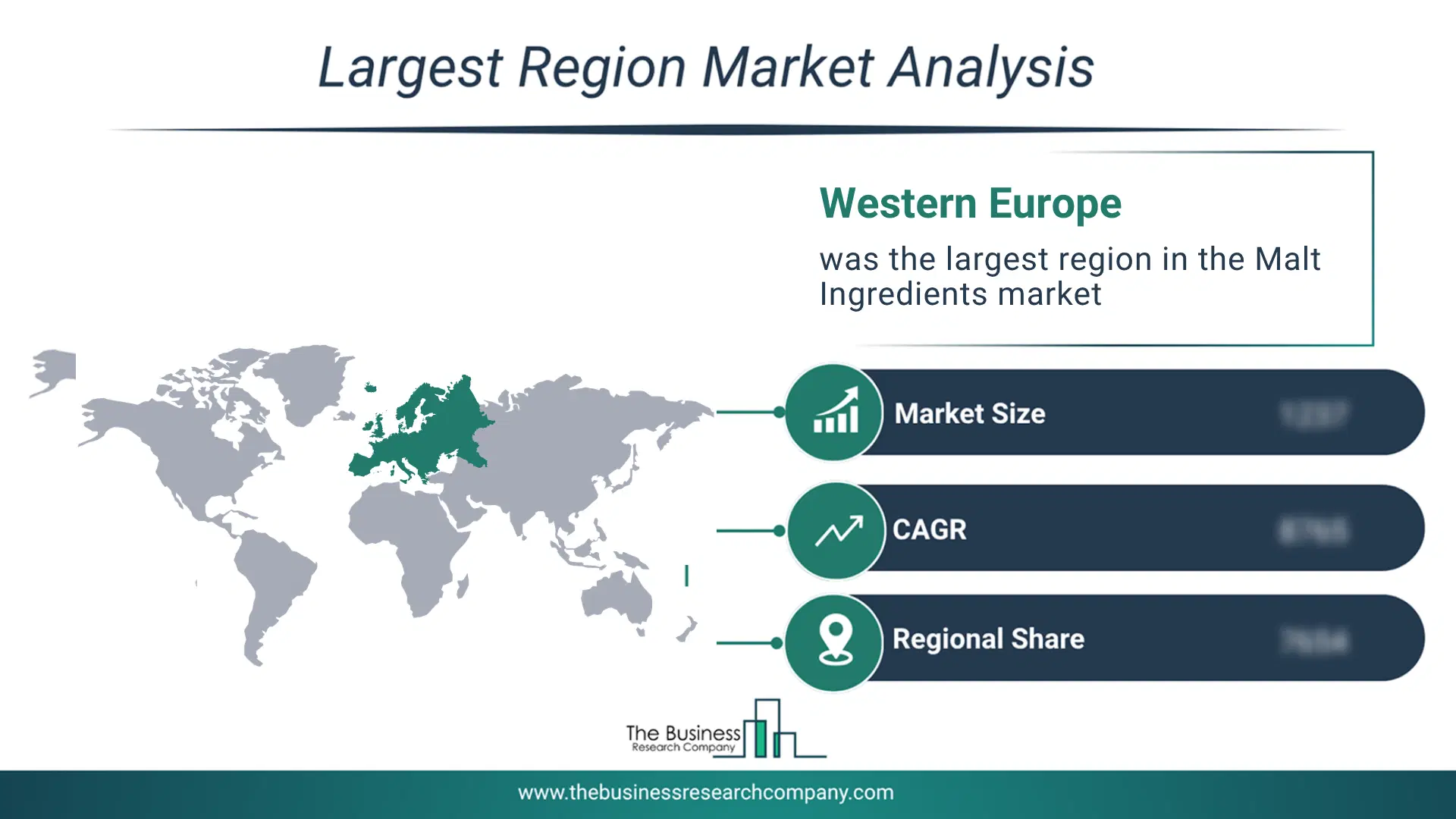
Regional Outlook
Western Europe was the largest region in the malt ingredients market share in 2025. The regions covered in this market report are Asia-Pacific, South East Asia, Western Europe, Eastern Europe, North America, South America, Middle East and Africa. The countries covered in this market report are Australia, Brazil, China, France, Germany, India, Indonesia, Japan, Taiwan, Russia, South Korea, UK, USA, Italy, Spain, CanadaWhat Defines the Malt Ingredients Market?
The malt ingredients market consists of sales of cereals, baked foods, biscuits, bagels, bread rolls, waffles, pancakes. Values in this market are ‘factory gate’ values, that is the value of goods sold by the manufacturers or creators of the goods, whether to other entities (including downstream manufacturers, wholesalers, distributors and retailers) or directly to end customers. The value of goods in this market includes related services sold by the creators of the goods.How is Market Value Defined and Measured?
The market value is defined as the revenues that enterprises gain from the sale of goods and/or services within the specified market and geography through sales, grants, or donations in terms of the currency (in USD unless otherwise specified). The revenues for a specified geography are consumption values that are revenues generated by organizations in the specified geography within the market, irrespective of where they are produced. It does not include revenues from resales along the supply chain, either further along the supply chain or as part of other products.
This chart presents market attractiveness based on a quantitative evaluation of growth, competition, strategic alignment, and risk, offering a clear view of opportunity areas for decision-making. This chart is for illustrative purposes; the full report contains the complete analysis.

This chart highlights the Total Addressable Market (TAM) by estimating the maximum revenue opportunity using an assumption-driven approach, supporting strategic planning and opportunity sizing across markets. The chart is illustrative; the full report provides a more comprehensive analysis.
What Key Data and Analysis Are Included in the Malt Ingredients Market Report 2026?
The malt ingredients market research report is one of a series of new reports from The Business Research Company that provides market statistics, including industry global market size, regional shares, competitors with the market share, detailed market segments, market trends and opportunities, and any further data you may need to thrive in the malt ingredients industry. The market research report delivers a complete perspective of everything you need, with an in-depth analysis of the current and future state of the industry.Malt Ingredients Market Report Forecast Analysis
| Report Attribute | Details |
|---|---|
| Market Size Value In 2026 | $25.52 billion |
| Revenue Forecast In 2030 | $32.06 billion |
| Growth Rate | CAGR of 5.6% from 2026 to 2030 |
| Base Year For Estimation | 2025 |
| Actual Estimates/Historical Data | 2020-2025 |
| Forecast Period | 2026 - 2030 |
| Market Representation | Revenue in USD Billion and CAGR from 2026 to 2030 |
| Segments Covered | Type, Raw Material, Application |
| Regional Scope | Asia-Pacific, Western Europe, Eastern Europe, North America, South America, Middle East, Africa |
| Country Scope | The countries covered in the report are Australia, Brazil, China, France, Germany, India, Indonesia, Japan, Taiwan, Russia, South Korea, UK, USA, Canada, Italy, Spain. |
| Key Companies Profiled | Deltamalt, Cargill Malt, GrainCorp Limited, Duerr Malzfabrik GmbH & Co KG, Dobele Malz GmbH & Co KG, Honeywell Specialty Grains LLC, IREKS GmbH, Grupo Huerga y CIA S.L., Haas Malz GmbH & Co KG, Gerkens Malt BV, Muntons PLC, Gambrinus Malterie NV, Malteurop Group S.A., Barmalt S.A., Briess Malt & Ingredients Company, Imperial Malt Ltd., Dingemans BV, Crisp Malt Limited, Frey Malz GmbH & Co KG, Farmos Oyj, Eiselt Malz GmbH & Co KG, Ernest Grain Ltd., Minnaar International BV, Neville Maltings Ltd., Permalz GmbH & Co KG, Provital Malt France, Rehorst GmbH & Co KG, Soufflet Malt Europe SAS, Viking Malt Inc., Weyermann Malz GmbH & Co KG |
| Customization Scope | Request for Customization |
| Pricing And Purchase Options | Explore Purchase Options |