
Man Made Cellulosic Fibers Market 2025
By Type (Viscose, Modal, Lyocell, Acetate, Other Types), By Application (Apparel, Home Textiles, Industrial, Other Applications), By Production Process (Wet Spinning, Dry Spinning, Other Production Processes), By Sustainability Attributes (Biodegradable, Renewable, Recyclable), And By Region, Opportunities And Strategies – Global Forecast To 2035
Man-Made Cellulosic Fibers Market Definition
Man-made cellulosic fibers (MMCF) are a category of regenerated fibers produced from natural cellulose, typically sourced from wood pulp or cotton linters, which is chemically processed into a soluble compound and then spun into fibers. The primary purpose of MMCF is to provide sustainable, comfortable and high-performance alternatives to synthetic fibers and traditional cotton in textiles. The man-made cellulosic fibers market consists of sales, by entities (organizations, sole traders, or partnerships), of man-made cellulosic fibers that are used in apparel manufacturing, where they are incorporated into garments such as dresses, shirts, blouses, trousers, activewear and intimate clothing. They are also widely used in home textiles, including bedding, curtains, towels and upholstery, where their softness and dyeability enhance comfort and style.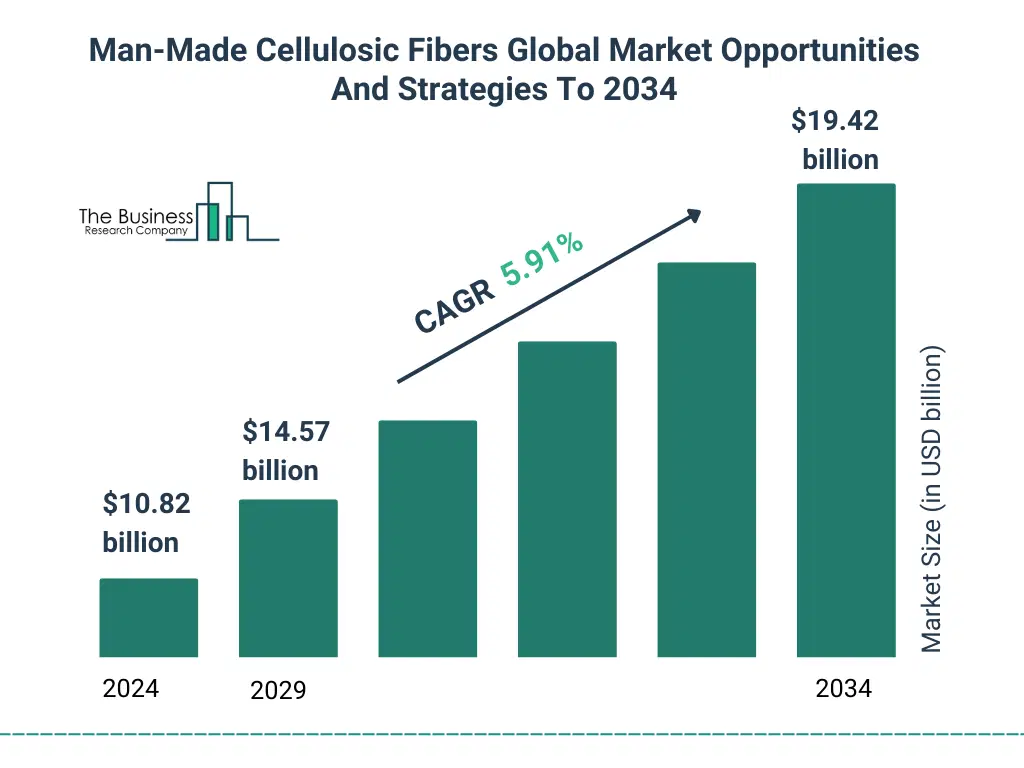
Man-Made Cellulosic Fibers Market Size
The global man-made cellulosic fibers market reached a value of nearly $10,823.22 million in 2024, having grown at a compound annual growth rate (CAGR) of 4.51% since 2019. The market is expected to grow from $10,823.22 million in 2024 to $14,574.80 million in 2029 at a rate of 6.13%. The market is then expected to grow at a CAGR of 5.91% from 2029 and reach $19,424.61 million in 2034. Growth in the historic period resulted from the growth in hygiene and nonwoven demand, growth of the textile and fashion industries, rising environmental concerns and investments in circular and recycling technologies. Factors that negatively affected growth in the historic period were stringent regulations and competition from synthetic fibers. Going forward, the growing corporate ESG commitment, rising demand for sustainable textiles, expansion into automotive and industrial applications and expansion of home and interior textiles will drive the growth. Factors that could hinder the growth of the man-made cellulosic fibers market in the future include high production costs, chemical pollution and trade war and tariffs.Man-Made Cellulosic Fibers Market Drivers
The key drivers of the man-made cellulosic fibers market include: Growing Corporate ESG Commitment Growing corporate ESG commitment is expected to propel the growth of the man-made cellulosic fibers market going forward. Growing corporate ESG (Environmental, Social and Governance) commitment drives companies to adopt sustainable practices, including using eco-friendly materials. Man-made cellulosic fibers, being renewable and biodegradable, align with these sustainability goals. As businesses aim to reduce environmental impact and meet consumer demand for greener products, the adoption of these fibers in textiles and nonwovens increases. The growing corporate ESG commitment contribution during the forecast period in 2024 is 1.27%.Man-Made Cellulosic Fibers Market Restraints
The key restraints on the man-made cellulosic fibers market include: High Production Costs High production costs are expected to restrain the growth of the man-made cellulosic fibers market during the forecast period by reducing manufacturers’ profit margins and limiting their ability to compete with low-cost alternatives such as polyester and cotton. The process of producing man-made cellulosic fibers, including viscose, modal and lyocell, involves high expenses related to raw materials, energy and chemicals. These rising input costs make large-scale production less economically viable, discouraging investments and capacity expansions. Growth affected by high production costs during the forecast period in 2024 is -2.11%.Man-Made Cellulosic Fibers Market Trends
Major trends shaping the man-made cellulosic fibers market include: Next-Generation Textile Dissolving Pulp Mill Launched To Boost Sustainable Fiber Production Major companies operating in the man-made cellulosic fibers market are focusing on developing textile dissolving pulp mills to ensure a stable supply of high-quality raw material, support sustainable fiber production and enhance the efficiency and scalability of man-made cellulosic fibers manufacturing. For instance, in April 2025, Yibin Grace, a prominent China-based company specializing in the production of man-made cellulosic fiber (MMCF) products, launched the first Next Generation (Next Gen) textile dissolving pulp mill in China. This new pilot facility, located in Sichuan, China, uses post-industrial and post-consumer textile waste to produce high-quality, low-carbon dissolving pulp for man-made cellulosic fiber (MMCF) products like viscose staple fiber and lyocell. The mill has an initial production capacity of 1,500 tons per year, with plans to expand to 60,000 tons by 2027, aligning with China’s national goal to reduce textile waste by 30% by 2030. Sustainable High-Performance Lyocell Fill Fibers For Next-Gen Home Textiles And Apparel Companies operating in the man-made cellulosic fibers market are expanding portfolio offerings to include more sustainable, high-performance and specialty fibers that meet the growing demand for eco-friendly textiles across apparel, home textiles and nonwoven applications. For instance, in January 2025, The Lenzing Group, an Austria-based company, specializes in producing high-quality man-made cellulosic fibers for textiles and nonwovens, expanded its LENZING Lyocell Fill portfolio within the TENCEL fiber family, introducing finer variants with multiple cut lengths for home textile and apparel filling applications. EU Ecolabel- and Climate Partner-certified, these fibers offer superior moisture management, thermal comfort and shape retention, blending seamlessly with polyester or down. Suitable for carding and blow-fill technologies, they enhance pillows, comforters and lightweight products.Opportunities And Recommendations In The Man-Made Cellulosic Fibers Market
Opportunities – The top opportunities in the man-made cellulosic fibers markets segmented by type will arise in the viscose segment, which will gain $1,769.36 million of global annual sales by 2029. The top opportunities in the man-made cellulosic fibers markets segmented by application will arise in the apparel segment, which will gain $2,654.40 million of global annual sales by 2029. The top opportunities in the man-made cellulosic fibers markets segmented by production process will arise in the wet spinning segment, which will gain $3,097.68 million of global annual sales by 2029. The top opportunities in the man-made cellulosic fibers markets segmented by sustainability attributes will arise in the renewable segment, which will gain $2,254.05 million of global annual sales by 2029. The man-made cellulosic fibers market size will gain the most in the USA at $710.26 million. Recommendations- To take advantage of the opportunities, The Business Research Company recommends the man-made cellulosic fibers companies to focus on expanding textile dissolving pulp production for sustainable growth, focus on expanding sustainable and high-performance fiber portfolios, focus on advancing circular production through trial initiatives, focus on expanding in the lyocell segment to capture high-growth opportunities, focus on expanding in the dry spinning segment to strengthen market position, focus on expanding in the biodegradable segment to capture high-growth opportunities, expand in emerging markets, continue to focus on developed markets, focus on strategic partnerships to accelerate circular and sustainable fiber production, focus on competitive value-based pricing to strengthen market position, focus on strengthening brand visibility through sustainability communication, focus on expanding digital and collaborative and marketing initiatives, focus on expanding in the industrial segment to capture high-growth opportunities.
Man-Made Cellulosic Fibers Market Segmentation
The man-made cellulosic fibers market is segmented by type, by application, by production process and by sustainability attributes.By Type –
The man-made cellulosic fibers market is segmented by type into:
- a) Viscose
- b) Modal
- c) Lyocell
- d) Acetate
- e) Other types
By Application –
The man-made cellulosic fibers market is segmented by application into:
- a) Apparel
- b) Home Textiles
- c) Industrial
- d) Other Applications
By Production Process –
The man-made cellulosic fibers market is segmented by production process into:
- a) Wet Spinning
- b) Dry Spinning
- c) Other Production Processes
By Sustainability Attributes –
The man-made cellulosic fibers market is segmented by sustainability attributes into:
- a) Biodegradable
- b) Renewable
- c) Recyclable
By Geography - The man-made cellulosic fibers market is segmented by geography into:
- • China
- • India
- • Japan
- • Australia
- • Indonesia
- • South Korea
- • USA
- • Canada
- • Brazil
- • France
- • Germany
- • UK
- • Italy
- • Spain
- • Russia
-
o Asia Pacific
o Africa