
Man-Portable Anti-Armor Weapons Market Report 2026
Global Outlook – By Type (Anti-Aircraft Missiles, Rocket Propelled Grenades, Anti-Tank Rifles, Recoilless Rifle ), By Technology (Guided Weapons, Unguided Weapons), By Application (Homeland Security, Defense) – Market Size, Trends, Strategies, and Forecast to 2030
Man-Portable Anti-Armor Weapons Market Overview
• Man-Portable Anti-Armor Weapons market size has reached to $6.24 billion in 2025 • Expected to grow to $8.13 billion in 2030 at a compound annual growth rate (CAGR) of 5.4% • Growth Driver: Rising Defense Budgets Fueling Growth In The Man-Portable Anti-Armor Weapons Market • Market Trend: DRDO Successfully Test-Fires Indigenously-Built Man-Portable Anti-Tank Guided Missile (MP-ATGM) • North America was the largest region in 2025 and Asia-Pacific is the fastest growing region.Market Gains By 2030 – Top Opportunities By Segment
Market Gain identifies the most promising market opportunities by highlighting the segments or products expected to generate the highest incremental revenue growth over the next five years.
What Is Covered Under Man-Portable Anti-Armor Weapons Market?
Man-portable anti-armor weapons refer to shoulder-fired military weapons such as missiles, rifles, and grenades. Troop can transfer these anti-armor weapons easily from one site to another in order to destroy enemy battle tanks, planes, and other armored vehicles. These weapons are highly capable of destroying both static and moving targets. The main types of man-portable anti-armor weapons are anti-aircraft missiles, rocket-propelled grenades, anti-tank rifles, and recoilless rifles. Anti-aircraft missiles (AAM) are short-range ballistic missile systems that are man-portable and designed to destroy aerial targets. The technologies involved are guided and unguided weapons, which are used for several applications, such as homeland security and defense.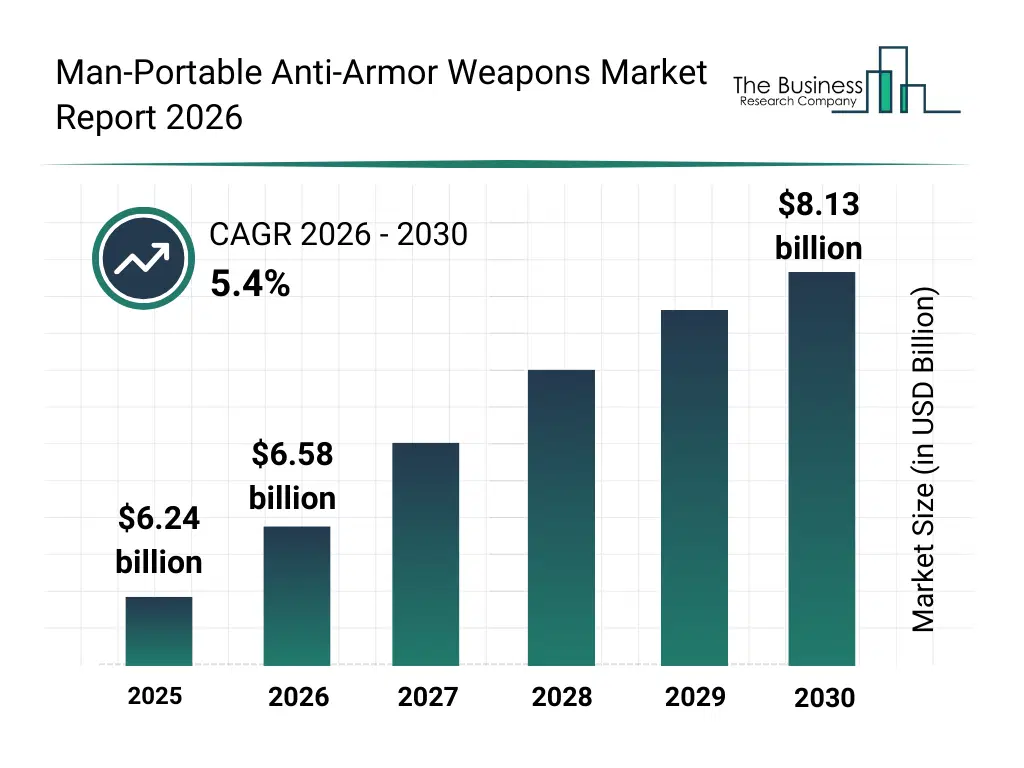
What Is The Man-Portable Anti-Armor Weapons Market Size and Share 2026?
The man-portable anti-armor weapons market size has grown strongly in recent years. It will grow from $6.24 billion in 2025 to $6.58 billion in 2026 at a compound annual growth rate (CAGR) of 5.5%. The growth in the historic period can be attributed to rising deployment of shoulder-launched anti-tank weapons in asymmetric and conventional warfare, increased procurement of lightweight and portable systems enhancing troop mobility, growth in modernization programs replacing aging anti-armor weapon inventories, advancements in guidance and propulsion technologies improving accuracy and range, expanding demand for multi-target capability to counter both stationary and moving armored threats.What Is The Man-Portable Anti-Armor Weapons Market Growth Forecast?
The man-portable anti-armor weapons market size is expected to see strong growth in the next few years. It will grow to $8.13 billion in 2030 at a compound annual growth rate (CAGR) of 5.4%. The growth in the forecast period can be attributed to growing investment in next-generation anti-armor systems with advanced seeker and targeting technologies, increasing development of modular and reusable launch platforms for enhanced operational flexibility, expansion of infantry modernization initiatives driving procurement of portable high-performance weapons, rising integration of network-enabled targeting for improved battlefield coordination, development of lighter and higher-penetration warheads to counter evolving armored vehicle defenses. Major trends in the forecast period include enhanced anti-armor warhead technology, lightweight and portable weapon designs, improved target acquisition systems, extended operational range and accuracy, advanced training and simulation for troops.
Global Man-Portable Anti-Armor Weapons Market Segmentation
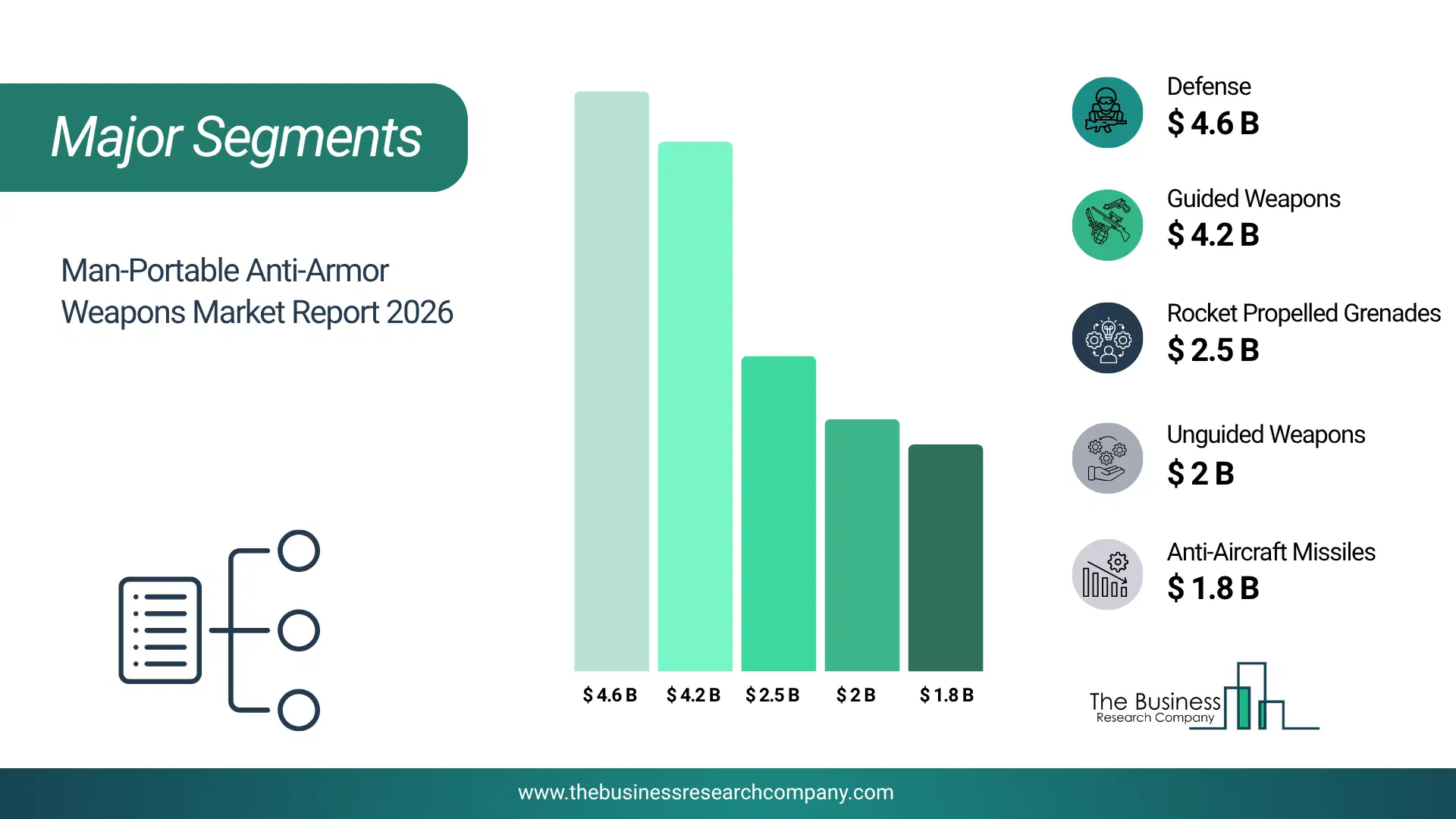
1) By Type: Anti-Aircraft Missiles, Rocket Propelled Grenades, Anti-Tank Rifles, Recoilless Rifle 2) By Technology: Guided Weapons, Unguided Weapons 3) By Application: Homeland Security, Defense Subsegments: 1) By Anti-Aircraft Missiles: Short-Range Air Defense Missiles, Man-Portable Air Defense Systems (MANPADS) 2) By Rocket Propelled Grenades (RPGs): Single-Use RPGs, Multi-Use RPGs 3) By Anti-Tank Rifles: Traditional Anti-Tank Rifles, Modern Anti-Material Rifles 4) By Recoilless Rifles: Lightweight Recoilless Rifles, Heavyweight Recoilless Rifles The top segments in the man-portable anti-armor weapons market will be: • Defense will reach $4601.07 Million by 2025. • Guided Weapons will reach $4239.86 Million by 2025. • Rocket Propelled Grenades will reach $2565.72 Million by 2025. • Unguided Weapons will reach $2002.5 Million by 2025. • Anti-Aircraft Missiles will reach $1823.13 Million by 2025.What Is Driver Of The Man-Portable Anti-Armor Weapons Market?
An increase in defense budgets is expected to propel the growth of the man-portable anti-armor weapons market. The defense budget is the amount of the federal budget devoted to defense, which pays for personnel, training, and medical expenses, in addition to the maintenance and acquisition of weapons and equipment. The increase in defense budgets makes it easier to implement costly but necessary missile defense system technologies. For instance, in April 2024, according to a report published by the Stockholm International Peace Research Institute (SIPRI), a Sweden-based international research institute, global military spending reached $2.443 trillion in 2023, marking a 6.8% increase in real terms compared to 2022. Therefore, an increase in defense budgets is driving the growth of the man-portable anti-armor weapons industry.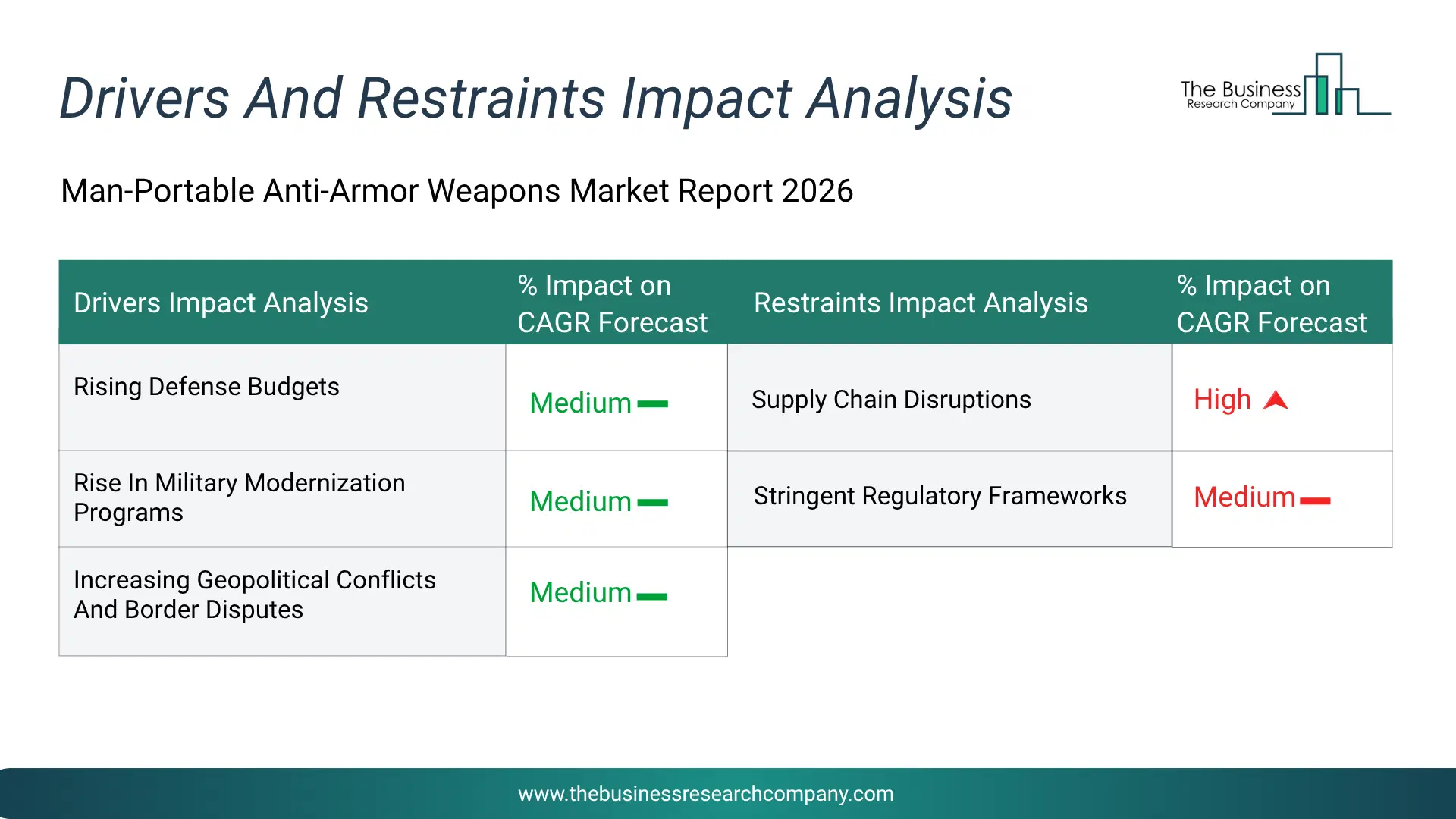
Infographic Chart Showing Key Market Drivers Analysis And Restraints For Man-Portable Anti-Armor Weapons Market
The chart presents an impact analysis of key drivers and restraints, quantifying their relative influence on the market's growth rate and helping assess the balance between growth enablers and limiting factors. This chart offers a high-level perspective; the full report contains more detailed insights.
How Will The Drivers Impact Growth In The Global Man-Portable Anti-Armor Weapons Market?
• Rising Defense Budgets (Medium) – The rising defense budgets will become a key driver of growth in the man-portable anti-armor weapons market by 2030. An increasing defense budget enables governments to allocate more funds toward procuring advanced man-portable anti-armor weapons, enhancing their military’s capability to counter armored threats effectively. Additionally, higher budgets drive investment in research and development, leading to innovations in lightweight, precision-guided, and more effective anti-armor weapon systems. As a result, the rising defense budgets is anticipated to contributing to a 2.0% annual growth in the market. • Rise In Military Modernization Programs (Medium) – The rise in military modernization programs will emerge as a major factor driving the expansion of the man-portable anti-armor weapons market by 2030. By replacing outdated systems with next-generation, high-precision, and lightweight solutions. These programs also foster technological advancements, ensuring that infantry forces are equipped with more effective and adaptable weaponry to counter evolving battlefield threats. Consequently, the rise in military modernization programs is projected to contributing to a 1.5% annual growth in the market. • Increasing Geopolitical Conflicts And Border Disputes (Medium) – The increasing geopolitical conflicts and border disputes within digital manufacturing processes will serve as a key growth catalyst for the man-portable anti-armor weapons market by 2030. As nations prioritize strengthening their defense capabilities to counter potential threats. This heightened security focus leads to higher procurement, research, and development investments, driving market growth for advanced and effective anti-armor solutions. Therefore, this increasing geopolitical conflicts and border disputes is projected to supporting to a 1.0% annual growth in the market. • Government Support And Policies (Low) – The government support and policies will become a significant driver contributing to the growth of the man-portable anti-armor weapons market by 2030. Government support and favorable policies, such as increased defense spending, streamlined procurement processes, and incentives for local production, drive the growth of the man-portable anti-armor weapons market by ensuring steady demand and funding for development. Additionally, export regulations, strategic defense partnerships, and technology transfer agreements facilitate market expansion and innovation, strengthening the industry’s global competitiveness. Consequently, the government support and policies is projected to contributing to a 0.5% annual growth in the market.How Will The Restraints Impact Growth In The Global Man-Portable Anti-Armor Weapons Market?
• Supply Chain Disruptions (Medium) – Supply Chain Disruptions will restrict the growth of the Man-Portable Anti-Armor Weapons market during the forecast period. The production of man-portable anti-armor weapons depends on complex supply chains for specialized materials, electronics, and propellants. Geopolitical tensions, trade restrictions, and raw material shortages can disrupt these supply chains, leading to production delays and cost increases. Supply chain vulnerabilities affect the ability of manufacturers to meet military demand and may limit market growth. • Stringent Regulatory Frameworks (Medium) – Stringent Regulatory Frameworks will restrict the growth of the Man-Portable Anti-Armor Weapons market during the forecast period. The production and export of man-portable anti-armor weapons are subject to strict international arms control regulations and national licensing requirements. Compliance with these regulations adds administrative burden and time to sales processes. Export restrictions to certain regions limit market opportunities and reduce the total addressable market for manufacturers.Key Players In The Global Man-Portable Anti-Armor Weapons Market
Major companies operating in the man-portable anti-armor weapons market are Lockheed Martin Corporation, Bharat Dynamics Limited, General Dynamics Corporation, Saab AB, Raytheon Company, Thales Group, BAE Systems plc, MBDA Holdings SAS, Konstruktorskoye Byuro Mashynostroyeniya (KBM), Nammo AS, Rostec State Corporation, Elbit Systems Ltd., Rafael Advanced Defense Systems Ltd., Denel Dynamics, Northrop Grumman, HDT Global Inc., FLIR Systems Inc., Argon Electronics Ltd., Chemring Group plc, Rheinmetall AG, Jadara Equipment & Defence Systems, Roketsan Roket Sanayii ve Ticaret A.S., Luch Design Bureau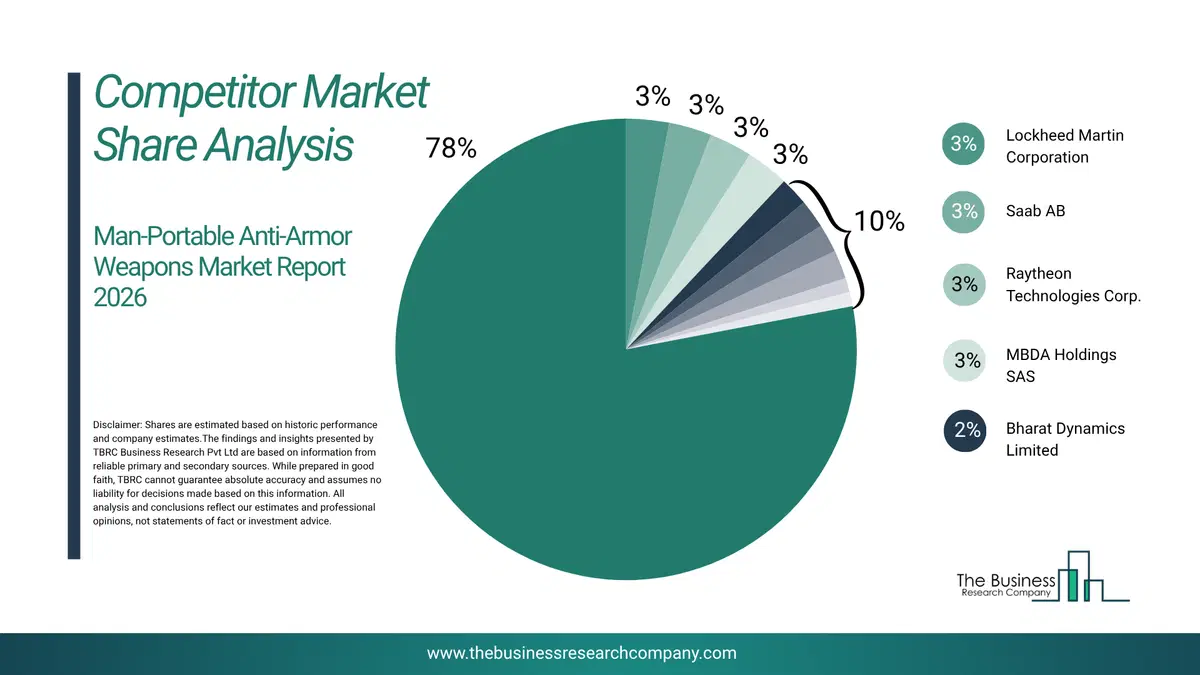
This chart is for illustrative purposes; the full report includes a detailed competitor analysis and comprehensive overview of the top 10 companies in the market.
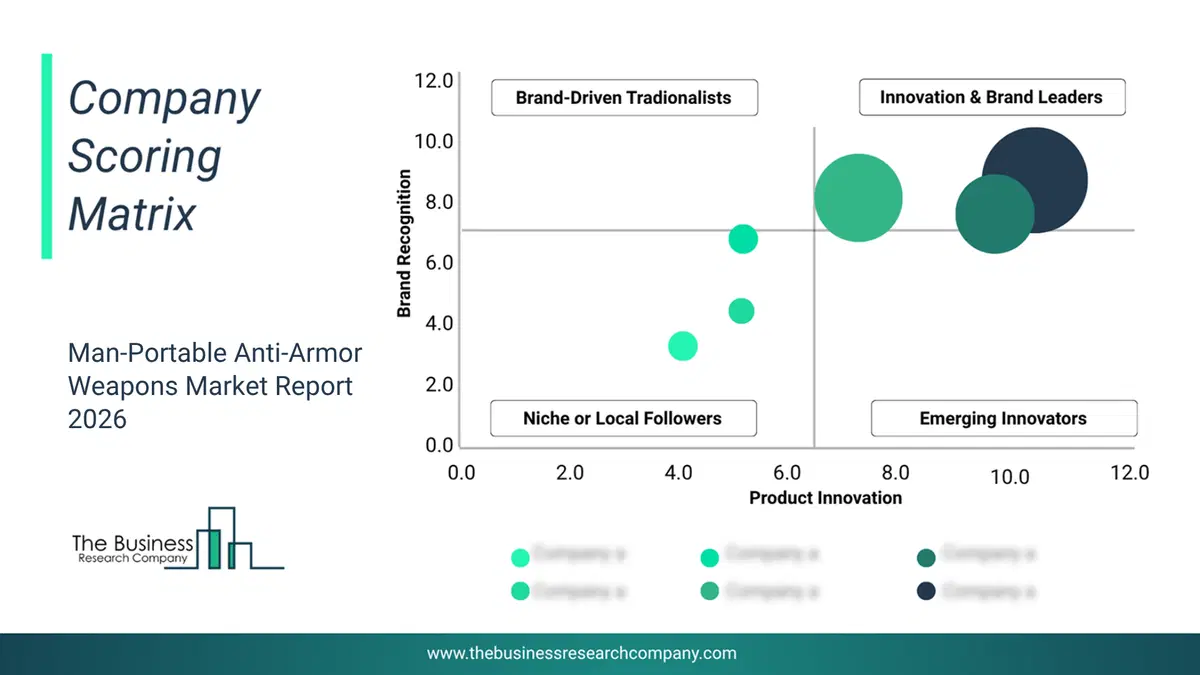
This chart maps companies by product innovation and brand strength, with bubble size indicating relative revenue, helping identify market leaders, challengers, and niche players. This is an illustrative chart; the full report provides a complete and accurate competitive analysis.
Global Man-Portable Anti-Armor Weapons Market Trends and Insights
Major companies operating in the man-portable anti-armor weapons market are focused on introducing new products, such as portable missile system, to strengthen their position in the market. A portable missile system also known as a man-portable air-defense weapon used by individuals or small teams to target aircraft, helicopters, or ground vehicles. Its high mobility and quick deployment make it effective in various combat scenarios. For instance, in August 2024, the Defence Research and Development Organization, an India-based military research and development agency announced the completion of successfully test-fired the indigenously-built Man-Portable Anti-Tank Guided Missile (MP-ATGM). The system weighs 14.5 kg, with an additional 14.25 kg for the command launch unit (CLU), making it highly portable. It features a HEAT warhead for destroying tanks and armored vehicles, with an operational range of 200 meters to 4 kilometers. The missile is equipped with an advanced IIR sensor and avionics for precise top-attack targeting. Its cylindrical design measures 130 cm in length and 12 cm in diameter, launched from a collapsible tripod and tube.What Are Latest Mergers And Acquisitions In The Man-Portable Anti-Armor Weapons Market? MBDA And Saab AB Forge Partnership To Enhance Anti-Tank And Air Defense Capabilities
In January 2024, MBDA, a France-based manufacturer of anti-aircraft missiles, partnered with Saab AB. The partnership seeks to strengthen collaboration in developing essential anti-tank and air defense capabilities for high-intensity conflicts. By concentrating on the Akeron MP missile system, the companies aim to incorporate advanced features such as beyond-line-of-sight firing to meet the demands of future battlefields. Saab AB is a Sweden-based aerospace and defense company.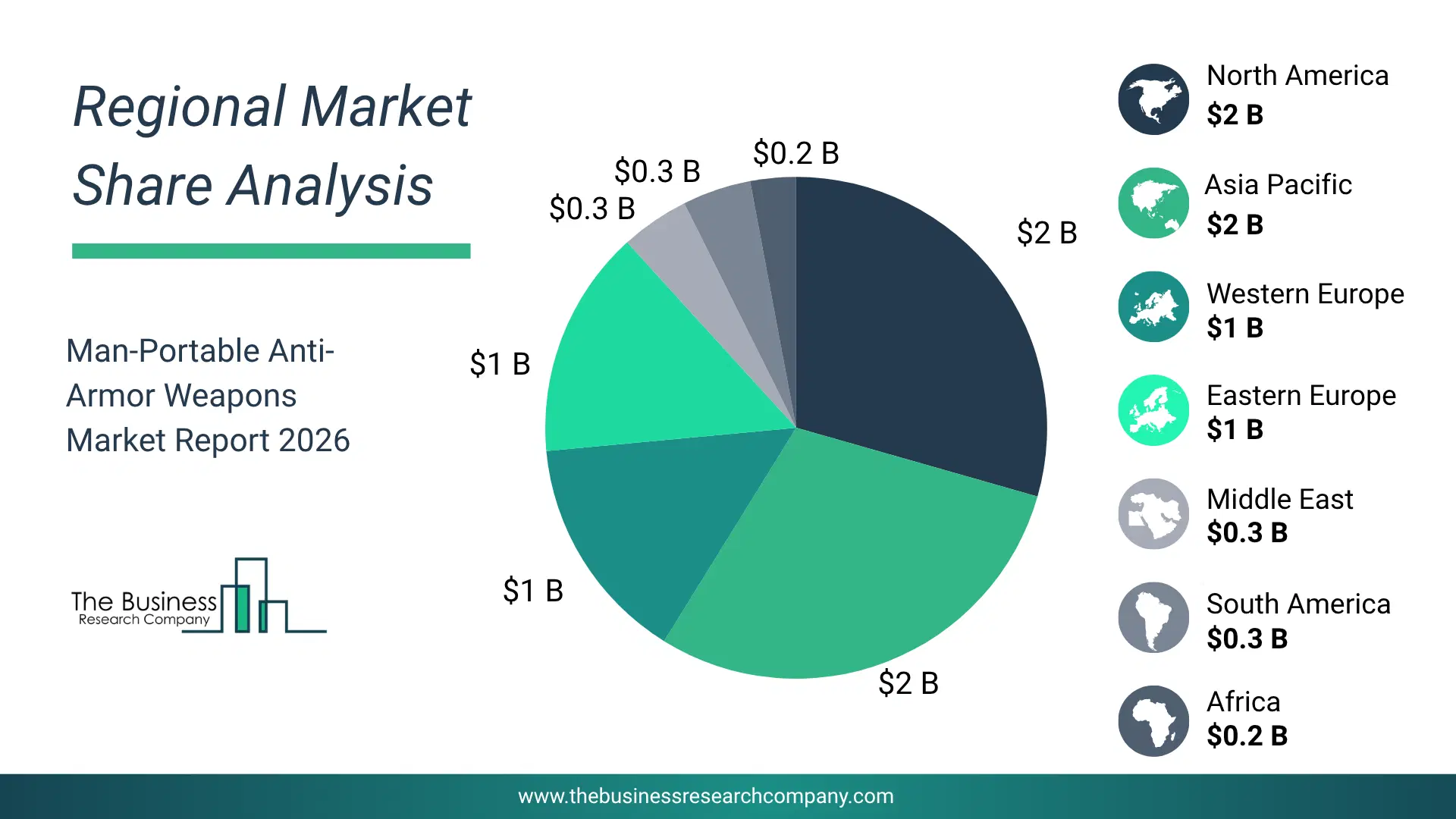
Regional Insights
North America was the largest region in the man-portable anti-armor weapons market in 2025. Asia-Pacific is expected to be the fastest-growing region in the man-portable anti-armor weapons market report during the forecast period. The regions covered in this market report are Asia-Pacific, South East Asia, Western Europe, Eastern Europe, North America, South America, Middle East, Africa. The countries covered in this market report are Australia, Brazil, China, France, Germany, India, Indonesia, Japan, Taiwan, Russia, South Korea, UK, USA, Canada, Italy, SpainWhat Defines the Man-Portable Anti-Armor Weapons Market?
The man-portable anti-armor weapons market consists of sales of shoulder-launched anti-tank rockets and javelin weapon system. Values in this market are ‘factory gate’ values, that is the value of goods sold by the manufacturers or creators of the goods, whether to other entities (including downstream manufacturers, wholesalers, distributors, and retailers) or directly to end customers. The value of goods in this market includes related services sold by the creators of the goods.How is Market Value Defined and Measured?
The market value is defined as the revenues that enterprises gain from the sale of goods and/or services within the specified market and geography through sales, grants, or donations in terms of the currency (in USD unless otherwise specified). The revenues for a specified geography are consumption values that are revenues generated by organizations in the specified geography within the market, irrespective of where they are produced. It does not include revenues from resales along the supply chain, either further along the supply chain or as part of other products.
This chart presents market attractiveness based on a quantitative evaluation of growth, competition, strategic alignment, and risk, offering a clear view of opportunity areas for decision-making. This chart is for illustrative purposes; the full report contains the complete analysis.

This chart highlights the Total Addressable Market (TAM) by estimating the maximum revenue opportunity using an assumption-driven approach, supporting strategic planning and opportunity sizing across markets. The chart is illustrative; the full report provides a more comprehensive analysis.
What Key Data and Analysis Are Included in the Man-Portable Anti-Armor Weapons Market Report 2026?
The man-portable anti-armor weapons market research report is one of a series of new reports from The Business Research Company that provides market statistics, including industry global market size, regional shares, competitors with the market share, detailed market segments, market trends and opportunities, and any further data you may need to thrive in the man-portable anti-armor weapons industry. The market research report delivers a complete perspective of everything you need, with an in-depth analysis of the current and future state of the industry.Man-Portable Anti-Armor Weapons Market Report Forecast Analysis
| Report Attribute | Details |
|---|---|
| Market Size Value In 2026 | $6.58 billion |
| Revenue Forecast In 2030 | $8.13 billion |
| Growth Rate | CAGR of 5.5% from 2026 to 2030 |
| Base Year For Estimation | 2025 |
| Actual Estimates/Historical Data | 2020-2025 |
| Forecast Period | 2026 - 2030 |
| Market Representation | Revenue in USD Billion and CAGR from 2026 to 2030 |
| Segments Covered | Type, Technology, Application |
| Regional Scope | Asia-Pacific, Western Europe, Eastern Europe, North America, South America, Middle East, Africa |
| Country Scope | The countries covered in the report are Australia, Brazil, China, France, Germany, India, Indonesia, Japan, Taiwan, Russia, South Korea, UK, USA, Canada, Italy, Spain. |
| Key Companies Profiled | Lockheed Martin Corporation, Bharat Dynamics Limited, General Dynamics Corporation, Saab AB, Raytheon Company, Thales Group, BAE Systems plc, MBDA Holdings SAS, Konstruktorskoye Byuro Mashynostroyeniya (KBM), Nammo AS, Rostec State Corporation, Elbit Systems Ltd., Rafael Advanced Defense Systems Ltd., Denel Dynamics, Northrop Grumman, HDT Global Inc., FLIR Systems Inc., Argon Electronics Ltd., Chemring Group plc, Rheinmetall AG, Jadara Equipment & Defence Systems, Roketsan Roket Sanayii ve Ticaret A.S., Luch Design Bureau |
| Customization Scope | Request for Customization |
| Pricing And Purchase Options | Explore Purchase Options |