

Managed Hybrid Cloud Hosting Market Report 2026
Global Outlook – By Service Type (Infrastructure As A Service (IaaS), Platform As A Service (PaaS), Software As A Service (SaaS), Disaster Recovery As A Service (DRaaS), Backup As A Service (BaaS)), By Type (Cloud-Based, On-Premises), By Organization Size (Small And Medium Enterprises, Large Enterprises), By Industry Vertical (Banking, Financial Services, And Insurance (BFSI), Information Technology (IT) And Telecommunications, Healthcare, Retail, Manufacturing, Government, Other Industry Verticals) – Market Size, Trends, Strategies, and Forecast to 2030
Managed Hybrid Cloud Hosting Market Overview
• Managed Hybrid Cloud Hosting market size has reached to $40.99 billion in 2025 • Expected to grow to $84.1 billion in 2030 at a compound annual growth rate (CAGR) of 15.4% • Growth Driver: Rising Adoption Of Cloud Computing Fueling The Growth Of The Market Due To Growing Demand For Cost-Efficient And Scalable IT Infrastructure Solutions • Market Trend: Advancement In Private Cloud Solutions For Hybrid IT Optimization Boosting Market Growth • North America was the largest region in 2025 and Asia-Pacific is the fastest growing region.Market Gains By 2030 – Top Opportunities By Segment
Market Gain identifies the most promising market opportunities by highlighting the segments or products expected to generate the highest incremental revenue growth over the next five years.
What Is Covered Under Managed Hybrid Cloud Hosting Market?
Managed hybrid cloud hosting is a service model that combines public and private cloud infrastructures, where a third-party provider manages and optimizes the entire environment. It enables businesses to balance scalability, security, and performance while simplifying operations through expert management and support. The main service types of managed hybrid cloud hosting are infrastructure as a service (IaaS), platform as a service (PaaS), software as a service (SaaS), disaster recovery as a service (DRaaS), and backup as a service (BaaS). Infrastructure as a service (IaaS) provides on-demand virtualized computing resources such as servers, storage, and networking. Types include cloud-based and on-premises, and they cater to organization sizes such as small and medium enterprises and large enterprises. It is widely adopted across various industry verticals such as banking, financial services and insurance (BFSI), information technology (IT) and telecommunications, healthcare, retail, manufacturing, government, and others.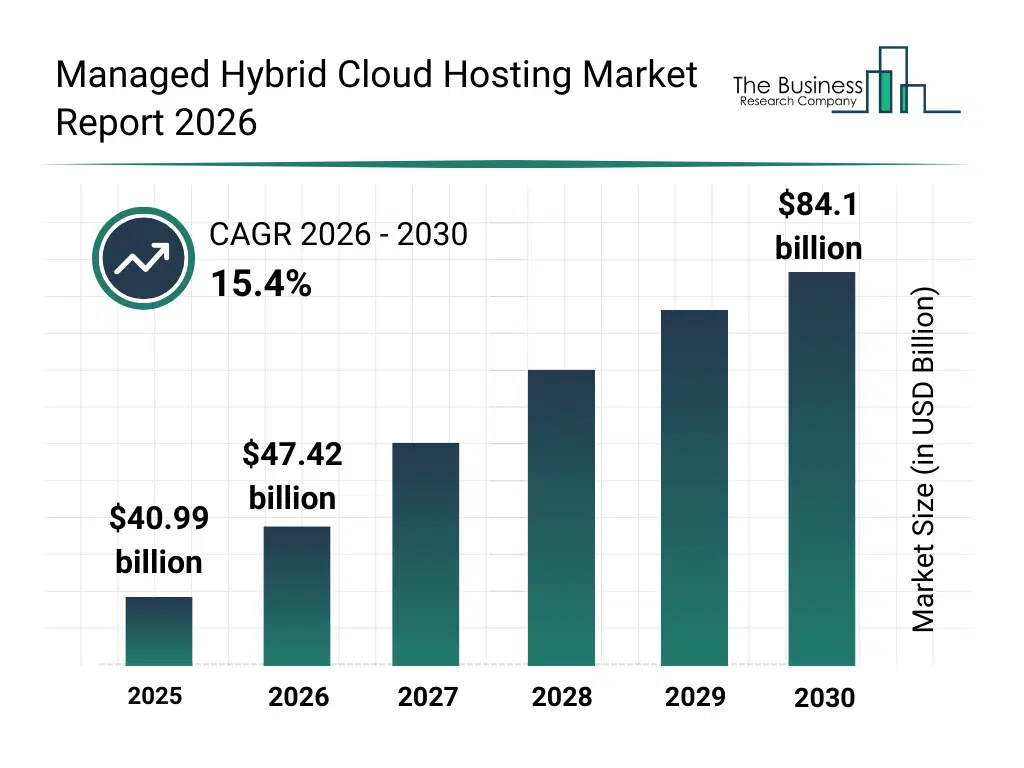
What Is The Managed Hybrid Cloud Hosting Market Size and Share 2026?
The managed hybrid cloud hosting market size has grown rapidly in recent years. It will grow from $40.99 billion in 2025 to $47.42 billion in 2026 at a compound annual growth rate (CAGR) of 15.7%. The growth in the historic period can be attributed to rapid enterprise cloud adoption and migration waves, need to keep sensitive workloads on private cloud, rising complexity of operating mixed environments, demand for business continuity and disaster recovery, growth of managed hosting for regulated industries.What Is The Managed Hybrid Cloud Hosting Market Growth Forecast?
The managed hybrid cloud hosting market size is expected to see rapid growth in the next few years. It will grow to $84.1 billion in 2030 at a compound annual growth rate (CAGR) of 15.4%. The growth in the forecast period can be attributed to AI-assisted capacity planning and autoscaling, sovereign cloud and regional hosting requirements, unified observability across hybrid estates, finops and chargeback for hybrid resource usage, zero trust networking for hybrid access. Major trends in the forecast period include multi-cloud and hybrid orchestration managed by providers, policy-driven workload placement across clouds, managed container platforms within hybrid hosting, integrated dr and backup services across environments, secure connectivity and segmentation for hybrid networks.
Global Managed Hybrid Cloud Hosting Market Segmentation
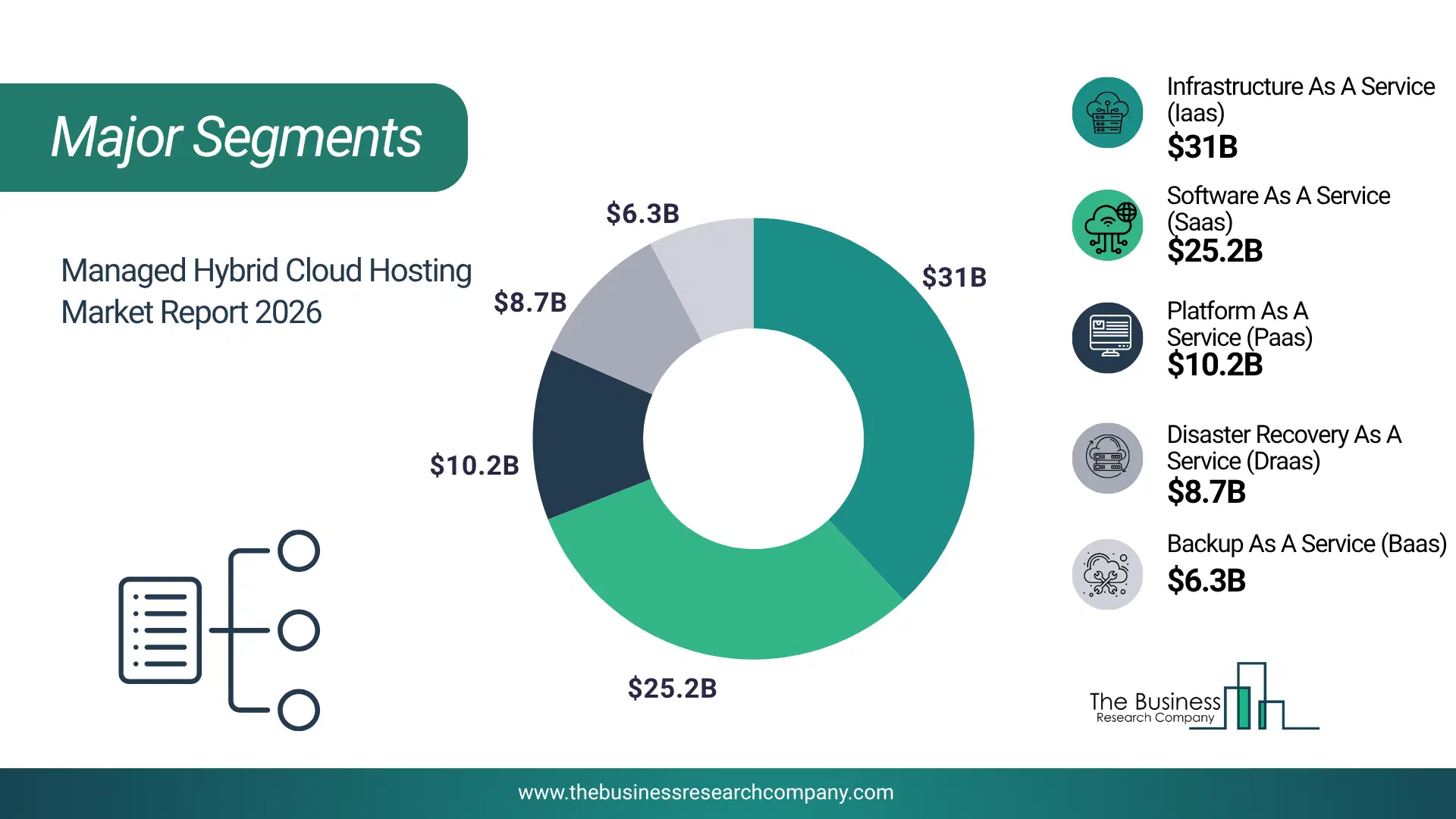
1) By Service Type: Infrastructure As A Service (IaaS), Platform As A Service (PaaS), Software As A Service (SaaS), Disaster Recovery As A Service (DRaaS), Backup As A Service (BaaS) 2) By Type: Cloud-Based, On-Premises 3) By Organization Size: Small And Medium Enterprises, Large Enterprises 4) By Industry Vertical: Banking, Financial Services, And Insurance (BFSI), Information Technology (IT) And Telecommunications, Healthcare, Retail, Manufacturing, Government, Other Industry Verticals Subsegments: 1) By Infrastructure As A Service (IaaS): Compute, Storage, Networking, GPU Or Accelerators, Virtualization And Hypervisor Services, Identity And Access Management, Monitoring And Logging 2) By Platform As A Service (PaaS): Application Runtimes, Database As A Service, Integration And Middleware, DevOps And CI Or CD, Serverless Or FaaS, Managed Container Orchestration, Messaging And Event Streaming 3) By Software As A Service (SaaS): Productivity And Collaboration, ERP Or CRM, Vertical Apps, Security And Compliance SaaS, Analytics And BI, DevTools Or Developer Platforms, Communications And Contact Center 4) By Disaster Recovery As A Service (DRaaS): Replication, Failover And Orchestration, Site Types, Recovery Testing And Compliance, RTO Or RPO SLA Tiers, Failback And Runbook Automation 5) By Backup As A Service (BaaS): Image-Level Backup, File-Level Backup, Database Backup, Continuous Data Protection (CDP), Snapshot And Versioning, Cloud-To-Cloud Backup, Encryption And Key Management, Long-Term Archival The top segments in the managed hybrid cloud hosting market will be: • Infrastructure As A Service (Iaas) will reach $30.93 billion by 2030. • Software As A Service (Saas) will reach $25.11 billion by 2030. • Platform As A Service (Paas) will reach $10.17 billion by 2030. • Disaster Recovery As A Service (Draas) will reach $8.63 billion by 2030. • Backup As A Service (Baas) will reach $6.27 billion by 2030.What Is The Driver Of The Managed Hybrid Cloud Hosting Market?
The increasing adoption of cloud computing is expected to propel the growth of the managed hybrid cloud hosting market going forward. Cloud computing refers to the delivery of computing resources such as servers, storage, databases, networking, software, and analytics over the internet to offer faster innovation, flexible resources, and economies of scale. The adoption of cloud computing is rising due to its cost-efficiency, allowing organizations to reduce infrastructure expenses while accessing scalable resources on demand. Managed hybrid cloud hosting in cloud computing integrates public and private cloud environments under expert management to optimize performance, security, and scalability for enterprise workloads. For instance, in December 2023, according to Eurostat, a Luxembourg-based government organization, reported that 45.2% of enterprises across the European Union purchased cloud computing services, with 77.6% of large enterprises, 59% of medium-sized enterprises, and 41.7% of small businesses adopting cloud services. The most purchased cloud computing services included email systems (82.7%), file storage (68.0%), and office software (66.3%). Therefore, the increasing adoption of cloud computing is driving the growth of the managed hybrid cloud hosting industry.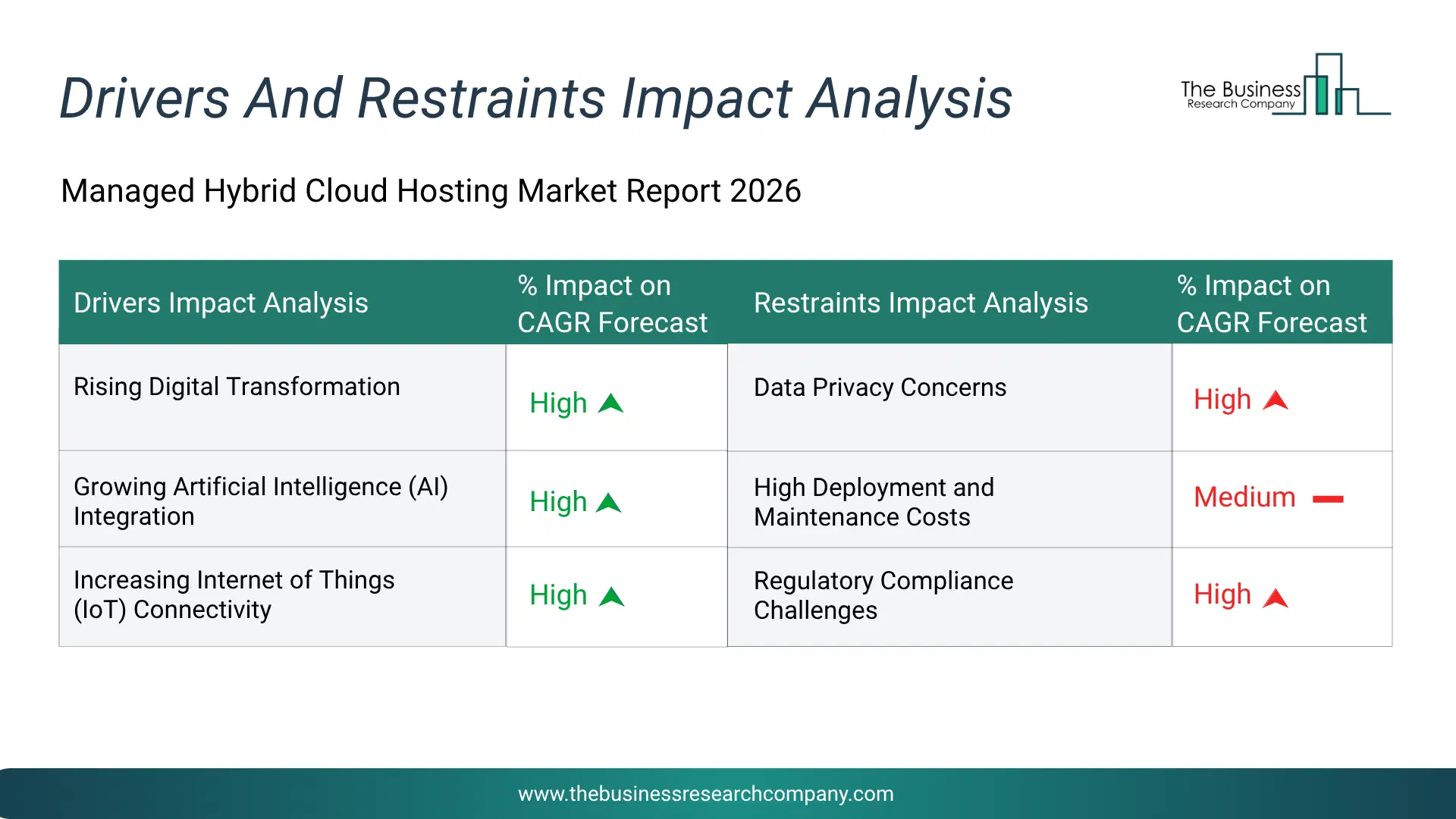
Infographic Chart Showing Key Market Drivers Analysis And Restraints For Managed Hybrid Cloud Hosting Market
The chart presents an impact analysis of key drivers and restraints, quantifying their relative influence on the market's growth rate and helping assess the balance between growth enablers and limiting factors. This chart offers a high-level perspective; the full report contains more detailed insights.
How Will The Drivers Impact Growth In The Global Managed Hybrid Cloud Hosting Market?
• Rising Digital Transformation (High) – During the forecast period, the rising digital transformation across industries is expected to be a key driver for the managed hybrid cloud hosting market by 2030. Organizations are increasingly modernizing their it environments, requiring flexible and scalable infrastructure that can support both legacy systems and cloud -native applications. Managed hybrid cloud solutions enable seamless integration between on -premises and cloud platforms, improving operational efficiency and accelerating innovation. They also support cost optimization by allowing workloads to be deployed in the most suitable environments. • Growing Artificial Intelligence (AI) Integration (High) – During the forecast period, the growing integration of artificial intelligence (ai) is expected to significantly drive the managed hybrid cloud hosting market by 2030. Ai technologies are enhancing cloud operations through intelligent automation, predictive analytics, and optimized resource allocation. These capabilities enable efficient workload management across hybrid environments while improving system performance and reliability. Ai also strengthens security monitoring and enables proactive issue resolution, supporting uninterrupted service delivery. • Increasing Internet of Things (IoT) Connectivity (High) – During the forecast period, the increasing internet of things (iot) connectivity is expected to act as a major growth catalyst for the managed hybrid cloud hosting market by 2030. The rapid growth of connected devices is generating large volumes of data that require robust infrastructure for storage, processing, and real-time analysis. Hybrid cloud environments provide the flexibility needed to manage distributed data sources while ensuring seamless connectivity between edge systems and centralized platforms. Managed services further enhance system performance, availability, and operational efficiency by simplifying complex infrastructure management.How Will The Restraints Impact Growth In The Global Managed Hybrid Cloud Hosting Market?
• Data Privacy Concerns (High) – During the forecast period, the data privacy concerns act as a major restraint for the managed hybrid cloud hosting market as organizations hesitate to move sensitive data to third-party cloud environments. The risk of unauthorized access, data breaches, and non-compliance with regional data protection laws such as gdpr or hipaa creates trust issues among enterprises. Managing consistent privacy controls across both on-premises and cloud systems adds complexity and cost. Additionally, varying data residency requirements across countries limit global cloud deployment strategies. These challenges collectively slow adoption, especially among highly regulated industries like finance and healthcare. • High Deployment and Maintenance Costs (Medium) – During the forecast period, the high deployment and maintenance costs act as a major restraint for the managed hybrid cloud hosting market because they increase the financial burden on organizations, especially small and medium enterprises. Implementing hybrid cloud infrastructure requires significant investment in hardware, software integration, and skilled personnel. Additionally, ongoing maintenance, updates, and security management add to operational expenses. These high costs often delay adoption or limit scalability for businesses with constrained budgets. As a result, many companies opt for simpler or public cloud alternatives to reduce initial and recurring expenditures. • Regulatory Compliance Challenges (High) – During the forecast period, the regulatory and data-sovereignty rules differ by country and industry, so a managed hybrid cloud provider must design, document, and audit separate environments, which adds complexity and time. Meeting standards like gdpr, hipaa, or rbi/sebi data rules often forces workloads to stay on-prem or in a specific region, limiting the elasticity that makes hybrid cloud attractive. Providers must maintain continuous compliance monitoring, certifications, and reporting, increasing operational costs. Any non-compliance risk pushes enterprises to move slower and choose simpler, more controllable architectures. Together, these factors reduce adoption speed and make managed hybrid cloud projects harder to justify financially.Key Players In The Global Managed Hybrid Cloud Hosting Market
Major companies operating in the managed hybrid cloud hosting market are Amazon.com Inc., Google LLC, Microsoft Corporation, Alibaba Cloud Computing Ltd., Huawei Technologies Co. Ltd., Hitachi Ltd., Cisco Systems Inc., Hewlett Packard Enterprise Company, Capgemini SE, NEC Corporation, Cognizant Technology Solutions Corporation, Infosys Limited, Super Micro Computer Inc., VMware Inc., Rackspace Technology Inc., Nutanix Inc., Penguin Computing Inc., Broadberry Data Systems Ltd., Cirrascale Cloud Services LLC, Microway Inc.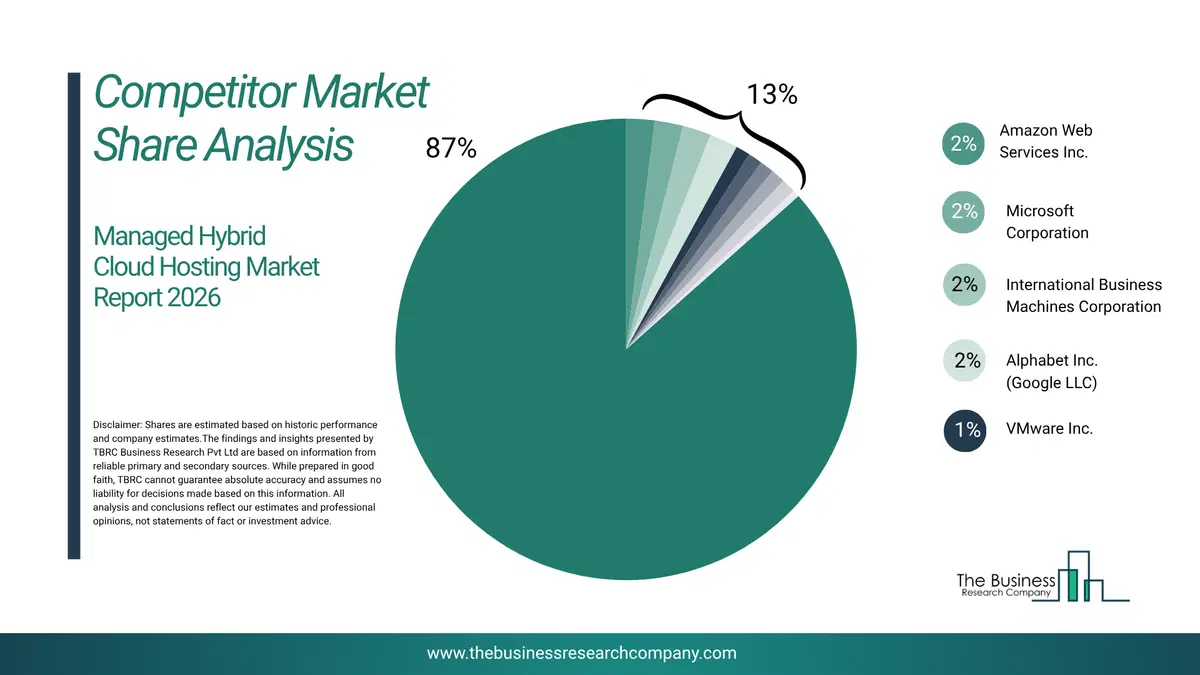
This chart is for illustrative purposes; the full report includes a detailed competitor analysis and comprehensive overview of the top 10 companies in the market.
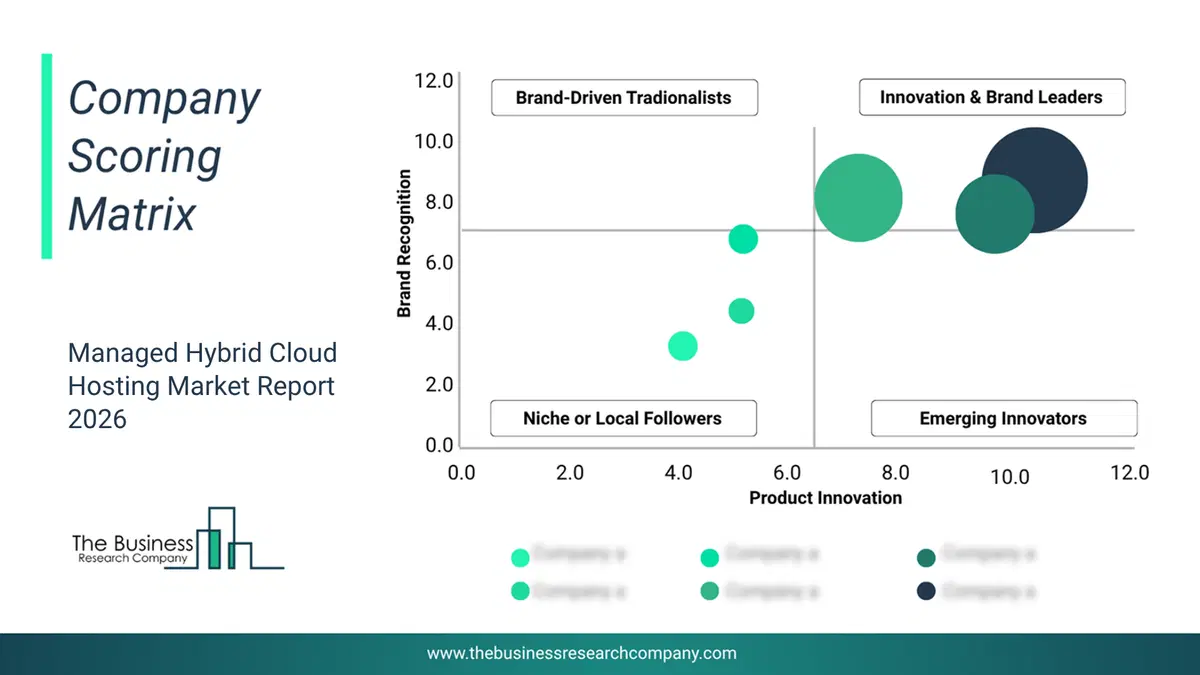
This chart maps companies by product innovation and brand strength, with bubble size indicating relative revenue, helping identify market leaders, challengers, and niche players. This is an illustrative chart; the full report provides a complete and accurate competitive analysis.
Global Managed Hybrid Cloud Hosting Market Trends and Insights
Major companies operating in the managed hybrid cloud hosting market are focusing on developing advanced private cloud solutions integrated with unified cloud management software and disaggregated infrastructure technologies to enhance scalability, reduce costs, and simplify hybrid IT operations. Private cloud solutions provide exclusive cloud infrastructure for one organization, offering enhanced security, control, and flexibility in managing data and applications. For instance, in May 2025, Hewlett Packard Enterprise (HPE), a US-based information technology company, has launched its next-generation private cloud portfolio, designed to modernize hybrid IT with greater cost efficiency, performance, and simplicity. The launch includes HPE Private Cloud Business Edition featuring Morpheus VM Essentials, which reduces VM licensing costs by up to 90% and delivers a 2.5x lower total cost of ownership through disaggregated infrastructure. The HPE Morpheus Software suite including enterprise software for unified cloud management enables automation, AI-driven operations, and multi-cloud integration. With enhanced scalability, security, and ecosystem support from partners such as Commvault, HPE aims to help enterprises streamline virtualization, reduce costs, and accelerate digital transformation across hybrid environments.What Are Latest Mergers And Acquisitions In The Managed Hybrid Cloud Hosting Market?
In August 2024, Hewlett Packard Enterprise (HPE), a US-based information technology company, acquired Morpheus Data for an undisclosed amount. With this acquisition, HPE aims to enhance its GreenLake cloud platform by integrating Morpheus’ advanced hybrid and multicloud management tools to deliver unified provisioning, workload optimization, and simplified IT operations across diverse environments. Morpheus Data is a US-based software company that specializes providing hybrid and multicloud management solutions.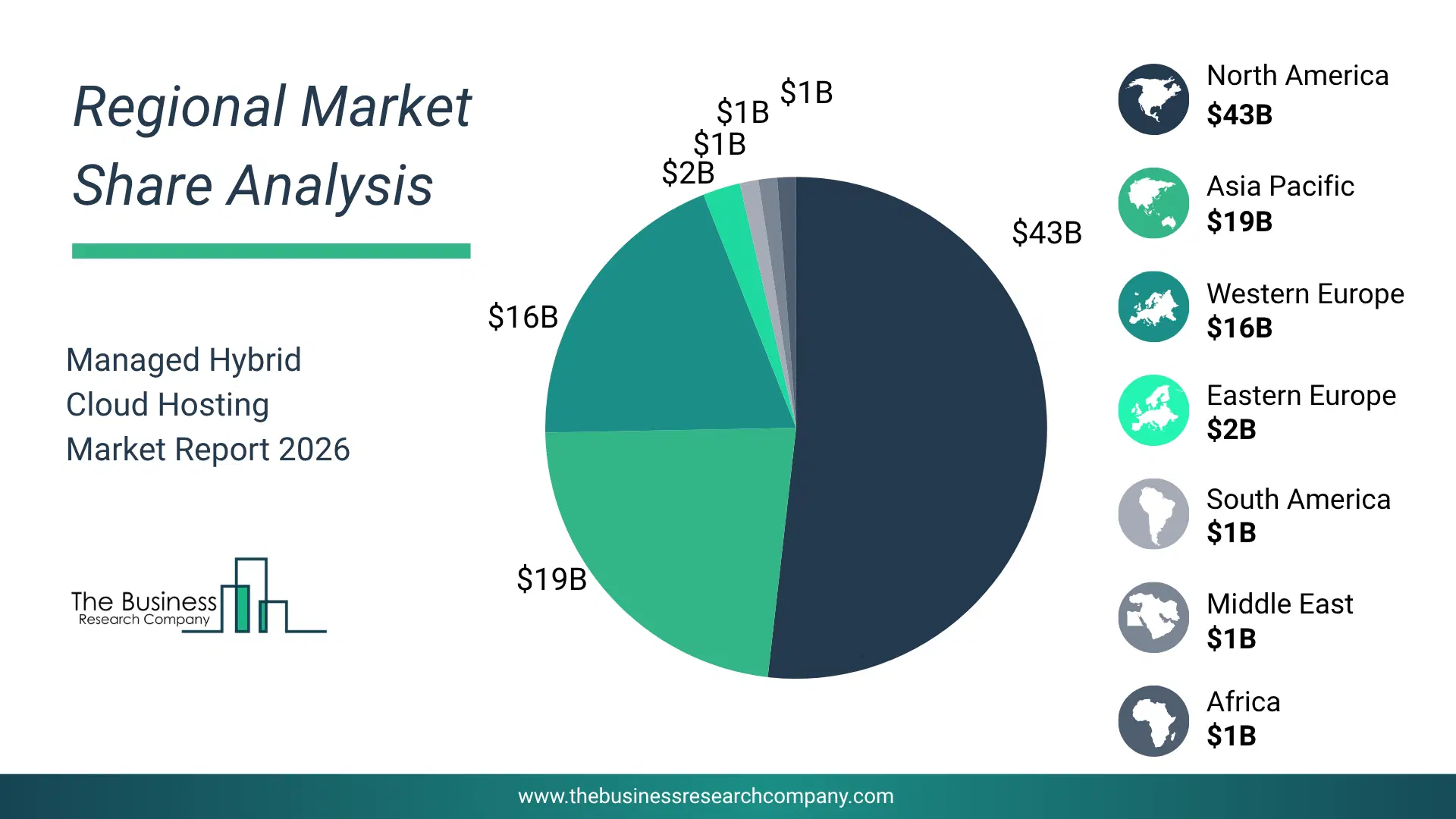
Regional Insights
North America was the largest region in the managed hybrid cloud hosting market in 2025. Asia-Pacific is expected to be the fastest-growing region in the forecast period. The regions covered in this market report are Asia-Pacific, South East Asia, Western Europe, Eastern Europe, North America, South America, Middle East, Africa. The countries covered in this market report are Australia, Brazil, China, France, Germany, India, Indonesia, Japan, Taiwan, Russia, South Korea, UK, USA, Canada, Italy, Spain.What Defines the Managed Hybrid Cloud Hosting Market?
The managed hybrid cloud hosting market includes revenues earned by entities by providing services such as hybrid cloud infrastructure management, on-premises and cloud integration, monitoring, and optimization services. The market value also includes the value of related goods sold by the service provider or included within the service offering. Only goods and services traded between entities or sold to end consumers are included.How is Market Value Defined and Measured?
The market value is defined as the revenues that enterprises gain from the sale of goods and/or services within the specified market and geography through sales, grants, or donations in terms of the currency (in USD unless otherwise specified). The revenues for a specified geography are consumption values that are revenues generated by organizations in the specified geography within the market, irrespective of where they are produced. It does not include revenues from resales along the supply chain, either further along the supply chain or as part of other products.
This chart presents market attractiveness based on a quantitative evaluation of growth, competition, strategic alignment, and risk, offering a clear view of opportunity areas for decision-making. This chart is for illustrative purposes; the full report contains the complete analysis.

This chart highlights the Total Addressable Market (TAM) by estimating the maximum revenue opportunity using an assumption-driven approach, supporting strategic planning and opportunity sizing across markets. The chart is illustrative; the full report provides a more comprehensive analysis.
What Key Data and Analysis Are Included in the Managed Hybrid Cloud Hosting Market Report 2026?
The managed hybrid cloud hosting market research report is one of a series of new reports from The Business Research Company that provides market statistics, including industry global market size, regional shares, competitors with the market share, detailed market segments, market trends and opportunities, and any further data you may need to thrive in the managed hybrid cloud hosting industry. The market research report delivers a complete perspective of everything you need, with an in-depth analysis of the current and future state of the industry.Managed Hybrid Cloud Hosting Market Report Forecast Analysis
| Report Attribute | Details |
|---|---|
| Market Size Value In 2026 | $47.42 billion |
| Revenue Forecast In 2030 | $84.1 billion |
| Growth Rate | CAGR of 15.4% from 2026 to 2030 |
| Base Year For Estimation | 2025 |
| Actual Estimates/Historical Data | 2020-2025 |
| Forecast Period | 2026 - 2030 |
| Market Representation | Revenue in USD Billion and CAGR from 2026 to 2030 |
| Segments Covered | Service Type, Type, Organization Size, Industry Vertical |
| Regional Scope | Asia-Pacific, Western Europe, Eastern Europe, North America, South America, Middle East, Africa |
| Country Scope | The countries covered in the report are Australia, Brazil, China, France, Germany, India, ... |
| Key Companies Profiled | Amazon.com Inc., Google LLC, Microsoft Corporation, Alibaba Cloud Computing Ltd., Huawei Technologies Co. Ltd., Hitachi Ltd., Cisco Systems Inc., Hewlett Packard Enterprise Company, Capgemini SE, NEC Corporation, Cognizant Technology Solutions Corporation, Infosys Limited, Super Micro Computer Inc., VMware Inc., Rackspace Technology Inc., Nutanix Inc., Penguin Computing Inc., Broadberry Data Systems Ltd., Cirrascale Cloud Services LLC, Microway Inc. |
| Customization Scope | Request for Customization |
| Pricing And Purchase Options | Explore Purchase Options |