
Manufacturing Execution System Market Report 2026
Global Outlook – By Offering (Software, Services), By Deployment (On-Premise, On-Demand, Hybrid), By Organization Size (Small and Medium-sized Enterprise, Large Enterprise), By Process Industry (Food And Beverages, Oil And Gas, Chemicals, Pulp And Paper, Pharmaceutical And Life Sciences, Energy And Power, Water And Wastewater Management, Other Process Industries) – Market Size, Trends, Strategies, and Forecast to 2030
Manufacturing Execution System Market Overview
• Manufacturing Execution System market size has reached to $16.83 billion in 2025 • Expected to grow to $30.96 billion in 2030 at a compound annual growth rate (CAGR) of 12.9% • Growth Driver: The Increased Demand For Remote Work Fueling The Growth Of The Market Due To Rising Need For Remote Monitoring And Connected Operations • Market Trend: Latest MES Version To Address The Need For Improved Operational Efficiency • Asia-Pacific was the largest region in 2025.Market Gains By 2030 – Top Opportunities By Segment
Market Gain identifies the most promising market opportunities by highlighting the segments or products expected to generate the highest incremental revenue growth over the next five years.
What Is Covered Under Manufacturing Execution System Market?
Manufacturing execution system refers to comprehensive dynamic software designed to monitor, track, and document and control the process of manufacturing from raw material to end product. It acts as a functional layer between ERP (enterprise resource planning) and process control systems, by offering data to decision-makers to establish efficient and optimized production activities. The main offering of manufacturing execution systems includes software and services. The manufacturing execution system software refers to a specialist class of production-oriented software, which is designed to manage, monitor and synchronize the execution of real-time physical processes involved in converting raw materials into finished products. They are deployed through on-premise, on-demand and hybrid delivery models. These systems are used in small and medium-sized enterprises and large enterprises in industries ranging from food & beverages, oil & gas, chemicals, pulp & paper, pharmaceutical & life sciences, energy & power, water & wastewater treatment, and other industries.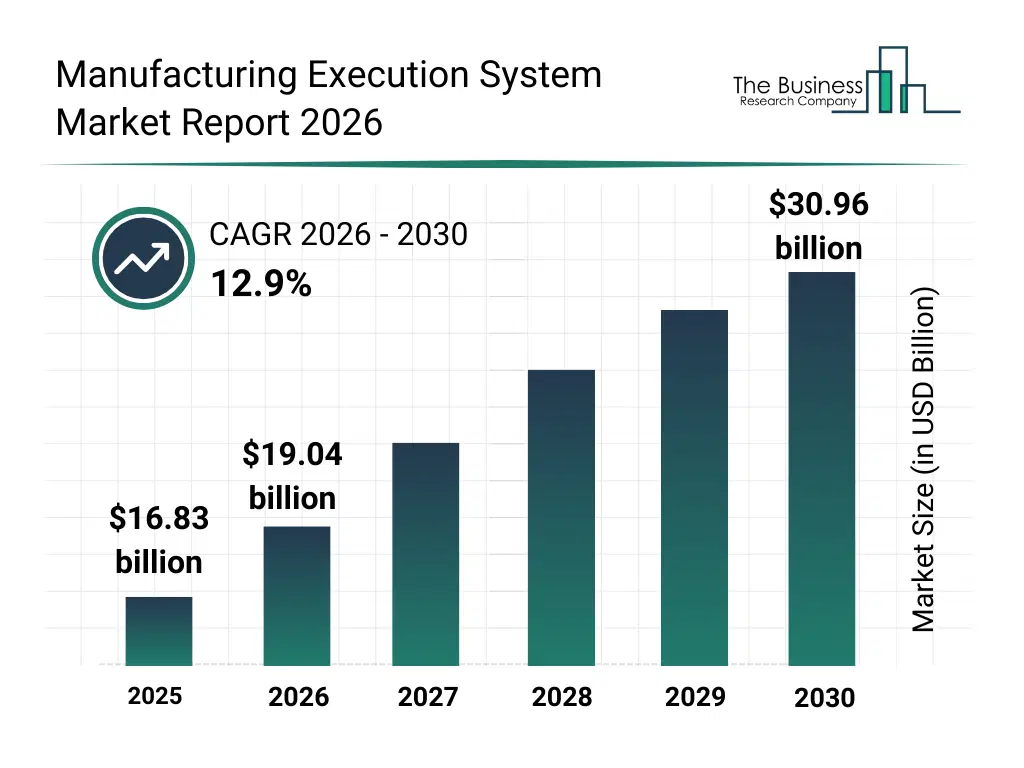
What Is The Manufacturing Execution System Market Size and Share 2026?
The manufacturing execution system market size has grown rapidly in recent years. It will grow from $16.83 billion in 2025 to $19.04 billion in 2026 at a compound annual growth rate (CAGR) of 13.2%. The growth in the historic period can be attributed to increasing complexity of manufacturing operations, rising demand for production transparency, early adoption of digital manufacturing systems, expansion of regulated process industries, growing need for operational efficiency.What Is The Manufacturing Execution System Market Growth Forecast?
The manufacturing execution system market size is expected to see rapid growth in the next few years. It will grow to $30.96 billion in 2030 at a compound annual growth rate (CAGR) of 12.9%. The growth in the forecast period can be attributed to increasing investments in smart factory transformation, rising adoption of cloud-native mes platforms, expansion of data-driven manufacturing decision-making, growing focus on sustainability reporting, increasing integration with advanced analytics and AI. Major trends in the forecast period include increasing adoption of real-time shop floor monitoring systems, rising demand for integrated mes and erp platforms, growing use of cloud and hybrid mes deployments, expansion of quality and traceability management modules, enhanced focus on production visibility and control.
Global Manufacturing Execution System Market Segmentation
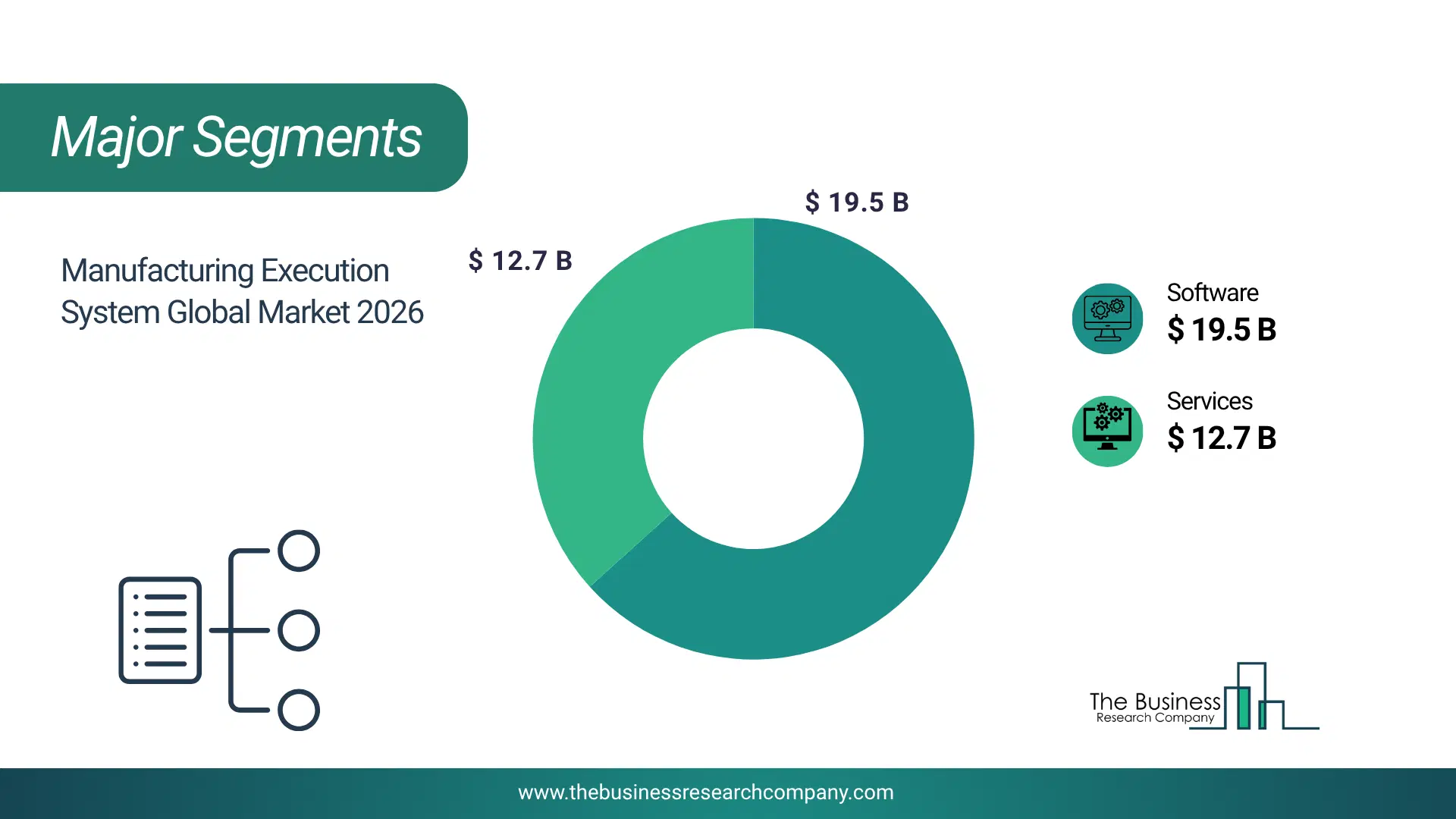
1) By Offering: Software, Services 2) By Deployment: On-Premise, On-Demand, Hybrid 3) By Organization Size: Small and Medium-sized Enterprise, Large Enterprise 4) By Process Industry: Food And Beverages, Oil And Gas, Chemicals, Pulp And Paper, Pharmaceutical And Life Sciences, Energy And Power, Water And Wastewater Management, Other Process Industries Subsegments: 1) By Software: MES Software, Advanced Planning And Scheduling Software, Quality Management Software, Manufacturing Intelligence Software 2) By Services: Consulting Services, Implementation Services, Support And Maintenance Services The top segments in the manufacturing execution system market will be: • Software will reach $19.5 billion by 2030. • Services will reach $11.32 billion by 2030.What Is The Driver Of The Manufacturing Execution System Market?
The increased demand for remote work is expected to propel the growth of the manufacturing execution system market going forward. The increased demand for remote work refers to the growing shift toward hybrid and home-based work environments, where employees rely on digital systems to perform operational and supervisory tasks from outside physical production sites. This demand is increasing because organizations across industries continue to formalize hybrid work policies to improve workforce flexibility and productivity. The manufacturing execution system market supports this shift by enabling real-time remote monitoring, centralized production visibility, and cloud-enabled decision-making for manufacturing teams that operate across distributed locations. For instance, in February 2023, according to the Office for National Statistics, a UK-based government department, between September 2022 and January 2023, 16% of working adults reported exclusively working from home, while 28% reported a combination of working from home and commuting to work. Therefore, the increased demand for remote work is driving the growth of the manufacturing execution system industry.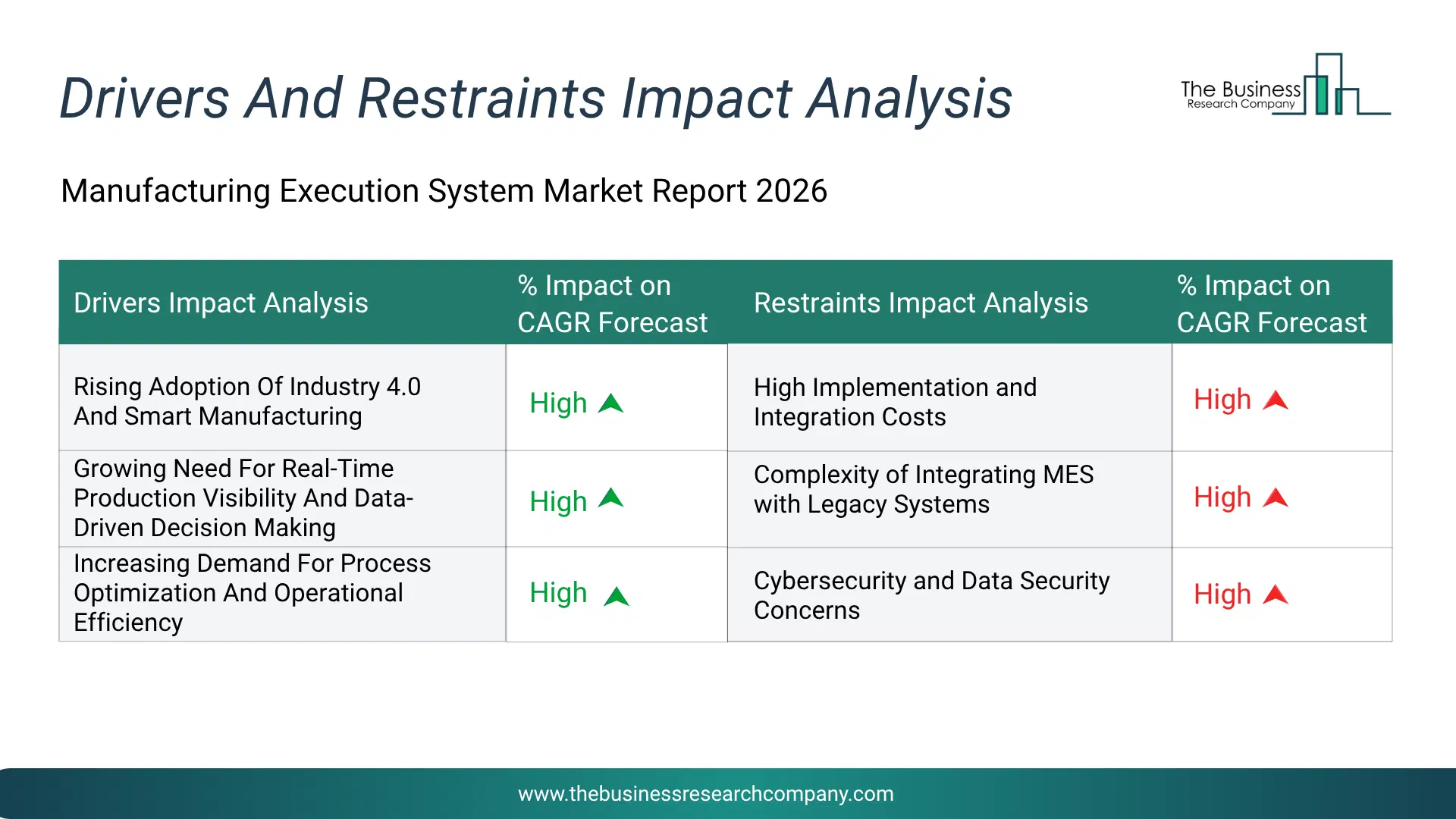
Infographic Chart Showing Key Market Drivers Analysis And Restraints For Manufacturing Execution System Market
The chart presents an impact analysis of key drivers and restraints, quantifying their relative influence on the market's growth rate and helping assess the balance between growth enablers and limiting factors. This chart offers a high-level perspective; the full report contains more detailed insights.
How Will The Drivers Impact Growth In The Global Manufacturing Execution System Market?
• Rising Adoption Of Industry 4.0 And Smart Manufacturing (High) – During the forecast period, the rising adoption of industry 4.0 and smart manufacturing is expected to become a key growth driver for the manufacturing execution system market by 2030. Manufacturers are increasingly integrating advanced technologies such as iot, ai, robotics, and digital twins into production environments to enable connected, automated, and intelligent operations. Mes platforms play a critical role in orchestrating these technologies by providing real -time coordination, data exchange, and process control across the shop floor. This shift toward smart factories is accelerating demand for scalable and interoperable mes solutions that support end -to -end digital transformation. • Growing Need For Real-Time Production Visibility And Data-Driven Decision Making (High) – During the forecast period, the growing need for real-time production visibility and data-driven decision making is expected to emerge as a major factor driving the expansion of the manufacturing execution system market by 2030. Manufacturers are prioritizing real-time monitoring of production processes, equipment performance, and quality metrics to improve responsiveness and minimize disruptions. Mes solutions enable centralized data collection and advanced analytics, allowing operators and managers to make informed decisions quickly and accurately. This capability is becoming increasingly critical in complex and high-volume manufacturing environments where agility and precision are essential. • Increasing Demand For Process Optimization And Operational Efficiency (High) – During the forecast period, the increasing demand for process optimization and operational efficiency is expected to act as a key growth catalyst for the manufacturing execution system market by 2030. Companies are under continuous pressure to reduce production costs, minimize waste, and enhance throughput while maintaining high quality standards. Mes platforms support these objectives by enabling workflow automation, predictive maintenance, performance tracking, and continuous improvement initiatives. By streamlining operations and reducing downtime, mes solutions help manufacturers achieve higher productivity and profitability.How Will The Restraints Impact Growth In The Global Manufacturing Execution System Market?
• High Implementation and Integration Costs (High) – During the forecast period, the deploying a manufacturing execution system often requires substantial investment in software licenses, system integration, and infrastructure upgrades. Many manufacturers must also customize the system to fit their specific production processes and existing enterprise platforms. These implementation efforts can increase overall project costs and extend deployment timelines. Smaller manufacturers may find these upfront expenses difficult to justify. Consequently, the high cost of adoption can slow the overall growth of the mes market. • Complexity of Integrating MES with Legacy Systems (High) – During the forecast period, the many manufacturing facilities still operate with legacy equipment and outdated information systems. Integrating modern mes platforms with these older technologies can be technically challenging. Compatibility issues, data standardization problems, and system configuration requirements often increase the complexity of deployment. These challenges may require additional technical expertise and longer implementation periods. As a result, some companies delay or avoid mes adoption due to integration difficulties. • Cybersecurity and Data Security Concerns (High) – During the forecast period, the manufacturing execution systems connect production equipment, enterprise systems, and sometimes cloud platforms to enable real-time monitoring and control. This connectivity increases the amount of operational data being transmitted across networks. As a result, manufacturers may face greater exposure to cyber threats and unauthorized access to sensitive production information. Concerns about data breaches or disruptions to manufacturing operations can make organizations cautious about implementing interconnected systems. These security considerations may limit the pace of mes adoption in certain industries.Key Players In The Global Manufacturing Execution System Market
Major companies operating in the manufacturing execution system market are ABB Ltd.; AVEVA Group plc; Dassault Systèmes; Honeywell International Inc.; Rockwell Automation Inc.; Siemens AG; Schneider Electric SE; Emerson Electric Co.; General Electric Company; Werum IT Solutions; Parsec Automation Corp.; PTC Inc.; Yokogawa Electric Corporation; SAP SE; Lighthouse Systems; Critical Manufacturing; Cogiscan Inc.; Andea Solutions; Plex Systems Inc.; L&T Technology Services; ATS Global B. V.; MPDV Mikrolab GmbH; CIMON Inc.; Prolink Technologies; Aegis Industrial Software Corporation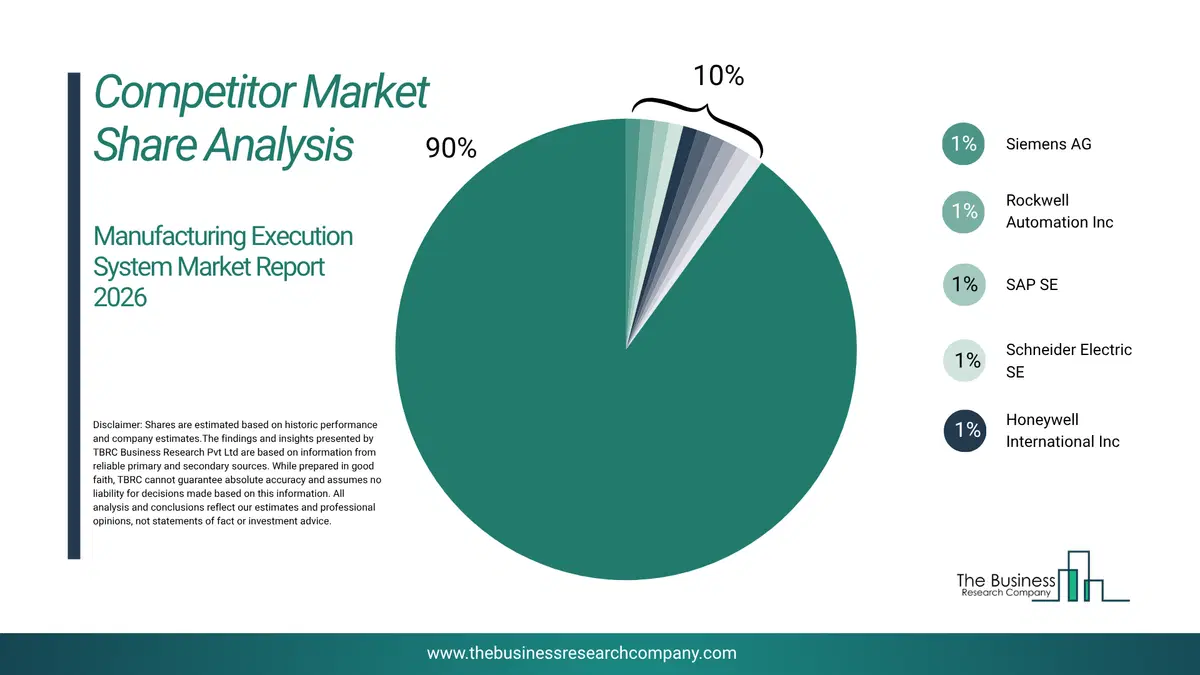
This chart is for illustrative purposes; the full report includes a detailed competitor analysis and comprehensive overview of the top 10 companies in the market.
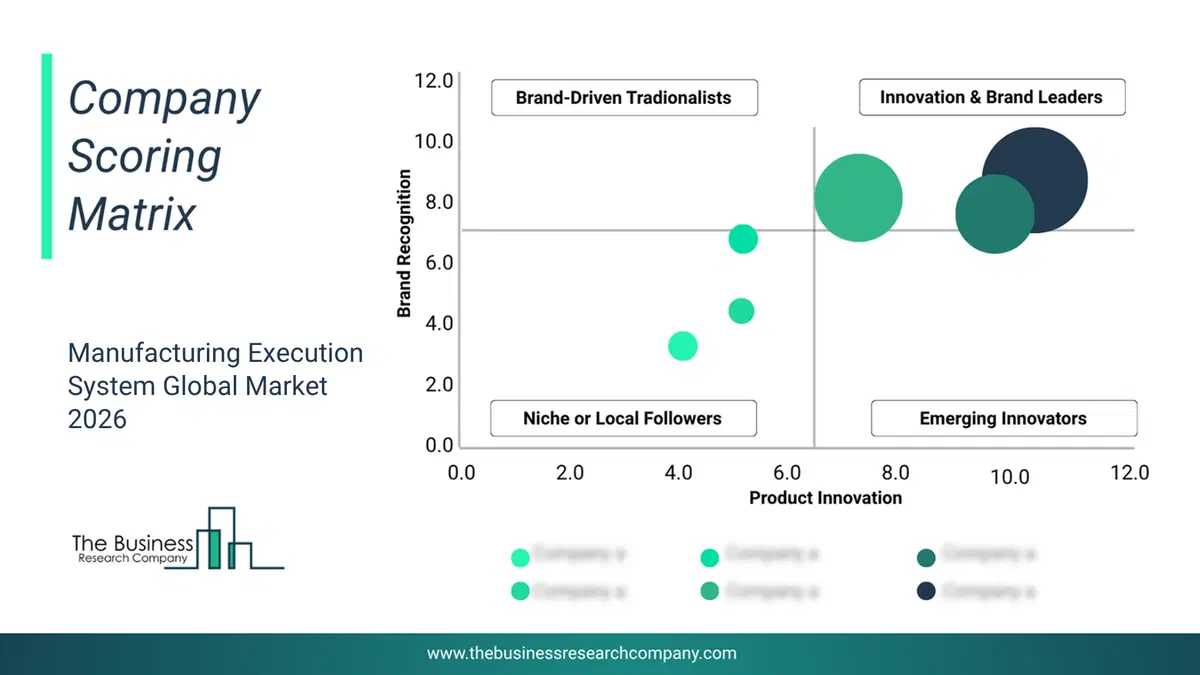
This chart maps companies by product innovation and brand strength, with bubble size indicating relative revenue, helping identify market leaders, challengers, and niche players. This is an illustrative chart; the full report provides a complete and accurate competitive analysis.
Global Manufacturing Execution System Market Trends and Insights
Major companies operating in the manufacturing execution system market are launching latest version of MES to address the need for improved operational efficiency. The latest MES (Manufacturing Execution System) version is the most current and up-to-date release of the software, providing the latest features, improvements, and bug fixes for managing and monitoring manufacturing processes. For instance, in February 2023, AVEVA, a UK-based corporate payment specialist, launched AVEVA Manufacturing Execution System 2023, which offers improvements for multi-site MES solutions, streamlining operational efficiency, sustainability, and supply chain resilience. This update allows for a single centrally deployed MES across various locations, reducing the total cost of ownership. It also incorporates worker shift management, enhanced security, and supports multi-site MES data centre deployments across different time zones, languages, and cultures. This release aims to help manufacturers achieve digital transformation and increased agility and resilience in a post-pandemic world.What Are Latest Mergers And Acquisitions In The Manufacturing Execution System Market?
In January 2023, Schneider Electric SE, a France-based provider of digital automation and energy management solutions, acquired AVEVA Group plc for approximately £9.48. Through this acquisition, Schneider Electric aims to consolidate AVEVA’s manufacturing execution system (MES), monitoring, and industrial software portfolio, including MES/MOM (ex-Wonderware), SCADA/HMI, and historian solutions, into a unified end-to-end stack, enhancing its ability to deliver integrated plant-floor and enterprise automation systems. AVEVA Group plc is a UK-based provider of industrial software solutions offering MES/MOM, digital twin, and cloud-based platforms serving manufacturing, energy, and process industries.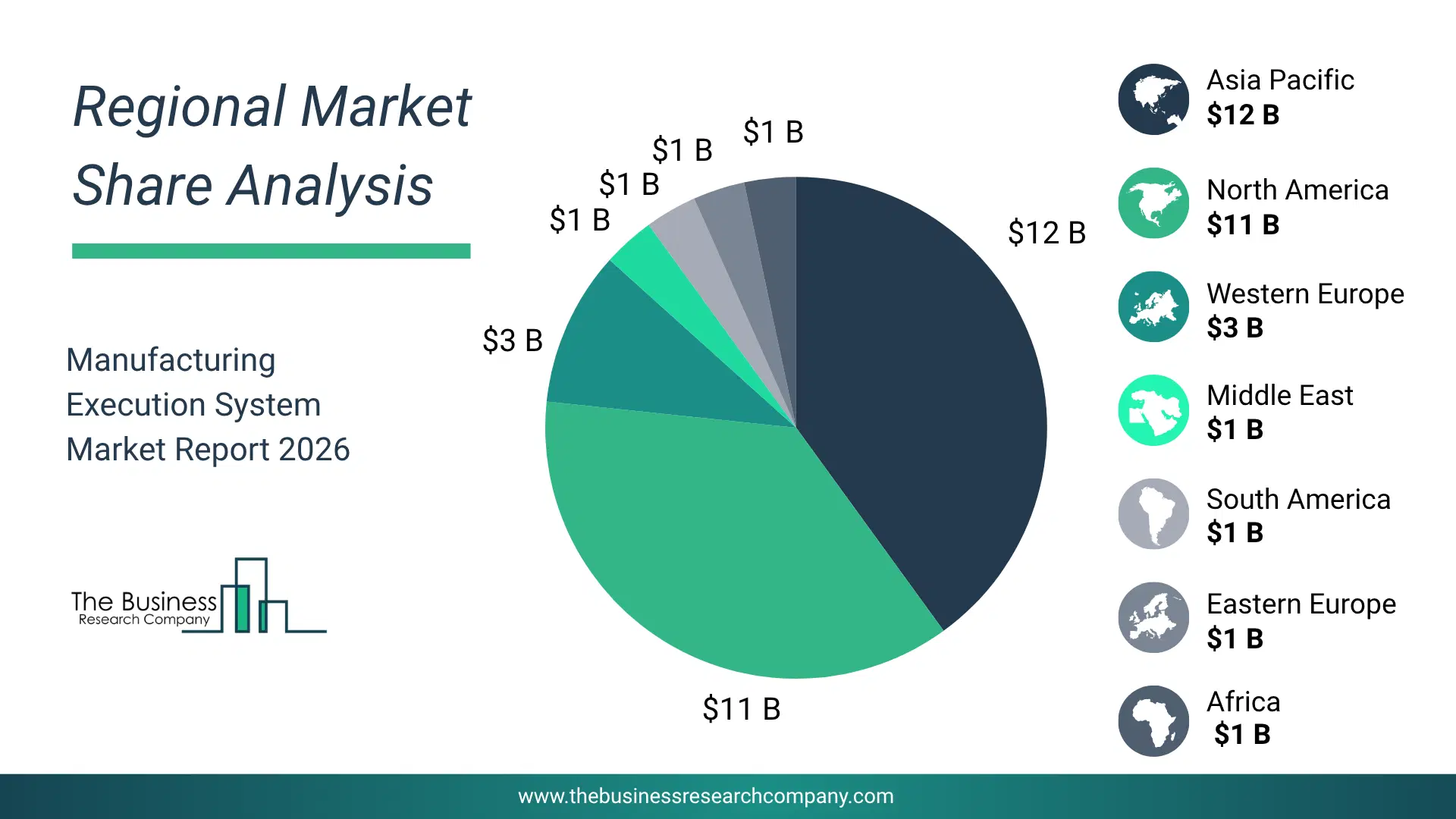
Regional Insights
Asia-Pacific was the largest region in the manufacturing execution system market in 2025. The regions covered in this market report are Asia-Pacific, South East Asia, Western Europe, Eastern Europe, North America, South America, Middle East, Africa. The countries covered in this market report are Australia, Brazil, China, France, Germany, India, Indonesia, Japan, Taiwan, Russia, South Korea, UK, USA, Canada, Italy, SpainWhat Defines the Manufacturing Execution System Market?
The manufacturing execution system market includes revenues earned by entities by providing services such as business planning and logistics, manufacturing operations management, process control systems, batch control, continuous control, discrete control. The market value includes the value of related goods sold by the service provider or included within the service offering. Only goods and services traded between entities or sold to end consumers are included.How is Market Value Defined and Measured?
The market value is defined as the revenues that enterprises gain from the sale of goods and/or services within the specified market and geography through sales, grants, or donations in terms of the currency (in USD unless otherwise specified). The revenues for a specified geography are consumption values that are revenues generated by organizations in the specified geography within the market, irrespective of where they are produced. It does not include revenues from resales along the supply chain, either further along the supply chain or as part of other products.
This chart presents market attractiveness based on a quantitative evaluation of growth, competition, strategic alignment, and risk, offering a clear view of opportunity areas for decision-making. This chart is for illustrative purposes; the full report contains the complete analysis.

This chart highlights the Total Addressable Market (TAM) by estimating the maximum revenue opportunity using an assumption-driven approach, supporting strategic planning and opportunity sizing across markets. The chart is illustrative; the full report provides a more comprehensive analysis.
What Key Data and Analysis Are Included in the Manufacturing Execution System Market Report 2026?
The manufacturing execution system market research report is one of a series of new reports from The Business Research Company that provides market statistics, including industry global market size, regional shares, competitors with the market share, detailed market segments, market trends and opportunities, and any further data you may need to thrive in the manufacturing execution system industry. The market research report delivers a complete perspective of everything you need, with an in-depth analysis of the current and future state of the industry.Manufacturing Execution System Market Report Forecast Analysis
| Report Attribute | Details |
|---|---|
| Market Size Value In 2026 | $19.04 billion |
| Revenue Forecast In 2030 | $30.96 billion |
| Growth Rate | CAGR of 13.2% from 2026 to 2030 |
| Base Year For Estimation | 2025 |
| Actual Estimates/Historical Data | 2020-2025 |
| Forecast Period | 2026 - 2030 |
| Market Representation | Revenue in USD Billion and CAGR from 2026 to 2030 |
| Segments Covered | Offering, Deployment, Organization Size, Process Industry |
| Regional Scope | Asia-Pacific, Western Europe, Eastern Europe, North America, South America, Middle East, Africa |
| Country Scope | The countries covered in the report are Australia, Brazil, China, France, Germany, India, Indonesia, Japan, Taiwan, Russia, South Korea, UK, USA, Canada, Italy, Spain. |
| Key Companies Profiled | ABB Ltd.; AVEVA Group plc; Dassault Systèmes; Honeywell International Inc.; Rockwell Automation Inc.; Siemens AG; Schneider Electric SE; Emerson Electric Co.; General Electric Company; Werum IT Solutions; Parsec Automation Corp.; PTC Inc.; Yokogawa Electric Corporation; SAP SE; Lighthouse Systems; Critical Manufacturing; Cogiscan Inc.; Andea Solutions; Plex Systems Inc.; L&T Technology Services; ATS Global B. V.; MPDV Mikrolab GmbH; CIMON Inc.; Prolink Technologies; Aegis Industrial Software Corporation |
| Customization Scope | Request for Customization |
| Pricing And Purchase Options | Explore Purchase Options |