
Marine Electric Vehicle Market Report 2026
Global Outlook – By Technology (Electric Propulsion Systems, Electric Motors, Energy Storage Systems, Charging Infrastructure), By Vessel-Size (Small Electric Boats (Up to 6 meters), Medium-Sized electric Boats (6-10 meters), Large Electric ships (Over 10 meters)), By Ownership (Rental And Charter Services, Individual Ownership), By Vehicle Type (Military Vehicle, Work Boat, Leisure And Tourist Surface Boat, Autonomous Underwater Vehicle, Other Vehicle Types), By Application (Leisure And Recreational, Commercial, Military) – Market Size, Trends, Strategies, and Forecast to 2030
Marine Electric Vehicle Market Overview
• Marine Electric Vehicle market size has reached to $11.84 billion in 2025 • Expected to grow to $21.27 billion in 2030 at a compound annual growth rate (CAGR) of 12.4% • Growth Driver: Rising Cruise Demand Fuels the Marine Electric Vehicle Market • Market Trend: Developing Innovative Products In Marine Electric Vehicles To Drive The Revenues • North America was the largest region in 2025 and Asia-Pacific is the fastest growing region.What Is Covered Under Marine Electric Vehicle Market?
Marine electric vehicles (MEVs) are a type of watercraft designed with electric propulsion as their primary power source. These vehicles utilize electrification and environmentally friendly alternatives that rely on internal combustion engines in the transportation sector, aiming to reduce emissions and environmental impacts in the maritime industry. It is used to operate on water bodies such as rivers, lakes, seas, and oceans. The main technologies in marine electric vehicles are electric propulsion systems, electric motors, energy storage systems, and charging infrastructure. Electric propulsion systems refer to a type of propulsion technology that uses electricity to generate thrust or propulsion for vehicles or vessels. The various vessel sizes include small electric boats (up to 6 meters), medium-sized electric boats (6-10 meters), and large electric ships (over 10 meters) with various ownerships such as rental and charter services, and individual ownership. The various vehicle types include military vehicles, work boats, leisure and tourist surface boats, autonomous underwater vehicles, and others. These are used in various applications such as leisure and recreational, commercial, and military.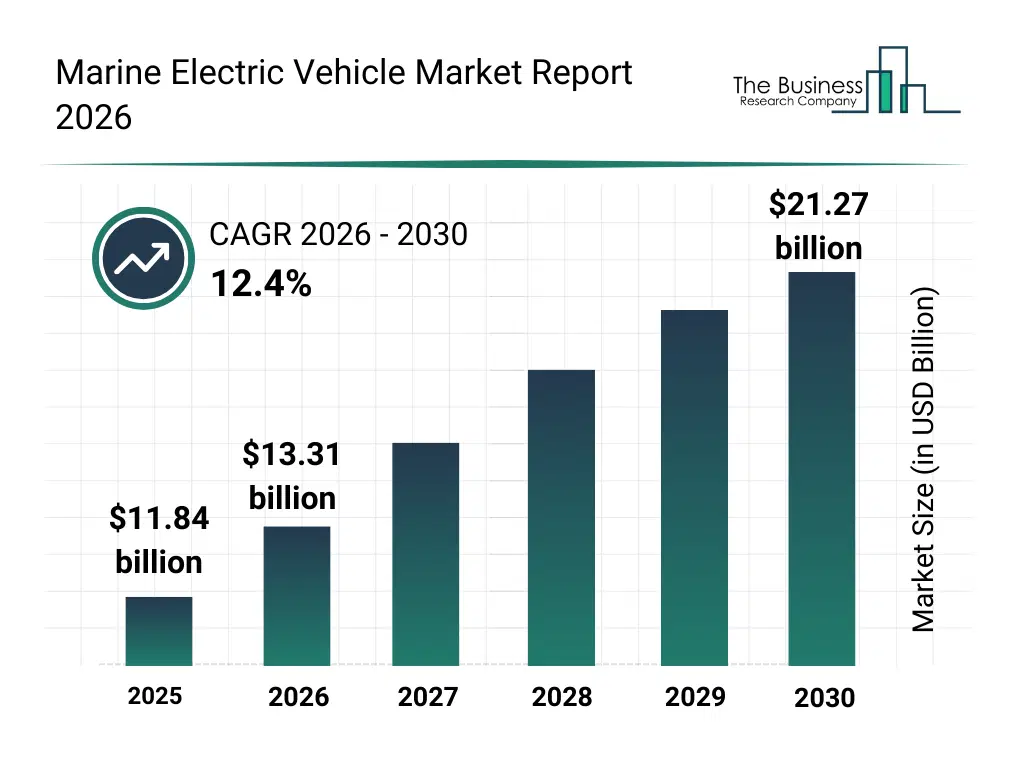
What Is The Marine Electric Vehicle Market Size and Share 2026?
The marine electric vehicle market size has grown rapidly in recent years. It will grow from $11.84 billion in 2025 to $13.31 billion in 2026 at a compound annual growth rate (CAGR) of 12.5%. The growth in the historic period can be attributed to environmental regulations in waterways, growth in electric propulsion technology, demand for low noise vessels, expansion of leisure boating, government sustainability initiatives.What Is The Marine Electric Vehicle Market Growth Forecast?
The marine electric vehicle market size is expected to see rapid growth in the next few years. It will grow to $21.27 billion in 2030 at a compound annual growth rate (CAGR) of 12.4%. The growth in the forecast period can be attributed to advancements in marine battery technology, expansion of electric ferries, growth in autonomous electric vessels, investment in green ports, adoption of fuel cell propulsion. Major trends in the forecast period include adoption of electric and hybrid marine propulsion, expansion of battery powered leisure boats, growth of shore charging infrastructure, demand for zero emission marine transport, integration of smart energy management systems.
Global Marine Electric Vehicle Market Segmentation
1) By Technology: Electric Propulsion Systems, Electric Motors, Energy Storage Systems, Charging Infrastructure 2) By Vessel-Size: Small Electric Boats (Up to 6 meters), Medium-Sized electric Boats (6-10 meters), Large Electric ships (Over 10 meters) 3) By Ownership: Rental And Charter Services, Individual Ownership 4) By Vehicle Type: Military Vehicle, Work Boat, Leisure And Tourist Surface Boat, Autonomous Underwater Vehicle, Other Vehicle Types 5) By Application: Leisure And Recreational, Commercial, Military Subsegments: 1) By Electric Propulsion Systems: Full Electric Propulsion, Hybrid Electric Propulsion, Fuel Cell Electric Propulsion 2) By Electric Motors: AC Motors, DC Motors, Permanent Magnet Motors 3) By Energy Storage Systems: Lithium-Ion Batteries, Lead-Acid Batteries, Solid-State Batteries, Supercapacitors 4) By Charging Infrastructure: Shore Power Charging Stations, Wireless Charging Systems, Onboard Charging SolutionsWhat Is The Driver Of The Marine Electric Vehicle Market?
The increasing demand for cruises is expected to propel the growth of the marine electric vehicle market going forward. Cruises refer to vacations or trips taken on cruise ships or cruise liners, which are large passenger vessels designed to offer a unique and enjoyable way to explore various destinations. Electric cruise ships are used as marine electric vehicles for passengers to provide and promote leisure, tourism, and transportation, encouraging eco-friendliness and reducing greenhouse gas emissions. For instance, in April 2023, according to the Cruise Lines International Association, a US-based trade association, British and Irish holidaymakers took around 1.7 million cruises, up from 479,000 the previous year. Therefore, the increasing demand for cruises is driving the growth of the marine electric vehicle industry.Key Players In The Global Marine Electric Vehicle Market
Major companies operating in the marine electric vehicle market report include ABB Ltd., Torqeedo GmbH, Corvus Energy Ltd., Duffy Electric Boat Company, Electrovaya Inc, Ruban Bleu, Saft, Triton Submarines LLC, BAE Systems, Kongsberg Gruppen, Vision Marine Technologies, Boesch Motorboote AG, Echandia Marine AB, Leclanché, WEG, Echandia Marine AB, Triton Submarines LLC, Azura Marine, Ruban Bleu, Elco Motor Yachts, Aquawatt, Alfastreet Marine, Rand Boats, Duffy Electric Boat Company, Boesch Motorboote AG, Aquon One, Iguana Yachts, Vita Power, Zin Boats, Crown Electric Ships and Boats
This chart is for illustrative purposes; the full report includes a detailed competitor analysis and comprehensive overview of the top 10 companies in the market.
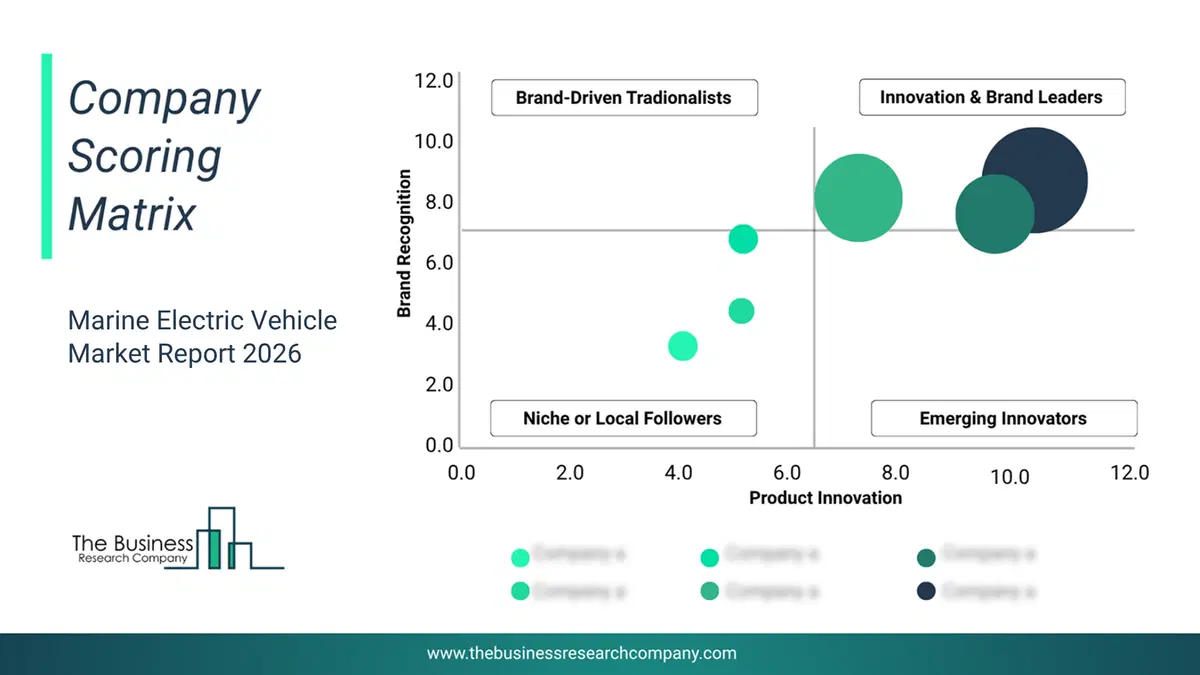
This chart maps companies by product innovation and brand strength, with bubble size indicating relative revenue, helping identify market leaders, challengers, and niche players. This is an illustrative chart; the full report provides a complete and accurate competitive analysis.
Global Marine Electric Vehicle Market Trends and Insights
Major companies operating in the marine electric vehicle market are focusing on the development of innovative products such as the Cheetah R630 to provide high-quality services to customers. The Cheetah R630 is the first electric RIB (rigid Inflatable Boat) with a highly efficient lightweight hull that saves fuel when propelled by a combustion engine but is easily converted to electric propulsion. For instance, in June 2023, Cheetah Marine, a UK-based company that designs and constructs power catamarans launched Cheetah R630. The Cheetah R630 is an electric vessel with a 6.3-meter (20 ft 6 in) rigid inflatable boat that is super-efficient and eco-friendly for the marine industry with sustainable boating. The Cheetah R630 electric vessel can also run on diesel or gasoline. It provides ample room for both passengers and equipment. The Cheetah R630 has fuel storage under the deck, which keeps the deck clear and clean.What Are Latest Mergers And Acquisitions In The Marine Electric Vehicle Market?
In January 2024, Yamaha Motor Co. Ltd., a Japan-based manufacturing company, acquired Torqeedo GmbH for an undisclosed amount. The aim of the acquisition is to enhance Yamaha Motor’s electric marine capabilities and accelerate its carbon neutrality goals within the Marine CASE Strategy. Torqeedo GmbH is a Germany-based manufacturing company that manufactures electric and hybrid propulsion systems for marine applications.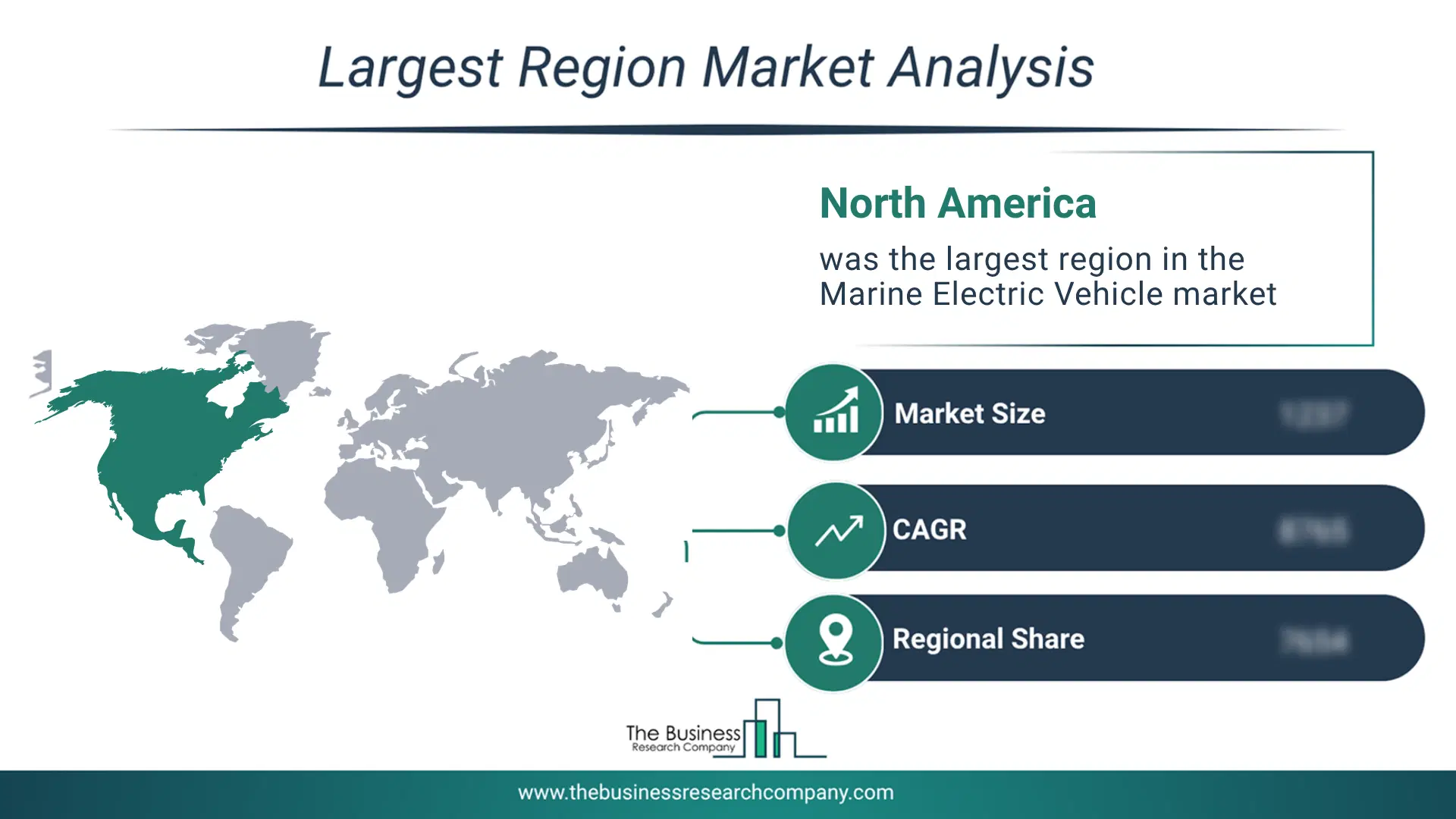
Regional Outlook
North America was the largest region in the marine electric vehicle market in 2025. Asia-Pacific is expected to be the fastest-growing region in the forecast period. The regions covered in this market report include Asia-Pacific, South East Asia, Western Europe, Eastern Europe, North America, South America, Middle East, Africa. The countries covered in this market report include Australia, Brazil, China, France, Germany, India, Indonesia, Japan, Taiwan, Russia, South Korea, UK, USA, Canada, Italy, SpainWhat Defines the Marine Electric Vehicle Market?
The marine electric vehicle market consists of revenues earned by entities by providing services such as charging infrastructure, repair services, and safety inspection. The market value includes the value of related goods sold by the service provider or included within the service offering. The marine electric vehicle market also includes sales of electric fishing boats, electric tugboats, and electric jet skis. Values in this market are ‘factory gate’ values, that is the value of goods sold by the manufacturers or creators of the goods, whether to other entities (including downstream manufacturers, wholesalers, distributors, and retailers) or directly to end customers. The value of goods in this market includes related services sold by the creators of the goods.How is Market Value Defined and Measured?
The market value is defined as the revenues that enterprises gain from the sale of goods and/or services within the specified market and geography through sales, grants, or donations in terms of the currency (in USD unless otherwise specified). The revenues for a specified geography are consumption values that are revenues generated by organizations in the specified geography within the market, irrespective of where they are produced. It does not include revenues from resales along the supply chain, either further along the supply chain or as part of other products.
This chart presents market attractiveness based on a quantitative evaluation of growth, competition, strategic alignment, and risk, offering a clear view of opportunity areas for decision-making. This chart is for illustrative purposes; the full report contains the complete analysis.

This chart highlights the Total Addressable Market (TAM) by estimating the maximum revenue opportunity using an assumption-driven approach, supporting strategic planning and opportunity sizing across markets. The chart is illustrative; the full report provides a more comprehensive analysis.
What Key Data and Analysis Are Included in the Marine Electric Vehicle Market Report 2026?
The marine electric vehicle market research report is one of a series of new reports from The Business Research Company that provides market statistics, including industry global market size, regional shares, competitors with the market share, detailed market segments, market trends and opportunities, and any further data you may need to thrive in the marine electric vehicle industry. The market research report delivers a complete perspective of everything you need, with an in-depth analysis of the current and future state of the industry.Marine Electric Vehicle Market Report Forecast Analysis
| Report Attribute | Details |
|---|---|
| Market Size Value In 2026 | $13.31 billion |
| Revenue Forecast In 2030 | $21.27 billion |
| Growth Rate | CAGR of 12.5% from 2026 to 2030 |
| Base Year For Estimation | 2025 |
| Actual Estimates/Historical Data | 2020-2025 |
| Forecast Period | 2026 - 2030 - 2030 |
| Market Representation | Revenue in USD Billion and CAGR from 2026 to 2030 |
| Segments Covered | Technology, Vessel-Size, Ownership, Vehicle Type, Application |
| Regional Scope | Asia-Pacific, Western Europe, Eastern Europe, North America, South America, Middle East, Africa |
| Country Scope | The countries covered in the report are Australia, Brazil, China, France, Germany, India, Indonesia, Japan, Taiwan, Russia, South Korea, UK, USA, Canada, Italy, Spain. |
| Key Companies Profiled | ABB Ltd., Torqeedo GmbH, Corvus Energy Ltd., Duffy Electric Boat Company, Electrovaya Inc, Ruban Bleu, Saft, Triton Submarines LLC, BAE Systems, Kongsberg Gruppen, Vision Marine Technologies, Boesch Motorboote AG, Echandia Marine AB, Leclanché, WEG, Echandia Marine AB, Triton Submarines LLC, Azura Marine, Ruban Bleu, Elco Motor Yachts, Aquawatt, Alfastreet Marine, Rand Boats, Duffy Electric Boat Company, Boesch Motorboote AG, Aquon One, Iguana Yachts, Vita Power, Zin Boats, Crown Electric Ships and Boats |
| Customization Scope | Request for Customization |
| Pricing And Purchase Options | Explore Purchase Options |