
Marine Electronics Tester Market Report 2026
Global Outlook – By Testing Type (Radio Frequency Testing, Electromagnetic Compatibility Testing, Environmental Testing, Performance Testing, Calibration Testing), By Product Type (Multimeters, Oscilloscopes, Spectrum Analyzers, Network Analyzers, Other Product Types), By Distribution Channel (Online Stores, Specialty Stores, Other Distribution Channels), By Application (Commercial Shipping, Recreational Boating, Naval Defense, Other Applications), By End User (Shipbuilders, Maintenance And Repair Companies, Other End Users) – Market Size, Trends, Strategies, and Forecast to 2030
Marine Electronics Tester Market Overview
• Marine Electronics Tester market size has reached to $5.45 billion in 2025 • Expected to grow to $7.41 billion in 2030 at a compound annual growth rate (CAGR) of 6.3% • Growth Driver: Rise In Global Maritime Trade Fueling The Growth Of The Market Due To Increasing Demand For Reliable Navigation And Communication System Testing • Market Trend: Advancements In Portable And Compact Marine Communication Testing Solutions For Enhanced Maritime Diagnostics • North America was the largest region in 2025 and Asia-Pacific is the fastest growing region.What Is Covered Under Marine Electronics Tester Market?
The marine electronics testers are specialized devices used to evaluate, inspect, and troubleshoot electronic and electrical systems installed on marine vessels. They help ensure the accuracy, reliability, and proper functioning of onboard systems operating in harsh marine environments. The marine electronics tester supports preventive maintenance, fault detection, and performance verification to enhance vessel safety and operational efficiency across marine applications. The main testing types of marine electronics tester include radio frequency testing, electromagnetic compatibility testing, environmental testing, performance testing, and calibration testing. Radio frequency testing refers to the evaluation of marine electronic systems to ensure proper signal transmission and communication performance in maritime environments. These testing solutions are based on product types including multimeters, oscilloscopes, spectrum analyzers, network analyzers, and other product types and are distributed through online stores, specialty stores, and other distribution channels. The various applications involved are commercial shipping, recreational boating, naval defense, and others, and they are utilized by end users including shipbuilders, maintenance and repair companies, and others.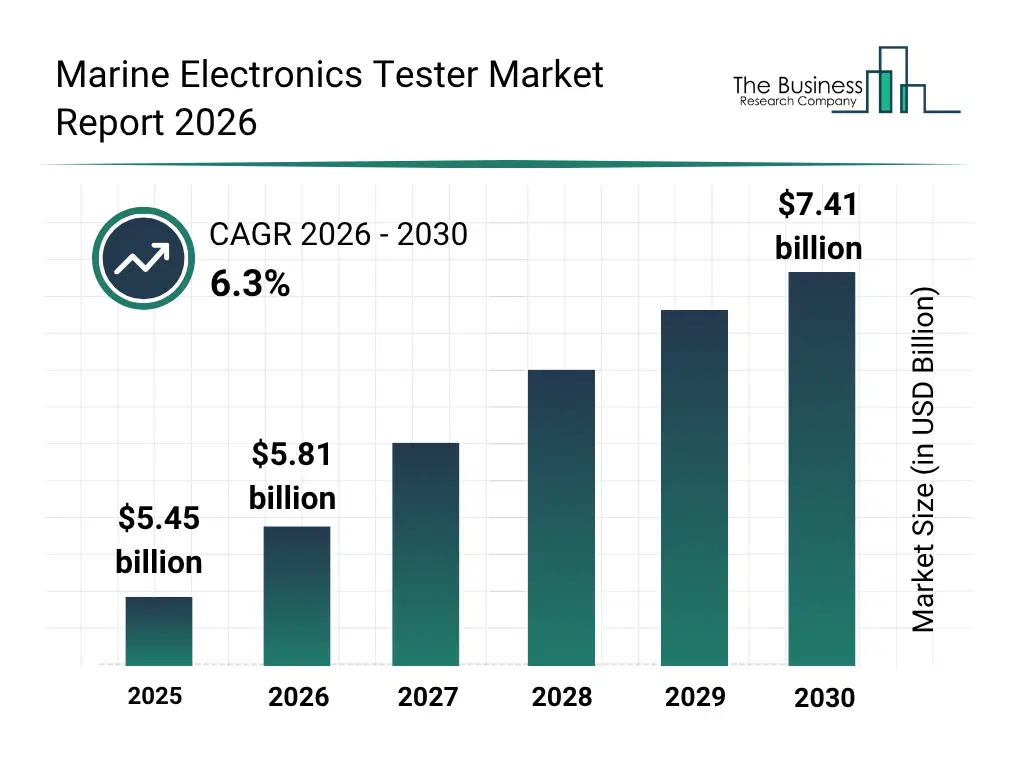
What Is The Marine Electronics Tester Market Size and Share 2026?
The marine electronics tester market size has grown strongly in recent years. It will grow from $5.45 billion in 2025 to $5.81 billion in 2026 at a compound annual growth rate (CAGR) of 6.7%. The growth in the historic period can be attributed to growth in global commercial shipping activities, increasing installation of marine navigation and communication systems, rising emphasis on maritime safety compliance, expansion of naval fleet modernization programs, growing demand for preventive maintenance of vessel electronics.What Is The Marine Electronics Tester Market Growth Forecast?
The marine electronics tester market size is expected to see strong growth in the next few years. It will grow to $7.41 billion in 2030 at a compound annual growth rate (CAGR) of 6.3%. The growth in the forecast period can be attributed to increasing deployment of smart ship technologies, rising investments in autonomous vessel development, growing adoption of connected marine electronic systems, expansion of offshore energy and marine infrastructure projects, increasing demand for advanced electronic testing and calibration solutions. Major trends in the forecast period include increasing integration of wireless diagnostic capabilities in marine electronics testers, growing demand for portable and ruggedized testing equipment for onboard inspections, rising adoption of multi-function marine electronics testing devices, expanding focus on predictive maintenance for vessel electronic systems, increasing use of high-precision calibration solutions for navigation and communication equipment.
Global Marine Electronics Tester Market Segmentation
1) By Testing Type: Radio Frequency Testing; Electromagnetic Compatibility Testing; Environmental Testing; Performance Testing; Calibration Testing 2) By Product Type: Multimeters; Oscilloscopes; Spectrum Analyzers; Network Analyzers; Other Product Types 3) By Distribution Channel: Online Stores; Specialty Stores; Other Distribution Channels 4) By Application: Commercial Shipping; Recreational Boating; Naval Defense; Other Applications 5) By End User: Shipbuilders; Maintenance And Repair Companies; Other End Users Subsegments: 1) By Radio Frequency Testing: Signal Integrity Testing; Antenna Performance Testing; Frequency Response Testing; Spectrum Analysis Testing; Transmission Power Testing 2) By Electromagnetic Compatibility Testing: Emission Testing; Immunity Testing; Electrostatic Discharge Testing; Radiated Susceptibility Testing; Conducted Interference Testing 3) By Environmental Testing: Temperature Testing; Humidity Testing; Vibration Testing; Salt Spray Testing; Shock Resistance Testing 4) By Performance Testing: Functional Testing; Load Testing; Navigation Accuracy Testing; Communication Reliability Testing; Power Efficiency Testing 5) By Calibration Testing: Voltage Calibration; Frequency Calibration; Sensor Calibration; Signal Calibration; Instrument Accuracy CalibrationWhat Are The Drivers Of The Marine Electronics Tester Market?
The rising global maritime trade activities are expected to propel the growth of the marine electronics tester market going forward. Global maritime trade refers to the large-scale movement of goods and commodities across international waters through shipping networks that support economic exchange between countries. Global maritime trade activities are rising due to increasing global demand for the international transportation of raw materials, manufactured goods, and consumer products, driven by expanding cross-border trade and globalization. A marine electronics tester supports global maritime trade activities by ensuring reliable performance, safety compliance, and operational efficiency of onboard electronic systems used in navigation and communication. For instance, in July 2024, according to the United Nations Conference on Trade and Development (UNCTAD), a Switzerland-based intergovernmental organization, maritime trade volumes reached 12,292 million tons in 2023, marking a 2.4 percent increase after contracting in 2022. Therefore, the rise in global maritime trade activities is driving the growth of the marine electronics tester industry. The growing digitalization and automation in maritime operations are expected to propel the growth of the marine electronics tester market going forward. Digitalization and automation in maritime operations refer to the integration of advanced technologies such as artificial intelligence (AI), blockchain, Internet of Things (IoT), and automated systems into shipping, port management, and vessel operations to enhance efficiency, safety, and decision-making. The growing digitalization and automation in maritime operations due to the rising complexity of global shipping networks, increasing trade volumes, route disruptions, and stricter regulations are accelerating the adoption of advanced tools for improved operational precision and reduced human error. This accelerating shift toward intelligent, connected maritime infrastructure directly increases the demand for sophisticated marine electronics testing equipment to ensure the reliability, accuracy, and compliance of onboard and port-based electronic systems. For instance, according to the Review of Maritime Transport 2024 published by the United Nations Conference on Trade and Development (UNCTAD), a Switzerland-based intergovernmental organization, there was a record of almost 250,000 port calls by container ships in the second half of 2023, while digitalization through blockchain, AI, and automation was identified as key to improving port operations, with ports adopting these technologies reporting reduced waiting times and more efficient transshipment. Therefore, growing digitalization and automation in maritime operations are driving the growth of the marine electronics tester industry.Key Players In The Global Marine Electronics Tester Market
Major companies operating in the marine electronics tester market are Garmin Ltd.; Keysight Technologies Inc.; Teledyne Technologies Incorporated; Rohde & Schwarz GmbH & Co. KG; Fluke Corporation; Tektronix Inc.; Yokogawa Electric Corporation; Anritsu Corporation; VIAVI Solutions Inc.; Furuno Electric Co. Ltd.; Japan Radio Co. Ltd. (JRC); Megger Group Limited; Chauvin Arnoux Group; Hioki E.E. Corporation; Uni-Trend Technology (UNI-T); Rigol Technologies Co. Ltd.; GW Instek (Good Will Instrument); Simrad Yachting (Navico Group / Brunswick); Siglent Technologies Co. Ltd.; IKM Instrutek AS; B&K Precision Corporation; Owon Technology Inc.; Hantek Electronics Co. Ltd.Global Marine Electronics Tester Market Trends and Insights
Major companies operating in the marine electronics tester market are focusing on developing portable and compact marine testing equipment to enhance diagnostic accuracy, onboard system reliability, operational efficiency, and ease of maintenance across commercial and recreational marine vessels. Portable and compact marine testing equipment refers to lightweight, easy-to-carry diagnostic and measurement devices designed for onboard inspection, maintenance, and performance testing of marine systems and components. For instance, in November 2025, GMDSS Testers, a Serbia-based manufacturing company, introduced MRTS-7 Pro and Beacon Tester Pro to enhance marine communication diagnostics, improve emergency beacon testing accuracy, and support efficient maintenance of maritime safety and navigation systems. The MRTS-7 Pro and Beacon Tester Pro feature portable and compact designs that support fast onboard diagnostics and simplified field testing of marine communication and emergency beacon systems.Regional Outlook
North America was the largest region in the marine electronics tester market in 2025. Asia-Pacific is expected to be the fastest-growing region in the forecast period. The regions covered in this market report are Asia-Pacific, South East Asia, Western Europe, Eastern Europe, North America, South America, Middle East, Africa. The countries covered in this market report are Australia, Brazil, China, France, Germany, India, Indonesia, Japan, Taiwan, Russia, South Korea, UK, USA, Canada, Italy, Spain.What Defines the Marine Electronics Tester Market?
The marine electronics tester market consists of sales of sound navigation and ranging (sonar) testers, very high frequency (VHF) communication device testers, global positioning system (GPS) and radar testers, acoustic beacon testers, and National Marine Electronics Association (NMEA) data testers. Values in this market are ‘factory gate’ values, that is, the value of goods sold by the manufacturers or creators of the goods, whether to other entities (including downstream manufacturers, wholesalers, distributors, and retailers) or directly to end customers. The value of goods in this market includes related services sold by the creators of the goods.How is Market Value Defined and Measured?
The market value is defined as the revenues that enterprises gain from the sale of goods and/or services within the specified market and geography through sales, grants, or donations in terms of the currency (in USD unless otherwise specified). The revenues for a specified geography are consumption values that are revenues generated by organizations in the specified geography within the market, irrespective of where they are produced. It does not include revenues from resales along the supply chain, either further along the supply chain or as part of other products.What Key Data and Analysis Are Included in the Marine Electronics Tester Market Report 2026?
The marine electronics tester market research report is one of a series of new reports from The Business Research Company that provides market statistics, including industry global market size, regional shares, competitors with the market share, detailed market segments, market trends and opportunities, and any further data you may need to thrive in the marine electronics tester industry. The market research report delivers a complete perspective of everything you need, with an in-depth analysis of the current and future state of the industry.Marine Electronics Tester Market Report Forecast Analysis
| Report Attribute | Details |
|---|---|
| Market Size Value In 2026 | $5.81 billion |
| Revenue Forecast In 2030 | $7.41 billion |
| Growth Rate | CAGR of 6.3% from 2026 to 2030 |
| Base Year For Estimation | 2025 |
| Actual Estimates/Historical Data | 2020-2025 |
| Forecast Period | 2026 - 2030 |
| Market Representation | Revenue in USD Billion and CAGR from 2026 to 2030 |
| Segments Covered | Testing Type, Product Type, Distribution Channel, Application, End User |
| Regional Scope | Asia-Pacific, Western Europe, Eastern Europe, North America, South America, Middle East, Africa |
| Country Scope | The countries covered in the report are Australia, Brazil, China, France, Germany, India, ... |
| Key Companies Profiled | Garmin Ltd.; Keysight Technologies Inc.; Teledyne Technologies Incorporated; Rohde & Schwarz GmbH & Co. KG; Fluke Corporation; Tektronix Inc.; Yokogawa Electric Corporation; Anritsu Corporation; VIAVI Solutions Inc.; Furuno Electric Co. Ltd.; Japan Radio Co. Ltd. (JRC); Megger Group Limited; Chauvin Arnoux Group; Hioki E.E. Corporation; Uni-Trend Technology (UNI-T); Rigol Technologies Co. Ltd.; GW Instek (Good Will Instrument); Simrad Yachting (Navico Group / Brunswick); Siglent Technologies Co. Ltd.; IKM Instrutek AS; B&K Precision Corporation; Owon Technology Inc.; Hantek Electronics Co. Ltd. |
| Customization Scope | Request for Customization |
| Pricing And Purchase Options | Explore Purchase Options |