
Marine Fuel Optimization Market Report 2026
Global Outlook – By Type Of Vessel (Container Ships, Tankers, Bulk Carriers, Fishing Vessels), By Technology (Throttle Optimization, Fuel Theft Detection, Tanks Level Monitoring, Other Technologies), By Application (Fuel Consumption, Fleet Management, Cross Fleet Standardization, Other Applications), By End User (Transportation And Shipping, Offshore Industry, Fishing Industry, Naval And Defense) – Market Size, Trends, Strategies, and Forecast to 2030
Marine Fuel Optimization Market Overview
• Marine Fuel Optimization market size has reached to $13.69 billion in 2025 • Expected to grow to $24.63 billion in 2030 at a compound annual growth rate (CAGR) of 12% • Growth Driver: Marine Fuel Optimization In Response To Increasing Fuel Expenses • Market Trend: Introduction of AI-Powered Ship Operation Support Systems to Enhance Marine Fuel Efficiency • North America was the largest region in 2025 and Asia-Pacific is the fastest growing region.What Is Covered Under Marine Fuel Optimization Market?
Marine fuel optimisation refers to the process of maximising the efficiency and effectiveness of fuel usage within the maritime industry. It employs various strategies and technologies to minimise fuel consumption while maintaining or enhancing operational performance. This optimisation can encompass a range of factors, including vessel design, propulsion systems, route planning, speed optimisation, fuel quality management, and operational practices. The primary goals of marine fuel optimisation typically include reducing fuel costs, lowering emissions, and ensuring compliance with environmental regulations. The main types of vessels for marine fuel optimisation are container ships, tankers, bulk carriers, and fishing vessels. Container ships are vessels specifically designed to transport containers, facilitating global trade by efficiently transporting goods across oceans and seas. Various technologies include throttle optimisation, fuel theft detection, tank level monitoring, and others used in different applications such as fuel consumption, fleet management, cross-fleet standardisation, and others for industries of end users, which include transportation and shipping, offshore industry, fishing industry, naval, and defence.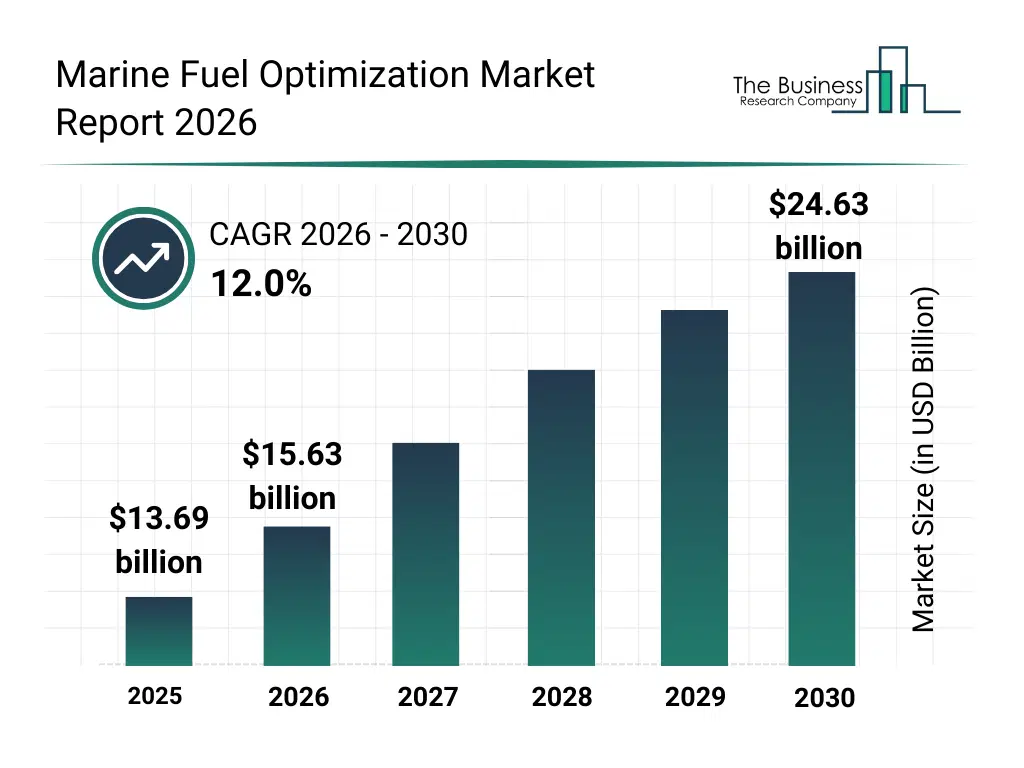
What Is The Marine Fuel Optimization Market Size and Share 2026?
The marine fuel optimization market size has grown rapidly in recent years. It will grow from $13.69 billion in 2025 to $15.63 billion in 2026 at a compound annual growth rate (CAGR) of 14.2%. The growth in the historic period can be attributed to rising marine fuel costs, increased focus on operational efficiency, early adoption of fleet management systems, growing fuel consumption monitoring needs, expansion of global shipping activities.What Is The Marine Fuel Optimization Market Growth Forecast?
The marine fuel optimization market size is expected to see rapid growth in the next few years. It will grow to $24.63 billion in 2030 at a compound annual growth rate (CAGR) of 12.0%. The growth in the forecast period can be attributed to stringent emission regulations, increasing adoption of digital vessel solutions, growth in autonomous vessel operations, demand for carbon footprint reduction, expansion of smart shipping technologies. Major trends in the forecast period include real-time fuel consumption monitoring, route and speed optimization systems, integrated fleet fuel analytics, operational efficiency management, regulatory-compliant fuel optimization.
Global Marine Fuel Optimization Market Segmentation
1) By Type Of Vessel: Container Ships, Tankers, Bulk Carriers, Fishing Vessels 2) By Technology: Throttle Optimization, Fuel Theft Detection, Tanks Level Monitoring, Other Technologies 3) By Application: Fuel Consumption, Fleet Management, Cross Fleet Standardization, Other Applications 4) By End User: Transportation And Shipping, Offshore Industry, Fishing Industry, Naval And Defense Subsegments: 1) By Container Ships: Large Container Ships, Medium-Sized Container Ships, Small Container Ships 2) By Tankers: Crude Oil Tankers, Product Tankers, LNG (Liquefied Natural Gas) Tankers, Chemical Tankers 3) By Bulk Carriers: Dry Bulk Carriers, Wet Bulk Carriers 4) By Fishing Vessels: Commercial Fishing Vessels, Industrial Fishing Vessels, Small-Scale Fishing VesselsWhat Is The Driver Of The Marine Fuel Optimization Market?
The rising fuel costs are expected to propel the growth of the marine fuel optimisation market going forward. Fuel costs are the expenses incurred by an individual, business, or organisation when purchasing fuel, such as gasoline, diesel, natural gas, or other energy sources, to power cars, machinery, equipment, or facilities. Rising fuel costs stem from political instability or conflicts in major oil-producing regions, which disrupt the supply of crude oil and subsequently drive up prices for marine fuel. Marine fuel optimisation assists in minimising the effects of growing fuel costs by improving fuel economy, optimising routes, modifying trim, monitoring fuel usage in real-time, and maintaining compliance with environmental requirements. For instance, in January 2024, according to the National Institute of Statistics and Economic Studies, a France-based government agency, the cost of heavy fuel oil rose from $362.7 per ton in December 2022 to $428.0 per ton in December 2023, reflecting an increase of 18%. Therefore, rising fuel costs are driving the growth of the marine fuel optimisation market.Key Players In The Global Marine Fuel Optimization Market
Major companies operating in the marine fuel optimization market are Siemens AG; General Electric Company; Caterpillar Inc.; Honeywell International Inc.; ABB Ltd.; Rolls-Royce Holdings plc; Emerson Electric Co.; Wärtsilä Corporation; Alfa Laval AB; MAN Energy Solutions SE; Trimble Inc.; Kongsberg Maritime AS; DNV GL AS; Lloyds Register Group Limited; NAVTOR; MarineTraffic; Royston Limited; Banlaw Pty Ltd; ZeroNorth A/S; METIS Cyberspace Technology; MESPAS AG; FuelTrax; Krill Systems Inc.; Bergan Marine Systems; Marine Digital GmbH
This chart is for illustrative purposes; the full report includes a detailed competitor analysis and comprehensive overview of the top 10 companies in the market.
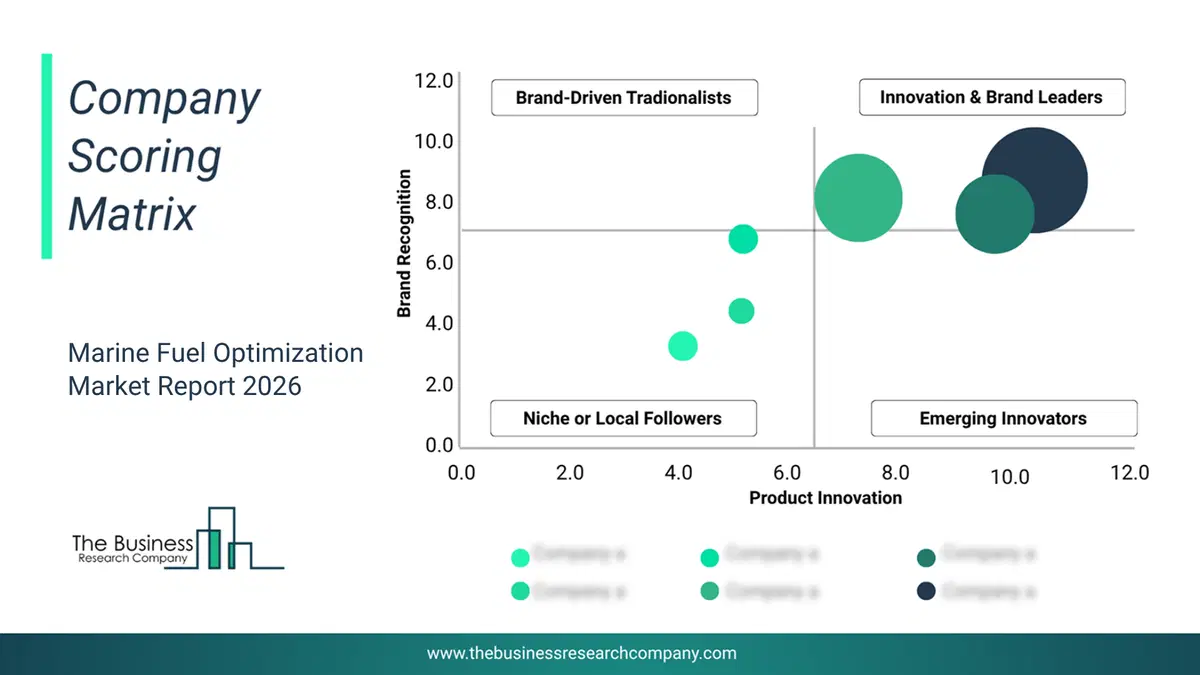
This chart maps companies by product innovation and brand strength, with bubble size indicating relative revenue, helping identify market leaders, challengers, and niche players. This is an illustrative chart; the full report provides a complete and accurate competitive analysis.
Global Marine Fuel Optimization Market Trends and Insights
Major companies operating in the marine fuel optimisation market are focusing on developing advanced solutions, such as AI-powered ship operation support systems, to enhance vessel efficiency, reduce fuel consumption, and minimise emissions. A ship operation support system refers to software that integrates vessel, environmental, and engine-performance data to optimise route, speed, and propulsion settings in real time. For instance, in February 2025, SmartSea, a Cyprus-based maritime technology company, and Digital Energy AI, a UAE-based artificial intelligence solutions provider, announced a collaboration aimed at enabling shipowners and operators to optimise their vessels’ fuel consumption and lower harmful pollutant emissions using AI-driven platforms. Designed to enhance operational efficiency and sustainability, this partnership supports the growing adoption of intelligent marine optimisation technologies across the global shipping industry.What Are Latest Mergers And Acquisitions In The Marine Fuel Optimization Market?
In January 2024, ZeroNorth Inc., a Denmark-based provider of voyage, vessel, and fuel-optimisation software, acquired Euronav’s Fleet Automatic Statistics and Tracking (FAST) platform for an undisclosed amount. Through this acquisition, ZeroNorth aims to enhance its fuel and voyage optimisation capabilities by integrating FAST’s high-frequency, sensor-derived fleet data, accelerating product development, and strengthening its sustainability and decarbonization offerings for large tanker operators. Euronav NV is a Belgium-based tanker shipping company that developed the FAST platform to collect real-time sensor data for ship reporting, voyage optimisation, fuel-use reduction, and operational collaboration.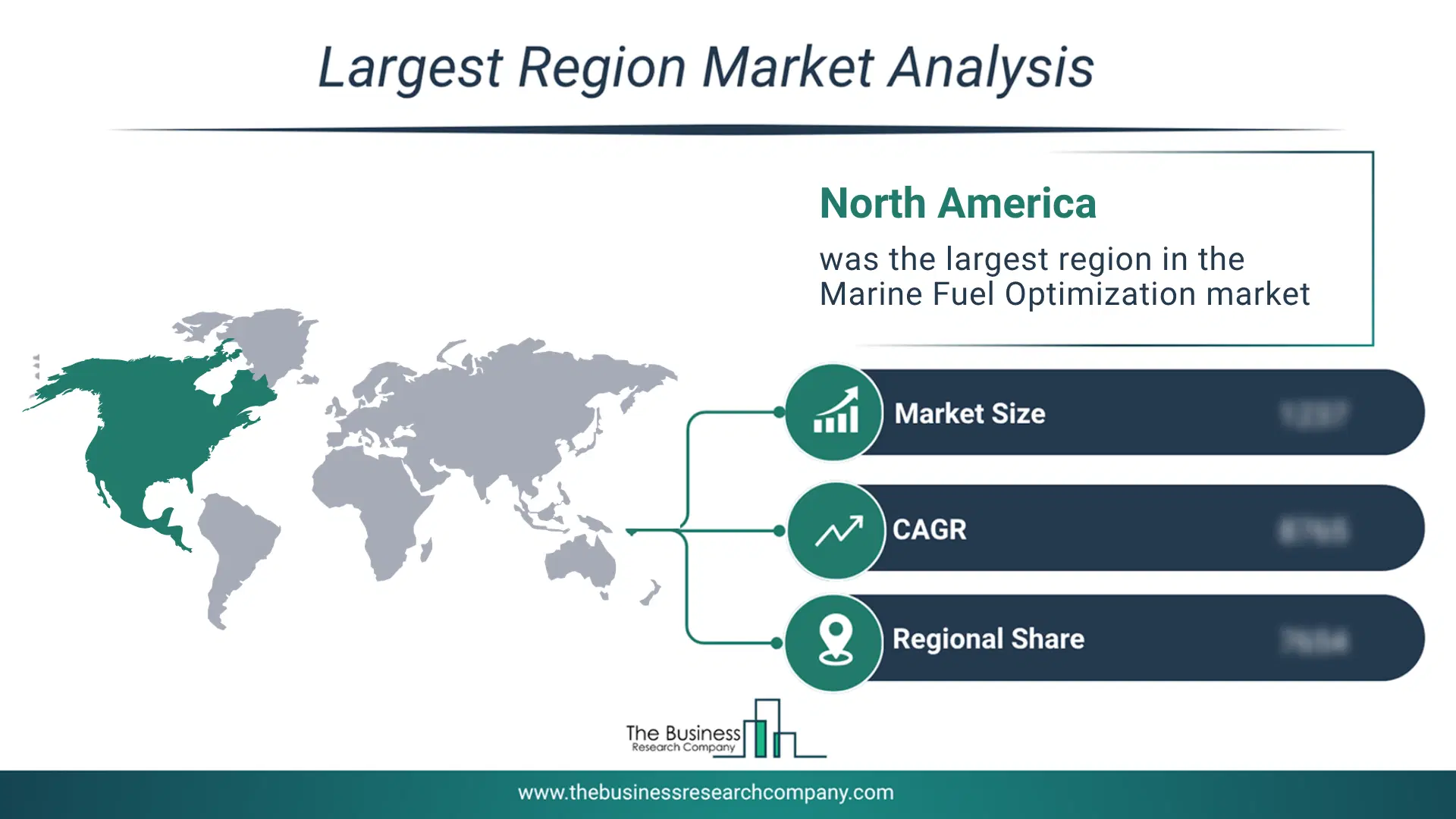
Regional Insights
North America was the largest region in the marine fuel optimisation market in 2025. Asia-Pacific is expected to be the fastest-growing region in the forecast period. The regions covered in this market report are Asia-Pacific, South East Asia, Western Europe, Eastern Europe, North America, South America, Middle East, Africa. The countries covered in this market report are Australia, Brazil, China, France, Germany, India, Indonesia, Japan, Taiwan, Russia, South Korea, UK, USA, Canada, Italy, SpainWhat Defines the Marine Fuel Optimization Market?
The marine fuel optimisation market consists of revenues earned by entities providing services such as route optimisation, real-time monitoring, and fuel management. The market value includes the value of related goods sold by the service provider or included within the service offering. The marine fuel optimisation market also includes sales of bunker management systems, fuel monitoring systems, and propulsion efficiency systems. Values in this market are ‘factory gate’ values, that is, the value of goods sold by the manufacturers or creators of the goods, whether to other entities (including downstream manufacturers, wholesalers, distributors, and retailers) or directly to end customers. The value of goods in this market includes related services sold by the creators of the goods.How is Market Value Defined and Measured?
The market value is defined as the revenues that enterprises gain from the sale of goods and/or services within the specified market and geography through sales, grants, or donations in terms of the currency (in USD unless otherwise specified). The revenues for a specified geography are consumption values that are revenues generated by organizations in the specified geography within the market, irrespective of where they are produced. It does not include revenues from resales along the supply chain, either further along the supply chain or as part of other products.
This chart presents market attractiveness based on a quantitative evaluation of growth, competition, strategic alignment, and risk, offering a clear view of opportunity areas for decision-making. This chart is for illustrative purposes; the full report contains the complete analysis.

This chart highlights the Total Addressable Market (TAM) by estimating the maximum revenue opportunity using an assumption-driven approach, supporting strategic planning and opportunity sizing across markets. The chart is illustrative; the full report provides a more comprehensive analysis.
What Key Data and Analysis Are Included in the Marine Fuel Optimization Market Report 2026?
The marine fuel optimization market research report is one of a series of new reports from The Business Research Company that provides market statistics, including industry global market size, regional shares, competitors with the market share, detailed market segments, market trends and opportunities, and any further data you may need to thrive in the marine fuel optimization industry. The market research report delivers a complete perspective of everything you need, with an in-depth analysis of the current and future state of the industry.Marine Fuel Optimization Market Report Forecast Analysis
| Report Attribute | Details |
|---|---|
| Market Size Value In 2026 | $15.63 billion |
| Revenue Forecast In 2030 | $24.63 billion |
| Growth Rate | CAGR of 12% from 2026 to 2030 |
| Base Year For Estimation | 2025 |
| Actual Estimates/Historical Data | 2020-2025 |
| Forecast Period | 2026 - 2030 |
| Market Representation | Revenue in USD Billion and CAGR from 2026 to 2030 |
| Segments Covered | Type Of Vessel, Technology, Application, End User |
| Regional Scope | Asia-Pacific, Western Europe, Eastern Europe, North America, South America, Middle East, Africa |
| Country Scope | The Countries Covered In This Market Report Are Australia, Brazil, China, France, Germany, India, Indonesia, Japan, Taiwan, Russia, South Korea, Uk, Usa, Canada, Italy, Spain. |
| Key Companies Profiled | Siemens AG, General Electric Company, Caterpillar Inc., Honeywell International Inc., ABB Ltd., Rolls-Royce Holdings plc, Emerson Electric Co., Wärtsilä Corporation, Alfa Laval AB, MAN Energy Solutions SE, Trimble Inc., Kongsberg Maritime AS, DNV GL AS, Lloyds Register Group Limited, NAVTOR, MarineTraffic, Royston Limited, Banlaw Pty Ltd, ZeroNorth A/S, METIS Cyberspace Technology, MESPAS AG, FuelTrax, Krill Systems Inc., Bergan Marine Systems, Marine Digital GmbH |
| Customization Scope | Request for Customization |
| Pricing And Purchase Options | Explore Purchase Options |