
Marine Inertial Navigation Systems Market Report 2026
Global Outlook – By Type (Ring Laser Gyroscope (RLG), Fiber Optic Gyroscope (FOG), Micro-Electro-Mechanical Systems (MEMS), Quantum Inertial Navigation System, Accelerometer-Based Systems), By System Type (Standalone Systems, Integrated Systems, High-Accuracy Systems, Low-Cost Systems), By Application (Aerospace, Marine, Land, Submersible, Missile Guidance), By End-User (Shipbuilders, Commercial Shipping Companies, Defense Agencies, Research Institutions, Offshore Drilling Companies) – Market Size, Trends, Strategies, and Forecast to 2030
Marine Inertial Navigation Systems Market Overview
• Marine Inertial Navigation Systems market size has reached to $9.44 billion in 2025 • Expected to grow to $12.6 billion in 2030 at a compound annual growth rate (CAGR) of 5.9% • Growth Driver: Increasing Offshore Oil And Gas Exploration Fueling The Growth Of The Market Due To Rising Need For Accurate Vessel Positioning In Remote Marine Environments • Market Trend: Advancements In GNSS-Aided Inertial Navigation Enhancing Precision And Reliability In Marine Operations • Asia-Pacific was the largest region and fastest growing region.What Is Covered Under Marine Inertial Navigation Systems Market?
Marine inertial navigation systems refer to advanced onboard navigation technologies that determine a vessel's position, velocity, and orientation by measuring motion through internal sensors such as accelerometers and gyroscopes. These systems are especially valuable for underwater or remote maritime operations where global positioning system signals are unavailable, ensuring continuous and accurate navigation. The main types of marine inertial navigation systems are ring laser gyroscope (RLG), fiber optic gyroscope (FOG), micro-electro-mechanical systems (MEMS), quantum inertial navigation system, and accelerometer-based systems. A ring laser gyroscope (RLG) refers to a gyroscope that uses laser beams traveling in opposite directions to detect rotation, providing high accuracy and reliability in navigation. The multiple system types used are standalone systems, integrated systems, high-accuracy systems, and low-cost systems. The various applications involved are aerospace, marine, land, submersible, and missile guidance, and they are used by several end users such as shipbuilders, commercial shipping companies, defense agencies, research institutions, and offshore drilling companies.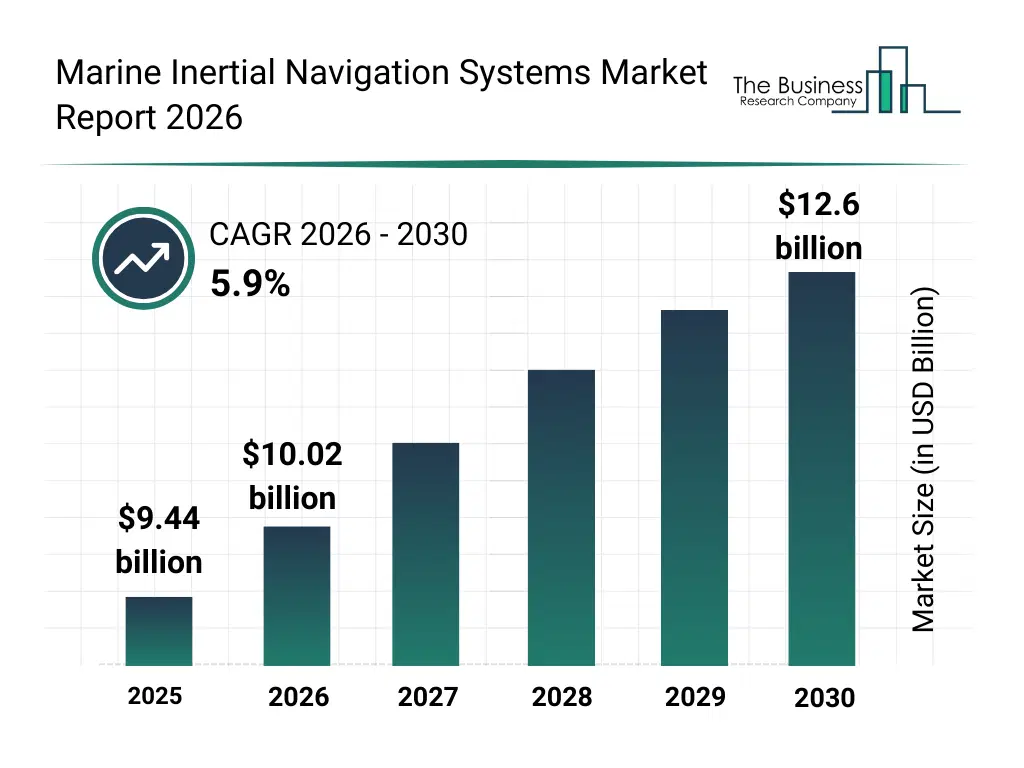
What Is The Marine Inertial Navigation Systems Market Size and Share 2026?
The marine inertial navigation systems market size has grown strongly in recent years. It will grow from $9.44 billion in 2025 to $10.02 billion in 2026 at a compound annual growth rate (CAGR) of 6.1%. The growth in the historic period can be attributed to increasing deployment of submarines and autonomous underwater vehicles, rising need for accurate navigation in gps-denied maritime environments, technological advancements in gyroscopes and accelerometers improving system precision, growth in naval modernization programs globally, expanding use of inertial measurement units in commercial and research marine vessels.What Is The Marine Inertial Navigation Systems Market Growth Forecast?
The marine inertial navigation systems market size is expected to see strong growth in the next few years. It will grow to $12.6 billion in 2030 at a compound annual growth rate (CAGR) of 5.9%. The growth in the forecast period can be attributed to growing adoption of hybrid navigation systems integrating inertial and satellite technologies, rising demand for high-accuracy navigation for autonomous and remotely operated maritime platforms, increasing investments in deep-sea exploration and offshore surveying, continuous enhancements in miniaturized and low-drift inertial sensors, expanding service requirements for calibration, software upgrades, and lifecycle maintenance. Major trends in the forecast period include advancements in high-precision gyroscope and imu technology, increasing adoption of compact and low-power marine ins for unmanned platforms, rising demand for hybrid navigation systems integrating ins with sonar and dvl, growth in aftermarket services including calibration, maintenance, and software upgrades, expansion of ruggedized marine ins for deep-sea and harsh-environment operations.
Global Marine Inertial Navigation Systems Market Segmentation
1) By Type: Ring Laser Gyroscope (RLG), Fiber Optic Gyroscope (FOG), Micro-Electro-Mechanical Systems (MEMS), Quantum Inertial Navigation System, Accelerometer-Based Systems 2) By System Type: Standalone Systems, Integrated Systems, High-Accuracy Systems, Low-Cost Systems 3) By Application: Aerospace, Marine, Land, Submersible, Missile Guidance 4) By End-User: Shipbuilders, Commercial Shipping Companies, Defense Agencies, Research Institutions, Offshore Drilling Companies Subsegments: 1) By Ring Laser Gyroscope: Single-Axis Ring Laser Gyroscope, Multi-Axis Ring Laser Gyroscope 2) By Fiber Optic Gyroscope: Single-Axis Fiber Optic Gyroscope, Multi-Axis Fiber Optic Gyroscope 3) By Micro-Electro-Mechanical Systems: Single-Axis Micro-Electro-Mechanical Systems, Multi-Axis Micro-Electro-Mechanical Systems 4) By Quantum Inertial Navigation System: Atom Interferometry Systems, Cold Atom Sensors 5) By Accelerometer Based Systems: Capacitive Accelerometers, Piezoresistive Accelerometers, Thermal AccelerometersWhat Is Driver Of The Marine Inertial Navigation Systems Market?
The increasing demand for offshore oil and gas exploration is expected to propel the growth of the marine inertial navigation systems market going forward. Offshore oil and gas exploration is the process of searching for and extracting hydrocarbons beneath the ocean floor using specialized drilling and seismic technologies. The rising demand for offshore oil and gas exploration is due to the growing need for energy resources that require advanced technologies to efficiently access untapped underwater reserves while ensuring safety and environmental protection. Marine inertial navigation systems are essential for offshore oil and gas exploration, as they provide accurate vessel positioning and motion tracking in remote marine environments where satellite signals may be limited. For instance, in December 2024, according to the Energy Information Administration (EIA), a US-based government entity, US oil output compared to 2022 increased from 12.2 to 13.3 million barrels per day, while natural gas production jumped from 121.1 to 128.8 billion cubic feet per day in 2023. Therefore, the increasing demand for offshore oil and gas exploration is driving the growth of the marine inertial navigation systems industry.Key Players In The Global Marine Inertial Navigation Systems Market
Major companies operating in the marine inertial navigation systems market are Northrop Grumman Corporation, Honeywell International Inc., Collins Aerospace, Safran SA, Teledyne Technologies Incorporated, Kongsberg Gruppen ASA, Furuno Electric Co. Ltd., NovAtel Inc., LORD MicroStrain, MEMSIC Inc., Movella Inc., IMAR Navigation GmbH, VectorNav Technologies LLC, Gladiator Technologies Inc., Nanjing Sky MEMS Technology Co. Ltd., Oxford Technical Solutions Ltd., Inertial Labs Inc., Aeron Systems Private Limited, Tersus GNSS Inc., Inertial Sense LLC.
This chart is for illustrative purposes; the full report includes a detailed competitor analysis and comprehensive overview of the top 10 companies in the market.
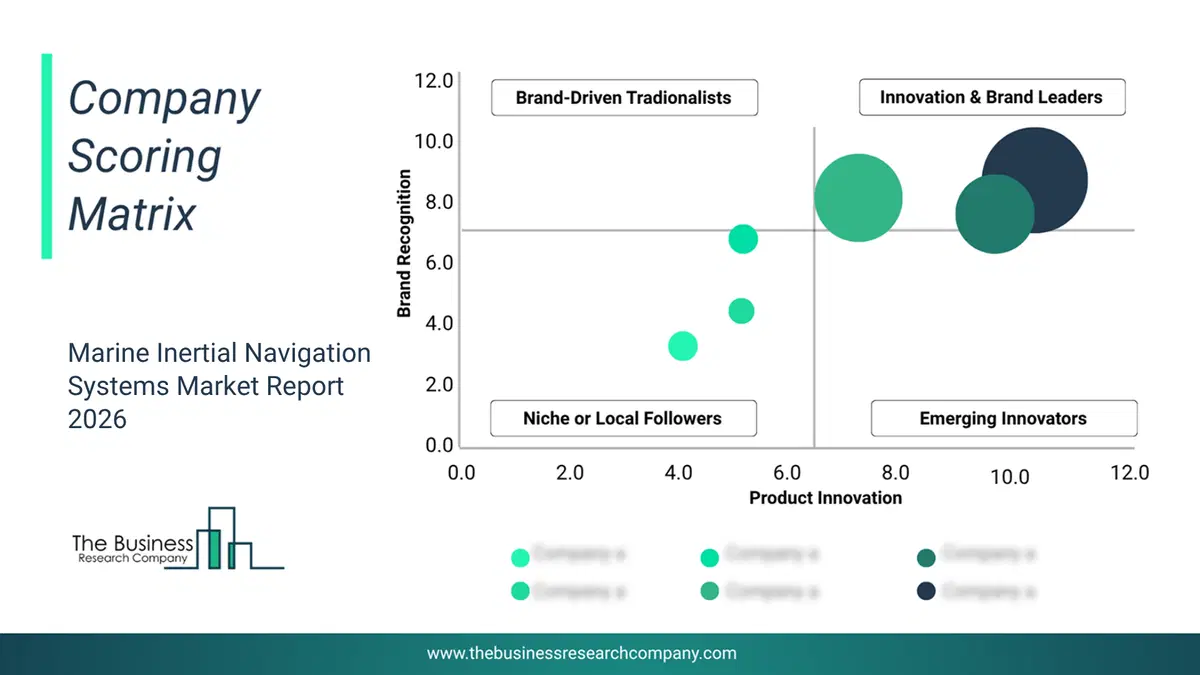
This chart maps companies by product innovation and brand strength, with bubble size indicating relative revenue, helping identify market leaders, challengers, and niche players. This is an illustrative chart; the full report provides a complete and accurate competitive analysis.
Global Marine Inertial Navigation Systems Market Trends and Insights
Major companies operating in the marine inertial navigation systems market are focusing on developing advanced solutions such as GNSS-aided inertial navigation systems to enhance precision and reliability in marine positioning and navigation. A GNSS-aided inertial navigation system integrates global navigation satellite system (GNSS) signals with inertial sensors to provide accurate and stable navigation data, even in challenging marine environments. For instance, in March 2024, Kongsberg Discovery AS, a Norway-based company that develops advanced technologies for ocean exploration, launched Seapath 385, a state-of-the-art marine inertial navigation system combining advanced sensors, multi-frequency satellite signals, and enhanced algorithms for precise hydrographic surveying. The modular system provides reliable, high-frequency data and accurate vessel positioning in challenging marine environments.What Are Latest Mergers And Acquisitions In The Marine Inertial Navigation Systems Market? Viavi Solutions Acquires Inertial Labs To Strengthen Position In Advanced Navigation And Autonomous Systems
In December 2024, Viavi Solutions Inc., a US-based provider of network and defense technologies, acquired Inertial Labs Inc. for an amount of $150 million. This acquisition expands Viavi's market presence in aerospace, defense, and industrial sectors by integrating Inertial Labs’ high-performance inertial navigation technologies, including IMUs, INS, assured positioning, GNSS tracking, and LiDAR scanning. Additionally, it complements Viavi’s existing portfolio and accelerates its entry into autonomous air, land, and sea systems, enhancing its capabilities in marine inertial navigation. Inertial Labs Inc. is a US-based leading designer, integrator, and manufacturer of cutting-edge inertial measurement units.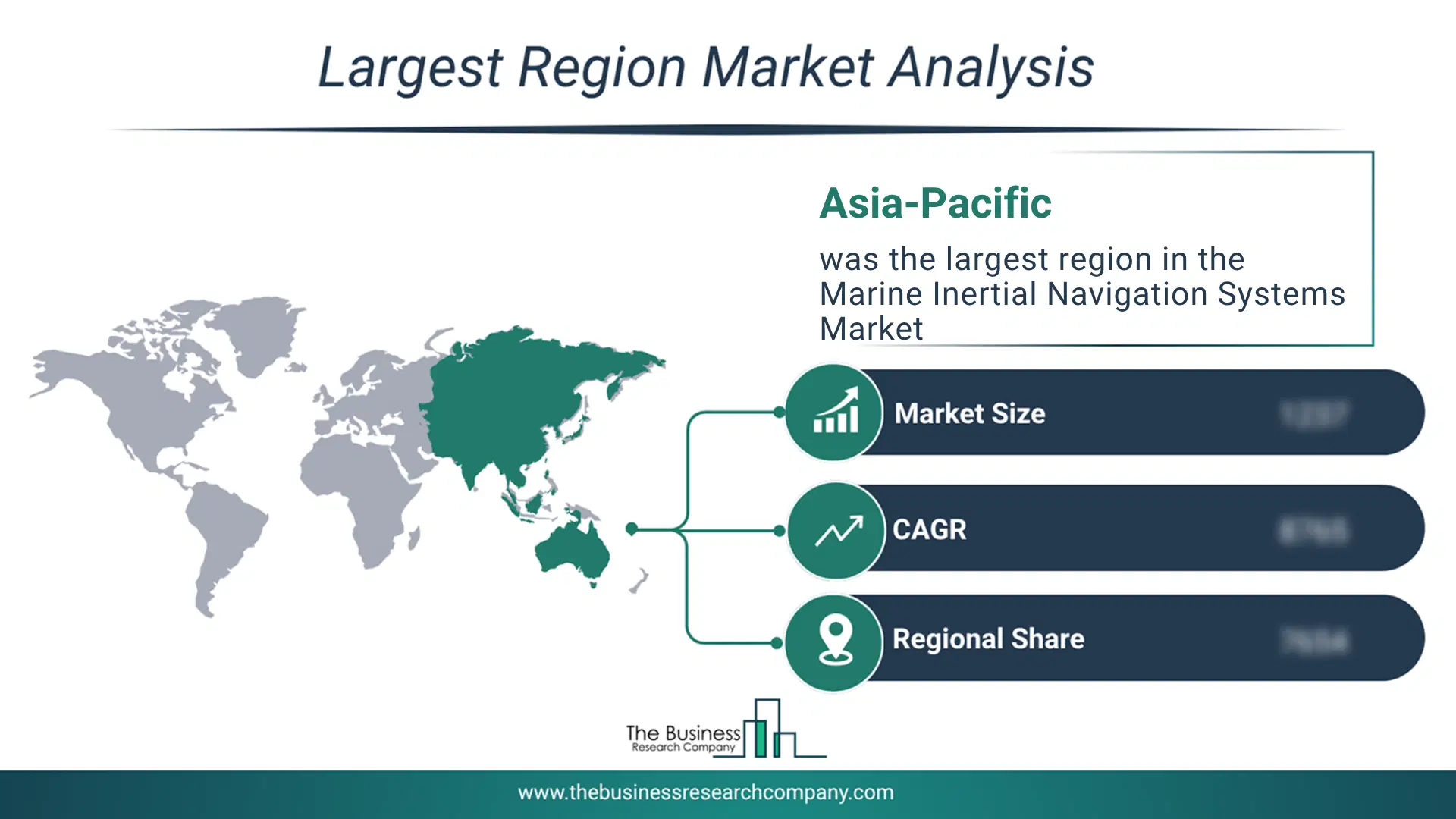
Regional Insights
Asia-Pacific was the largest region in the marine inertial navigation systems market in 2025 and it is expected to be the fastest-growing region in the forecast period. The regions covered in this market report are Asia-Pacific, South East Asia, Western Europe, Eastern Europe, North America, South America, Middle East, Africa. The countries covered in this market report are Australia, Brazil, China, France, Germany, India, Indonesia, Japan, Taiwan, Russia, South Korea, UK, USA, Canada, Italy, SpainWhat Defines the Marine Inertial Navigation Systems Market?
The marine inertial navigation systems market consists of revenues earned by entities by providing services such as installation and integration services, calibration and alignment services, maintenance and repair services, software updates and upgrades, and training and support services. The market value includes the value of related goods sold by the service provider or included within the service offering. The marine inertial navigation systems market consists of sales of gyroscopes, accelerometers, inertial measurement units (IMUs), inertial navigation units (INUs), and processing units and embedded controllers. Values in this market are ‘factory gate’ values, that is the value of goods sold by the manufacturers or creators of the goods, whether to other entities (including downstream manufacturers, wholesalers, distributors, and retailers) or directly to end customers. The value of goods in this market includes related services sold by the creators of the goods.How is Market Value Defined and Measured?
The market value is defined as the revenues that enterprises gain from the sale of goods and/or services within the specified market and geography through sales, grants, or donations in terms of the currency (in USD unless otherwise specified). The revenues for a specified geography are consumption values that are revenues generated by organizations in the specified geography within the market, irrespective of where they are produced. It does not include revenues from resales along the supply chain, either further along the supply chain or as part of other products.
This chart presents market attractiveness based on a quantitative evaluation of growth, competition, strategic alignment, and risk, offering a clear view of opportunity areas for decision-making. This chart is for illustrative purposes; the full report contains the complete analysis.

This chart highlights the Total Addressable Market (TAM) by estimating the maximum revenue opportunity using an assumption-driven approach, supporting strategic planning and opportunity sizing across markets. The chart is illustrative; the full report provides a more comprehensive analysis.
What Key Data and Analysis Are Included in the Marine Inertial Navigation Systems Market Report 2026?
The marine inertial navigation systems market research report is one of a series of new reports from The Business Research Company that provides market statistics, including industry global market size, regional shares, competitors with the market share, detailed market segments, market trends and opportunities, and any further data you may need to thrive in the marine inertial navigation systems industry. The market research report delivers a complete perspective of everything you need, with an in-depth analysis of the current and future state of the industry.Marine Inertial Navigation Systems Market Report Forecast Analysis
| Report Attribute | Details |
|---|---|
| Market Size Value In 2026 | $10.02 billion |
| Revenue Forecast In 2030 | $12.6 billion |
| Growth Rate | CAGR of 5.9% from 2026 to 2030 |
| Base Year For Estimation | 2025 |
| Actual Estimates/Historical Data | 2020-2025 |
| Forecast Period | 2026 - 2030 |
| Market Representation | Revenue in USD Billion and CAGR from 2026 to 2030 |
| Segments Covered | Type, System Type, Application, End-User |
| Regional Scope | Asia-Pacific, Western Europe, Eastern Europe, North America, South America, Middle East, Africa |
| Country Scope | The countries covered in the marine inertial navigation systems market report are Australia, Brazil, China, France, Germany, India, Indonesia, Japan, Taiwan, Russia, South Korea, UK, USA, Canada, Italy, Spain |
| Key Companies Profiled | Northrop Grumman Corporation, Honeywell International Inc., Collins Aerospace, Safran SA, Teledyne Technologies Incorporated, Kongsberg Gruppen ASA, Furuno Electric Co. Ltd., NovAtel Inc., LORD MicroStrain, MEMSIC Inc., Movella Inc., IMAR Navigation GmbH, VectorNav Technologies LLC, Gladiator Technologies Inc., Nanjing Sky MEMS Technology Co. Ltd., Oxford Technical Solutions Ltd., Inertial Labs Inc., Aeron Systems Private Limited, Tersus GNSS Inc., Inertial Sense LLC. |
| Customization Scope | Request for Customization |
| Pricing And Purchase Options | Explore Purchase Options |