
Marine Vessel Energy Efficiency Market Report 2026
Global Outlook – By Type (Hardware System, Sensors And Software), By Operation Type (Parallel Hybrid Propulsion System, Serial Hybrid Propulsion System), By Application (Passenger Ships And Ferries, Dry Cargo Vessels, Service Vessels, Fishing Vessels, Dry Bulk Carriers, Off-Shore Vessels, Yachts, Other Applications ) – Market Size, Trends, Strategies, and Forecast to 2030
Marine Vessel Energy Efficiency Market Overview
• Marine Vessel Energy Efficiency market size has reached to $2 billion in 2025 • Expected to grow to $3.39 billion in 2030 at a compound annual growth rate (CAGR) of 11.1% • Growth Driver: International Trade And Shipping Demand Driving Growth Of The Marine Vessel Energy Efficiency Market • Market Trend: Innovative Technologies In Marine Vessel Energy Efficiency Wind Power-Aided Ships • Asia-Pacific was the largest region in 2025.What Is Covered Under Marine Vessel Energy Efficiency Market?
Marine vessel energy efficiency refers to the practice of optimizing energy consumption and reducing emissions in the operation of marine vessels. It involves the application of various technologies, operational practices, and management strategies to improve the energy efficiency of ships, reduce fuel consumption, and lower greenhouse gas emissions. The main types of marine vessel energy efficiency are hardware system, and sensors and software. Marine vessel energy efficiency hardware systems refer to the physical components and equipment installed on ships to optimize fuel consumption and reduce emissions. They are operated by parallel hybrid propulsion system and serial hybrid propulsion system for passenger ships and ferries, dry cargo vessels, service vessels, fishing vessels, dry bulk carriers, off-shore vessels, yachts, and others.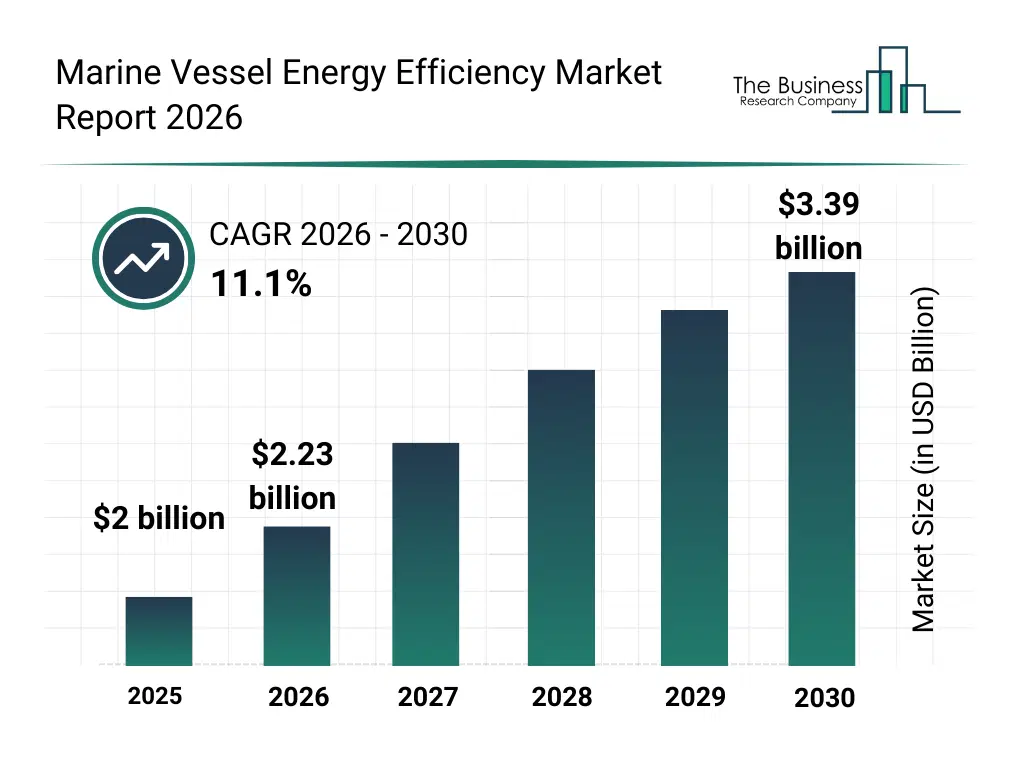
What Is The Marine Vessel Energy Efficiency Market Size and Share 2026?
The marine vessel energy efficiency market size has grown rapidly in recent years. It will grow from $2 billion in 2025 to $2.23 billion in 2026 at a compound annual growth rate (CAGR) of 11.2%. The growth in the historic period can be attributed to rising fuel costs driving demand for energy-efficient marine solutions, stricter international maritime regulations on emissions and fuel efficiency, growing adoption of energy management systems in shipping fleets, increased focus on retrofitting existing vessels with energy-saving technologies, technological advancements in marine propulsion systems and hull design.What Is The Marine Vessel Energy Efficiency Market Growth Forecast?
The marine vessel energy efficiency market size is expected to see rapid growth in the next few years. It will grow to $3.39 billion in 2030 at a compound annual growth rate (CAGR) of 11.1%. The growth in the forecast period can be attributed to rising adoption of autonomous and electric vessels for reduced fuel consumption, increasing investments in alternative and blended fuels for shipping, integration of digital twin and ai-driven optimization for vessel performance, growing demand for sustainable shipping solutions due to environmental regulations, expansion of energy audit and consultancy services for fleet efficiency improvements. Major trends in the forecast period include adoption of autonomous energy-efficient vessels, implementation of hull modifications and air lubrication systems, integration of real-time fuel and emissions monitoring systems, development of hybrid propulsion systems for commercial vessels, use of predictive maintenance and energy optimization software.
Global Marine Vessel Energy Efficiency Market Segmentation
1) By Type: Hardware System, Sensors And Software 2) By Operation Type: Parallel Hybrid Propulsion System, Serial Hybrid Propulsion System 3) By Application: Passenger Ships And Ferries, Dry Cargo Vessels, Service Vessels, Fishing Vessels, Dry Bulk Carriers, Off-Shore Vessels, Yachts, Other Applications Subsegments: 1) By Hardware System: Propulsion Systems, Hull Modifications, Air Lubrication Systems, Energy Saving Devices (ESDs), Waste Heat Recovery Systems 2) By Sensors And Software: Monitoring and Control Systems, Fuel Management Systems, Emissions Monitoring Systems, Energy Efficiency Software Solutions, Data Analytics And Optimization ToolsWhat Is Driver Of The Marine Vessel Energy Efficiency Market?
International trade and shipping demand is expected to propel the growth of the marine vessel energy efficiency market going forward. International trade and shipping demand is increasing due to global freight demand, economic significance, trade facilitation, globalization, transport costs, and market influence. Improved energy efficiency in marine transportation helps reduce greenhouse gas emissions and other pollutants associated with fossil fuel combustion. This improves economic competitiveness, reduces environmental impact, ensures regulatory compliance, and contributes to a more reliable and efficient global supply chain. For instance, in June 2024, according to the Bureau of Economic Analysis (BEA), a US-based government agency, average exports increased by $10.2 billion, while average imports rose by $13.1 billion from April 2023. Therefore, international trade and shipping demand is driving the growth of the marine vessel energy efficiency industry.Key Players In The Global Marine Vessel Energy Efficiency Market
Major companies operating in the marine vessel energy efficiency market are Siemens AG, General Electric Company (GE), Schneider Electric SE, Mitsubishi Heavy Industries Ltd. (MHI), ABB Group, Emerson Electric Co., Kawasaki Heavy Industries Ltd., Wärtsilä Corporation, Bureau Veritas S.A., MAN Energy Solutions SE, KONGSBERG, China Classification Society (CCS), Gaztransport & Technigaz S.A. (GTT), PowerCell Sweden AB, Yara Marine Technologies AS, Becker Marine Systems GmbH, PowerX, Mustang Technologies, Foreship Ltd., Norsepower Oy Ltd., Marorka ehf, Bound4blue, X Shore, GreenSteam Ltd.
This chart is for illustrative purposes; the full report includes a detailed competitor analysis and comprehensive overview of the top 10 companies in the market.
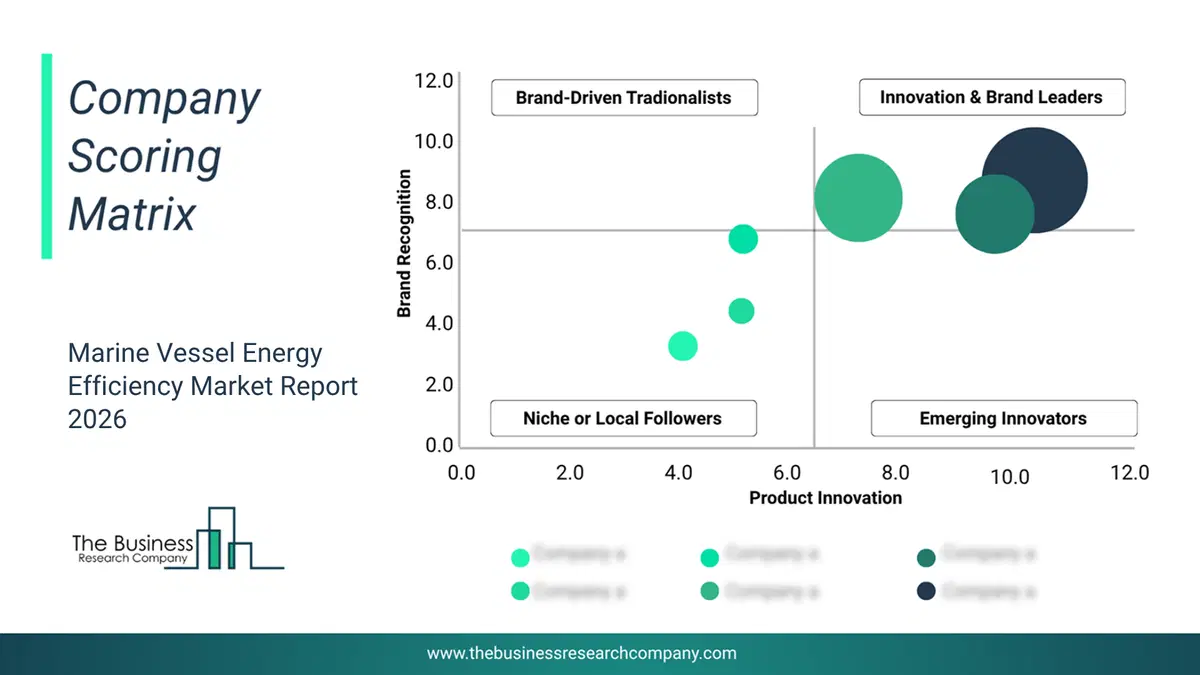
This chart maps companies by product innovation and brand strength, with bubble size indicating relative revenue, helping identify market leaders, challengers, and niche players. This is an illustrative chart; the full report provides a complete and accurate competitive analysis.
Global Marine Vessel Energy Efficiency Market Trends and Insights
Major companies operating in the marine vessel energy efficiency market are developing innovative technologies, such as wind power-aided ships to cut emissions. A wind power-aided ship is a vessel that utilizes wind propulsion technologies to complement traditional fossil fuel engines, thereby reducing fuel consumption and carbon emissions. For instance, in October 2023, Berge Bulk Limited, a Singapore-based technology company, launched Berge Olympus, a ship fitted with steel and composite sails to reduce fuel consumption and carbon dioxide emissions. The ship is equipped with four sails known as WindWings, which are expected to save up to 20% of fuel, or six tons per day, on an average worldwide route and cut carbon emissions by about 19.5 tons per day.What Are Latest Mergers And Acquisitions In The Marine Vessel Energy Efficiency Market? ABB Acquires DTN Shipping for Data-Driven Solutions in the Marine Vessel Energy Efficiency Market
In January 2024, ABB Group, a Switzerland-based technology company in electrification and automation, acquired DTN Shipping for an undisclosed amount. The acquisition could potentially enhance ABB's ability to provide data-driven solutions for optimizing vessel performance and reducing fuel consumption for the marine vessel energy efficiency market. DTN is a US-based company, offers a comprehensive solution called DTN marine content services, which integrates marine weather data and analytics into systems.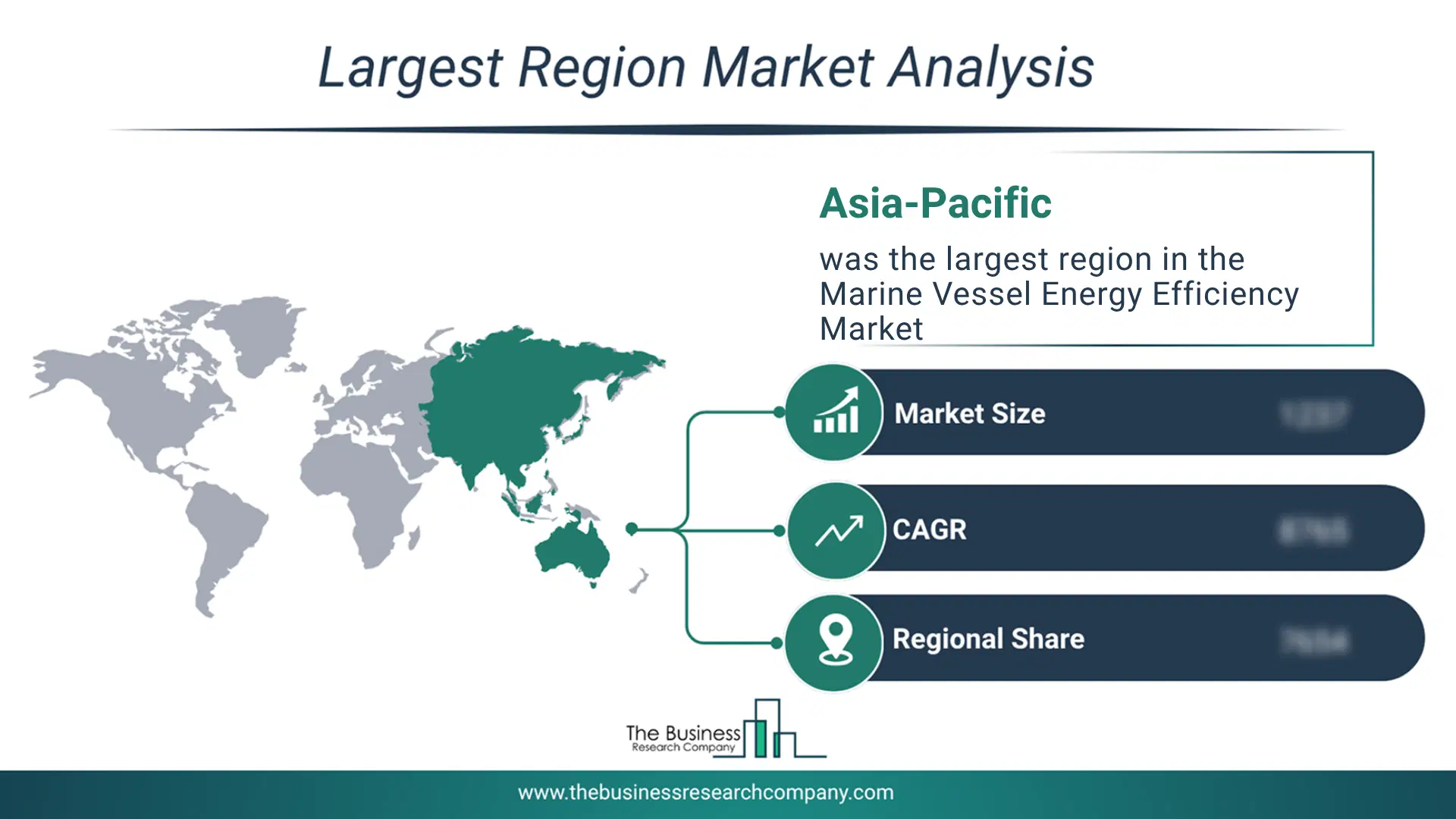
Regional Insights
Asia-Pacific was the largest region in the marine vessel energy efficiency market in 2025. The regions covered in this market report are Asia-Pacific, South East Asia, Western Europe, Eastern Europe, North America, South America, Middle East, Africa. The countries covered in this market report are Australia, Brazil, China, France, Germany, India, Indonesia, Japan, Taiwan, Russia, South Korea, UK, USA, Canada, Italy, SpainWhat Defines the Marine Vessel Energy Efficiency Market?
The marine vessel energy efficiency market includes revenues earned by entities by providing services such as design and engineering services, fuel efficiency optimization, retrofit solutions, and energy audits. The market value includes the value of related goods sold by the service provider or included within the service offering. The marine vessel energy efficiency market also includes sales of marine propulsion systems, optimization systems, autonomous electric vessels, and blended fuel solutions. Values in this market are ‘factory gate’ values, that is, the value of goods sold by the manufacturers or creators of the goods, whether to other entities (including downstream manufacturers, wholesalers, distributors, and retailers) or directly to end customers. The value of goods in this market includes related services sold by the creators of the goods.How is Market Value Defined and Measured?
The market value is defined as the revenues that enterprises gain from the sale of goods and/or services within the specified market and geography through sales, grants, or donations in terms of the currency (in USD unless otherwise specified). The revenues for a specified geography are consumption values that are revenues generated by organizations in the specified geography within the market, irrespective of where they are produced. It does not include revenues from resales along the supply chain, either further along the supply chain or as part of other products.
This chart presents market attractiveness based on a quantitative evaluation of growth, competition, strategic alignment, and risk, offering a clear view of opportunity areas for decision-making. This chart is for illustrative purposes; the full report contains the complete analysis.

This chart highlights the Total Addressable Market (TAM) by estimating the maximum revenue opportunity using an assumption-driven approach, supporting strategic planning and opportunity sizing across markets. The chart is illustrative; the full report provides a more comprehensive analysis.
What Key Data and Analysis Are Included in the Marine Vessel Energy Efficiency Market Report 2026?
The marine vessel energy efficiency market research report is one of a series of new reports from The Business Research Company that provides market statistics, including industry global market size, regional shares, competitors with the market share, detailed market segments, market trends and opportunities, and any further data you may need to thrive in the marine vessel energy efficiency industry. The market research report delivers a complete perspective of everything you need, with an in-depth analysis of the current and future state of the industry.Marine Vessel Energy Efficiency Market Report Forecast Analysis
| Report Attribute | Details |
|---|---|
| Market Size Value In 2026 | $2.23 billion |
| Revenue Forecast In 2030 | $3.39 billion |
| Growth Rate | CAGR of 11.1% from 2026 to 2030 |
| Base Year For Estimation | 2025 |
| Actual Estimates/Historical Data | 2020-2025 |
| Forecast Period | 2026 - 2030 |
| Market Representation | Revenue in USD Billion and CAGR from 2026 to 2030 |
| Segments Covered | Type, Operation Type, Application |
| Regional Scope | Asia-Pacific, Western Europe, Eastern Europe, North America, South America, Middle East, Africa |
| Country Scope | The countries covered in the marine vessel energy efficiency market report are Australia, Brazil, China, France, Germany, India, Indonesia, Japan, Taiwan, Russia, South Korea, UK, USA, Canada, Italy, Spain |
| Key Companies Profiled | Siemens AG, General Electric Company (GE), Schneider Electric SE, Mitsubishi Heavy Industries Ltd. (MHI), ABB Group, Emerson Electric Co., Kawasaki Heavy Industries Ltd., Wärtsilä Corporation, Bureau Veritas S.A., MAN Energy Solutions SE, KONGSBERG, China Classification Society (CCS), Gaztransport & Technigaz S.A. (GTT), PowerCell Sweden AB, Yara Marine Technologies AS, Becker Marine Systems GmbH, PowerX, Mustang Technologies, Foreship Ltd., Norsepower Oy Ltd., Marorka ehf, Bound4blue, X Shore, GreenSteam Ltd. |
| Customization Scope | Request for Customization |
| Pricing And Purchase Options | Explore Purchase Options |