

Contact Us
  Search
The Business Research Company Logo
Maritime Digitization Global Market Opportunities And Strategies To 2035
Published :June 2026
Pages :381
Format :PDF
Delivery Time :2-3 Business Days
Why 2-3 days? We update the report with the latest data and news before delivery. Let us know if you need us to expedite.
Report Price :$4,490.00

Maritime Digitization Global Market Opportunities And Strategies To 2035

By Technology (Internet Of Things (IoT), Artificial Intelligence, Blockchain, Other Technologies), By Application (Fleet Management, Vessel Tracking, Energy Management, Inventory Management, Predictive Maintenance, Other Applications), By End-User (Ports And Terminals, Shipping Companies, Maritime Freight Forwarders, Other End Users), And By Region, Opportunities And Strategies – Global Forecast To 2035

Maritime Digitization Market Definition

Maritime digitization refers to the integration and application of digital technologies across maritime operations to enhance efficiency, safety, transparency, and sustainability in the shipping and port industries. It encompasses the use of connected devices, advanced analytics, automation systems, and digital platforms to optimize various aspects of maritime activities, including vessel operations, cargo handling, logistics coordination, and port management. The maritime digitization market consists of sales by entities (organizations, sole traders and partnerships) of maritime digitization that is utilized by a wide range of stakeholders, including shipping companies, port authorities, logistics providers, freight forwarders, and regulatory bodies. These technologies are employed throughout the lifecycle of maritime operations, from voyage planning and cargo loading to real-time monitoring and post-voyage analysis.
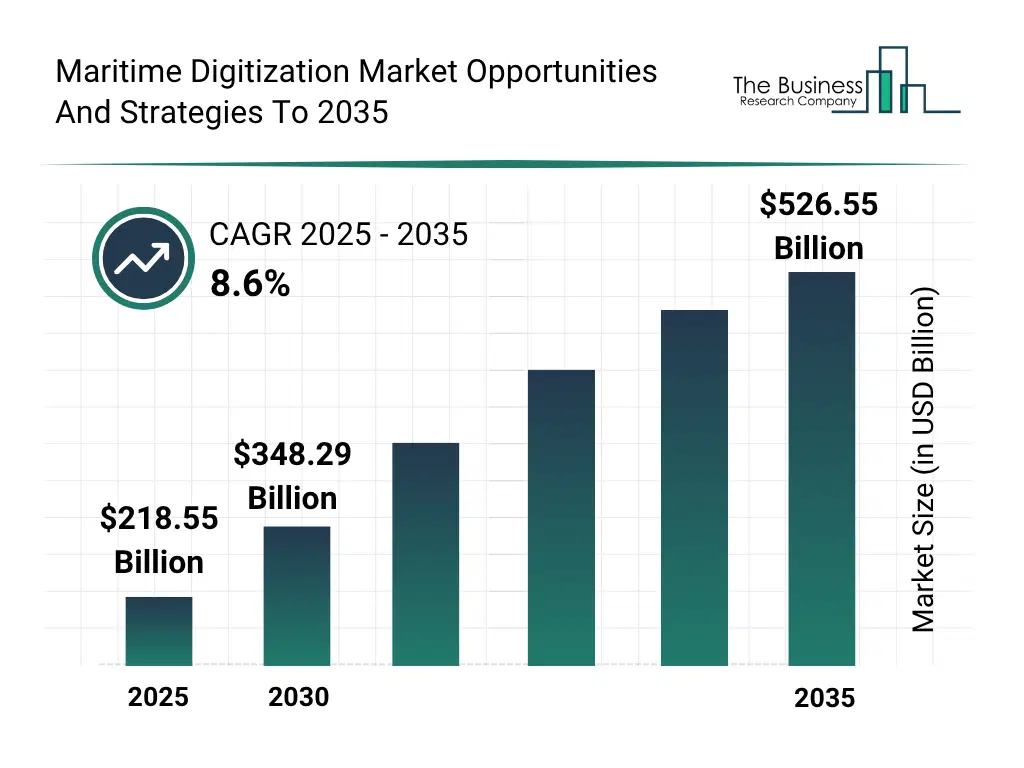
Maritime Digitization Global Market Opportunities And Strategies To 2035 Market Size and growth rate 2026 to 2030: Graph

Maritime Digitization Market Size

The global maritime digitization market reached a value of nearly $218,552.3 million in 2025, having grown at a compound annual growth rate (CAGR) of 10.4% since 2020. The market is expected to grow from $218,552.3 million in 2025 to $348,294.9 million in 2030 at a rate of 9.8%. The market is then expected to grow at a CAGR of 8.6% from 2029 and reach $526,545.4 million in 2035. Growth in the historic period resulted from growth of e-commerce and just-in-time logistics, growth of global trade and seaborne transportation, rising shipping fuel costs and port congestion, traffic and delays. Factors that negatively affected growth in the historic period were high initial investment costs and cybersecurity risks and threats. Going forward, government and institutional support programs towards shipping digitalization, increasing focus on sustainability and green shipping initiatives, increasing investments in port infrastructure modernization and increasing labor costs and workforce shortage will drive the growth. Factors that could hinder the growth of the maritime digitization market in the future include lack of standardization and interoperability, high maintenance and upgrade costs of digital systems and impact of trade war and tariff.
Research Expert

Book your 30 minutes free consultation with our research experts

Maritime Digitization Market Segmentation

The maritime digitization market is segmented by technology, by application, by end-user.

By Technology –
The maritime digitization market is segmented by technology into:
    • a) Internet Of Things (IoT)
    • b) Artificial Intelligence
    • c) Blockchain
    • d) Other Technologies
The internet of things (IoT)was the largest segment of the maritime digitization market segmented by technology, accounting for 27.8% or $2,080.8 million of the total in 2025. Going forward, the artificial intelligence segment is expected to be the fastest-growing segment in the maritime digitization market segmented by technology, at a CAGR of 10.5% during 2025-2030.

By Application –
The maritime digitization market is segmented by application into:
    • a) Fleet Management
    • b) Vessel Tracking
    • c) Energy Management
    • d) Inventory Management
    • e) Predictive Maintenance
    • f) Other Applications
The fleet management market was the largest segment of the maritime digitization market segmented by application, accounting for 25.0% or $1,870.8 million of the total in 2025. Going forward, the predictive maintenance segment is expected to be the fastest-growing segment in the maritime digitization market segmented by application, at a CAGR of 10.6% during 2025-2030.

By End-User –
The maritime digitization market is segmented by end-user into:
  1. a) Ports And Terminals
  2. b) Shipping Companies
  3. c) Maritime Freight Forwarders
  4. d) Other End Users
The ports and terminals market was the largest segment of the maritime digitization market segmented by end user, accounting for 35.6% or $2,665.0 million of the total in 2025. Going forward, the maritime freight forwarders segment is expected to be the fastest-growing segment in the maritime digitization market segmented by end user, at a CAGR of 10.0% during 2025-2030.

By Geography - The maritime digitization market is segmented by geography into:
      o Asia Pacific
      • China
      • India
      • Japan
      • Australia
      • Indonesia
      • South Korea
      o North America
      • USA
      • Canada
      o South America
      • Brazil
      o Western Europe
      • France
      • Germany
      • UK
      • Italy
      • Spain
      o Eastern Europe
      • Russia
      o Middle East
      o Africa
North America was the largest region in the maritime digitization market, accounting for 32.0% or $70,038.1 million of the total in 2025. It was followed by Asia Pacific, Western Europe and then the other regions. Going forward, the fastest-growing regions in the maritime digitization market will be Asia Pacific and South America where growth will be at CAGRs of 11.9% and 9.5% respectively. These will be followed by Middle East and North America where the markets are expected to grow at CAGRs of 9.0% and 8.9% respectively.

Maritime Digitization Market Drivers

The key drivers of the maritime digitization market include: Government And Institutional Support Programs Towards Shipping Digitalization During the forecast period, the government and institutional support programs towards shipping digitalization is expected to propel the growth of the maritime digitization market. Many governments, port authorities, and international organizations are investing in digital infrastructure, smart port initiatives, and data-sharing platforms to improve operational efficiency and transparency across the maritime value chain. Funding programs, regulatory frameworks, and public–private partnerships are also encouraging shipping companies to adopt advanced technologies such as IoT, AI, blockchain, and digital documentation systems. In addition, training initiatives and innovation grants are helping maritime stakeholders modernize legacy systems. These supportive measures are strengthening industry confidence and enabling wider adoption of digital solutions across global shipping operations. The government and institutional support programs towards shipping digitalization growth contribution during the forecast period in 2025 is 1.5%.

Maritime Digitization Market Restraints

The key restraints on the maritime digitization market include: Lack Of Standardization And Interoperability Lack of standardization and interoperability is expected to hinder the growth of the maritime digitization market in forecast period. The maritime industry involves multiple stakeholders, including shipping companies, port authorities, logistics providers, and regulatory bodies, each using different digital systems and platforms. In the absence of common standards, integrating these systems becomes complex and costly, limiting seamless data exchange and operational coordination. This fragmentation can slow the adoption of advanced technologies such as blockchain-based documentation, IoT-enabled tracking, and digital trade platforms. Additionally, inconsistent regulatory frameworks across regions further complicate implementation. Growth affected by Lack of standardization and interoperability during the forecast period in 2025 is -2.0%.

Maritime Digitization Market Competitive Landscape

Major Competitors are:

  • Microsoft Corporation
  • Huawei Technologies Co. Ltd.
  • Siemens AG
  • Cisco Systems Inc.
  • Oracle Corporation
  • Other Competitors Include:

  • SAP SE
  • Schneider Electric SE
  • ABB Ltd.
  • Honeywell International Inc.
  • Intel Corporation
  • MVXchange Technologies Ltd.
  • DP World Limited
  • Kobo360 Inc.
  • Jetstream Africa Limited
  • Kale Logistics Solutions Private Limited
  • ADNOC Logistics & Services plc
  • AD Ports Group PJSC
  • American Bureau of Shipping (ABS)
  • Logistaas Technologies LLC
  • Staunch Technologies FZCO
  • Maritronics India Private Limited
  • ABB Marine & Ports
  • Siemens AG
  • Wärtsilä Oyj Abp
  • Kongsberg Gruppen ASA
  • Cisco Systems, Inc.
  • Inmarsat Global Limited
  • Oracle Corporation
  • Iridium Communications Inc.
  • i4sea AS
  • Microsoft Corporation
  • International Business Machines Corporation (IBM)
  • Telefonaktiebolaget LM Ericsson
  • Det Norske Veritas Holding AS (DNV)
  • Spire Global, Inc.
  • ORBCOMM Inc.
  • SparkCognition, Inc.
  • Humanitas Solutions Inc.
  • Amphinicy Technologies d.o.o.
  • VesselFinder Ltd.
  • Comarch S.A.
  • Navarino S.A.
  • HAVELSAN A.Ş.
  • Kaiko Systems GmbH
  • Lloyd's Register Group Limited
  • Windward Ltd.
  • EurA AG
  • Naval Group SA
  • Damen Shipyards Group N.V.
  • CMB.TECH NV
  • Deutsche Telekom AG
  • Huawei Technologies Co., Ltd.
  • Envision Enterprise Solutions Pvt. Ltd.
  • Marine Solutionz Ship Management Pvt. Ltd.
  • KT SAT Corporation
  • KLCSM Co., Ltd.
  • Anglo-Eastern Univan Group
  • BMT Group Ltd.
  • Need data on a specific region in this market?

    Opportunities And Recommendations In The Maritime Digitization Market

    Opportunities – The top opportunities in the maritime digitization market segmented by technology will arise in the artificial intelligence segment, which will gain $43,461.0 million of global annual sales by 2030. The top opportunities in the maritime digitization market segmented by application will arise in the fleet management segment, which will gain $39,096.2 million of global annual sales by 2030. The top opportunities in the maritime digitization market segmented by end user will arise in the ports and terminals segment, which will gain $52,171.8 million of global annual sales by 2030. The maritime digitization market size will gain the most in the USA at $33,418.0 million. Recommendations- To take advantage of the opportunities, The Business Research Company recommends the maritime digitization companies to focus on continuous AI risk monitoring and governance, focus on end-to-end AI security and threat mitigation, focus on AI content authenticity and provenance tracking, focus on open-source frameworks and governance integration, focus on software segment for scalable AI safety growth, focus on cloud segment for scalable ai safety deployment, focus on natural language processing safety for rapid growth, focus on value-based and tiered pricing for AI safety, focus on outcome-driven promotion for credibility and adoption, focus on data-driven personalized promotion for engagement, focus on small enterprise segment for rapid adoption growth, focus on government segment for high-growth AI safety deployment.
    Chat with us