
Maritime Satellite Communication Market Report 2026
Global Outlook – By Type (Mobile Satellite Communication, Very Small Aperture Terminal (VSAT)), By Offering (Solution, Service), By End User (Merchant Shipping, Fishing, Passenger Ships, Leisure Vessel, Offshore, Government, Other End-Users) – Market Size, Trends, Strategies, and Forecast to 2030
Maritime Satellite Communication Market Overview
• Maritime Satellite Communication market size has reached to $4.53 billion in 2025 • Expected to grow to $6.27 billion in 2030 at a compound annual growth rate (CAGR) of 6.7% • Growth Driver: Maritime Satellite Communication Market Surges Amidst Global Growth In Marine Trade • Market Trend: Innovations In Bidirectional Satellite Communications For Seamless And Secure Connectivity • North America was the largest region in 2025 and Asia-Pacific is the fastest growing region.What Is Covered Under Maritime Satellite Communication Market?
Maritime satellite communication refers to the use of satellite technology to enable communication at sea. These systems support both voice and data communication, allowing for real-time conversations, messaging, and the exchange of important data such as navigation information, weather updates, and operational details. The main types of maritime satellite communication are mobile satellite communication and very small aperture terminals (VSAT). Mobile satellite communication refers to the use of satellite technology to enable communication services, including voice and data, for mobile users in remote or maritime environments. The offering includes solutions and services for end users such as merchant shipping, fishing, passenger ships, leisure vessels, offshore, government, and others.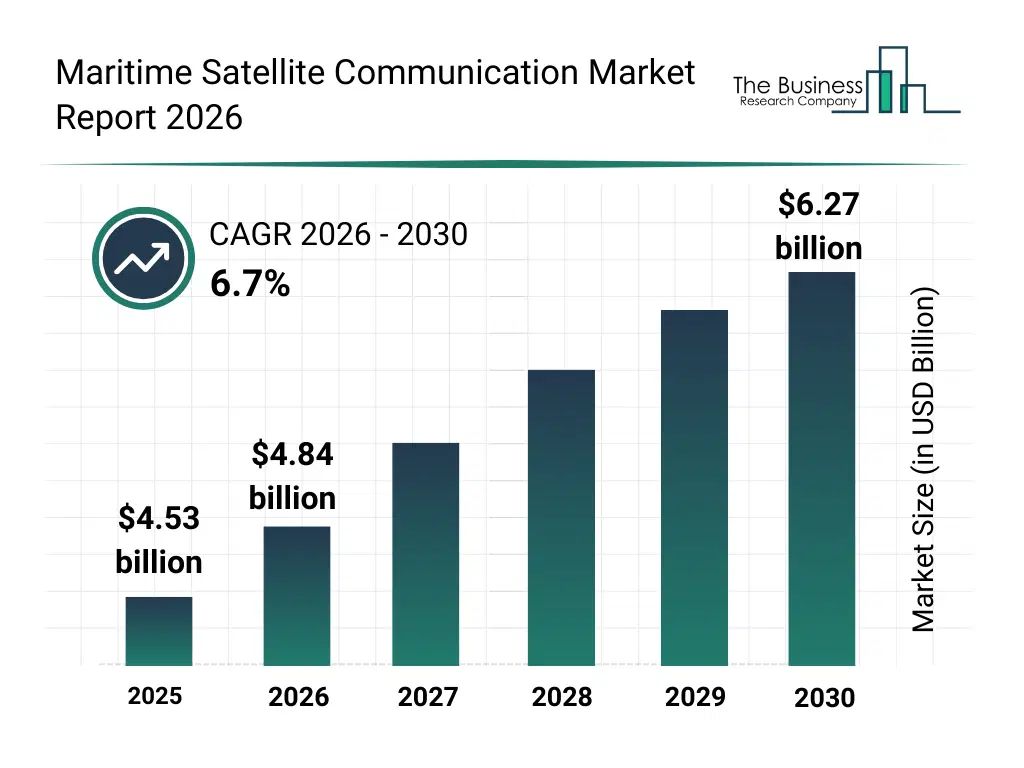
What Is The Maritime Satellite Communication Market Size and Share 2026?
The maritime satellite communication market size has grown strongly in recent years. It will grow from $4.53 billion in 2025 to $4.84 billion in 2026 at a compound annual growth rate (CAGR) of 6.9%. The growth in the historic period can be attributed to expansion of satellite networks for maritime coverage, increasing use of vsat systems on commercial vessels, rising demand for maritime voice and data services, adoption of satellite phones and maritime antennas, regulatory mandates for continuous maritime communication.What Is The Maritime Satellite Communication Market Growth Forecast?
The maritime satellite communication market size is expected to see strong growth in the next few years. It will grow to $6.27 billion in 2030 at a compound annual growth rate (CAGR) of 6.7%. The growth in the forecast period can be attributed to deployment of next-generation low-earth-orbit satellites, growth in digitalization of maritime operations, increasing demand for high-speed data connectivity at sea, expansion of tracking and monitoring services, integration of satellite communication with onboard navigation and safety systems. Major trends in the forecast period include integration of high-speed broadband connectivity on vessels, adoption of maritime iot for real-time tracking and monitoring, use of energy-efficient satellite communication terminals, enhanced interoperability with navigation and safety systems, deployment of hybrid satellite-terrestrial communication solutions.
Global Maritime Satellite Communication Market Segmentation
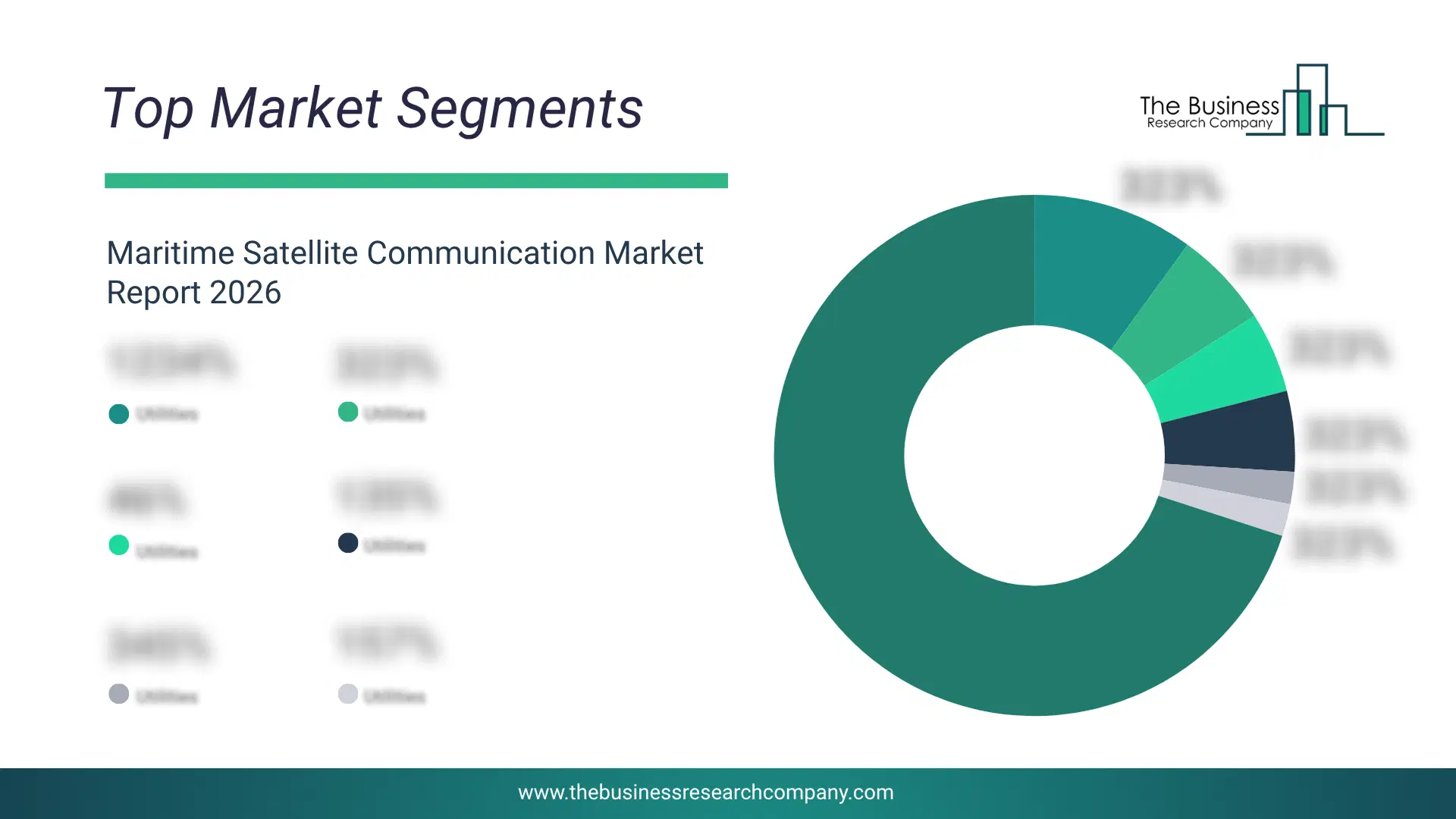
1) By Type: Mobile Satellite Communication, Very Small Aperture Terminal (VSAT) 2) By Offering: Solution, Service 3) By End User: Merchant Shipping, Fishing, Passenger Ships, Leisure Vessel, Offshore, Government, Other End-Users Subsegments: 1) By Mobile Satellite Communication: L-Band Services, Ku-Band Services, Ka-Band Services 2) By Very Small Aperture Terminal (VSAT): Fixed VSAT Systems, Portable VSAT Systems, VSAT-As-A-Service (VSaaS)What Is Driver Of The Maritime Satellite Communication Market?
The growing marine trade operations are expected to propel the growth of the maritime satellite communication market going forward. Marine trade operations involve the shipping, buying, and selling of goods and services through sea routes, facilitating international commerce. The interconnectedness of economies has facilitated increased trade between countries, leading to a rise in both import and export activities. The marine industry relies on maritime satellite communication for real-time tracking of vessels, weather updates, and efficient exchange of critical navigation and operational data, enhancing global trade operations. For instance, in October 2024, according to UN Trade and Development, a Switzerland-based intergovernmental body, global maritime trade expanded by 2.4% in 2023. Therefore, the growing Marine trade operations are driving the growth of the maritime satellite communication industry.Key Players In The Global Maritime Satellite Communication Market
Major companies operating in the maritime satellite communication market are Leonardo S.p.A, Saab AB, Space Exploration Technologies Corp. (SpaceX), Cobham SATCOM, Kongsberg Maritime AS, Viasat Inc., Advantech Wireless Inc., SES S.A., EchoStar Corporation, Hughes Network Systems LLC, Inmarsat plc, Iridium Communications Inc., Telespazio S.p.A., Comtech Telecommunications Corp., ORBCOMM Inc., Speedcast International Limited, ST Engineering iDirect, Marlink AS, Thuraya Telecommunications Company, RigNet Inc., Gilat Satellite Networks Ltd., Gogo Business Aviation LLC, Orbit Communication Systems, Newtec, KVH Industries Inc., Global Eagle Entertainment Inc., NSSL Global, Globecomm Systems Inc., RASCOM, Norsat International Inc.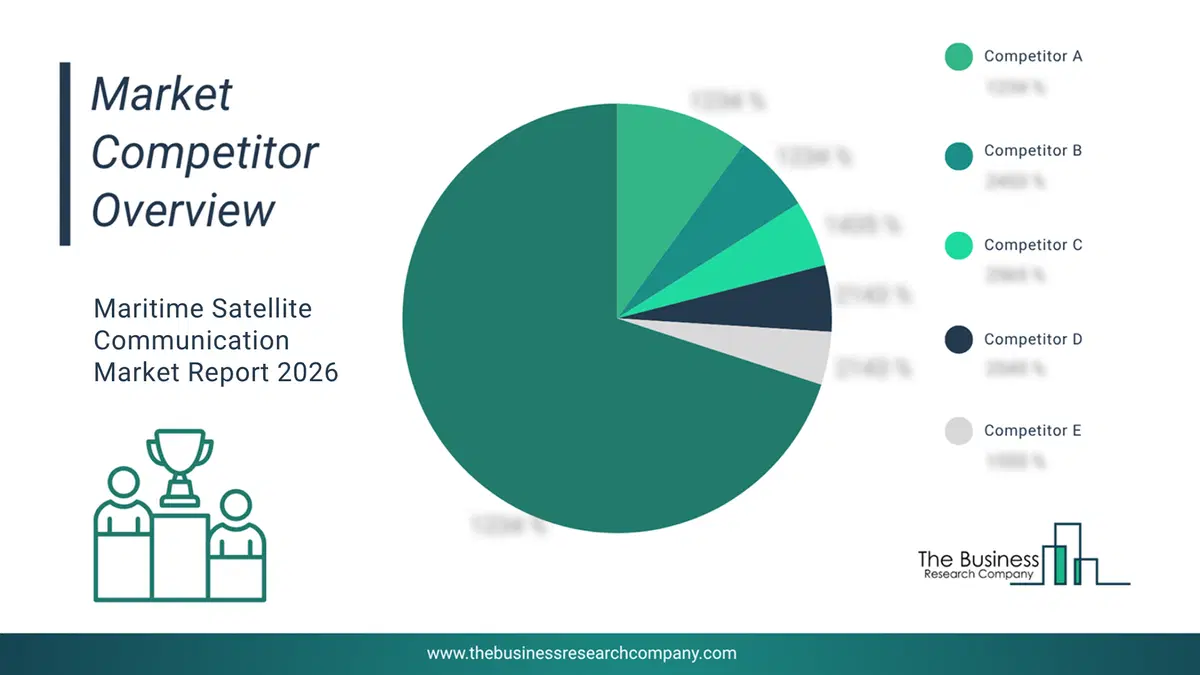
This chart is for illustrative purposes; the full report includes a detailed competitor analysis and comprehensive overview of the top 10 companies in the market.
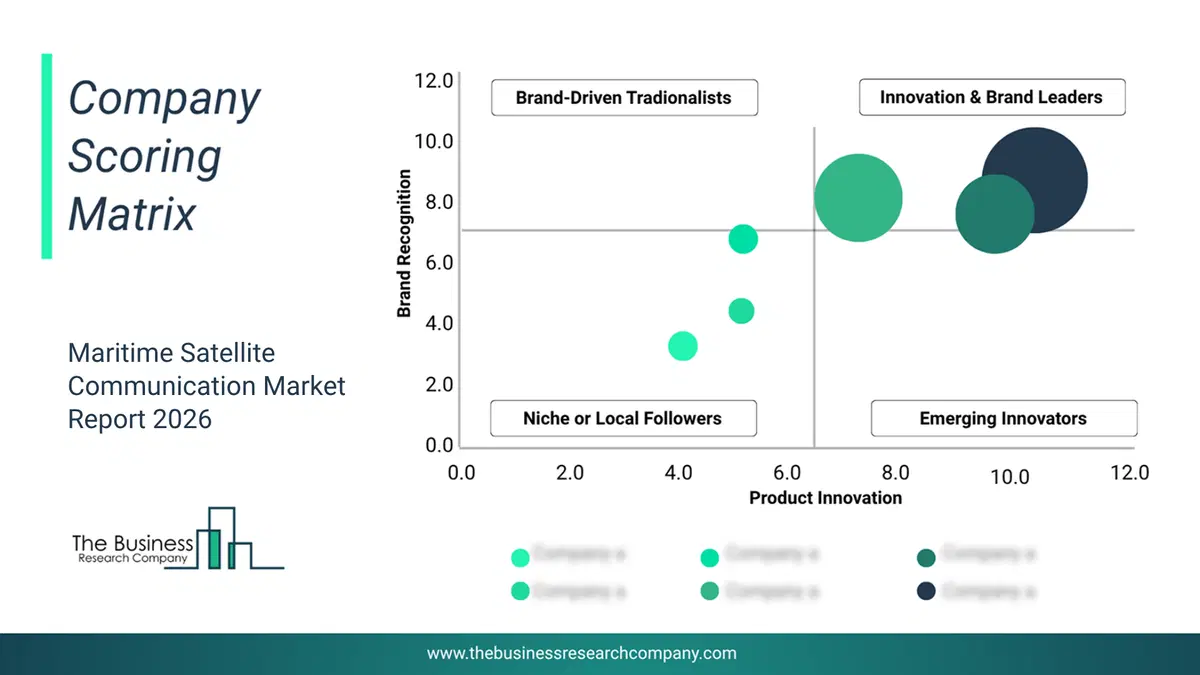
This chart maps companies by product innovation and brand strength, with bubble size indicating relative revenue, helping identify market leaders, challengers, and niche players. This is an illustrative chart; the full report provides a complete and accurate competitive analysis.
Global Maritime Satellite Communication Market Trends and Insights
Major companies operating in the maritime satellite communication market are focusing on developing advanced products such as bidirectional VHF satellite communication to enhance safety, efficiency, and connectivity in remote maritime operations. Bidirectional VHF satellite communication enables vessels and shore stations to directly exchange digital information over the VHF band via satellite, overcoming coastal-range limitations and network saturation in traditional systems. For instance, in June 2025, Alén Space, a Spain-based provider of technology for the manufacturing of small satellites and services, launched the nanosatellite SATMAR (6U) aboard a Falcon 9 rocket to validate the new VHF Data Exchange System (VDES)-based communications in orbit. It operates over Spain and surrounding waters and aims to demonstrate bidirectional digital communications in the VHF band and the replacement of the current AIS (Automatic Identification System). It supports new services for maritime traffic, including more accurate vessel arrival estimation, emission of maritime safety alerts, and connectivity even far from the coast, and it includes a secondary payload that functions as an in-orbit Software Defined Radio (SDR) laboratory to monitor RF spectrum in VHF, L, and S bands and test high-speed communications in the S-band.What Are Latest Mergers And Acquisitions In The Maritime Satellite Communication Market? Viasat Inc. Completes Acquisition of Inmarsat, Reinforcing Global Leadership in Satellite Connectivity
In May 2023, Viasat Inc., a US-based communications company, acquired Inmarsat for an undisclosed amount. The merged entity anticipates strengthening its market position by leveraging increased scale, expanded scope, and heightened innovation within the global satellite connectivity sector. This strategic move aims to meet rising customer demands for enhanced speed, flexibility, reliability, coverage, and security. Inmarsat is a UK-based satellite telecommunications company that offers maritime communications services.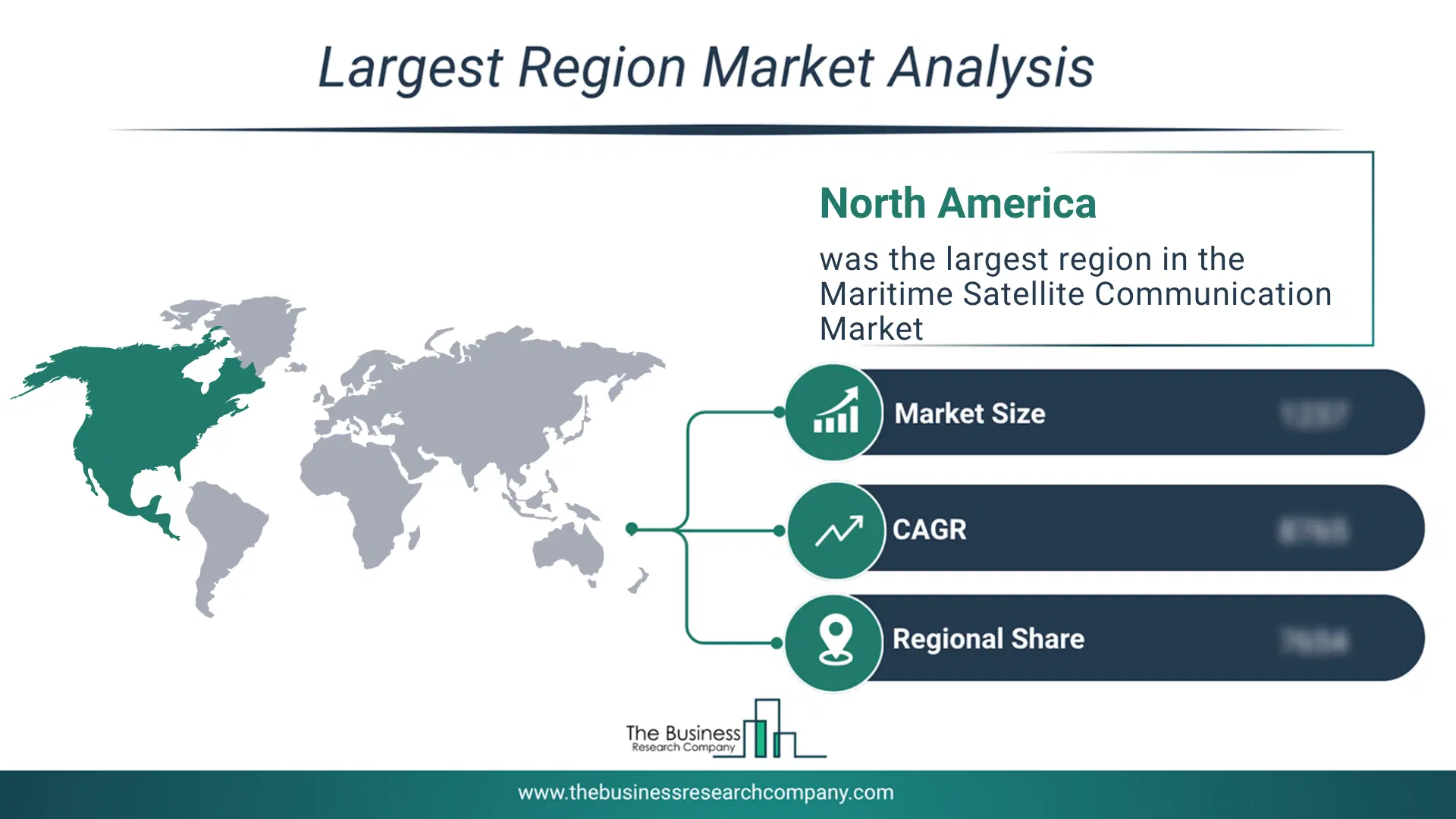
Regional Insights
North America was the largest region in the maritime satellite communication market in 2025. Asia-Pacific is expected to be the fastest-growing region in the forecast period. The regions covered in this market report are Asia-Pacific, South East Asia, Western Europe, Eastern Europe, North America, South America, Middle East, Africa. The countries covered in this market report are Australia, Brazil, China, France, Germany, India, Indonesia, Japan, Taiwan, Russia, South Korea, UK, USA, Canada, Italy, SpainWhat Defines the Maritime Satellite Communication Market?
The maritime satellite communication market consists of revenues earned by entities providing services such as voice services, tracking and monitoring, and very small aperture terminal(VSAT) services. The market value includes the value of related goods sold by the service provider or included within the service offering. The maritime satellite communication market also includes sales of TV and satellite phones, maritime antennas, VSAT systems, and navigation satellite systems. Values in this market are ‘factory gate’ values, that is the value of goods sold by the manufacturers or creators of the goods, whether to other entities (including downstream manufacturers, wholesalers, distributors and retailers) or directly to end customers. The value of goods in this market includes related services sold by the creators of the goods.How is Market Value Defined and Measured?
The market value is defined as the revenues that enterprises gain from the sale of goods and/or services within the specified market and geography through sales, grants, or donations in terms of the currency (in USD unless otherwise specified). The revenues for a specified geography are consumption values that are revenues generated by organizations in the specified geography within the market, irrespective of where they are produced. It does not include revenues from resales along the supply chain, either further along the supply chain or as part of other products.
This chart presents market attractiveness based on a quantitative evaluation of growth, competition, strategic alignment, and risk, offering a clear view of opportunity areas for decision-making. This chart is for illustrative purposes; the full report contains the complete analysis.

This chart highlights the Total Addressable Market (TAM) by estimating the maximum revenue opportunity using an assumption-driven approach, supporting strategic planning and opportunity sizing across markets. The chart is illustrative; the full report provides a more comprehensive analysis.
What Key Data and Analysis Are Included in the Maritime Satellite Communication Market Report 2026?
The maritime satellite communication market research report is one of a series of new reports from The Business Research Company that provides market statistics, including industry global market size, regional shares, competitors with the market share, detailed market segments, market trends and opportunities, and any further data you may need to thrive in the maritime satellite communication industry. The market research report delivers a complete perspective of everything you need, with an in-depth analysis of the current and future state of the industry.Maritime Satellite Communication Market Report Forecast Analysis
| Report Attribute | Details |
|---|---|
| Market Size Value In 2026 | $4.84 billion |
| Revenue Forecast In 2030 | $6.27 billion |
| Growth Rate | CAGR of 6.7% from 2026 to 2030 |
| Base Year For Estimation | 2025 |
| Actual Estimates/Historical Data | 2020-2025 |
| Forecast Period | 2026 - 2030 |
| Market Representation | Revenue in USD Billion and CAGR from 2026 to 2030 |
| Segments Covered | Type, Offering, End User |
| Regional Scope | Asia-Pacific, Western Europe, Eastern Europe, North America, South America, Middle East, Africa |
| Country Scope | The countries covered in the maritime satellite communication market report are Australia, Brazil, China, France, Germany, India, Indonesia, Japan, Taiwan, Russia, South Korea, UK, USA, Canada, Italy, Spain |
| Key Companies Profiled | Leonardo S.p.A, Saab AB, Space Exploration Technologies Corp. (SpaceX), Cobham SATCOM, Kongsberg Maritime AS, Viasat Inc., Advantech Wireless Inc., SES S.A., EchoStar Corporation, Hughes Network Systems LLC, Inmarsat plc, Iridium Communications Inc., Telespazio S.p.A., Comtech Telecommunications Corp., ORBCOMM Inc., Speedcast International Limited, ST Engineering iDirect, Marlink AS, Thuraya Telecommunications Company, RigNet Inc., Gilat Satellite Networks Ltd., Gogo Business Aviation LLC, Orbit Communication Systems, Newtec, KVH Industries Inc., Global Eagle Entertainment Inc., NSSL Global, Globecomm Systems Inc., RASCOM, Norsat International Inc. |
| Customization Scope | Request for Customization |
| Pricing And Purchase Options | Explore Purchase Options |