
Material Handling Equipment Market Report 2026
Global Outlook – By Product Type (Cranes And Lifting Equipment, Industrial Trucks, Continuous Handling Equipment, Racking And Storage Equipment), By Operation Type (Manual Material Handling Equipment, Semi-Automated Material Handling Equipment, Automated Material Handling Equipment), By Application (Transportation And Conveying, Storage And Warehousing, Picking And Sorting, Loading And Unloading, Assembly Line Handling), By End-User Industry (Automotive, Food And Beverages, Chemical, Semiconductor And Electronics, E-commerce And Logistics, Aviation, Pharmaceutical, Other End-User Industries) – Market Size, Trends, Strategies, and Forecast to 2030
Material Handling Equipment Market Overview
• Material Handling Equipment market size has reached to $215.97 billion in 2025 • Expected to grow to $298.08 billion in 2030 at a compound annual growth rate (CAGR) of 6.6% • Growth Driver: Growing Adoption Of Automated Solutions Fueling Material Handling Equipment Market • Market Trend: Innovation In Material Handling Equipment With Artificial Intelligence-Powered Automated Pallet Tracking For Enhanced Warehouse Efficiency • Asia-Pacific was the largest region in 2025.What Is Covered Under Material Handling Equipment Market?
The material handling equipment refers to a mechanical equipment utilized for a variety of purposes throughout the transit or storage of products in industrial settings. It facilitates the transportation, storage, and control of commodities and materials during the manufacturing, distribution, usage, and disposal. These devices make it possible to move big quantities of products and heavy objects quickly and efficiently. The main types of material handling equipment are used by manufacturer and distributor. The manufacturer refers to company who are in the manufacturing and handling of material handling equipment. A manufacturer is a person or a registered corporation that creates finished goods from raw materials in order to gain profit. The different product are cranes and lifting equipment, industrial trucks, continuous handling equipment, and racking and storage equipment, which are used in automotive, food and beverages, chemical, semiconductor and electronics, e-commerce, aviation, pharmaceutical, and others.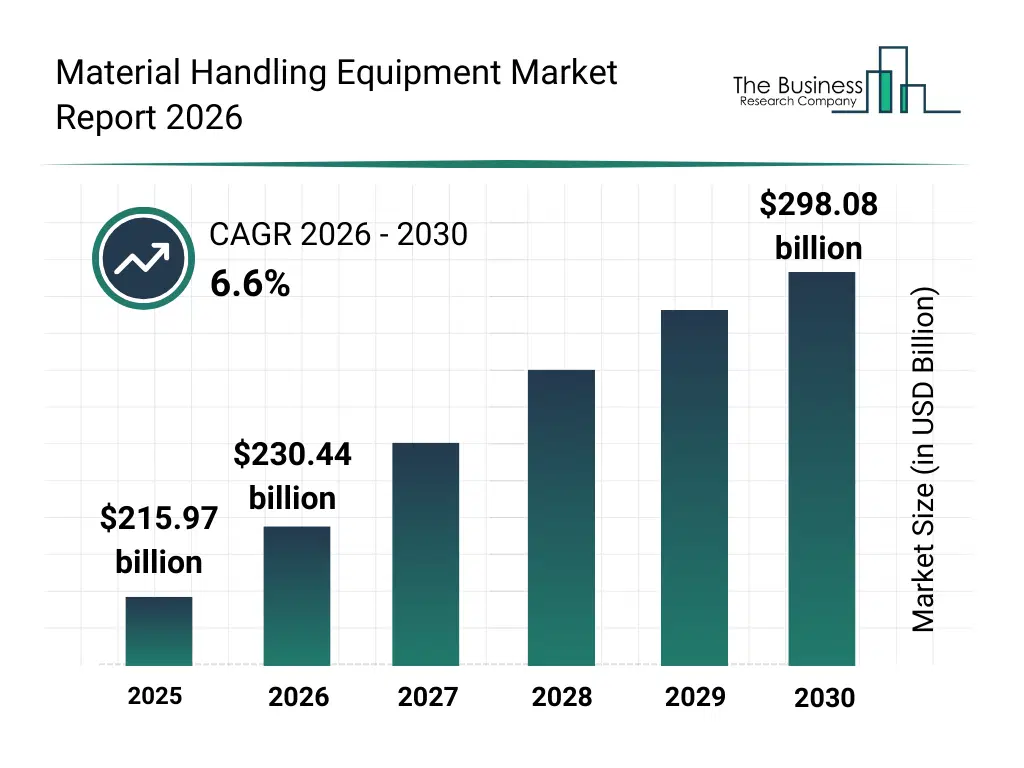
What Is The Material Handling Equipment Market Size and Share 2026?
The material handling equipment market size has grown strongly in recent years. It will grow from $215.97 billion in 2025 to $230.44 billion in 2026 at a compound annual growth rate (CAGR) of 6.7%. The growth in the historic period can be attributed to manufacturing capacity expansion, warehouse modernization, forklift penetration growth, retail logistics demand, industrial safety requirements.What Is The Material Handling Equipment Market Growth Forecast?
The material handling equipment market size is expected to see strong growth in the next few years. It will grow to $298.08 billion in 2030 at a compound annual growth rate (CAGR) of 6.6%. The growth in the forecast period can be attributed to e-commerce warehouse investments, smart logistics adoption, electrification of industrial trucks, demand for high-density storage, automation in distribution centers. Major trends in the forecast period include demand for automated industrial trucks, expansion of racking and storage systems, growth of continuous handling equipment, integration of smart sensors, focus on energy-efficient equipment.Tariff Impact On Material Handling Equipment Market
Tariffs are impacting the material handling equipment market by increasing the cost of imported forklifts, cranes, conveyor systems, electric drives, and control electronics. Automotive, e-commerce, and food processing industries in North America and Europe are particularly affected due to dependence on imported equipment, while Asia-Pacific manufacturers face export competitiveness challenges. These tariffs are raising procurement costs and slowing fleet replacement cycles. However, they are also encouraging domestic assembly, regional supplier development, and innovation in electric and energy-efficient material handling equipment.
Global Material Handling Equipment Market Segmentation
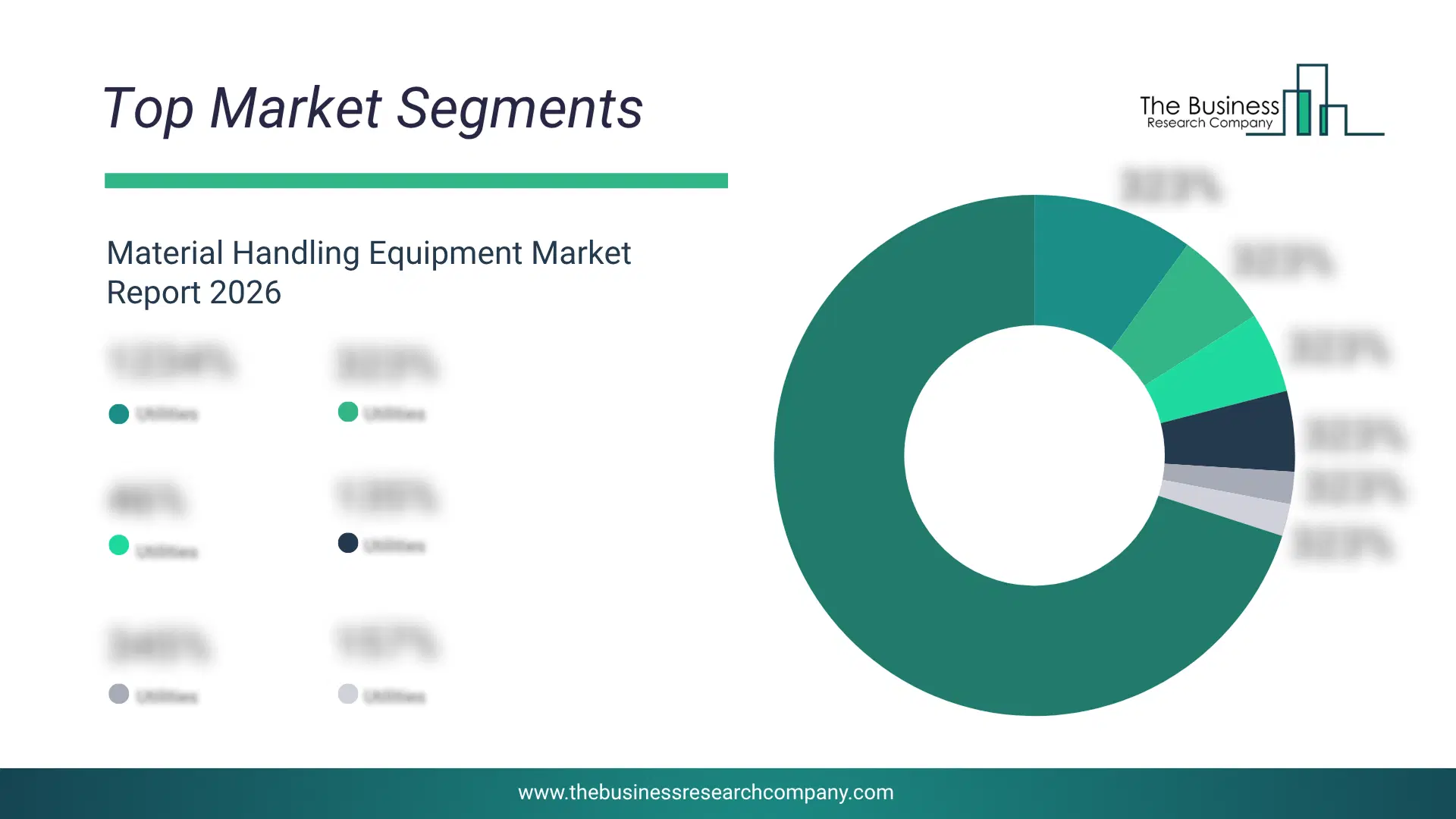
1) By Product Type: Cranes And Lifting Equipment, Industrial Trucks, Continuous Handling Equipment, Racking And Storage Equipment 2) By Operation Type: Manual Material Handling Equipment, Semi-Automated Material Handling Equipment, Automated Material Handling Equipment 3) By Application: Transportation And Conveying, Storage And Warehousing, Picking And Sorting, Loading And Unloading, Assembly Line Handling 4) By End-User Industry: Automotive, Food And Beverages, Chemical, Semiconductor And Electronics, E-commerce And Logistics, Aviation, Pharmaceutical, Other End-User Industries Subsegments: 1) By Cranes And Lifting Equipment: Overhead Cranes, Gantry Cranes, Jib Cranes, Mobile Cranes, Hoists And Winches 2) By Industrial Trucks: Forklift Trucks, Pallet Trucks, Reach Trucks, Tow Tractors, Automated Guided Vehicles (AGVs) 3) By Continuous Handling Equipment: Belt Conveyors, Roller Conveyors, Chain Conveyors, Bucket Elevators, Sortation Systems 4) By Racking And Storage Equipment: Selective Pallet Racking, Drive-In And Drive-Through Racking, Cantilever Racking, Mobile Racking Systems, Automated Storage And Retrieval Systems (ASRS)What Is The Driver Of The Material Handling Equipment Market?
The rising adoption of automated solutions and robotics is expected to propel the material handling equipment market going forward. Automated solutions and robotics involve the application of technology to create systems that perform tasks and operations without direct human intervention, streamlining processes and increasing efficiency across various industries. Automated solutions and robotics utilize material-handling equipment for efficient transportation, sorting, and distribution due to their precision, speed, and ability to handle repetitive tasks accurately. For instance, in September 2024, the International Federation of Robotics (IFR), a Germany-based non-profit organization, reported that global industrial robotics installations reached 4.28 million units in 2023, reflecting a 10% increase from 3.9 million units in 2022. Thus, such a rising adoption of automated solutions will drive the growth of the material-handling equipment market.Key Players In The Global Material Handling Equipment Market
Major companies operating in the material handling equipment market are Beumer Group GmbH And Co. KG, Daifuku Co. Limited, KION Group AG, Toyota Industries Corporation, Honeywell International Incorporated, SSI Schäfer Group GmbH, Jungheinrich AG, Crown Equipment Corporation, Hyster-Yale Materials Handling Incorporated, Mitsubishi Caterpillar Forklift America Incorporated, Mecalux S.A., Liebherr Group, Swisslog Holding AG, Action Construction Equipment Limited, TGW Logistics Group GmbH, Viastore Systems GmbH, WITRON Logistik And Informatik GmbH, Cimcorp Automation Limited, Columbus McKinnon Corporation, Elettric80 S.p.A., Hanel GmbH And Co. KG, Hapman LLC, Hytrol Conveyor Company Incorporated, Jervis B. Webb Company, KITO Corporation, KNAPP AG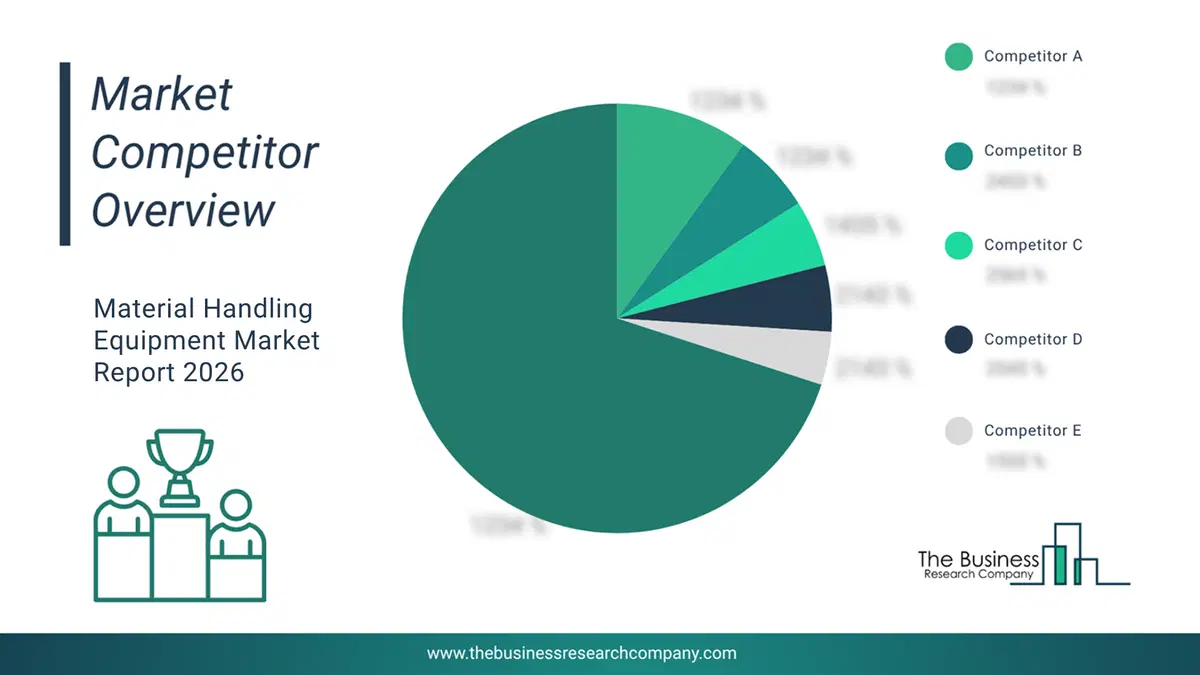
This chart is for illustrative purposes; the full report includes a detailed competitor analysis and comprehensive overview of the top 10 companies in the market.
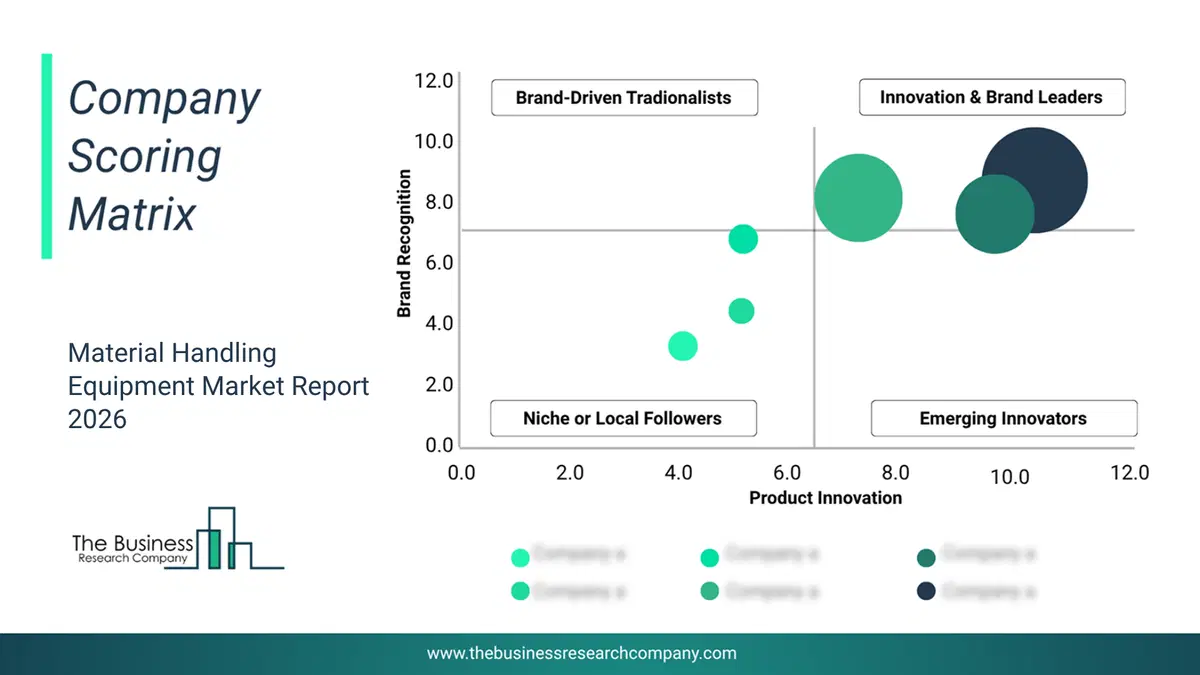
This chart maps companies by product innovation and brand strength, with bubble size indicating relative revenue, helping identify market leaders, challengers, and niche players. This is an illustrative chart; the full report provides a complete and accurate competitive analysis.
Global Material Handling Equipment Market Trends and Insights
Major companies operating in the material handling equipment market are focused on product innovation such as automated pallet tracking, which allows for real-time visibility of inventory and optimization of warehouse workflows to increase throughput and operational efficiency. Automated pallet tracking refers to a technology-driven system that automatically monitors and records the movement and location of pallets within a warehouse or distribution center without requiring manual scanning or human intervention. For instance, in March 2025, Gather AI, a U.S.-based warehouse automation and artificial intelligence solutions company specializing in inventory visibility and material-handling optimization, launched MHE Vision, an artificial intelligence-powered camera system designed to increase warehouse throughput by providing automated, real-time tracking of pallets and material-handling equipment, and this system integrates high-resolution cameras mounted on forklifts and automated pickers, along with artificial intelligence-powered analytics to capture and interpret inventory movements, monitor slot utilization, detect damaged or misplaced goods, and deliver actionable insights for workflow optimization. Additionally, the system features plug-and-play deployment without requiring new infrastructure, making it compatible with existing warehouse setups and multiple types of material-handling equipment.What Are Latest Mergers And Acquisitions In The Material Handling Equipment Market?
In February 2024, Big Lift, a US-based machinery manufacturer, acquired ePicker LLC for an undisclosed amount. This acquisition represents a key move in expanding Big Lift's presence in the competitive material handling market, particularly in lithium-powered equipment. ePicker LLC, a US-based company, specializes in providing a wide range of material handling equipment aimed at boosting efficiency and productivity across various industrial applications.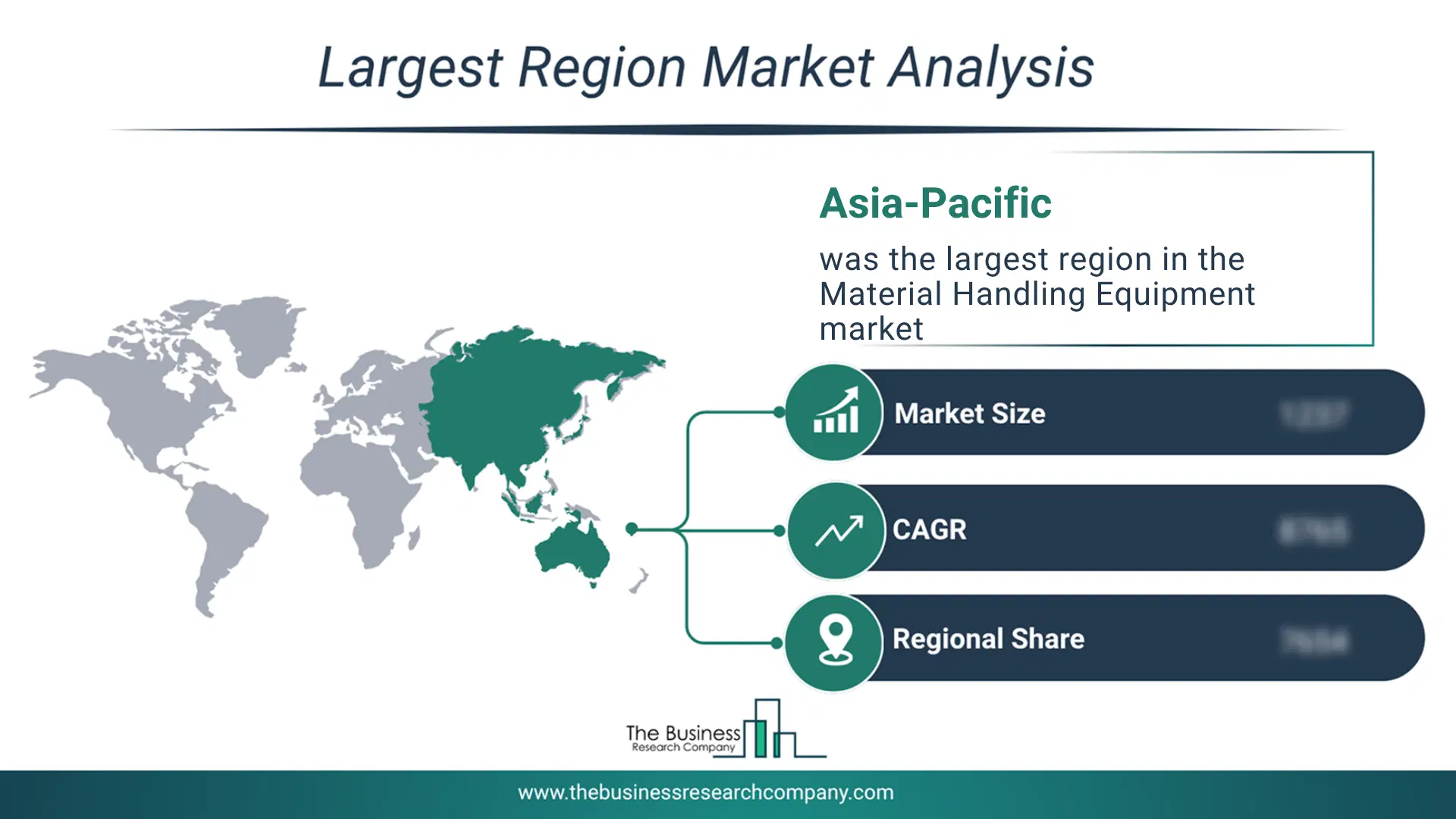
Regional Outlook
Asia-Pacific was the largest region in the material handling equipment market share in 2025. The regions covered in this market report are Asia-Pacific, South East Asia, Western Europe, Eastern Europe, North America, South America, Middle East, Africa The countries covered in this market report are Australia, Brazil, China, France, Germany, India, Indonesia, Japan, Taiwan, Russia, South Korea, UK, USA, Canada, Italy, Spain.What Defines the Material Handling Equipment Market?
The material handling equipment market consists of sales of casters and wheels, controllers, conveyors, dock equipment. Values in this market are ‘factory gate’ values, that is the value of goods sold by the manufacturers or creators of the goods, whether to other entities (including downstream manufacturers, wholesalers, distributors and retailers) or directly to end customers. The value of goods in this market includes related services sold by the creators of the goods.How is Market Value Defined and Measured?
The market value is defined as the revenues that enterprises gain from the sale of goods and/or services within the specified market and geography through sales, grants, or donations in terms of the currency (in USD unless otherwise specified). The revenues for a specified geography are consumption values that are revenues generated by organizations in the specified geography within the market, irrespective of where they are produced. It does not include revenues from resales along the supply chain, either further along the supply chain or as part of other products.
This chart presents market attractiveness based on a quantitative evaluation of growth, competition, strategic alignment, and risk, offering a clear view of opportunity areas for decision-making. This chart is for illustrative purposes; the full report contains the complete analysis.

This chart highlights the Total Addressable Market (TAM) by estimating the maximum revenue opportunity using an assumption-driven approach, supporting strategic planning and opportunity sizing across markets. The chart is illustrative; the full report provides a more comprehensive analysis.
What Key Data and Analysis Are Included in the Material Handling Equipment Market Report 2026?
The material handling equipment market research report is one of a series of new reports from The Business Research Company that provides market statistics, including industry global market size, regional shares, competitors with the market share, detailed market segments, market trends and opportunities, and any further data you may need to thrive in the material handling equipment industry. The market research report delivers a complete perspective of everything you need, with an in-depth analysis of the current and future state of the industry.Material Handling Equipment Market Report Forecast Analysis
| Report Attribute | Details |
|---|---|
| Market Size Value In 2026 | $230.44 billion |
| Revenue Forecast In 2030 | $298.08 billion |
| Growth Rate | CAGR of 6.6% from 2026 to 2030 |
| Base Year For Estimation | 2025 |
| Actual Estimates/Historical Data | 2020-2025 |
| Forecast Period | 2026 - 2030 |
| Market Representation | Revenue in USD Billion and CAGR from 2026 to 2030 |
| Segments Covered | Product Type, Operation Type, Application, End-User Industry |
| Regional Scope | Asia-Pacific, Western Europe, Eastern Europe, North America, South America, Middle East, Africa |
| Key Companies Profiled | Beumer Group GmbH And Co. KG, Daifuku Co. Limited, KION Group AG, Toyota Industries Corporation, Honeywell International Incorporated, SSI Schäfer Group GmbH, Jungheinrich AG, Crown Equipment Corporation, Hyster-Yale Materials Handling Incorporated, Mitsubishi Caterpillar Forklift America Incorporated, Mecalux S.A., Liebherr Group, Swisslog Holding AG, Action Construction Equipment Limited, TGW Logistics Group GmbH, Viastore Systems GmbH, WITRON Logistik And Informatik GmbH, Cimcorp Automation Limited, Columbus McKinnon Corporation, Elettric80 S.p.A., Hanel GmbH And Co. KG, Hapman LLC, Hytrol Conveyor Company Incorporated, Jervis B. Webb Company, KITO Corporation, KNAPP AG |
| Customization Scope | Request for Customization |
| Pricing And Purchase Options | Explore Purchase Options |