
Mathematics Market Report 2026
Global Outlook – By Type (Mathematical Modeling And Simulation, Data Analytics Solutions, Algorithm Development Services, Optimization And Forecasting Solutions, Scientific Computing Tools, Mathematical Education Software, Other Types), By Deployment (On Premises, Cloud Based, Hybrid Deployment, Other Deployments), By Application (Decision-Making Support, Product Development, Operational Efficiency, Risk Management, Supply Chain Optimization, Financial Forecasting, Predictive Maintenance), By End User (Banking, Financial Services And Insurance, Retail And Ecommerce, Manufacturing And Industrial Engineering, Healthcare And Pharmaceuticals, Telecommunications And Information Technology, Government And Public Sector, Energy And Utilities, Transportation And Logistics, Education And Academic Institutions, Other End Users) – Market Size, Trends, Strategies, and Forecast to 2030
Mathematics Market Overview
• Mathematics market size has reached to $10.56 billion in 2025 • Expected to grow to $12.24 billion in 2030 at a compound annual growth rate (CAGR) of 16.2% • Growth Driver: The Rising Demand For Data-Driven Decision Making The Growth Of The Market Due To Rapid Growth In Data Generated From Digital Platforms And Connected Systems • Market Trend: Artificial Intelligence-Powered Coding Systems Transform Complex Problem Solving And Algorithm Design • North America was the largest region in 2025 and Asia-Pacific is the fastest growing region.What Is Covered Under Mathematics Market?
Mathematics in the enterprise technology context refers to the application of mathematical models, algorithms, and computational techniques to solve business, engineering, and analytical problems. It enables organizations to perform complex calculations, data analysis, optimization, forecasting, and simulation to support decision-making, product development, and operational efficiency. It forms the foundation for advanced analytics, artificial intelligence, and enterprise software solutions. The main types of mathematics are mathematical modeling and simulation, data analytics solutions, algorithm development services, optimization and forecasting solutions, scientific computing tools, mathematical education software, and other types. Mathematical modeling and simulation refers to techniques used to represent real-world systems using mathematical expressions and computational models to analyze behavior and predict outcomes. These solutions are delivered through different deployment modes, including on-premises, cloud-based, hybrid deployment, and other deployments. They are used across various applications, such as decision-making support, product development, operational efficiency, risk management, supply chain optimization, financial forecasting, and predictive maintenance, and serve multiple end users, including banking, financial services and insurance, retail and ecommerce, manufacturing and industrial engineering, healthcare and pharmaceuticals, telecommunications and information technology, government and public sector, energy and utilities, transportation and logistics, education and academic institutions, and other end users.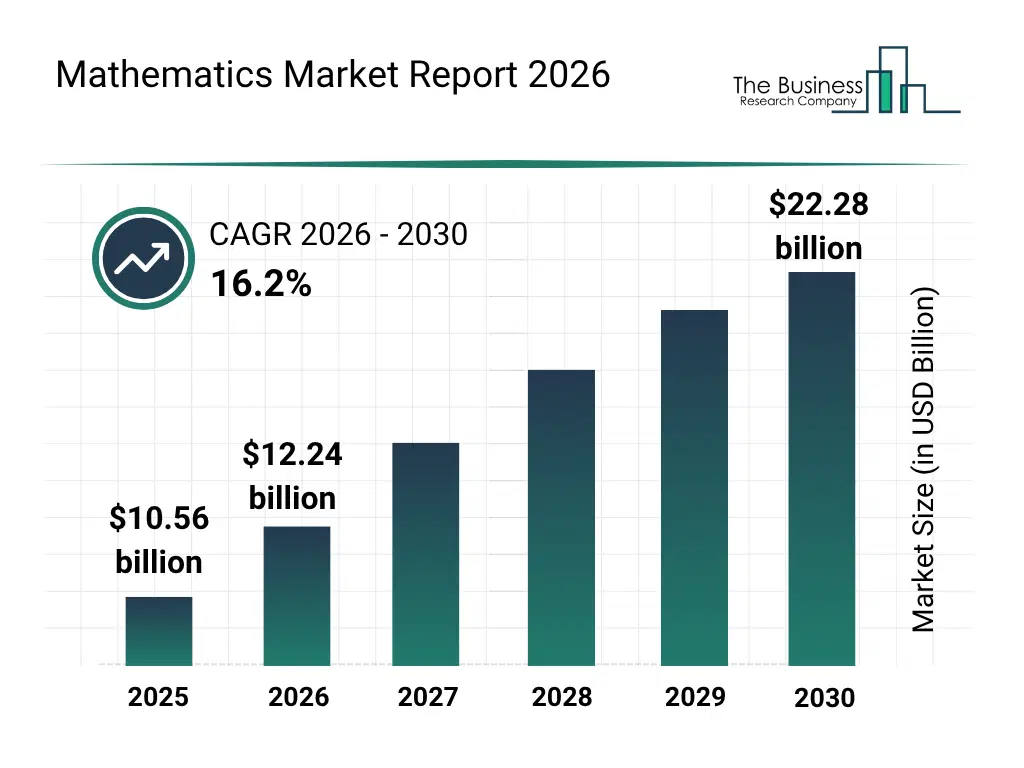
What Is The Mathematics Market Size and Share 2026?
The mathematics market size has grown rapidly in recent years. It will grow from $10.56 billion in 2025 to $12.24 billion in 2026 at a compound annual growth rate (CAGR) of 15.9%. The growth in the historic period can be attributed to growth of traditional statistical methods usage, expansion of enterprise decision science departments, early adoption of computational modeling in engineering, increasing reliance on actuarial calculations in insurance, development of basic optimization techniques in logistics and operations research.What Is The Mathematics Market Growth Forecast?
The mathematics market size is expected to see rapid growth in the next few years. It will grow to $22.28 billion by 2030 at a compound annual growth rate (CAGR) of 16.2%. The growth in the forecast period can be attributed to rising demand for advanced algorithmic optimization services, increasing need for high precision simulation in research applications, expansion of hybrid analytical consulting services, growing emphasis on enterprise risk quantification models, increased integration of mathematical tools in professional training and education systems. Major trends in the forecast period include actuarial and insurance mathematics services expansion, operations research and decision science consulting growth, statistical analysis and data modeling services adoption, mathematical education and assessment software penetration in academic institutions, scientific computing and numerical simulation services expansion.
Global Mathematics Market Segmentation
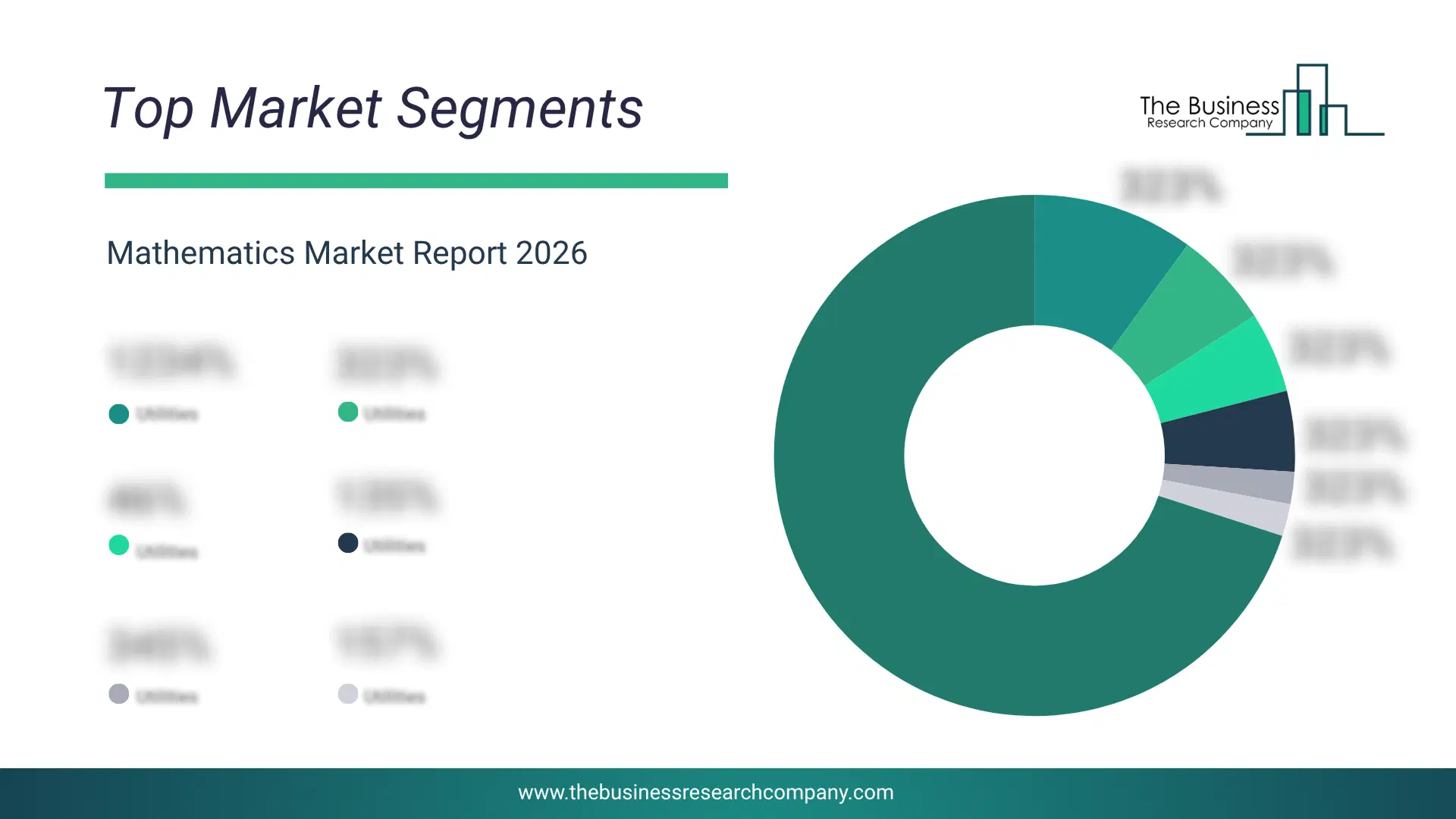
1) By Type: Mathematical Modeling And Simulation, Data Analytics Solutions, Algorithm Development Services, Optimization And Forecasting Solutions, Scientific Computing Tools, Mathematical Education Software, Other Types 2) By Deployment: On Premises, Cloud Based, Hybrid Deployment, Other Deployments 3) By Application: Decision-Making Support, Product Development, Operational Efficiency, Risk Management, Supply Chain Optimization, Financial Forecasting, Predictive Maintenance 4) By End User: Banking, Financial Services And Insurance, Retail And Ecommerce, Manufacturing And Industrial Engineering, Healthcare And Pharmaceuticals, Telecommunications And Information Technology, Government And Public Sector, Energy And Utilities, Transportation And Logistics, Education And Academic Institutions, Other End Users Subsegments: 1) By Mathematical Modeling And Simulation: Deterministic Modeling Solutions, Stochastic Modeling Solutions, Simulation Software Platforms, Computational Fluid Dynamics Modeling, Agent Based Modeling Systems, System Dynamics Modeling Tools 2) By Data Analytics Solutions: Descriptive Analytics Tools, Predictive Analytics Solutions, Prescriptive Analytics Platforms, Big Data Processing Tools, Statistical Analysis Software, Data Visualization Solutions 3) By Algorithm Development Services: Machine Learning Algorithm Development, Artificial Intelligence Algorithm Design, Numerical Algorithm Development, Optimization Algorithm Design, Cryptographic Algorithm Development, Custom Algorithm Engineering Services 4) By Optimization And Forecasting Solutions: Linear Optimization Solutions, Non Linear Optimization Tools, Time Series Forecasting Models, Demand Forecasting Systems, Supply Chain Optimization Tools, Risk Analysis And Forecasting Platforms 5) By Scientific Computing Tools: High Performance Computing Systems, Numerical Analysis Software, Parallel Computing Frameworks, Quantum Computing Simulation Tools, Scientific Programming Libraries, Computational Mathematics Platforms 6) By Mathematical Education Software: Interactive Learning Platforms, E Learning Mathematics Applications, Assessment And Testing Software, Gamified Mathematics Learning Tools, Curriculum Based Learning Systems, Virtual Classroom Mathematics Tools 7) By Other Types: Consulting And Advisory Services, Mathematical Research Services, Custom Software Development Solutions, Training And Skill Development Programs, Cloud Based Mathematics Platforms, Open Source Mathematics ToolsWhat Is The Driver Of The Mathematics Market?
The rising demand for data-driven decision-making is expected to propel the growth of the mathematics market going forward. Data-driven decision-making is the practice of using verified data, analytical models, and evidence-based insights to guide strategic, operational, and financial decisions across organizations. Rising demand for data-driven decision-making is primarily due to the rapid growth in data generated from digital platforms and connected systems, which enables organizations to analyze large volumes of real-time information and make more accurate, timely, and evidence-based decisions. The mathematics tools strengthens the data-driven decision-making by increasing its application in statistical modeling, predictive analytics, and algorithm development that transform raw data into actionable insights. For instance, in January 2025, according to Kanerika Software Pvt. Ltd., an India-based software company, 95% of organizations aim to strengthen their data-driven decision-making, highlighting the pivotal role of analytics in shaping strategic plans. Therefore, the rising demand for data-driven decision-making is driving the growth of the mathematics industry.Key Players In The Global Mathematics Market
Major companies operating in the mathematics market are Amazon.com Inc., Apple Inc., Alphabet Inc., Microsoft Corporation, Meta Platforms Inc., Huawei Technologies Co Ltd., International Business Machines Corporation, Intel Corporation, Oracle Corporation, Xiaomi Corporation, Tata Consultancy Services Limited, Infosys Limited, Pearson plc, McGraw Hill Inc., Renaissance Learning Inc., Carnegie Learning Inc., DreamBox Learning Inc., Zearn Inc., Matific Pty Ltd, Cue Learn Private Limited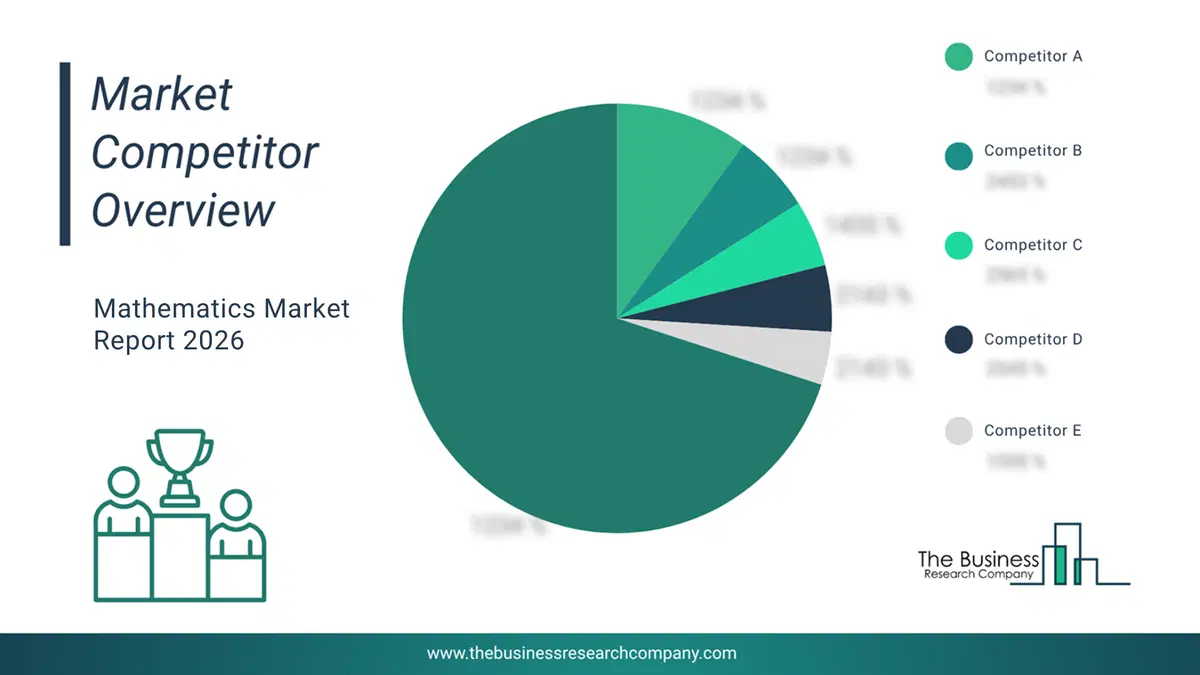
This chart is for illustrative purposes; the full report includes a detailed competitor analysis and comprehensive overview of the top 10 companies in the market.
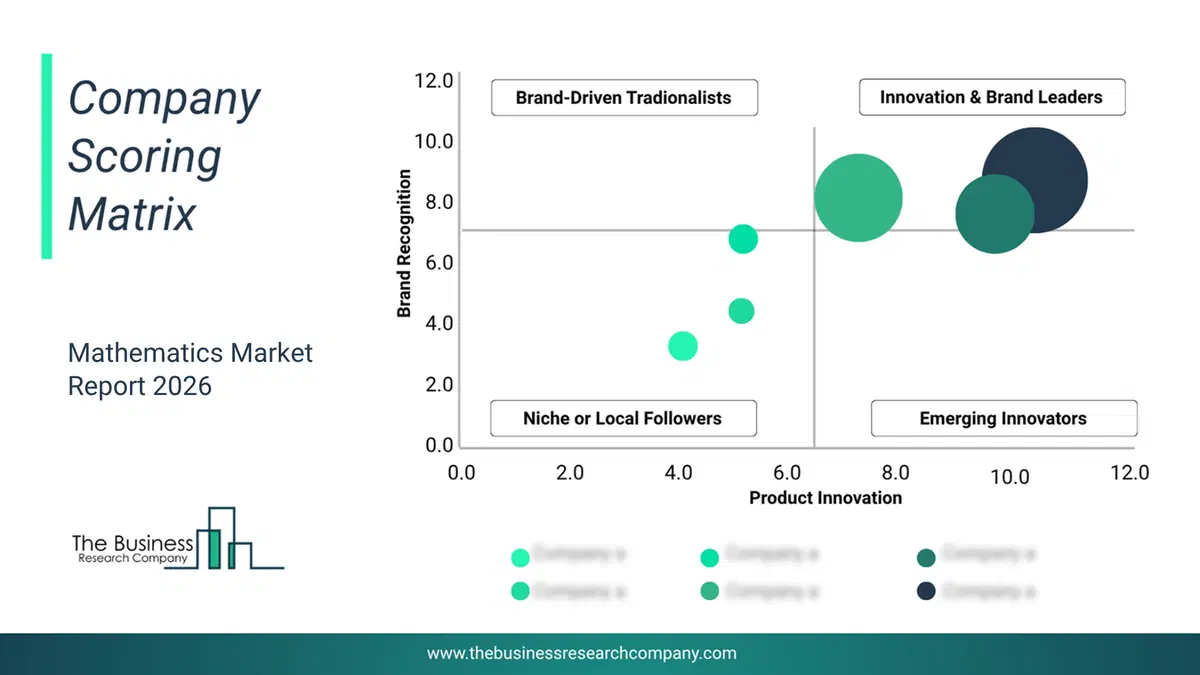
This chart maps companies by product innovation and brand strength, with bubble size indicating relative revenue, helping identify market leaders, challengers, and niche players. This is an illustrative chart; the full report provides a complete and accurate competitive analysis.
Global Mathematics Market Trends and Insights
Major companies operating in the mathematics market are focusing on developing innovative solutions, such as artificial intelligence-coding systems, to solve complex mathematical problems and design more efficient algorithms. Artificial intelligence-coding systems are artificial intelligence tools that can automatically generate, analyze, and improve computer code to solve problems or design algorithms. For instance, in May 2025, DeepMind Technologies Limited, a UK-based artificial intelligence research company, launched AlphaEvolve, an innovative AI coding agent to solve complex mathematical problems and design optimized algorithms. It is designed to tackle highly complex mathematical and computational problems by generating multiple candidate solutions, evaluating them automatically for correctness and efficiency, and iteratively improving the best-performing approaches. The system has been used in real-life tasks like making data centers more efficient, designing chips, and training AI models, showing that it can connect advanced math with practical computing uses. It represents a shift from traditional human-written algorithm design toward AI-assisted and partially autonomous mathematical discovery systems, significantly reducing development time while improving solution quality and scalability.What Are Latest Mergers And Acquisitions In The Mathematics Market?
In January 2026, EAERA Ltd., a US-based fintech company, partnered with the Vietnam Institute for Advanced Study in Mathematics (VIASM) to advance applied mathematics, data science, and artificial intelligence in finance. This partnership aims to improve research and real-world uses in areas like financial modeling, risk analysis, fraud detection, and algorithmic decision-making by bringing together EAERA’s knowledge of AI in finance and VIASM’s solid background in math research and innovation. Vietnam Institute for Advanced Study in Mathematics (VIASM) is a US-based research institute specializing in advanced mathematics and theoretical sciences.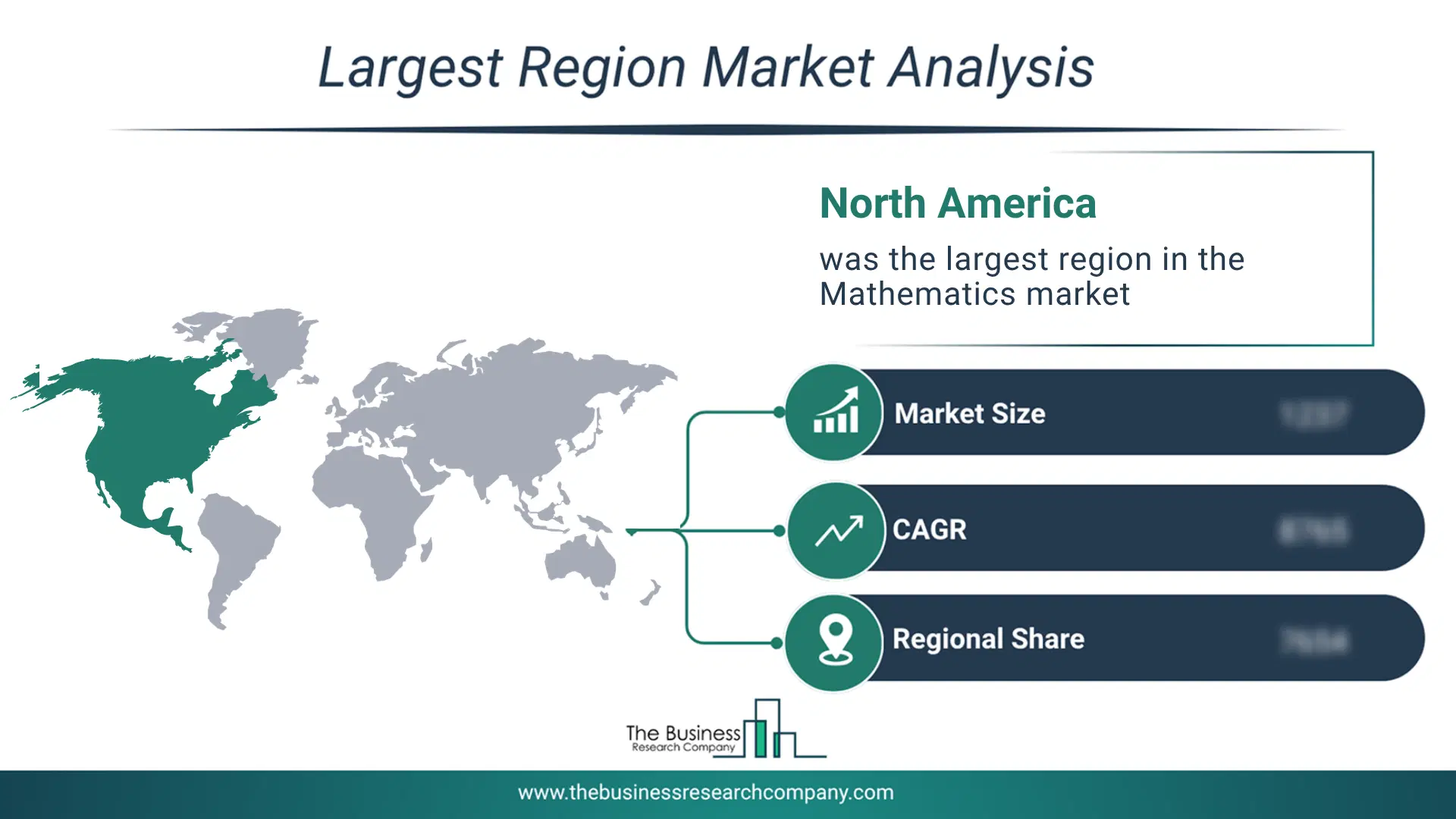
Regional Insights
North America was the largest region in the mathematics market in 2025. Asia-Pacific is expected to be the fastest-growing region in the forecast period. The regions covered in this market report are Asia-Pacific, South East Asia, Western Europe, Eastern Europe, North America, South America, Middle East, Africa. The countries covered in this market report are Australia, Brazil, China, France, Germany, India, Indonesia, Japan, Taiwan, Russia, South Korea, UK, USA, Canada, Italy, Spain.What Defines the Mathematics Market?
The mathematics market includes revenues earned by entities by providing services such as actuarial and insurance mathematics services, cryptography and information security mathematics services, operations research and decision science services, financial engineering and quantitative trading services, and data analytics and statistical consulting services. The market value includes the value of related goods sold by the service provider or included within the service offering. Only goods and services traded between entities or sold to end consumers are included.How is Market Value Defined and Measured?
The market value is defined as the revenues that enterprises gain from the sale of goods and/or services within the specified market and geography through sales, grants, or donations in terms of the currency (in USD unless otherwise specified). The revenues for a specified geography are consumption values that are revenues generated by organizations in the specified geography within the market, irrespective of where they are produced. It does not include revenues from resales along the supply chain, either further along the supply chain or as part of other products.
This chart presents market attractiveness based on a quantitative evaluation of growth, competition, strategic alignment, and risk, offering a clear view of opportunity areas for decision-making. This chart is for illustrative purposes; the full report contains the complete analysis.

This chart highlights the Total Addressable Market (TAM) by estimating the maximum revenue opportunity using an assumption-driven approach, supporting strategic planning and opportunity sizing across markets. The chart is illustrative; the full report provides a more comprehensive analysis.
What Key Data and Analysis Are Included in the Mathematics Market Report 2026?
The mathematics market research report is one of a series of new reports from The Business Research Company that provides market statistics, including industry global market size, regional shares, competitors with the market share, detailed market segments, market trends and opportunities, and any further data you may need to thrive in the mathematics industry. The market research report delivers a complete perspective of everything you need, with an in-depth analysis of the current and future state of the industry.Mathematics Market Report Forecast Analysis
| Report Attribute | Details |
|---|---|
| Market Size Value In 2026 | $12.24 billion |
| Revenue Forecast In 2030 | $22.28 billion |
| Growth Rate | CAGR of 16.2% from 2026 to 2030 |
| Base Year For Estimation | 2025 |
| Actual Estimates/Historical Data | 2020-2025 |
| Forecast Period | 2026 - 2030 |
| Market Representation | Revenue in USD Billion and CAGR from 2026 to 2030 |
| Segments Covered | Type, Deployment, Application, End User |
| Regional Scope | Asia-Pacific, Western Europe, Eastern Europe, North America, South America, Middle East, Africa |
| Country Scope | The Countries Covered In This Market Report Are Australia, Brazil, China, France, Germany, India, Indonesia, Japan, Taiwan, Russia, South Korea, Uk, Usa, Canada, Italy, Spain. |
| Key Companies Profiled | Amazon.com Inc., Apple Inc., Alphabet Inc., Microsoft Corporation, Meta Platforms Inc., Huawei Technologies Co Ltd., International Business Machines Corporation, Intel Corporation, Oracle Corporation, Xiaomi Corporation, Tata Consultancy Services Limited, Infosys Limited, Pearson plc, McGraw Hill Inc., Renaissance Learning Inc., Carnegie Learning Inc., DreamBox Learning Inc., Zearn Inc., Matific Pty Ltd, Cue Learn Private Limited |
| Customization Scope | Request for Customization |
| Pricing And Purchase Options | Explore Purchase Options |