
Mathematics software Market Report 2026
Global Outlook – By Component Type (Software, Services, Support And Maintenance), By Features Offered (Interactive Visualizations, Problem-Solving Algorithms, Collaboration Tools, Customizable User Interfaces, Integration Capabilities With Other Software), By Deployment Type (On-Premise, Cloud-Based, Hybrid Deployment), By Application (Engineering Construction, School, Academic And Research Institutes, Other Applications), By End Use Industry (Education, Healthcare, Research And Development, Financial Services, Engineering And Manufacturing) – Market Size, Trends, Strategies, and Forecast to 2030
Mathematics software Market Overview
• Mathematics software market size has reached to $7.05 billion in 2025 • Expected to grow to $10.79 billion in 2030 at a compound annual growth rate (CAGR) of 8.9% • Growth Driver: Rising Education Technology Adoption Fueling The Growth Of The Market Due To Personalized Learning And Interactive Tools • Market Trend: AI-Powered Assistants Streamline Complex Mathematical Problem Solving • North America was the largest region in 2025 and Asia-Pacific is the fastest growing region.What Is Covered Under Mathematics software Market?
Mathematics software is a computer program designed to perform, visualize, and solve mathematical computations and problems. It can handle tasks ranging from basic arithmetic to advanced calculus, algebra, statistics, and symbolic computations. It helps to assist students, researchers, and professionals in analyzing data, solving equations, modeling systems, and visualizing mathematical concepts efficiently and accurately. The main components of mathematics software include software, services, and support and maintenance. Software refers to platforms that provide interactive visualizations, problem-solving algorithms, collaboration tools, customizable user interfaces, and integration capabilities with other software. The deployment types involved are on-premise, cloud-based, and hybrid deployment. The applications involved are engineering construction, schools, academic and research institutes, and other applications, and these solutions are utilized across several end-use industries, including education, healthcare, research and development, financial services, and engineering and manufacturing.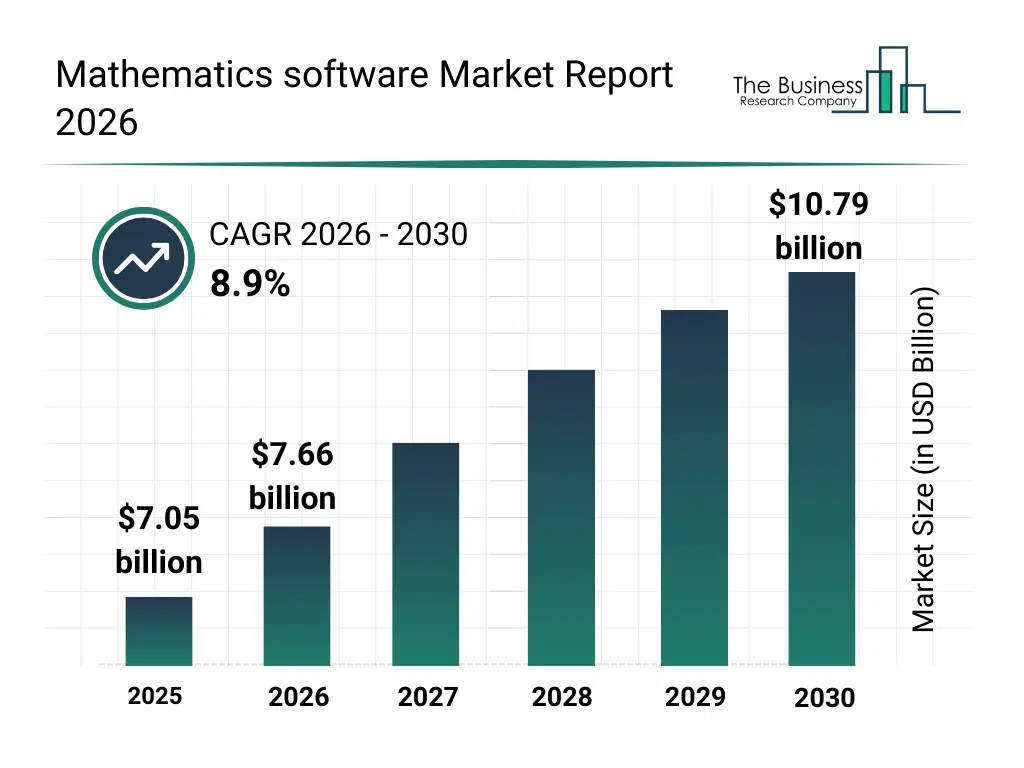
What Is The Mathematics software Market Size and Share 2026?
The mathematics software market size has grown strongly in recent years. It will grow from $7.05 billion in 2025 to $7.66 billion in 2026 at a compound annual growth rate (CAGR) of 8.7%. The growth in the historic period can be attributed to rising adoption of educational software in schools, increasing demand for computational tools in research, growth of e-learning platforms, expansion of academic curriculum requirements, increasing use of visualization tools in mathematics education.What Is The Mathematics software Market Growth Forecast?
The mathematics software market size is expected to see strong growth in the next few years. It will grow to $10.79 billion in 2030 at a compound annual growth rate (CAGR) of 8.9%. The growth in the forecast period can be attributed to growing adoption of AI-powered learning software, increasing integration with cloud-based LMS, rising demand for real-time analytics in education, expansion of hybrid and remote learning models, increasing use of mathematics software in professional R&D applications. Major trends in the forecast period include growing adoption of cloud-based mathematics software, increasing use of interactive learning and visualization tools, rising demand for curriculum-aligned lesson plans, expansion of adaptive assessments and tutoring services, increasing integration of analytics and reporting tools.
Global Mathematics software Market Segmentation
1) By Component Type: Software, Services, Support And Maintenance 2) By Features Offered: Interactive Visualizations, Problem-Solving Algorithms, Collaboration Tools, Customizable User Interfaces, Integration Capabilities With Other Software 3) By Deployment Type: On-Premise, Cloud-Based, Hybrid Deployment 4) By Application: Engineering Construction, School, Academic And Research Institutes, Other Applications 5) By End Use Industry: Education, Healthcare, Research And Development, Financial Services, Engineering And Manufacturing Subsegments: 1) By Software: Computer Algebra Systems, Statistical Analysis Software, Geometry And Visualization Tools, Learning Management Systems, Tutoring And Assessment Software 2) By Services: Implementation Services, Consulting Services, Training And Education Services, Customization Services 3) By Support And Maintenance: Technical Support, Software Updates And Upgrades, Troubleshooting Services, User Assistance And Helpdesk ServicesWhat Is The Driver Of The Mathematics software Market?
The rising adoption of educational technology is expected to propel the growth of the mathematics software market going forward. Education technology adoption refers to the extent to which digital tools, software platforms, and technology-enabled solutions are integrated and used within teaching, learning, and educational management processes. The adoption of educational technology is increasing due to the growing emphasis on personalized learning, as it enables tailored lessons and adaptive feedback for individual student needs. Mathematics software supports educational technology adoption by providing interactive tools for learning, practice, and assessment, making it ideal for classrooms, online courses, and self-paced learning. It reduces manual grading and lesson preparation while enhancing student engagement and conceptual understanding, improving overall teaching and learning outcomes. For instance, in January 2024, according to Eurostat, a Luxembourg-based government agency, 30% of internet users aged 16 to 74 have used an online course or online learning material, up from 28% in 2022. Therefore, the rising adoption of educational technology is driving the growth of the mathematics software industry.Key Players In The Global Mathematics software Market
Major companies operating in the mathematics software market are market are Microsoft Corporation, Siemens AG, International Business Machines Corporation, Intel Corporation, Oracle Corporation, SAP SE, Dassault Systèmes SE, Hexagon AB, Autodesk Incorporated, Cadence Design Systems Incorporated, SAS Institute Incorporated, PTC Inc., CASIO, National Instruments Corporation, MathWorks Incorporated, Wolfram Research Incorporated, Wolfram Research, and COMSOL Inc.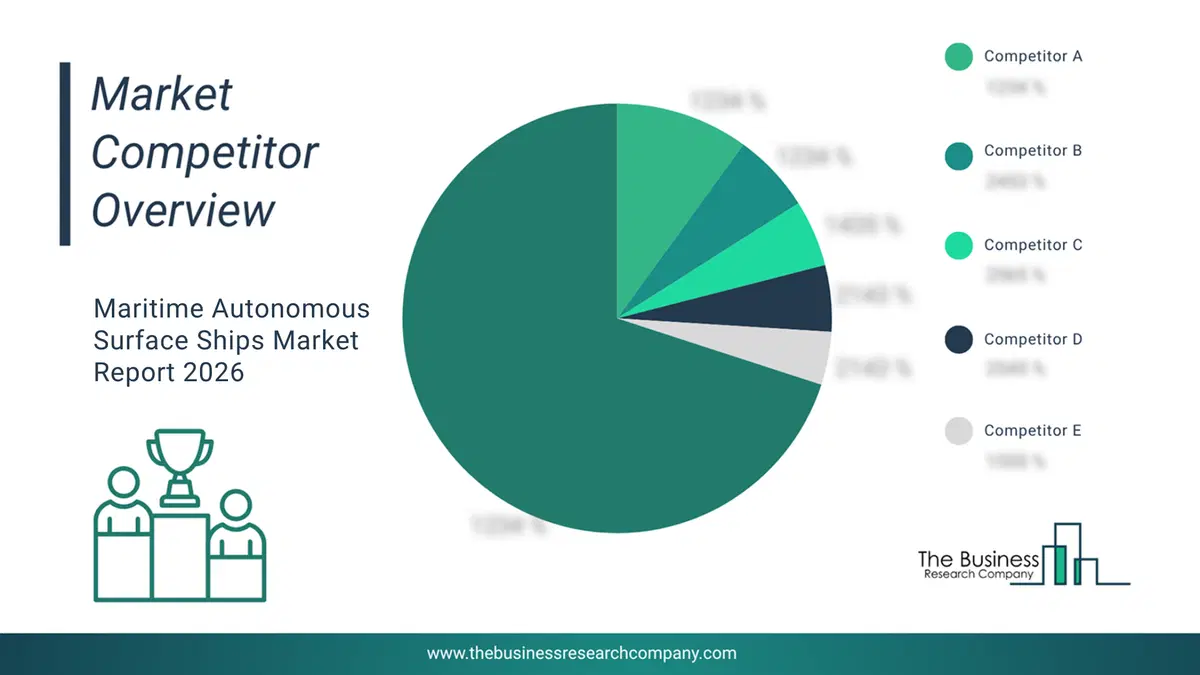
This chart is for illustrative purposes; the full report includes a detailed competitor analysis and comprehensive overview of the top 10 companies in the market.
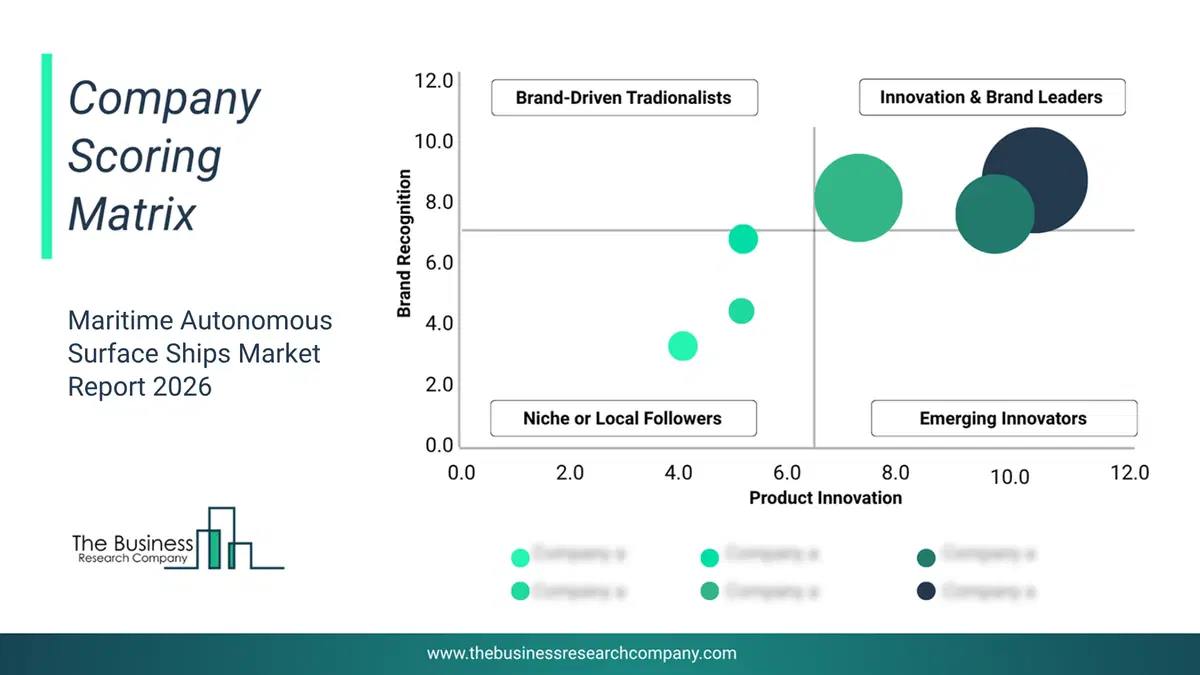
This chart maps companies by product innovation and brand strength, with bubble size indicating relative revenue, helping identify market leaders, challengers, and niche players. This is an illustrative chart; the full report provides a complete and accurate competitive analysis.
Global Mathematics software Market Trends and Insights
Major companies operating in the mathematics software market are focusing on developing technologically advanced solutions, such as AI-powered assistants, to boost efficiency, enhance learning, and reduce the time spent on complex problem-solving. AI-powered assistants refer to advanced features in mathematical software that use artificial intelligence to generate formulas, equations, and step-by-step solutions, helping users complete tasks more quickly and accurately. For instance, in March 2024, Maplesoft, a Canada-based mathematics software company, launched the latest release of its flagship product, Maple 2024. It is a powerful mathematical software package featuring a new AI Formula Assistant that provides users with formulas, equations, explanations, and Maple commands, shortening the time spent on tasks and enabling creative uses of AI. It includes cutting-edge algorithms in multivariate polynomial systems and integral equations, expanding problem-solving capabilities. It also incorporates the expanded "Check My Work" feature, which analyzes each step of a student's solution to identify errors, along with enhanced units support and automatic command completion for improved usability in education and research.What Are Latest Mergers And Acquisitions In The Mathematics software Market?
In August 2023, Discovery Education Inc., a US-based provider of digital learning platforms, curriculum, and adaptive educational software, acquired DreamBox Learning Inc. for an undisclosed amount. With this acquisition, Discovery Education aimed to broaden its suite of personalized, research-based educational tools by integrating DreamBox’s adaptive mathematics and reading software to better serve K-12 educators and students globally. DreamBox Learning Inc. is a US-based provider of adaptive mathematics and reading software that delivers personalized learning experiences to millions of students and educators through data-driven instructional technology.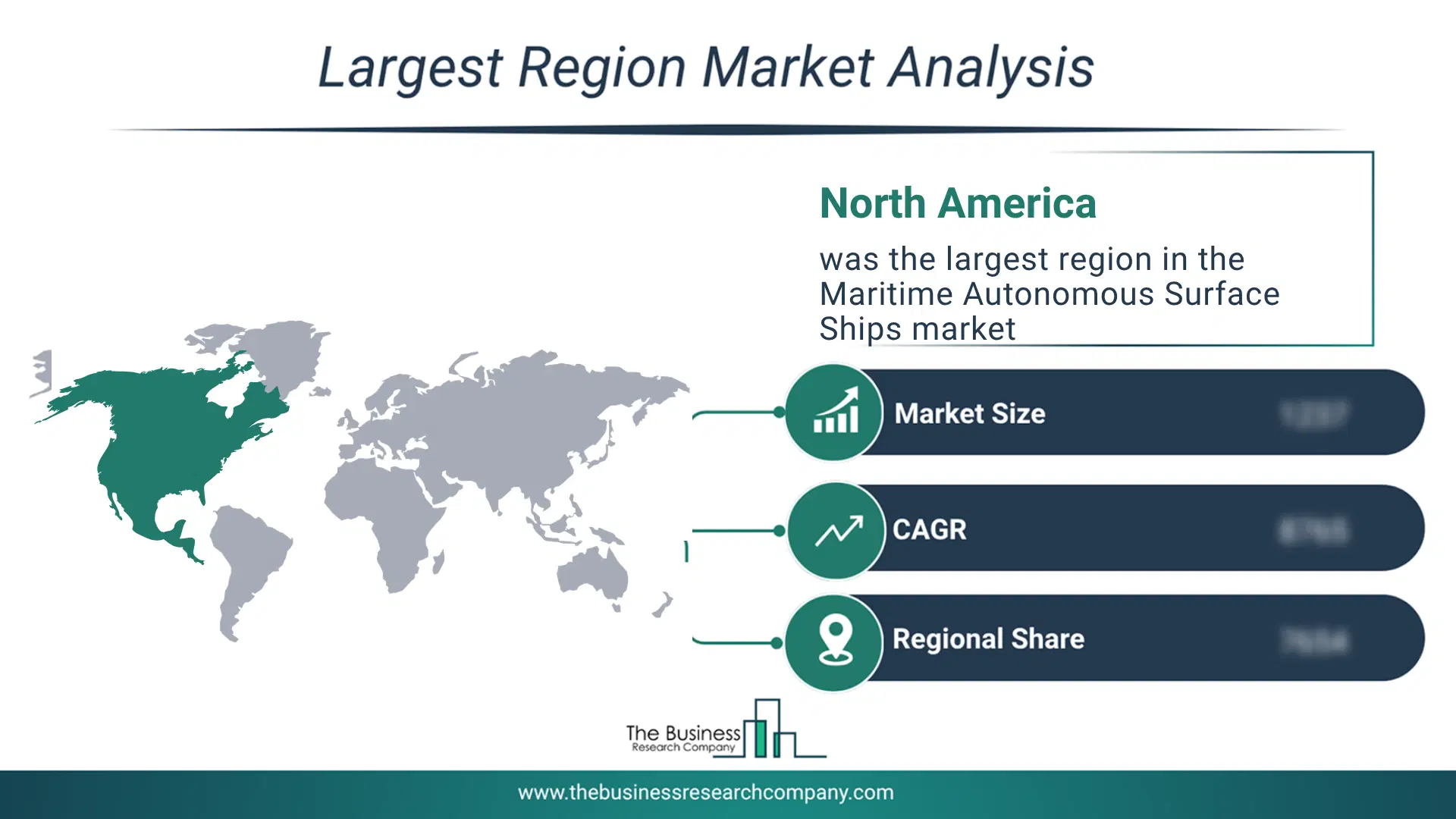
Regional Insights
North America was the largest region in the mathematics software market in 2025. Asia-Pacific is expected to be the fastest-growing region in the forecast period. The regions covered in this market report are Asia-Pacific, South East Asia, Western Europe, Eastern Europe, North America, South America, Middle East, Africa. The countries covered in this market report are Australia, Brazil, China, France, Germany, India, Indonesia, Japan, Taiwan, Russia, South Korea, UK, USA, Canada, Italy, Spain.What Defines the Mathematics software Market?
The mathematics software market consists of revenues earned by entities by providing services such as educational software development, e-learning platforms, interactive learning tools, curriculum-aligned lesson plans, adaptive assessments, analytics and reporting tools, and tutoring support. The market value includes the value of related goods sold by the service provider or included within the service offering. The mathematics software market also includes sales of numerical analysis tools, statistical analysis software, mathematical modeling and simulation software, geometry and graphing tools, optimization and linear programming software, and symbolic computation platforms. Values in this market are ‘factory gate’ values, that is the value of goods sold by the manufacturers or creators of the goods, whether to other entities (including downstream manufacturers, wholesalers, distributors and retailers) or directly to end customers. The value of goods in this market includes related services sold by the creators of the goods.How is Market Value Defined and Measured?
The market value is defined as the revenues that enterprises gain from the sale of goods and/or services within the specified market and geography through sales, grants, or donations in terms of the currency (in USD unless otherwise specified). The revenues for a specified geography are consumption values that are revenues generated by organizations in the specified geography within the market, irrespective of where they are produced. It does not include revenues from resales along the supply chain, either further along the supply chain or as part of other products.
This chart presents market attractiveness based on a quantitative evaluation of growth, competition, strategic alignment, and risk, offering a clear view of opportunity areas for decision-making. This chart is for illustrative purposes; the full report contains the complete analysis.

This chart highlights the Total Addressable Market (TAM) by estimating the maximum revenue opportunity using an assumption-driven approach, supporting strategic planning and opportunity sizing across markets. The chart is illustrative; the full report provides a more comprehensive analysis.
What Key Data and Analysis Are Included in the Mathematics software Market Report 2026?
The mathematics software market research report is one of a series of new reports from The Business Research Company that provides mathematics software market statistics, including mathematics software industry global market size, regional shares, competitors with a mathematics software market share, detailed mathematics software market segments, market trends and opportunities, and any further data you may need to thrive in the mathematics software industry. This mathematics software market research report delivers a complete perspective of everything you need, with an in-depth analysis of the current and future scenario of the industry.Mathematics software Market Report Forecast Analysis
| Report Attribute | Details |
|---|---|
| Market Size Value In 2026 | $7.66 billion |
| Revenue Forecast In 2030 | $10.79 billion |
| Growth Rate | CAGR of 8.9% from 2026 to 2030 |
| Base Year For Estimation | 2025 |
| Actual Estimates/Historical Data | 2020-2025 |
| Forecast Period | 2026 - 2030 |
| Market Representation | Revenue in USD Billion and CAGR from 2026 to 2030 |
| Segments Covered | Component Type, Features Offered, Deployment Type, Application, End Use Industry |
| Regional Scope | Asia-Pacific, Western Europe, Eastern Europe, North America, South America, Middle East, Africa |
| Country Scope | The Countries Covered In This Market Report Are Australia, Brazil, China, France, Germany, India, Indonesia, Japan, Taiwan, Russia, South Korea, Uk, Usa, Canada, Italy, Spain. |
| Key Companies Profiled | market are Microsoft Corporation, Siemens AG, International Business Machines Corporation, Intel Corporation, Oracle Corporation, SAP SE, Dassault Systèmes SE, Hexagon AB, Autodesk Incorporated, Cadence Design Systems Incorporated, SAS Institute Incorporated, PTC Inc., CASIO, National Instruments Corporation, MathWorks Incorporated, Wolfram Research Incorporated, Wolfram Research, and COMSOL Inc. |
| Customization Scope | Request for Customization |
| Pricing And Purchase Options | Explore Purchase Options |