
Matrix Infrared (IR) Sensor Market Report 2026
Global Outlook – By Product Type (Matrix Infrared Sensor Modules, Standalone Infrared Sensors, Integrated Infrared Sensor Solutions), By Technology (Passive Infrared Sensors, Active Infrared Sensors, Dual Technology Sensors), By Distribution Channel (Online Retail, Offline Retail, Distributors And Wholesalers), By End User (Residential, Commercial, Industrial, Government) – Market Size, Trends, Strategies, and Forecast to 2030
Matrix Infrared (IR) Sensor Market Overview
• Matrix Infrared (IR) Sensor market size has reached to $1.85 billion in 2025 • Expected to grow to $2.97 billion in 2030 at a compound annual growth rate (CAGR) of 9.8% • Growth Driver: Growth Of Industrial Automation Fueling The Growth Of The Market Due To Increasing Demand For Precision Monitoring, Process Optimization, And Operational Efficiency In Manufacturing Processes • Market Trend: Advancing Intelligent And Energy-Efficient Thermal Sensing Technologies • North America was the largest region in 2025 and Asia-Pacific is the fastest growing region.What Is Covered Under Matrix Infrared (IR) Sensor Market?
Matrix infrared (IR) sensor refers to a sensor system that uses a two-dimensional array of infrared detector elements arranged in a matrix format to capture thermal radiation from objects in its field of view. it converts infrared energy into electrical signals, enabling thermal imaging, detection, and tracking of heat signatures even in low-light or no-light conditions. these sensors are widely used in applications such as surveillance, industrial monitoring, automotive safety systems, and defense targeting due to their high sensitivity and spatial resolution The main product types of matrix infrared (IR) sensor include matrix infrared sensor modules, standalone infrared sensors, and integrated infrared sensor solutions. Matrix infrared sensor modules refer to sensor arrays that detect and measure infrared radiation across multiple sensing elements for monitoring and detection applications. These products utilize technologies including passive infrared sensors, active infrared sensors, and dual technology sensors. They are distributed through online retail, offline retail, and distributors and wholesalers and serving end users including residential, commercial, industrial, and government.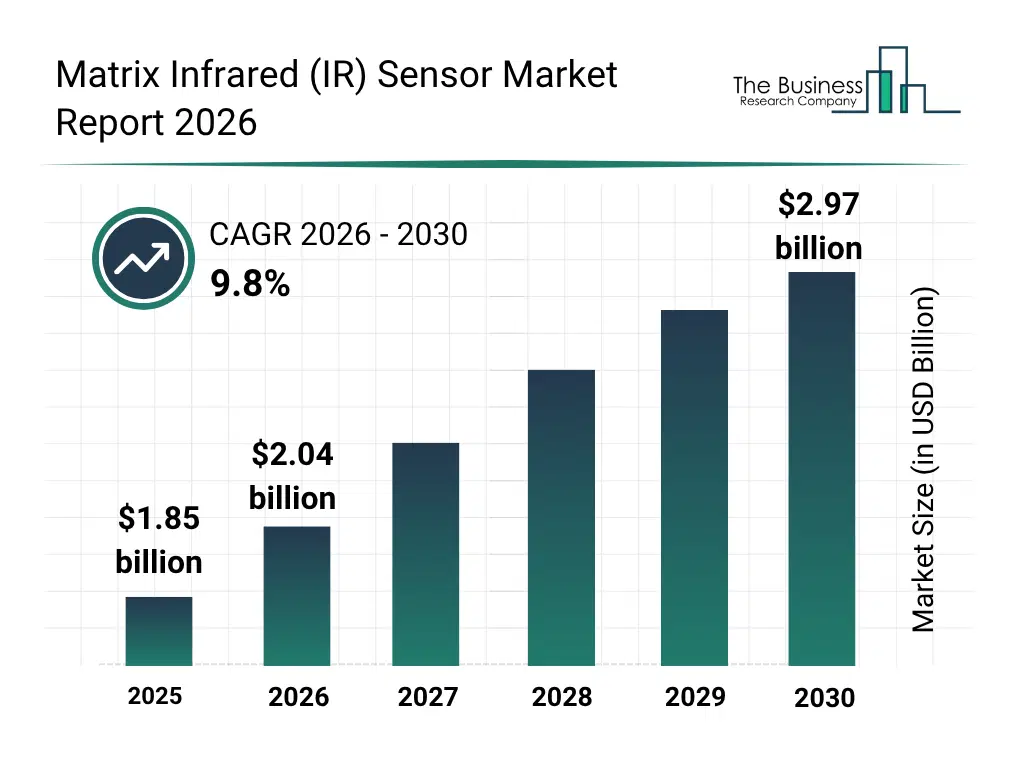
What Is The Matrix Infrared (IR) Sensor Market Size and Share 2026?
The matrix infrared (IR) sensor market size has grown rapidly in recent years. It will grow from $1.85 billion in 2025 to $2.04 billion in 2026 at a compound annual growth rate (CAGR) of 10.3%. The growth in the historic period can be attributed to growth in defense and surveillance applications, increasing adoption of industrial automation systems, rising demand for automotive safety technologies, expansion of thermal imaging applications, growth in smart security infrastructure deployment.What Is The Matrix Infrared (IR) Sensor Market Growth Forecast?
The matrix infrared (IR) sensor market size is expected to see strong growth in the next few years. It will grow to $2.97 billion in 2030 at a compound annual growth rate (CAGR) of 9.8%. The growth in the forecast period can be attributed to increasing demand for autonomous vehicle sensing systems, rising deployment of smart city surveillance infrastructure, growth in industrial predictive maintenance solutions, increasing adoption of advanced driver assistance systems, expansion of AI enabled imaging technologies. Major trends in the forecast period include increasing adoption of high resolution thermal imaging technologies, rising demand for compact and low power infrared sensor modules, growing integration of multi sensor fusion systems, increasing use of infrared sensing for predictive maintenance applications, rising deployment of advanced surveillance and security monitoring systems.
Global Matrix Infrared (IR) Sensor Market Segmentation
1) By Product Type: Matrix Infrared Sensor Modules; Standalone Infrared Sensors; Integrated Infrared Sensor Solutions 2) By Technology: Passive Infrared Sensors; Active Infrared Sensors; Dual Technology Sensors 3) By Distribution Channel: Online Retail; Offline Retail; Distributors And Wholesalers 4) By End User: Residential; Commercial; Industrial; Government Subsegments: 1) By Matrix Infrared Sensor Modules: Long Wave Infrared Sensor Modules; Mid Wave Infrared Sensor Modules; Short Wave Infrared Sensor Modules; Uncooled Infrared Sensor Modules; Cooled Infrared Sensor Modules 2) By Standalone Infrared Sensors: Thermal Detection Sensors; Motion Detection Sensors; Temperature Measurement Sensors; Passive Infrared Sensors; Radiometric Infrared Sensors 3) By Integrated Infrared Sensor Solutions: Embedded Vision Sensor Solutions; Automotive Infrared Sensor Solutions; Industrial Monitoring Sensor Solutions; Smart Surveillance Sensor Solutions; Multi Sensor Fusion SolutionsWhat Are The Drivers Of The Matrix Infrared (IR) Sensor Market?
The growth of industrial automation is expected to propel the growth of the matrix infrared (IR) sensor market going forward. Industrial automation is the use of control systems, robots, and information technologies to operate machinery and processes in manufacturing and other industries with minimal human intervention. Industrial automation is increasing due to the growing need for higher productivity and operational efficiency in manufacturing processes. Matrix infrared (IR) sensors are used in industrial automation to detect, monitor, and map object presence, position, temperature, or movement across multiple points for precision control and process optimization. For instance, in September 2024, according to the International Federation of Robotics (IFR), a Germany-based non-profit organization, industrial robot installations in the UK rose by 51%, reaching 3,830 units, while in the Americas, over 50,000 units were installed for the third consecutive year, totaling 55,389 units in 2023. Therefore, the growth of industrial automation is driving the growth of the matrix infrared (IR) sensor industry. The rise in adoption of electric vehicles is expected to propel the growth of the matrix infrared (IR) sensor market going forward. Electric vehicles are vehicles powered primarily or entirely by electric motors using energy stored in rechargeable batteries or other electrical energy storage systems instead of relying on internal combustion engines. The adoption of electric vehicles is increasing due to growing demand for environmentally sustainable and low-emission transportation solutions. Matrix infrared (IR) sensors are used in electric vehicles to enable thermal monitoring, occupant detection, battery temperature management, and advanced driver-assistance functions for improved safety and efficiency. For instance, in April 2024, according to the International Energy Agency (IEA), a France-based intergovernmental organization, the number of new electric car registrations in China reached 8.1 million in 2023, representing a 35% increase compared to 2022. Therefore, the rise in adoption of electric vehicles is driving the growth of the matrix infrared (IR) sensor industry.Key Players In The Global Matrix Infrared (IR) Sensor Market
Major companies operating in the matrix infrared (ir) sensor market are Teledyne Technologies; Lynred SA; Leonardo DRS Inc.; Hamamatsu Photonics K.K.; Murata Manufacturing Co. Ltd.; Omron Corporation; Honeywell International Inc.; Melexis NV; Exosens; Seek Thermal Inc.; Heimann Sensor GmbH; Mitsubishi Electric Corporation; Excelitas Technologies Corp.; VIGO Photonics S.A.; IRnova AB; Global Sensor Technology; InfraTec GmbH; New England Photoconductor Corp.; Nippon Ceramic Co. Ltd.Global Matrix Infrared (IR) Sensor Market Trends and Insights
Major companies operating in the matrix infrared (IR) sensor market are focusing on developing advanced solutions, such as thermographic sensing solutions with higher resolution, low-noise performance, AI-enabled thermal analytics, and energy-efficient architectures to enhance non-contact temperature monitoring across industrial, automotive, smart home, and consumer applications. Thermographic sensing solutions are technologies that use infrared sensors to detect and visualize heat patterns or temperature variations without physical contact. For instance, in April 2025, Melexis, a Belgium-based semiconductor company, launched the MLX90642, a next-generation thermographic sensor featuring a 32x24 infrared pixel array designed to improve non-contact temperature sensing across industrial and consumer applications. The sensor delivers enhanced thermal imaging performance through low-noise operation, global shutter readout, and onboard temperature calculation, eliminating the need for a dedicated microcontroller and reducing overall system cost and complexity. Housed in a compact TO39 package, the MLX90642 supports applications such as smart cooking, HVAC systems, fire prevention, overheating detection, and AI-enabled occupancy monitoring. Its high accuracy, configurable refresh rates, and wide operating temperature range help enable more intelligent, energy-efficient, and sustainable thermal sensing solutions.Regional Outlook
North America was the largest region in the matrix infrared (IR) sensor market in 2025. Asia-Pacific is expected to be the fastest-growing region in the forecast period. The regions covered in this market report are Asia-Pacific, South East Asia, Western Europe, Eastern Europe, North America, South America, Middle East, Africa. The countries covered in this market report are Australia, Brazil, China, France, Germany, India, Indonesia, Japan, Taiwan, Russia, South Korea, UK, USA, Canada, Italy, Spain.What Defines the Matrix Infrared (IR) Sensor Market?
The matrix infrared (IR) sensor market consists of sales of thermal imaging sensors, infrared detector arrays, cooled infrared sensors, uncooled infrared sensors, infrared camera modules, focal plane arrays, infrared sensor chips, long-wave infrared sensors and short-wave infrared sensors. Values in this market are ‘factory gate’ values, that is the value of goods sold by the manufacturers or creators of the goods, whether to other entities (including downstream manufacturers, wholesalers, distributors and retailers) or directly to end customers. The value of goods in this market includes related services sold by the creators of the goods.How is Market Value Defined and Measured?
The market value is defined as the revenues that enterprises gain from the sale of goods and/or services within the specified market and geography through sales, grants, or donations in terms of the currency (in USD unless otherwise specified). The revenues for a specified geography are consumption values that are revenues generated by organizations in the specified geography within the market, irrespective of where they are produced. It does not include revenues from resales along the supply chain, either further along the supply chain or as part of other products.What Key Data and Analysis Are Included in the Matrix Infrared (IR) Sensor Market Report 2026?
The matrix infrared (ir) sensor market research report is one of a series of new reports from The Business Research Company that provides market statistics, including industry global market size, regional shares, competitors with the market share, detailed market segments, market trends and opportunities, and any further data you may need to thrive in the matrix infrared (ir) sensor industry. The market research report delivers a complete perspective of everything you need, with an in-depth analysis of the current and future state of the industry.Matrix Infrared (IR) Sensor Market Report Forecast Analysis
| Report Attribute | Details |
|---|---|
| Market Size Value In 2026 | $2.04 billion |
| Revenue Forecast In 2030 | $2.97 billion |
| Growth Rate | CAGR of 9.8% from 2026 to 2030 |
| Base Year For Estimation | 2025 |
| Actual Estimates/Historical Data | 2020-2025 |
| Forecast Period | 2026 - 2030 |
| Market Representation | Revenue in USD Billion and CAGR from 2026 to 2030 |
| Segments Covered | Product Type, Technology, Distribution Channel, End User |
| Regional Scope | Asia-Pacific, Western Europe, Eastern Europe, North America, South America, Middle East, Africa |
| Country Scope | The countries covered in the report are Australia, Brazil, China, France, Germany, India, ... |
| Key Companies Profiled | Teledyne Technologies; Lynred SA; Leonardo DRS Inc.; Hamamatsu Photonics K.K.; Murata Manufacturing Co. Ltd.; Omron Corporation; Honeywell International Inc.; Melexis NV; Exosens; Seek Thermal Inc.; Heimann Sensor GmbH; Mitsubishi Electric Corporation; Excelitas Technologies Corp.; VIGO Photonics S.A.; IRnova AB; Global Sensor Technology; InfraTec GmbH; New England Photoconductor Corp.; Nippon Ceramic Co. Ltd. |
| Customization Scope | Request for Customization |
| Pricing And Purchase Options | Explore Purchase Options |