
Medical Device Structural Adhesives Market Report 2026
Global Outlook – By Product Type (Epoxy Structural Adhesives, Cyanoacrylate Structural Adhesives, Acrylic Structural Adhesives, Silicone Structural Adhesives), By Material Bonded (Plastics, Metals, Glass, Composites), By Curing Method (Ultraviolet Or Light-Curing Adhesives, Heat-Curing Adhesives, Room-Temperature-Curing Adhesives), By Application (Diagnostic Equipment Assembly, Surgical Instruments Assembly, Wearable Medical Device Assembly, Catheters And Tubing Assembly, Drug Delivery Devices, Implantable Medical Devices, Disposable Medical Devices, Other Applications), By End User (Medical Device Manufacturers, Contract Manufacturing Organizations, Research And Development Laboratories) – Market Size, Trends, Strategies, and Forecast to 2030
Medical Device Structural Adhesives Market Overview
• Medical Device Structural Adhesives market size has reached to $1.6 billion in 2025 • Expected to grow to $2.55 billion in 2030 at a compound annual growth rate (CAGR) of 9.8% • Growth Driver: Surge In Increasing Demand For Medical Devices Fueling The Growth Of The Market Due To Rising Prevalence Of Chronic Diseases • Market Trend: Technological Advancements In Light-Cure Adhesive Chemistry Enhance Precision Bonding And Regulatory Compliance In Medical Device Assembly • North America was the largest region in 2025 and Asia-Pacific is the fastest growing region.What Is Covered Under Medical Device Structural Adhesives Market?
Medical device structural adhesives refer to high-performance, biocompatible bonding materials engineered to permanently join dissimilar substrates during the assembly of medical devices and healthcare equipment. These adhesives are designed to withstand demanding sterilization processes while maintaining exceptional bond strength, structural integrity, and fluid-tight sealing. They play a critical role in the manufacturing of diagnostic instruments, surgical devices, implantable medical devices, drug delivery systems, and wearable medical technologies by ensuring long-term durability, device reliability, patient safety, and regulatory compliance. The main product types of medical device structural adhesives include epoxy structural adhesives, cyanoacrylate structural adhesives, acrylic structural adhesives, and silicone structural adhesives. Epoxy structural adhesives refer to high-strength bonding materials used to join medical device components and provide durable structural integrity under demanding operating conditions. These adhesives bond plastics, metals, glass, and composites and are available as ultraviolet or light-curing adhesives, heat-curing adhesives, and room-temperature-curing adhesives. They find application in diagnostic equipment assembly, surgical instruments assembly, wearable medical device assembly, catheters and tubing assembly, drug delivery devices, implantable medical devices, disposable medical devices, and others, serving end users including medical device manufacturers, contract manufacturing organizations, and research and development laboratories.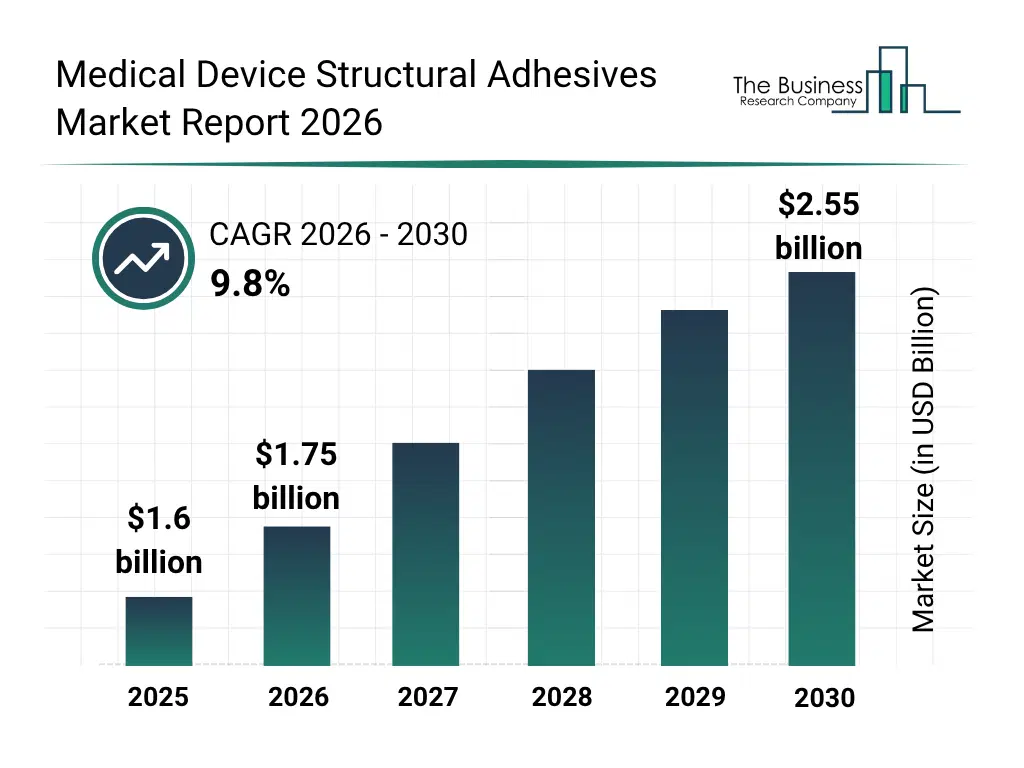
What Is The Medical Device Structural Adhesives Market Size and Share 2026?
The medical device structural adhesives market size has grown strongly in recent years. It will grow from $1.6 billion in 2025 to $1.75 billion in 2026 at a compound annual growth rate (CAGR) of 9.6%. The growth in the historic period can be attributed to increasing adoption of minimally invasive medical devices, growing demand for durable medical device assembly, rising use of polymer and metal components in medical devices, increasing emphasis on device reliability and patient safety, growing demand for permanent fluid-tight bonding.What Is The Medical Device Structural Adhesives Market Growth Forecast?
The medical device structural adhesives market size is expected to see strong growth in the next few years. It will grow to $2.55 billion in 2030 at a compound annual growth rate (CAGR) of 9.8%. The growth in the forecast period can be attributed to increasing demand for advanced biocompatible adhesive formulations, rising adoption of wearable and connected medical devices, growing development of implantable medical technologies, increasing demand for lightweight and miniaturized medical devices, expanding use of automated adhesive dispensing and curing processes. Major trends in the forecast period include growing adoption of biocompatible structural adhesives, increasing demand for sterilization-resistant adhesive formulations, rising use of low-outgassing medical adhesives, increasing demand for dissimilar substrate bonding, growing preference for fast-curing structural adhesives.
Global Medical Device Structural Adhesives Market Segmentation
1) By Product Type: Epoxy Structural Adhesives, Cyanoacrylate Structural Adhesives, Acrylic Structural Adhesives, Silicone Structural Adhesives 2) By Material Bonded: Plastics, Metals, Glass, Composites 3) By Curing Method: Ultraviolet Or Light-Curing Adhesives, Heat-Curing Adhesives, Room-Temperature-Curing Adhesives 4) By Application: Diagnostic Equipment Assembly, Surgical Instruments Assembly, Wearable Medical Device Assembly, Catheters And Tubing Assembly, Drug Delivery Devices, Implantable Medical Devices, Disposable Medical Devices, Other Applications 5) By End User: Medical Device Manufacturers, Contract Manufacturing Organizations, Research And Development Laboratories Subsegments: 1) By Epoxy Structural Adhesives: Bisphenol A Epoxy Adhesives, Bisphenol F Epoxy Adhesives, Novolac Epoxy Adhesives, Aliphatic Epoxy Adhesives 2) By Cyanoacrylate Structural Adhesives: Ethyl Cyanoacrylate Adhesives, Methyl Cyanoacrylate Adhesives, Butyl Cyanoacrylate Adhesives, Octyl Cyanoacrylate Adhesives 3) By Acrylic Structural Adhesives: Methyl Methacrylate Adhesives, Methacrylate Structural Adhesives, Modified Acrylic Adhesives 4) By Silicone Structural Adhesives: One-Component Silicone Adhesives, Two-Component Silicone Adhesives, Heat-Cure Silicone AdhesivesWhat Is The Driver Of The Medical Device Structural Adhesives Market?
The increasing demand for medical devices is expected to propel the growth of the medical device structural adhesives market going forward. Medical devices are instruments, apparatuses, machines, or implants that healthcare providers use to diagnose, treat, monitor, or prevent diseases. Demand for medical devices is increasing due to the rising prevalence of chronic diseases, which require continuous diagnosis, monitoring, and treatment. Medical device structural adhesives enable the reliable bonding of diverse materials, supporting the production of durable, high-performance devices that meet stringent quality and regulatory standards. For instance, in May 2026, according to the U.S. Food and Drug Administration (FDA), a US-based federal agency, the cumulative number of Breakthrough Devices receiving marketing authorization increased from 179 in 2025 to 198 in 2026, while cumulative Breakthrough Device designations rose from 1,179 to 1,284 over the same period. This growth reflects the accelerating development and commercialization of innovative medical technologies, driving demand for high-performance structural adhesives used in the assembly of advanced medical devices. Therefore, the increasing demand for medical devices is driving the medical device structural adhesives industry.Key Players In The Global Medical Device Structural Adhesives Market
Major companies operating in the medical device structural adhesives market are Henkel AG & Co. KGaA, 3M Company, Dow Inc., Sika AG, Arkema SA, DuPont de Nemours Inc., H.B. Fuller Company, Huntsman Corporation, Illinois Tool Works Inc., Avery Dennison Corporation, The Lubrizol Corporation, Ashland Inc., DELO Industrie Klebstoffe GmbH & Co. KGaA, Meridian Adhesives Group, Dymax Corporation, Parson Adhesives Inc., Chemence Medical Inc., Panacol-Elosol GmbH, Adhezion Biomedical LLC, Permabond LLC, Master Bond Inc., Scott Bader Company Ltd., Hubei Huitian New Materials Co. Ltd.
This chart is for illustrative purposes; the full report includes a detailed competitor analysis and comprehensive overview of the top 10 companies in the market.
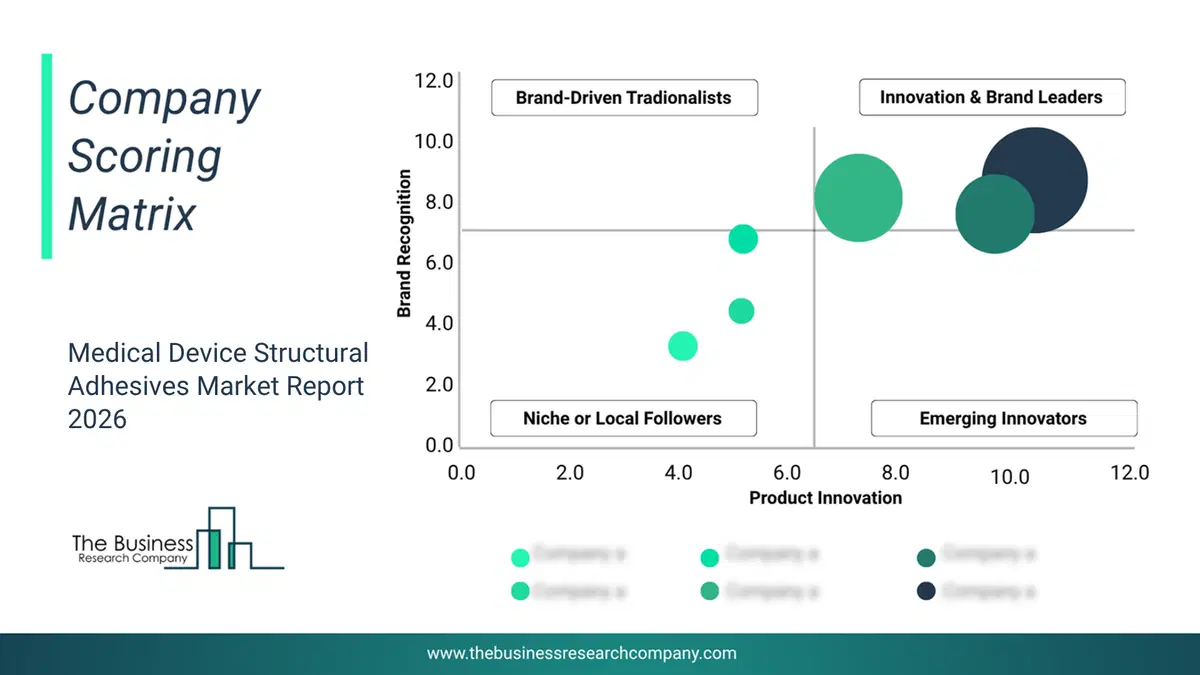
This chart maps companies by product innovation and brand strength, with bubble size indicating relative revenue, helping identify market leaders, challengers, and niche players. This is an illustrative chart; the full report provides a complete and accurate competitive analysis.
Global Medical Device Structural Adhesives Market Trends and Insights
Major companies operating in the medical device structural adhesives market are focusing on technological advancements in adhesive chemistry, such as light cure bonding technology, to improve manufacturing efficiency, enable rapid curing, enhance bond strength, and support the assembly of increasingly complex medical devices. Light cure bonding technology uses UV or visible light exposure to trigger rapid polymerization of adhesive formulations, enabling manufacturers to bond flexible substrates such as thermoplastic elastomers with high precision and minimal processing time. For instance, in January 2025, Henkel, a Germany-based industrial adhesives company, launched Loctite AA 3952 and Loctite SI 5057, two light cure adhesives designed for flexible medical device assembly. Both products are tested for ISO 10993 biocompatibility, formulated to bond thermoplastic elastomer substrates effectively, and engineered to maintain performance under heat and humidity aging conditions critical for device reliability.What Are Latest Mergers And Acquisitions In The Medical Device Structural Adhesives Market?
In December 2024, H.B. Fuller Company, a US-based manufacturer of adhesives, sealants, and specialty chemical products, acquired Medifill Ltd. for approximately €49.9 million ($51.3 million). With this acquisition, H.B. Fuller expanded its Medical Adhesive Technologies portfolio by strengthening its medical-grade cyanoacrylate adhesive capabilities and enhancing its presence in the wound closure and tissue adhesives market. Medifill Ltd. is an Ireland-based manufacturer of medical-grade cyanoacrylate tissue adhesives and wound closure technologies.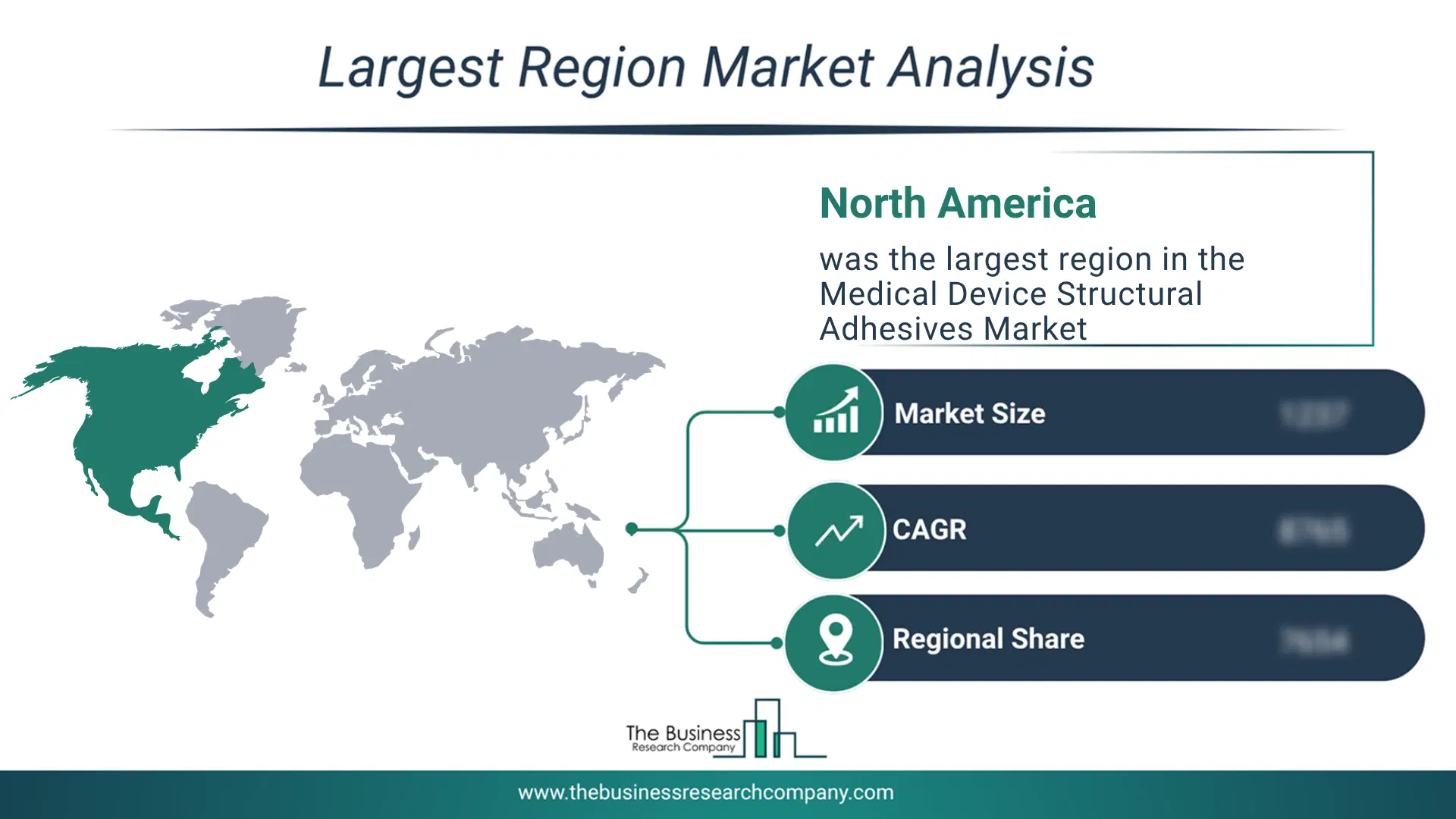
Regional Insights
North America was the largest region in the medical device structural adhesives market in 2025. Asia-Pacific is expected to be the fastest-growing region in the forecast period. The regions covered in this market report are Asia-Pacific, South East Asia, Western Europe, Eastern Europe, North America, South America, Middle East, Africa. The countries covered in this market report are Australia, Brazil, China, France, Germany, India, Indonesia, Japan, Taiwan, Russia, South Korea, UK, USA, Canada, Italy, Spain.What Defines the Medical Device Structural Adhesives Market?
The medical device structural adhesives market consists of sales of polyurethane structural adhesives, polyurethane hot melt structural adhesives, light-curable structural adhesives, anaerobic structural adhesives, hybrid polymer structural adhesives. Values in this market are ‘factory gate’ values, that is, the value of goods sold by the manufacturers or creators of the goods, whether to other entities (including downstream manufacturers, wholesalers, distributors, and retailers) or directly to end customers. The value of goods in this market includes related services sold by the creators of the goods.How is Market Value Defined and Measured?
The market value is defined as the revenues that enterprises gain from the sale of goods and/or services within the specified market and geography through sales, grants, or donations in terms of the currency (in USD unless otherwise specified). The revenues for a specified geography are consumption values that are revenues generated by organizations in the specified geography within the market, irrespective of where they are produced. It does not include revenues from resales along the supply chain, either further along the supply chain or as part of other products.
This chart presents market attractiveness based on a quantitative evaluation of growth, competition, strategic alignment, and risk, offering a clear view of opportunity areas for decision-making. This chart is for illustrative purposes; the full report contains the complete analysis.

This chart highlights the Total Addressable Market (TAM) by estimating the maximum revenue opportunity using an assumption-driven approach, supporting strategic planning and opportunity sizing across markets. The chart is illustrative; the full report provides a more comprehensive analysis.
What Key Data and Analysis Are Included in the Medical Device Structural Adhesives Market Report 2026?
The medical device structural adhesives market research report is one of a series of new reports from The Business Research Company that provides market statistics, including industry global market size, regional shares, competitors with the market share, detailed market segments, market trends and opportunities, and any further data you may need to thrive in the medical device structural adhesives industry. The market research report delivers a complete perspective of everything you need, with an in-depth analysis of the current and future state of the industry.Medical Device Structural Adhesives Market Report Forecast Analysis
| Report Attribute | Details |
|---|---|
| Market Size Value In 2026 | $1.75 billion |
| Revenue Forecast In 2030 | $2.55 billion |
| Growth Rate | CAGR of 9.8% from 2026 to 2030 |
| Base Year For Estimation | 2025 |
| Actual Estimates/Historical Data | 2020-2025 |
| Forecast Period | 2026 - 2030 |
| Market Representation | Revenue in USD Billion and CAGR from 2026 to 2030 |
| Segments Covered | Product Type, Material Bonded, Curing Method, Application, End User |
| Regional Scope | Asia-Pacific, Western Europe, Eastern Europe, North America, South America, Middle East, Africa |
| Country Scope | The countries covered in the report are Australia, Brazil, China, France, Germany, India, Indonesia, Japan, Taiwan, Russia, South Korea, UK, USA, Canada, Italy, Spain. |
| Key Companies Profiled | Henkel AG & Co. KGaA, 3M Company, Dow Inc., Sika AG, Arkema SA, DuPont de Nemours Inc., H.B. Fuller Company, Huntsman Corporation, Illinois Tool Works Inc., Avery Dennison Corporation, The Lubrizol Corporation, Ashland Inc., DELO Industrie Klebstoffe GmbH & Co. KGaA, Meridian Adhesives Group, Dymax Corporation, Parson Adhesives Inc., Chemence Medical Inc., Panacol-Elosol GmbH, Adhezion Biomedical LLC, Permabond LLC, Master Bond Inc., Scott Bader Company Ltd., Hubei Huitian New Materials Co. Ltd. |
| Customization Scope | Request for Customization |
| Pricing And Purchase Options | Explore Purchase Options |