
Medical Grade Engineering Plastics Market Report 2026
Global Outlook – By Type (Polycarbonate, Polyether Ether Ketone, Polyamide, UHMWPE, Polysulfone), By Form (Pellets Or Granules, Sheets And Plates, Rods And Tubes, Films And Membranes, Custom Molded Components, Compounded Materials), By Manufacturing Process (Injection Molding, Extrusion, Compression Molding, Blow Molding, Thermoforming, Three Dimensional Printing Or Additive Manufacturing), By Application (Medical Devices And Equipment, Surgical Instruments, Implantable Medical Components, Diagnostic And Laboratory Equipment, Drug Delivery Systems, Disposable Medical Products, Dental Applications, Healthcare Packaging, Wearable Medical Devices), By End User (Hospitals, Clinics, Pharmaceutical Companies, Research Laboratories, Healthcare Equipment Manufacturers) – Market Size, Trends, Strategies, and Forecast to 2030
Medical Grade Engineering Plastics Market Overview
• Medical Grade Engineering Plastics market size has reached to $1.54 billion in 2025 • Expected to grow to $2.32 billion in 2030 at a compound annual growth rate (CAGR) of 8.4% • Growth Driver: Surge In Chronic Diseases Fueling The Growth Of The Market Due To Increasing Demand For Minimally Invasive Surgical Devices • Market Trend: Medical Grade Engineering Plastics Innovations Enhance Biocompatibility And Medical Device Performance • Asia-Pacific was the largest region and fastest growing region.What Is Covered Under Medical Grade Engineering Plastics Market?
Medical-grade engineering plastics are high-performance polymer materials designed to meet stringent medical standards for safety, quality, and reliability. They provide biocompatibility, mechanical strength, chemical resistance, sterilization stability, and dimensional precision for demanding healthcare applications. Medical-grade engineering plastics enhance product durability, support regulatory compliance, and enable lightweight, high-precision medical components. The main types of medical grade engineering plastics include polycarbonate, polyether ether ketone, polyamide, ultra high molecular weight polyethylene (UHMWPE), and polysulfone. Polycarbonate refers to a durable, transparent engineering plastic with high impact strength, dimensional stability, and resistance to heat and chemicals, making it suitable for various medical applications. These plastics are available in pellets or granules, sheets and plates, rods and tubes, films and membranes, custom molded components, and compounded materials and are manufactured through injection molding, extrusion, compression molding, blow molding, thermoforming, and three dimensional printing or additive manufacturing. They find application in medical devices and equipment, surgical instruments, implantable medical components, diagnostic and laboratory equipment, drug delivery systems, disposable medical products, dental applications, healthcare packaging, and wearable medical devices, serving end users including hospitals, clinics, pharmaceutical companies, research laboratories, and healthcare equipment manufacturers.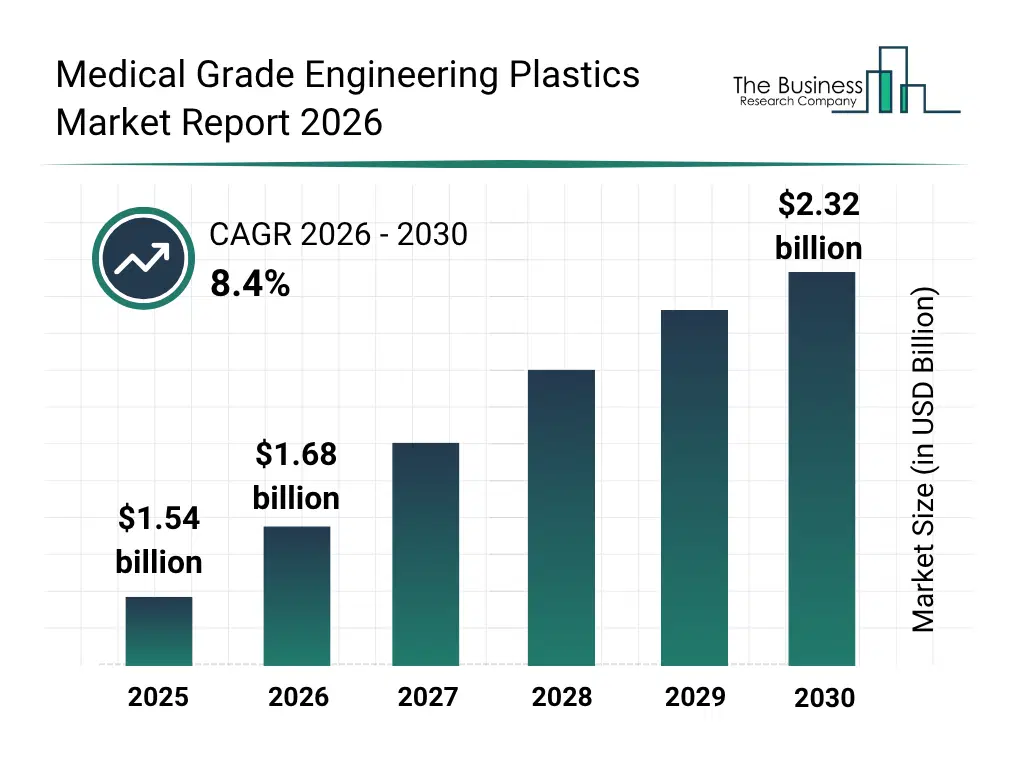
What Is The Medical Grade Engineering Plastics Market Size and Share 2026?
The medical grade engineering plastics market size has grown strongly in recent years. It will grow from $1.54 billion in 2025 to $1.68 billion in 2026 at a compound annual growth rate (CAGR) of 8.9%. The growth in the historic period can be attributed to growing demand for medical devices, increasing healthcare expenditure, rising adoption of minimally invasive procedures, expansion of medical device manufacturing, increasing demand for durable medical components.What Is The Medical Grade Engineering Plastics Market Growth Forecast?
The medical grade engineering plastics market size is expected to see strong growth in the next few years. It will grow to $2.32 billion in 2030 at a compound annual growth rate (CAGR) of 8.4%. The growth in the forecast period can be attributed to increasing demand for advanced surgical equipment, rising adoption of implantable medical components, growth of diagnostic and laboratory equipment, increasing demand for disposable medical products, expansion of wearable medical devices. Major trends in the forecast period include increasing adoption of sterilization-resistant engineering plastics, rising demand for high-strength medical-grade polymers, growing use of lightweight plastic components in medical devices, increasing demand for chemically resistant medical plastics, rising development of customized medical plastic components.Tariff Impact On Medical Grade Engineering Plastics Market
Tariffs are impacting the medical-grade engineering plastics market by increasing the cost of imported polymers, specialty additives, processing materials, and manufacturing equipment used to produce medical-grade plastic components. This is slowing medical-grade plastic production and increasing costs, particularly in regions dependent on imported polymers such as North America, Europe, and Asia-Pacific. Polymer-intensive segments such as polycarbonate, polyether ether ketone, polyamide, and polysulfone are most affected due to global supply chain dependencies. However, tariffs are also encouraging local polymer manufacturing, regional supplier diversification, and increased investment in domestic medical-grade plastics production ecosystems, creating long-term resilience in the market.
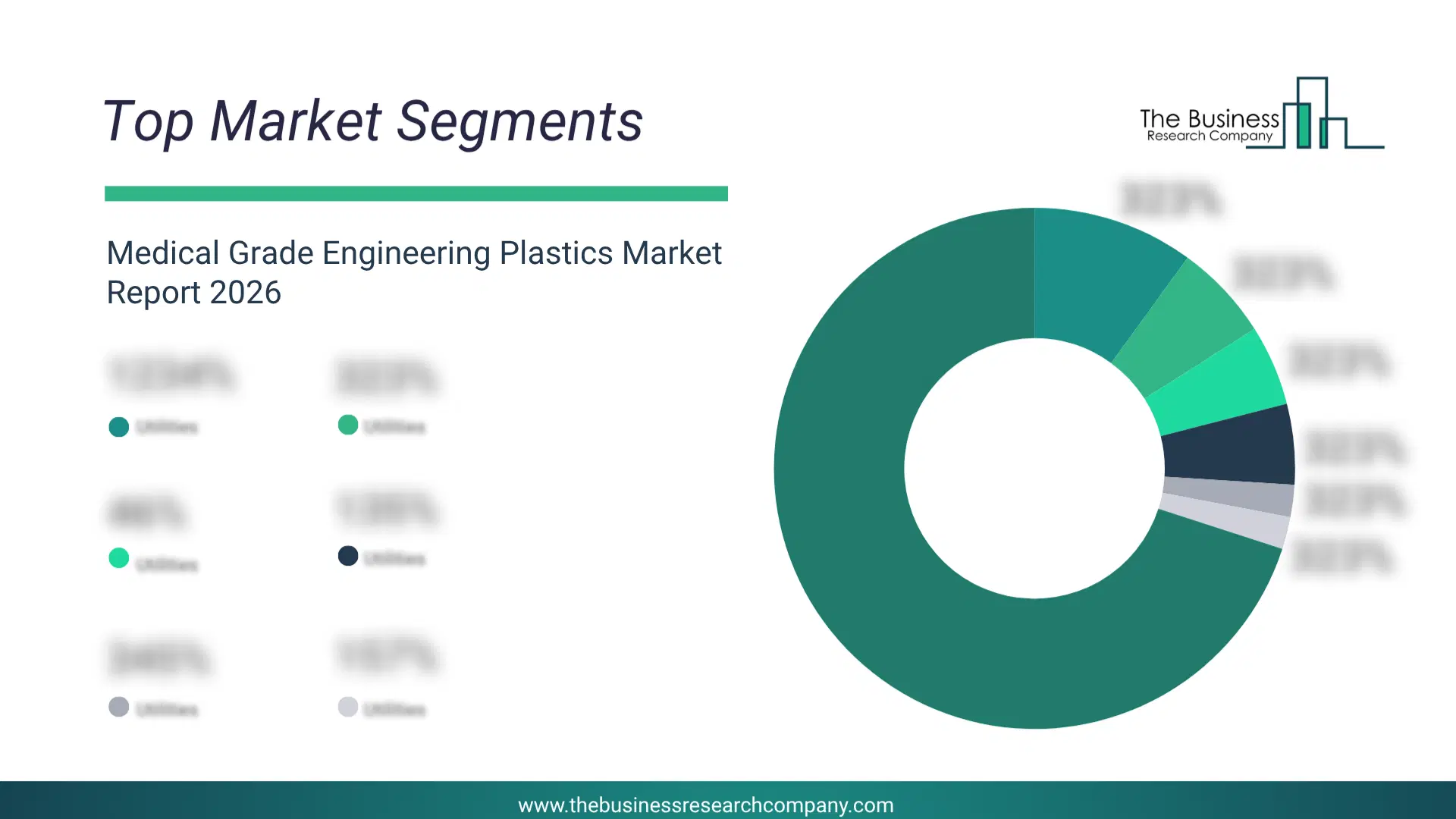
Global Medical Grade Engineering Plastics Market Segmentation
1) By Type: Polycarbonate, Polyether Ether Ketone, Polyamide, UHMWPE, Polysulfone 2) By Form: Pellets Or Granules, Sheets And Plates, Rods And Tubes, Films And Membranes, Custom Molded Components, Compounded Materials 3) By Manufacturing Process: Injection Molding, Extrusion, Compression Molding, Blow Molding, Thermoforming, Three Dimensional Printing Or Additive Manufacturing 4) By Application: Medical Devices And Equipment, Surgical Instruments, Implantable Medical Components, Diagnostic And Laboratory Equipment, Drug Delivery Systems, Disposable Medical Products, Dental Applications, Healthcare Packaging, Wearable Medical Devices 5) By End User: Hospitals, Clinics, Pharmaceutical Companies, Research Laboratories, Healthcare Equipment Manufacturers Subsegments: 1) By Polycarbonate: Medical Implant Grade, Medical Device Grade, Optical Grade, Radiation Resistant Grade 2) By Polyether Ether Ketone: Implant Grade, Reinforced Grade, Unfilled Grade, Wear Resistant Grade 3) By Polyamide: Polyamide 6, Polyamide 66, Bio Based Polyamide, Transparent Polyamide 4) By UHMWPE: Medical Grade UHMWPE, Implant Grade UHMWPE, Highly Cross Linked UHMWPE, Vitamin E Stabilized UHMWPE 5) By Polysulfone: Standard Grade, Glass Fiber Reinforced Grade, High Flow Grade, Transparent GradeWhat Is The Driver Of The Medical Grade Engineering Plastics Market?
The rising prevalence of chronic diseases is expected to propel the growth of the medical-grade engineering plastics market going forward. Chronic diseases refer to long-term health conditions that persist for one year or more and typically require ongoing medical care or limit daily activities. The rise in chronic diseases is driven by aging populations, as older adults are more susceptible to long-term conditions such as cardiovascular diseases, diabetes, and cancer, increasing the need for ongoing medical care and treatment. The increasing prevalence of chronic diseases drives demand for minimally invasive surgical devices, where medical-grade engineering plastics enable lightweight, strong, biocompatible, sterilization-resistant, and precision components that enhance device performance, patient safety, and procedural efficiency. For instance, in May 2026, according to the Centers for Disease Control and Prevention, a US-based government department, more than 90% of United States adults aged 65 and older, over 75% of those aged 35–64, and 60% of adults aged 18–34 were living with at least one chronic condition. Therefore, the rising prevalence of chronic diseases is driving the growth of the medical-grade engineering plastics market.Key Players In The Global Medical Grade Engineering Plastics Market
Major companies operating in the medical grade engineering plastics market are BASF SE, SABIC, Mitsubishi Chemical Group Corporation, Sumitomo Chemical Co. Ltd., Evonik Industries AG, Covestro AG, DuPont de Nemours Inc., Celanese Corporation, Arkema SA, Syensqo SA, Envalior B.V., Trinseo PLC, Avient Corporation, Röchling SE & Co. KG, Ascend Performance Materials LLC, RTP Company Inc., Ensinger GmbH, Lehmann & Voss & Co. KG, Victrex plc, Westlake Plastics Company
This chart is for illustrative purposes; the full report includes a detailed competitor analysis and comprehensive overview of the top 10 companies in the market.
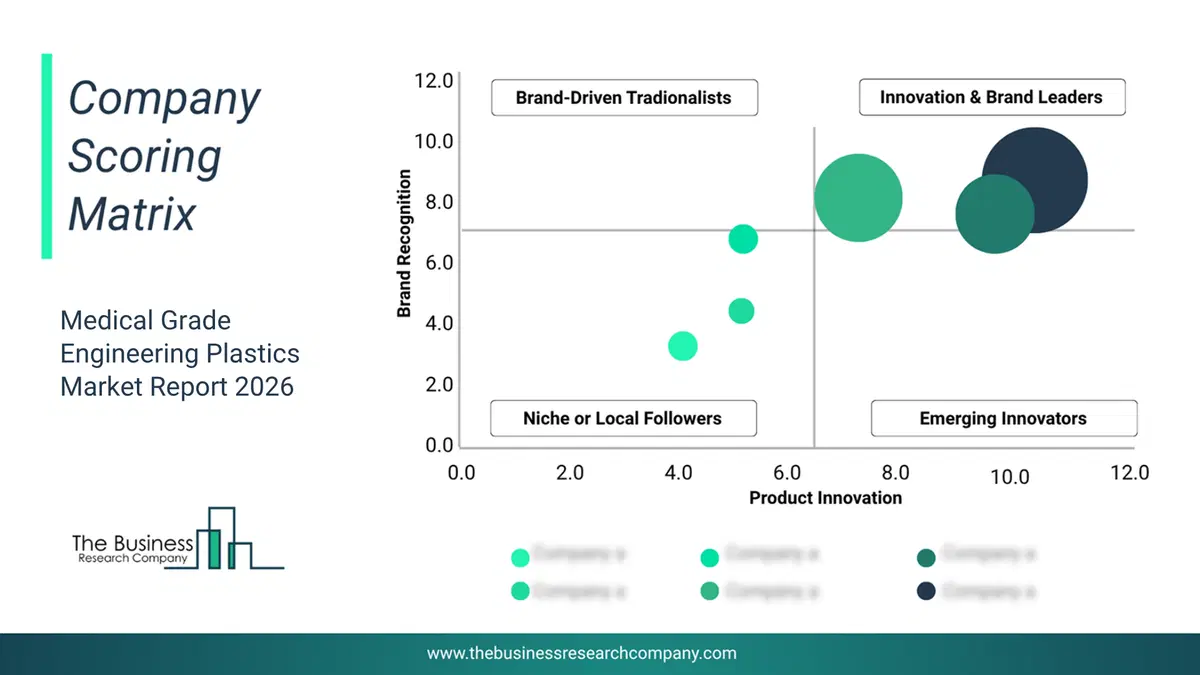
This chart maps companies by product innovation and brand strength, with bubble size indicating relative revenue, helping identify market leaders, challengers, and niche players. This is an illustrative chart; the full report provides a complete and accurate competitive analysis.
Global Medical Grade Engineering Plastics Market Trends and Insights
Major companies operating in the medical grade engineering plastics market are focusing on developing advanced biocompatible thermoplastic materials to enhance medical device performance, meet regulatory requirements, and support demanding healthcare applications. Biocompatible thermoplastic materials are high-performance polymer materials designed to safely interact with medical applications while providing properties such as chemical resistance, sterilization compatibility, strength, and durability. For instance, in February 2026, SABIC, a Saudi Arabia-based chemicals company, showcased new medical-grade thermoplastics at MD&M West 2026, including biocompatible SILTEM HU resins and a new family of polycarbonate copolymers certified under UL746G. The SILTEM HU resins are designed as potential fluoropolymer alternatives for select medical tubing applications, while ULTEM HU polyetherimide resins provide lightweight strength and sterilization compatibility for surgical robot components. SABIC also demonstrated its medical-grade materials for drug delivery applications through an autoinjector prototype, highlighting the use of engineering plastics in advanced medical devices.What Are Latest Mergers And Acquisitions In The Medical Grade Engineering Plastics Market?
In December 2025, Covestro AG, a Germany-based medical-grade polycarbonate and polycarbonate-blends manufacturer, partnered with Allmed to investigate the recycling of used artificial kidney filters. Through this partnership, Covestro and Allmed aim to assess the technical and economic feasibility of recovering polycarbonate from medical devices for use in new materials containing recycled content, supporting the development of circular solutions for medical-grade engineering plastics and reducing medical device waste. Allmed is a UK-based blood purification device company.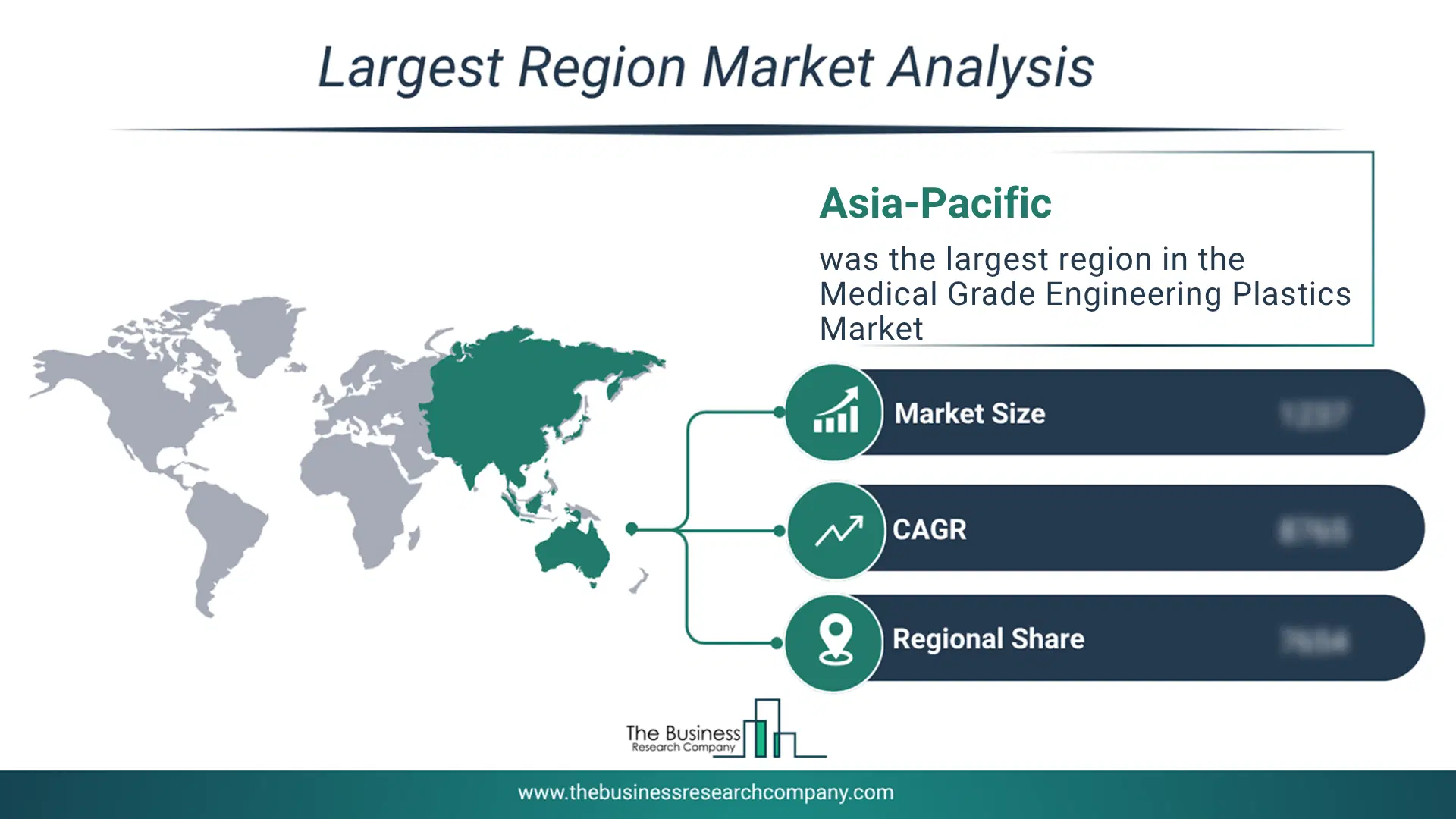
Regional Outlook
Asia-Pacific was the largest region in the medical grade engineering plastics market in 2025. Asia-Pacific is expected to be the fastest-growing region in the forecast period. The regions covered in this market report are Asia-Pacific, South East Asia, Western Europe, Eastern Europe, North America, South America, Middle East, Africa. The countries covered in this market report are Australia, Brazil, China, France, Germany, India, Indonesia, Japan, Taiwan, Russia, South Korea, UK, USA, Canada, Italy, Spain.What Defines the Medical Grade Engineering Plastics Market?
The medical-grade engineering plastics market consists of sales of syringe components, inhaler components, catheter components, surgical handle components, medical connector components, and laboratory instrument components. Values in this market are ‘factory gate’ values, that is, the value of goods sold by the manufacturers or creators of the goods, whether to other entities (including downstream manufacturers, wholesalers, distributors, and retailers) or directly to end customers. The value of goods in this market includes related services sold by the creators of the goods.How is Market Value Defined and Measured?
The market value is defined as the revenues that enterprises gain from the sale of goods and/or services within the specified market and geography through sales, grants, or donations in terms of the currency (in USD unless otherwise specified). The revenues for a specified geography are consumption values that are revenues generated by organizations in the specified geography within the market, irrespective of where they are produced. It does not include revenues from resales along the supply chain, either further along the supply chain or as part of other products.
This chart presents market attractiveness based on a quantitative evaluation of growth, competition, strategic alignment, and risk, offering a clear view of opportunity areas for decision-making. This chart is for illustrative purposes; the full report contains the complete analysis.

This chart highlights the Total Addressable Market (TAM) by estimating the maximum revenue opportunity using an assumption-driven approach, supporting strategic planning and opportunity sizing across markets. The chart is illustrative; the full report provides a more comprehensive analysis.
What Key Data and Analysis Are Included in the Medical Grade Engineering Plastics Market Report 2026?
The medical grade engineering plastics market research report is one of a series of new reports from The Business Research Company that provides market statistics, including industry global market size, regional shares, competitors with the market share, detailed market segments, market trends and opportunities, and any further data you may need to thrive in the medical grade engineering plastics industry. The market research report delivers a complete perspective of everything you need, with an in-depth analysis of the current and future state of the industry.Medical Grade Engineering Plastics Market Report Forecast Analysis
| Report Attribute | Details |
|---|---|
| Market Size Value In 2026 | $1.68 billion |
| Revenue Forecast In 2030 | $2.32 billion |
| Growth Rate | CAGR of 8.4% from 2026 to 2030 |
| Base Year For Estimation | 2025 |
| Actual Estimates/Historical Data | 2020-2025 |
| Forecast Period | 2026 - 2030 |
| Market Representation | Revenue in USD Billion and CAGR from 2026 to 2030 |
| Segments Covered | Type, Form, Manufacturing Process, Application, End User |
| Regional Scope | Asia-Pacific, Western Europe, Eastern Europe, North America, South America, Middle East, Africa |
| Country Scope | The countries covered in the report are Australia, Brazil, China, France, Germany, India, Indonesia, Japan, Taiwan, Russia, South Korea, UK, USA, Canada, Italy, Spain. |
| Key Companies Profiled | BASF SE, SABIC, Mitsubishi Chemical Group Corporation, Sumitomo Chemical Co. Ltd., Evonik Industries AG, Covestro AG, DuPont de Nemours Inc., Celanese Corporation, Arkema SA, Syensqo SA, Envalior B.V., Trinseo PLC, Avient Corporation, Röchling SE & Co. KG, Ascend Performance Materials LLC, RTP Company Inc., Ensinger GmbH, Lehmann & Voss & Co. KG, Victrex plc, Westlake Plastics Company |
| Customization Scope | Request for Customization |
| Pricing And Purchase Options | Explore Purchase Options |