
Medicated Candy Market Report 2026
Global Outlook – By Product Type (Cough Drops, Throat Lozenges, Herbal Candies, Vitamin And Nutraceutical Candies, Digestive Candies, Breath Freshening Medicated Candies, Nicotine Replacement Candies, Immunity Boosting Candies, Honey Based Therapeutic Candies, Other Product Types), By Sugar Content (Sugar Based, Sugar Free, Low Calorie), By Distribution Channel (Pharmacies And Drug Stores, Supermarkets And Hypermarkets, Convenience Stores, Online Retail And Electronic Commerce, Specialty Health Stores), By Application (Cough And Cold Relief, Sore Throat Relief, Oral Freshening, Digestive Support, Immunity Support, Smoking Cessation Support, Wellness And Nutritional Supplementation), By End User (Pediatric Population, Adult Population, Geriatric Population) – Market Size, Trends, Strategies, and Forecast to 2030
Medicated Candy Market Report 2026 Market Overview
• Medicated Candy Market Report 2026 market size has reached to $4.47 billion in 2025 • Expected to grow to $6.6 billion in 2030 at a compound annual growth rate (CAGR) of 8.1% • Growth Driver: Increasing Incidence of Influenza Driving The Market Growth Due To Rising Demand for Medicated Relief Products • North America was the largest region in 2025 and Asia-Pacific is the fastest growing region.What Is Covered Under Medicated Candy Market?
Medicated candy is a confectionery that is formulated with active pharmaceutical or herbal ingredients along with sweetening agents. It is designed to deliver a controlled amount of therapeutic compounds through a candy-based delivery format. Medicated candy is commonly developed using techniques that ensure stability, taste masking, and consistent dosing of the active ingredients. The main product types of medicated candy include cough drops, throat lozenges, herbal candies, vitamin and nutraceutical candies, digestive candies, breath freshening medicated candies, nicotine replacement candies, immunity boosting candies, honey based therapeutic candies, and other product types. Cough drops refer to medicated confectionery products formulated to soothe throat irritation and provide relief from cough symptoms. These products are available in sugar content types including sugar based, sugar free, and low calorie and are distributed through pharmacies and drug stores, supermarkets and hypermarkets, convenience stores, online retail and electronic commerce, and specialty health stores. The key applications of cough and cold relief, sore throat relief, oral freshening, digestive support, immunity support, smoking cessation support, wellness and nutritional supplementation, while the end-users pediatric population, adult population, and geriatric population.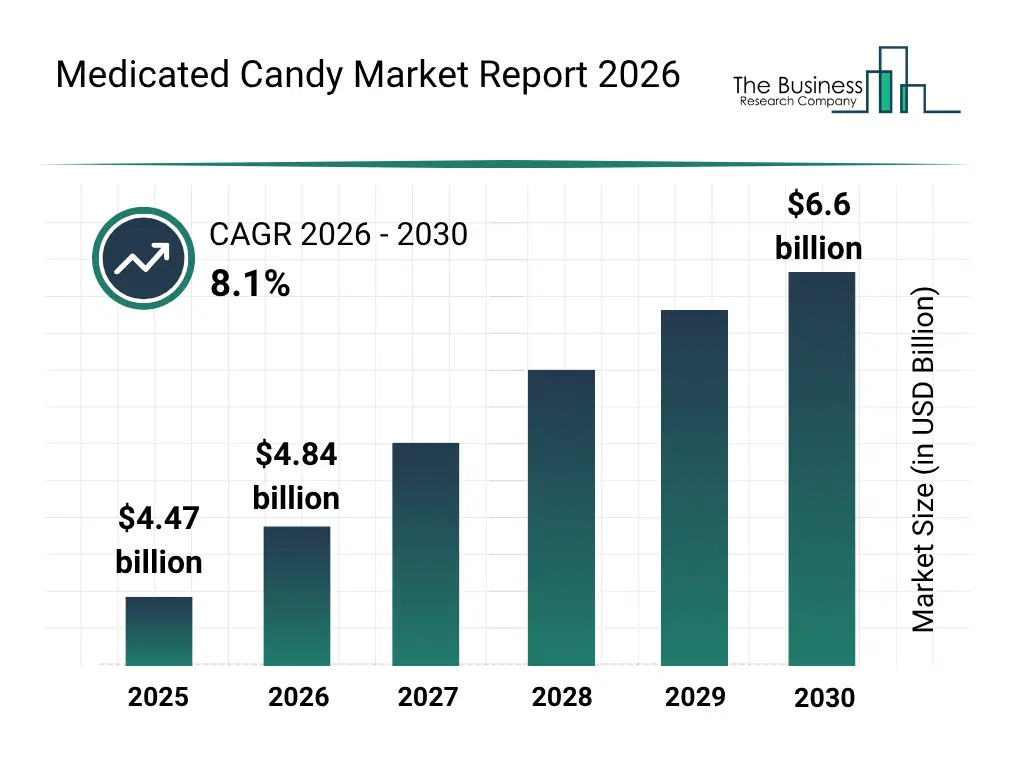
What Is The Medicated Candy Market Size and Share 2026?
The medicated candy market size has grown strongly in recent years. It will grow from $4.47 billion in 2025 to $4.84 billion in 2026 at a compound annual growth rate (CAGR) of 8.5%. The growth in the historic period can be attributed to rising prevalence of cough and cold conditions driving demand for lozenge based remedies, increasing consumer preference for oral dosage convenience formats, expansion of retail pharmacy distribution networks, growing awareness of herbal and natural remedies, rising adoption of flavored pharmaceutical products for pediatric compliance.What Is The Medicated Candy Market Growth Forecast?
The medicated candy market size is expected to see strong growth in the next few years. It will grow to $6.6 billion in 2030 at a compound annual growth rate (CAGR) of 8.1%. The growth in the forecast period can be attributed to increasing demand for personalized nutrition and nutraceutical confectionery, growing shift toward sugar free and diabetic friendly medicated formulations, rising investment in functional food and pharmaceutical convergence products, expansion of e commerce based healthcare product distribution, increasing innovation in controlled release taste masking technologies. Major trends in the forecast period include advancement in nutraceutical infused confectionery for functional wellness delivery, rising demand for sugar free and low calorie medicated candy formulations, increasing adoption of herbal and ayurvedic candy variants for natural therapy, expansion of pediatric friendly taste masked drug delivery systems, growing use of medicated candies for smoking cessation and oral health management.
Global Medicated Candy Market Segmentation
1) By Product Type: Cough Drops, Throat Lozenges, Herbal Candies, Vitamin And Nutraceutical Candies, Digestive Candies, Breath Freshening Medicated Candies, Nicotine Replacement Candies, Immunity Boosting Candies, Honey Based Therapeutic Candies, Other Product Types 2) By Sugar Content: Sugar Based, Sugar Free, Low Calorie 3) By Distribution Channel: Pharmacies And Drug Stores, Supermarkets And Hypermarkets, Convenience Stores, Online Retail And Electronic Commerce, Specialty Health Stores 4) By Application: Cough And Cold Relief, Sore Throat Relief, Oral Freshening, Digestive Support, Immunity Support, Smoking Cessation Support, Wellness And Nutritional Supplementation 5) By End User: Pediatric Population, Adult Population, Geriatric Population Subsegments: 1) By Cough Drops: Menthol Cough Drops, Herbal Cough Drops, Honey Cough Drops, Vitamin Enriched Cough Drops, Sugar Free Cough Drops 2) By Throat Lozenges: Antiseptic Lozenges, Menthol Lozenges, Honey Lemon Lozenges, Herbal Throat Lozenges, Cooling Effect Lozenges 3) By Herbal Candies: Ginger Herbal Candies, Tulsi Herbal Candies, Eucalyptus Herbal Candies, Ayurvedic Candies, Mixed Herb Candies 4) By Vitamin And Nutraceutical Candies: Vitamin C Candies, Multivitamin Candies, Zinc Enriched Candies, Probiotic Candies, Energy Supplement Candies 5) By Digestive Candies: Mint Digestive Candies, Herbal Digestive Candies, Fennel Based Candies, Ginger Digestive Candies, Antacid Candies 6) By Breath Freshening Medicated Candies: Mint Breath Candies, Herbal Breath Fresheners, Antibacterial Breath Candies, Sugar Free Breath Candies, Cooling Breath Strips And Candies 7) By Nicotine Replacement Candies: Nicotine Lozenges, Mint Nicotine Candies, Flavored Nicotine Candies, Sugar Free Nicotine Candies 8) By Immunity Boosting Candies: Vitamin C Immunity Candies, Zinc Immunity Candies, Herbal Immunity Candies, Probiotic Immunity Candies, Honey Based Immunity Candies 9) By Honey Based Therapeutic Candies: Honey Lemon Candies, Honey Ginger Candies, Honey Menthol Candies, Herbal Honey Candies, Organic Honey Candies 10) By Other Product Types: Sleep Support Candies, Oral Health Candies, Anti Nausea Candies, Electrolyte CandiesWhat Are The Drivers Of The Medicated Candy Market?
The increasing incidence of influenza is expected to propel the growth of the medicated candy market going forward. Influenza is a contagious respiratory illness caused by influenza viruses that infect the nose, throat, and lungs, often leading to fever, cough, and body aches. The growing prevalence of influenza is largely driven by the resurgence of seasonal virus circulation post-COVID-19, as reduced prior exposure during the pandemic years has left populations with diminished natural immunity, making communities more susceptible to widespread seasonal outbreaks. The rising incidence of influenza boosts demand for medicated candies as they provide a convenient and accessible form of symptom relief, particularly for sore throat and cough, encouraging higher consumption among affected individuals seeking over-the-counter options. For instance, in February 2025, according to the World Health Organization, a Switzerland-based intergovernmental organization, seasonal influenza affects about one billion people annually, causing 3–5 million severe cases and an estimated 290,000 to 650,000 respiratory deaths each year. Therefore, the increasing incidence of influenza is driving the growth of the medicated candy industry. The rising health and wellness consciousness is expected to propel the growth of the medicated candy market going forward. Health and wellness consciousness is the awareness and proactive focus on maintaining overall physical, mental, and emotional well-being through healthy lifestyle choices and preventive care. Health and wellness consciousness is increasing mainly due to the rising burden of lifestyle diseases, which is pushing people to adopt healthier habits and preventive care. Medicated candy supports health and wellness consciousness by making basic wellness care more accessible and convenient, encouraging people to address minor health issues early and maintain daily well-being habits. For instance, in June 2024, according to the International Food Information Council (IFIC), a US-based non-profit organization, the share of Americans following a specific diet remains high at 54%, while interest in increasing protein intake has steadily risen from 59% in 2022 to 67% in 2023 and 71% in 2024. Therefore, the rising health and wellness consciousness is driving the growth of the medicated candy industry. The increasing healthcare expenditure is expected to propel the growth of the medicated candy market going forward. Healthcare expenditure is the total spending on healthcare services, medicines, medical equipment, and related healthcare activities by governments, organizations, and individuals. Healthcare expenditure is increasing due to the growing aging population, as older adults typically require more frequent medical care, chronic disease management, and specialized healthcare services, resulting in higher healthcare spending. Higher healthcare expenditure drives medicated candy demand by expanding insurance coverage and healthcare awareness, which leads more people to choose convenient OTC soothing and therapeutic candies for minor ailments. For instance, in April 2025, according to the Office for National Statistics, a UK-based independent producer of official statistics, in 2024, the UK’s healthcare spending reached around $370.71 billion (£317 billion), reflecting a 6.5% nominal increase compared with 2023. Therefore, the increasing healthcare expenditure is driving the growth of the medicated candy industry.Key Players In The Global Medicated Candy Market
Major companies operating in the medicated candy market report are Cargill Incorporated, Nestle S.A., Mondelez International Inc., Reckitt Benckiser Group plc, Perfetti Van Melle Group B.V., Cipla Ltd., Dabur India Ltd., Ricola Group AG, Himalaya Wellness Company, Pine Bros. LLC, Herbion International, Y.S. Eco Bee Farms, Aravindh Herbal Labs (P) Limited, Haleon, Lofthouse of Fleetwood, Procter & Gamble, Lotte Wellfood, Church & Dwight
This chart is for illustrative purposes; the full report includes a detailed competitor analysis and comprehensive overview of the top 10 companies in the market.
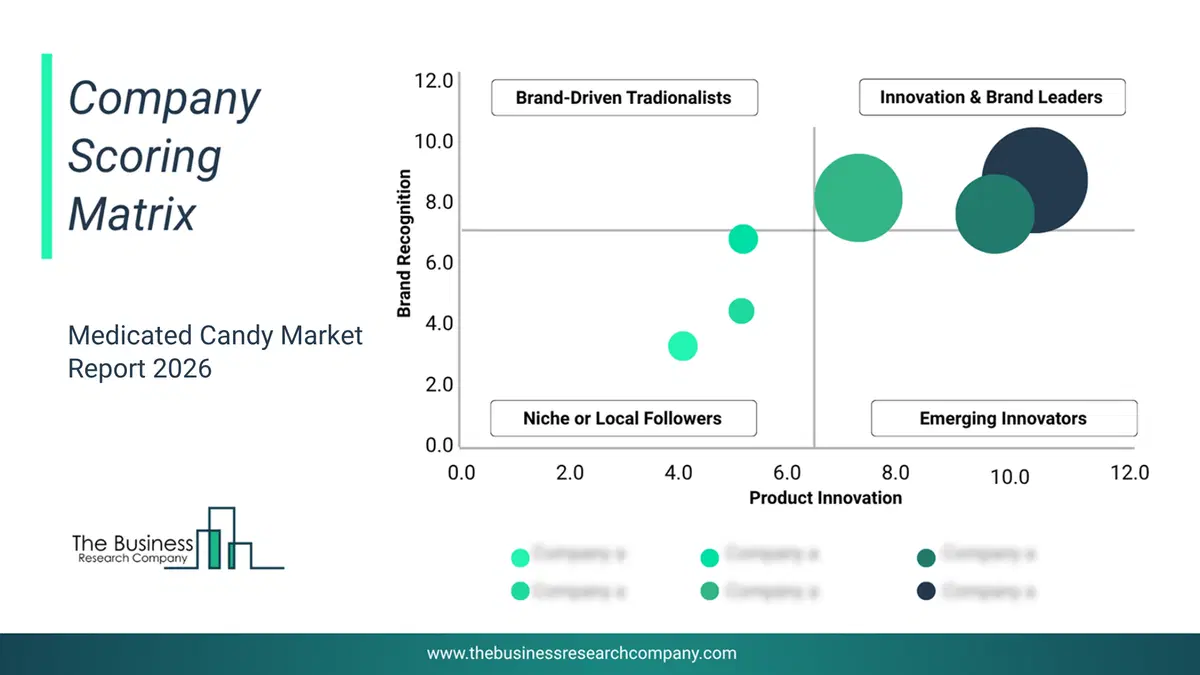
This chart maps companies by product innovation and brand strength, with bubble size indicating relative revenue, helping identify market leaders, challengers, and niche players. This is an illustrative chart; the full report provides a complete and accurate competitive analysis.
Regional Outlook
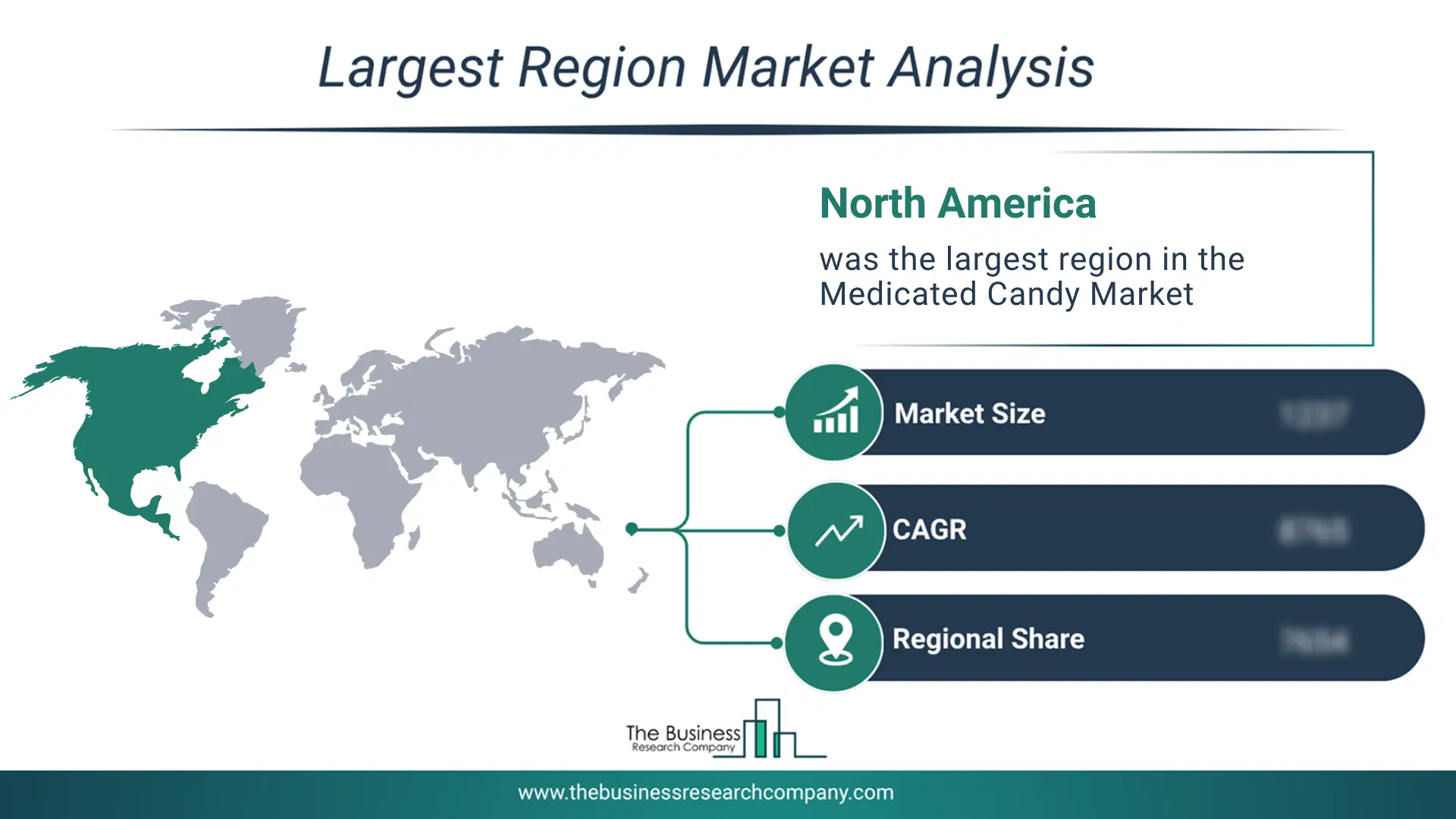
North America was the largest region in the medicated candy market in 2025. Asia-Pacific is expected to be the fastest-growing region in the forecast period. The regions covered in this market report are Asia-Pacific, South East Asia, Western Europe, Eastern Europe, North America, South America, Middle East, Africa. The countries covered in this market report are Australia, Brazil, China, France, Germany, India, Indonesia, Japan, Taiwan, Russia, South Korea, UK, USA, Canada, Italy, Spain.What Defines the Medicated Candy Market?
The medicated candy consists of sales of pain-relief hard candies, antiseptic oral candies, and decongestant sugar candies. Values in this market are ‘factory gate’ values, that is, the value of goods sold by the manufacturers or creators of the goods, whether to other entities (including downstream manufacturers, wholesalers, distributors, and retailers) or directly to end customers. The value of goods in this market includes related services sold by the creators of the goods.How is Market Value Defined and Measured?
The market value is defined as the revenues that enterprises gain from the sale of goods and/or services within the specified market and geography through sales, grants, or donations in terms of the currency (in USD unless otherwise specified). The revenues for a specified geography are consumption values that are revenues generated by organizations in the specified geography within the market, irrespective of where they are produced. It does not include revenues from resales along the supply chain, either further along the supply chain or as part of other products.
This chart presents market attractiveness based on a quantitative evaluation of growth, competition, strategic alignment, and risk, offering a clear view of opportunity areas for decision-making. This chart is for illustrative purposes; the full report contains the complete analysis.

This chart highlights the Total Addressable Market (TAM) by estimating the maximum revenue opportunity using an assumption-driven approach, supporting strategic planning and opportunity sizing across markets. The chart is illustrative; the full report provides a more comprehensive analysis.
What Key Data and Analysis Are Included in the Medicated Candy Market Report 2026?
The medicated candy market research report is one of a series of new reports from The Business Research Company that provides market statistics, including industry global market size, regional shares, competitors with the market share, detailed market segments, market trends and opportunities, and any further data you may need to thrive in the medicated candy industry. The market research report delivers a complete perspective of everything you need, with an in-depth analysis of the current and future state of the industry.Medicated Candy Market Report Forecast Analysis
| Report Attribute | Details |
|---|---|
| Market Size Value In 2026 | $4.84 billion |
| Revenue Forecast In 2030 | $6.6 billion |
| Growth Rate | CAGR of 8.1% from 2026 to 2030 |
| Base Year For Estimation | 2025 |
| Actual Estimates/Historical Data | 2020-2025 |
| Forecast Period | 2026 - 2030 |
| Market Representation | Revenue in USD Billion and CAGR from 2026 to 2030 |
| Segments Covered | Product Type, Sugar Content, Distribution Channel, Application, End User |
| Regional Scope | Asia-Pacific, Western Europe, Eastern Europe, North America, South America, Middle East, Africa |
| Country Scope | The countries covered in the report are Australia, Brazil, China, France, Germany, India, Indonesia, Japan, Taiwan, Russia, South Korea, UK, USA, Canada, Italy, Spain. |
| Key Companies Profiled | Cargill Incorporated, Nestle S.A., Mondelez International Inc., Reckitt Benckiser Group plc, Perfetti Van Melle Group B.V., Cipla Ltd., Dabur India Ltd., Ricola Group AG, Himalaya Wellness Company, Pine Bros. LLC, Herbion International, Y.S. Eco Bee Farms, Aravindh Herbal Labs (P) Limited, Haleon, Lofthouse of Fleetwood, Procter & Gamble, Lotte Wellfood, Church & Dwight |
| Customization Scope | Request for Customization |
| Pricing And Purchase Options | Explore Purchase Options |