
Memory Devices Market Report 2026
Global Outlook – By Type (Dynamic Random Access Memory (DRAM), Static Random Access Memory (SRAM), Not AND Flash Memory (NAND) Flash Memory, Not OR Flash Memory (NOR) Flash Memory, Electrically Erasable Programmable Read Only Memory (EEPROM), Other Types ), By Memory Capacity (Less Than 1 Gigabyte (GB), 1 Gigabyte (GB) To 8 Gigabytes (GB), 8 Gigabyte (GB) To 64 Gigabyte (GB), 64 Gigabyte (GB) To 256 Gigabyte (GB), More Than 256 Gigabyte (GB) ), By Form Factor (Integrated Circuits (ICs), Memory Cards, Memory Modules ), By Application (Consumer Electronics, Enterprise Storage, Industrial, Automotive, Healthcare ) – Market Size, Trends, Strategies, and Forecast to 2030
Memory Devices Market Overview
• Memory Devices market size has reached to $222.4 billion in 2025 • Expected to grow to $398.93 billion in 2030 at a compound annual growth rate (CAGR) of 12.3% • Growth Driver: Rising Electric Vehicle Adoption Driving The Market Growth Due To Increasing Demand For Efficient Power Conversion And Energy Management • Market Trend: Advanced Lightweight Materials Enhance Safety And Efficiency In Public Transportation • Asia-Pacific was the largest region and fastest growing region.What Is Covered Under Memory Devices Market?
Memory devices are semiconductor-based electronic components that store, retain, and retrieve digital data and program instructions for electronic systems. They provide both temporary and permanent data storage, enabling reliable data access, processing, and long-term information retention. Memory devices are designed to meet the speed, performance, durability, and power efficiency requirements of modern electronic applications. The main types of memory devices include dynamic random access memory (DRAM), static random access memory (SRAM), not AND flash memory (NAND) flash memory, not OR flash memory (NOR) flash memory, electrically erasable programmable read only memory (EEPROM), and other types. Dynamic random access memory (DRAM) refers to volatile memory that stores data in memory cells containing capacitors and is widely used for temporary data storage and high-speed processing. These devices are available in memory capacities of less than 1 Gigabyte (GB), 1 Gigabyte (GB) to 8 Gigabytes (GB), 8 Gigabytes (GB) to 64 Gigabytes (GB), 64 Gigabytes (GB) to 256 Gigabytes (GB), and more than 256 Gigabytes (GB). They are offered in integrated circuits (ICs), memory cards, and memory modules and the key applications include consumer electronics, enterprise storage, industrial, automotive, and healthcare.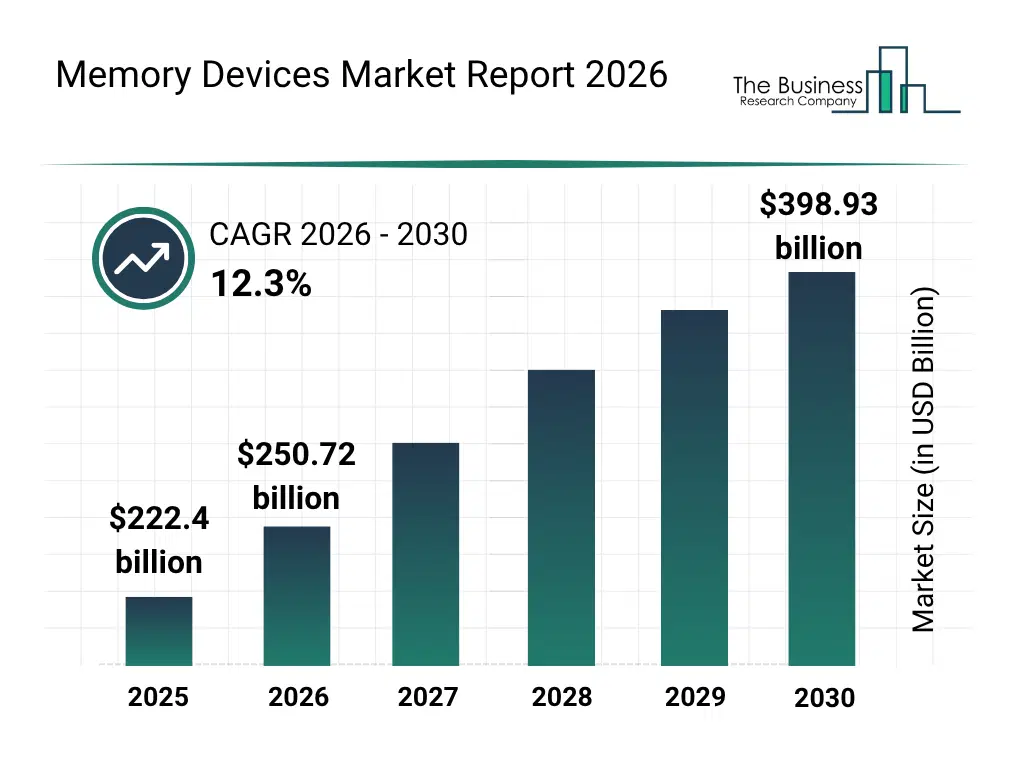
What Is The Memory Devices Market Size and Share 2026?
The memory devices market size has grown rapidly in recent years. It will grow from $222.4 billion in 2025 to $250.72 billion in 2026 at a compound annual growth rate (CAGR) of 12.7%. The growth in the historic period can be attributed to rising demand for digital data storage, increasing semiconductor manufacturing capacity, growing adoption of smartphones and personal computers, expansion of consumer electronics applications, increasing demand for embedded memory in electronic devices.What Is The Memory Devices Market Growth Forecast?
The memory devices market size is expected to see rapid growth in the next few years. It will grow to $398.93 billion in 2030 at a compound annual growth rate (CAGR) of 12.3%. The growth in the forecast period can be attributed to growing demand for memory-intensive computing applications, increasing adoption of advanced memory technologies, rising demand for higher memory bandwidth, growing integration of memory in automotive electronics, increasing demand for energy-efficient memory solutions. Major trends in the forecast period include increasing adoption of high-density memory architectures, growing demand for low-power memory solutions, rising development of high-speed memory interfaces, increasing integration of non-volatile memory technologies, growing adoption of heterogeneous memory architectures.Tariff Impact On Memory Devices Market
Tariffs are impacting the memory devices market by increasing the cost of imported semiconductor manufacturing equipment, memory components, raw materials, and related electronic devices required for memory production and deployment. This is increasing manufacturing expenses and disrupting supply chains, particularly in regions dependent on semiconductor imports and cross-border manufacturing networks such as Asia-Pacific and North America. Hardware-intensive segments like DRAM, flash memory, embedded memory, and advanced memory technologies are most affected due to their reliance on specialized semiconductor production and global supply chains. However, tariffs are also encouraging domestic semiconductor manufacturing, regional supplier diversification, localized production, and increased investment in resilient memory technology ecosystems, creating long-term supply chain stability in the market.
Global Memory Devices Market Segmentation
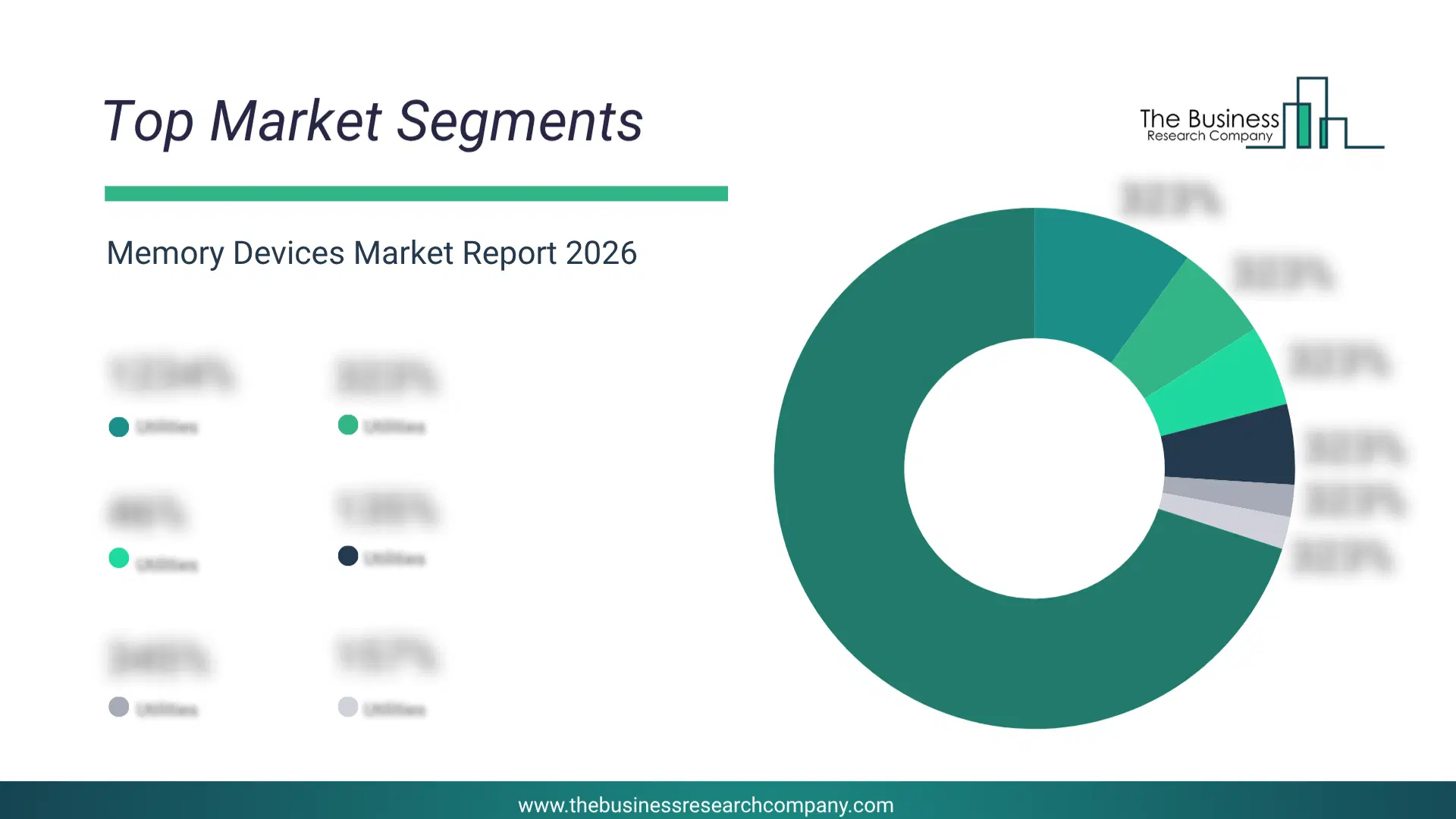
2) By Memory Capacity: Less Than 1 Gigabyte (GB), 1 Gigabyte (GB) To 8 Gigabytes (GB), 8 Gigabyte (GB) To 64 Gigabyte (GB), 64 Gigabyte (GB) To 256 Gigabyte (GB), More Than 256 Gigabyte (GB) 3) By Form Factor: Integrated Circuits (ICs), Memory Cards, Memory Modules 4) By Application: Consumer Electronics, Enterprise Storage, Industrial, Automotive, Healthcare Subsegments: 1) By Dynamic Random Access Memory: Synchronous Dynamic Random Access Memory, Double Data Rate Dynamic Random Access Memory, Graphics Dynamic Random Access Memory, Low Power Dynamic Random Access Memory, High Bandwidth Memory 2) By Static Random Access Memory: Asynchronous Static Random Access Memory, Synchronous Static Random Access Memory, Low Power Static Random Access Memory, Nonvolatile Static Random Access Memory 3) By Not AND Flash Memory (NAND) Flash Memory: Single Level Cell, Multi Level Cell, Triple Level Cell, Quad Level Cell, Penta Level Cell 4) By Not OR Flash Memory (NOR) Flash Memory: Parallel Interface NOR Flash, Serial Interface NOR Flash 5) By Electrically Erasable Programmable Read Only Memory: Serial Electrically Erasable Programmable Read Only Memory, Parallel Electrically Erasable Programmable Read Only Memory 6) By Other Types: Read Only Memory, Programmable Read Only Memory, Erasable Programmable Read Only Memory, Magnetoresistive Random Access Memory, Ferroelectric Random Access Memory, Phase Change Memory, Resistive Random Access Memory, Three Dimensional Crosspoint MemoryWhat Is The Driver Of The Memory Devices Market?
The rise of data centers and cloud computing is expected to propel the growth of the memory devices market going forward. Data centers and cloud computing provide scalable infrastructure for storing, processing, and managing digital data while supporting reliable computing, storage, and networking services. The rise of data centers and cloud computing is increasing as organizations are rapidly adopting artificial intelligence, digital services, big data analytics, and enterprise applications that require scalable computing and storage capacity. The rise of data centers and cloud computing supports the memory devices by increasing demand for high-performance dynamic random-access memory, NAND flash memory, and other advanced memory technologies that enable faster data processing, reliable storage, and efficient workload management across servers and cloud infrastructure. For instance, in September 2024, according to the National Telecommunications and Information Administration, a US-based government agency, the United States has approximately 5,000 data centers, with domestic demand anticipated to grow by about nine percent each year through 2030. Therefore, the rise of data centers and cloud computing is driving the growth of the memory devices industry.Key Players In The Global Memory Devices Market
Major companies operating in the memory devices market are Samsung Electronics Co. Ltd., SK hynix Inc., Micron Technology Inc., Western Digital Corporation, Kioxia Holdings Corporation, Intel Corporation, Sony Group Corporation, Toshiba Electronic Devices & Storage Corporation, Infineon Technologies AG, STMicroelectronics N.V., Renesas Electronics Corporation, Microchip Technology Incorporated, Kingston Technology Corporation, Rohm Co. Ltd., Panasonic Holdings Corporation, Fujitsu Limited, Yangtze Memory Technologies Co. Ltd., ChangXin Memory Technologies Inc., Macronix International Co. Ltd., Winbond Electronics Corporation, Nanya Technology Corporation, GigaDevice Semiconductor Inc., Elite Semiconductor Microelectronics Technology Inc., Etron Technology Inc., Everspin Technologies Inc., Crossbar Inc.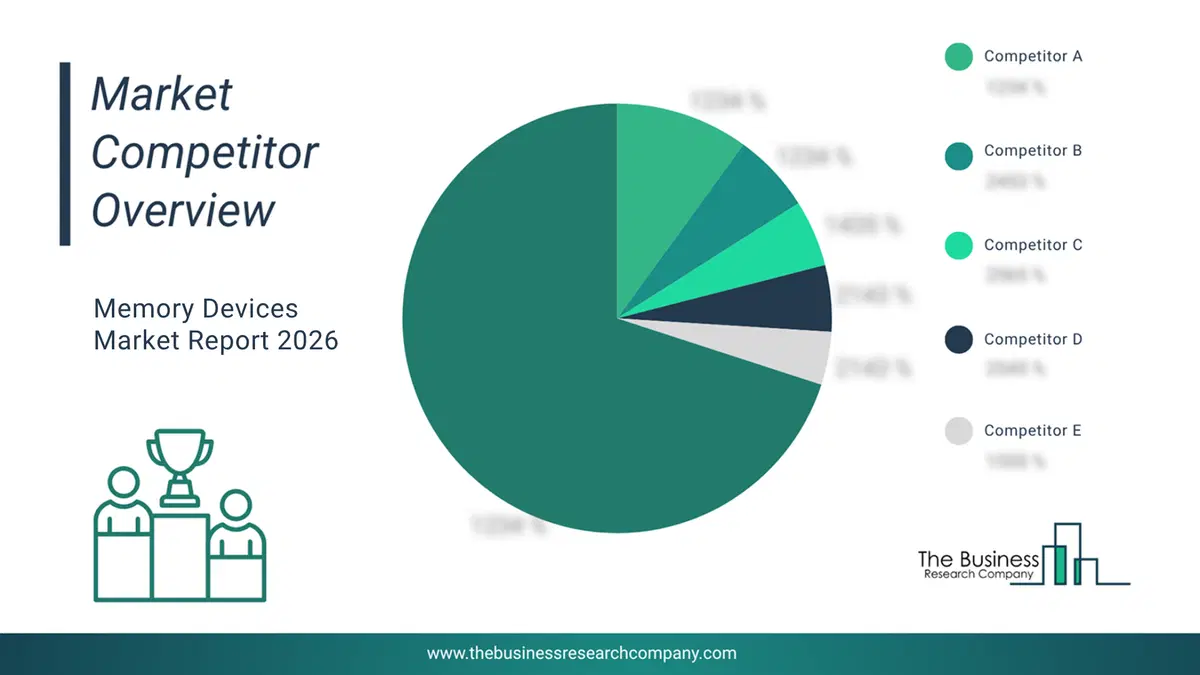
This chart is for illustrative purposes; the full report includes a detailed competitor analysis and comprehensive overview of the top 10 companies in the market.
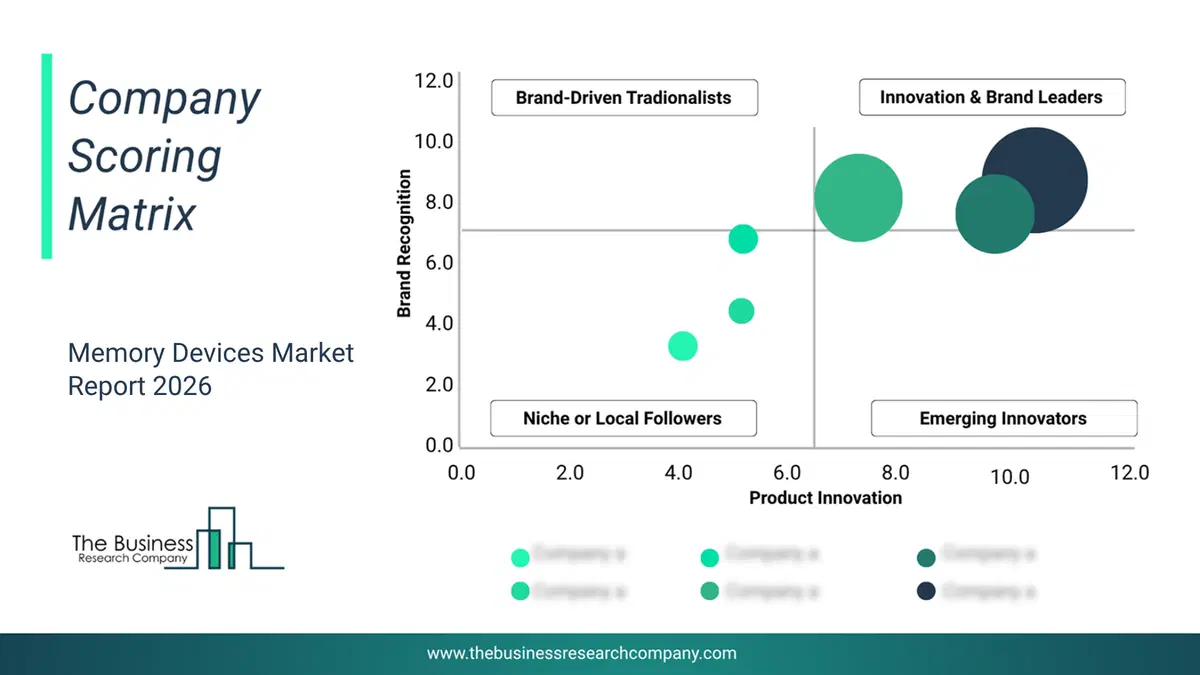
This chart maps companies by product innovation and brand strength, with bubble size indicating relative revenue, helping identify market leaders, challengers, and niche players. This is an illustrative chart; the full report provides a complete and accurate competitive analysis.
Global Memory Devices Market Trends and Insights
Major companies operating in the memory devices market are focusing on developing advanced high bandwidth memory (HBM) solutions to improve data processing speed, energy efficiency, and thermal performance for artificial intelligence (AI) and high-performance computing applications. High Bandwidth Memory (HBM) is a high-performance DRAM technology that vertically stacks multiple memory chips to deliver significantly higher bandwidth and lower power consumption than conventional memory. For instance, in March 2024, SK Hynix Inc., a South Korea-based semiconductor manufacturer, began volume production of HBM3E, the industry's first fifth-generation high-bandwidth memory product. It is designed for AI accelerators and data-intensive computing. HBM3E delivers data processing speeds of up to 1.18 terabytes per second and offers approximately 10% better heat dissipation than the previous generation through the company's advanced MR MUF packaging technology, strengthening AI memory performance and system reliability.What Are Latest Mergers And Acquisitions In The Memory Devices Market?
In October 2024, JCET Group, a China-based provider of semiconductor packaging, assembly, testing, and manufacturing services, acquired an 80% stake in SanDisk Semiconductor (Shanghai) Co., Ltd. for approximately $624 million. With this acquisition, JCET aimed to expand its presence in the memory device industry by strengthening its flash memory manufacturing capabilities, increasing its share in the data storage market, and deepening its long-term partnership with Western Digital. SanDisk Semiconductor (Shanghai) Co., Ltd. is a China-based provider of NAND flash memory modules, SD cards, microSD cards, embedded flash memory products, and other flash memory storage solutions.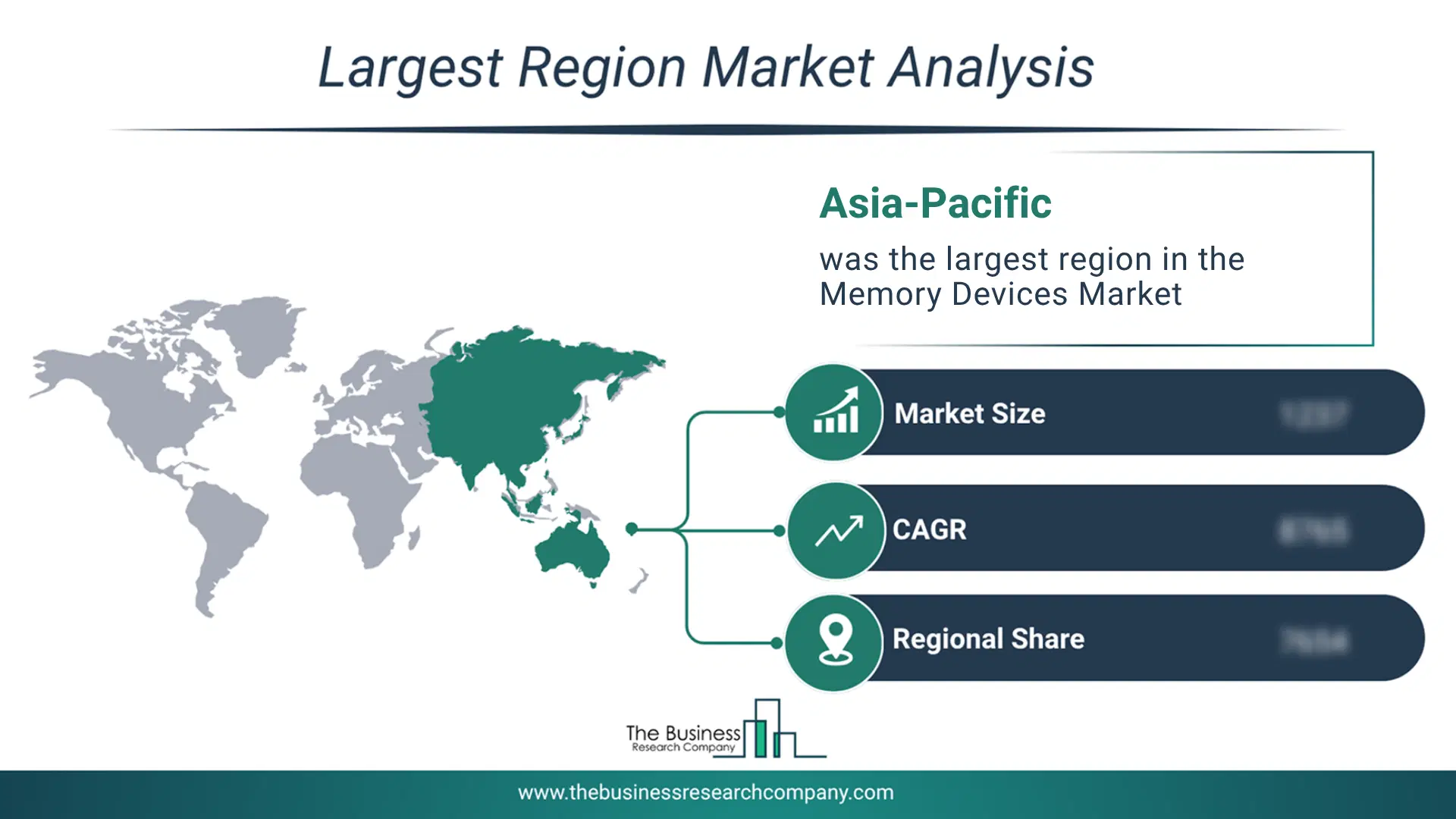
Regional Outlook
Asia-Pacific was the largest region in the memory devices market in 2025. Asia-Pacific is expected to be the fastest-growing region in the forecast period. The regions covered in the memory devices market are Asia-Pacific, South East Asia, Western Europe, Eastern Europe, North America, South America, Middle East, Africa. The countries covered in the memory devices market are Australia, Brazil, China, France, Germany, India, Indonesia, Japan, Taiwan, Russia, South Korea, UK, USA, Canada, Italy, Spain.What Defines the Memory Devices Market?
The memory devices market consists of sales of embedded multimedia card (eMMC), universal flash storage (UFS), solid-state drive (SSD), and secure digital (SD) memory card. Values in this market are ‘factory gate’ values, that is, the value of goods sold by the manufacturers or creators of the goods, whether to other entities (including downstream manufacturers, wholesalers, distributors, and retailers) or directly to end customers. The value of goods in this market includes related services sold by the creators of the goods.How is Market Value Defined and Measured?
The market value is defined as the revenues that enterprises gain from the sale of goods and/or services within the specified market and geography through sales, grants, or donations in terms of the currency (in USD unless otherwise specified). The revenues for a specified geography are consumption values that are revenues generated by organizations in the specified geography within the market, irrespective of where they are produced. It does not include revenues from resales along the supply chain, either further along the supply chain or as part of other products.
This chart presents market attractiveness based on a quantitative evaluation of growth, competition, strategic alignment, and risk, offering a clear view of opportunity areas for decision-making. This chart is for illustrative purposes; the full report contains the complete analysis.

This chart highlights the Total Addressable Market (TAM) by estimating the maximum revenue opportunity using an assumption-driven approach, supporting strategic planning and opportunity sizing across markets. The chart is illustrative; the full report provides a more comprehensive analysis.
What Key Data and Analysis Are Included in the Memory Devices Market Report 2026?
The memory devices market research report is one of a series of new reports from The Business Research Company that provides market statistics, including industry global market size, regional shares, competitors with the market share, detailed market segments, market trends and opportunities, and any further data you may need to thrive in the memory devices industry. The market research report delivers a complete perspective of everything you need, with an in-depth analysis of the current and future state of the industry.Memory Devices Market Report Forecast Analysis
| Report Attribute | Details |
|---|---|
| Market Size Value In 2026 | $250.72 billion |
| Revenue Forecast In 2030 | $398.93 billion |
| Growth Rate | CAGR of 12.3% from 2026 to 2030 |
| Base Year For Estimation | 2025 |
| Actual Estimates/Historical Data | 2020-2025 |
| Forecast Period | 2026 - 2030 |
| Market Representation | Revenue in USD Billion and CAGR from 2026 to 2030 |
| Segments Covered | Type, Memory Capacity, Form Factor, Application |
| Regional Scope | Asia-Pacific, Western Europe, Eastern Europe, North America, South America, Middle East, Africa |
| Country Scope | The countries covered in the report are Australia, Brazil, China, France, Germany, India, Indonesia, Japan, Taiwan, Russia, South Korea, UK, USA, Canada, Italy, Spain. |
| Key Companies Profiled | Samsung Electronics Co. Ltd., SK hynix Inc., Micron Technology Inc., Western Digital Corporation, Kioxia Holdings Corporation, Intel Corporation, Sony Group Corporation, Toshiba Electronic Devices & Storage Corporation, Infineon Technologies AG, STMicroelectronics N.V., Renesas Electronics Corporation, Microchip Technology Incorporated, Kingston Technology Corporation, Rohm Co. Ltd., Panasonic Holdings Corporation, Fujitsu Limited, Yangtze Memory Technologies Co. Ltd., ChangXin Memory Technologies Inc., Macronix International Co. Ltd., Winbond Electronics Corporation, Nanya Technology Corporation, GigaDevice Semiconductor Inc., Elite Semiconductor Microelectronics Technology Inc., Etron Technology Inc., Everspin Technologies Inc., Crossbar Inc. |
| Customization Scope | Request for Customization |
| Pricing And Purchase Options | Explore Purchase Options |