

Memory Intellectual Property (IP) Market Report 2026
Global Outlook –By Memory Type (Dynamic Random Access Memory (DRAM) Intellectual Property, Static Random Access Memory (SRAM) Intellectual Property, Read Only Memory (ROM) Intellectual Property, Flash Memory Intellectual Property, Embedded Memory Intellectual Property ), By Fabrication Process Node (Advanced Nodes, Mainstream Nodes, Legacy Nodes ), By Deployment (On-Premises IP Licensing, Cloud-Based IP Licensing ), By End User (Semiconductor Companies, Integrated Device Manufacturers, Fabless Semiconductor Companies, Electronic Design Automation Providers, Consumer Electronics Manufacturers, Automotive Electronics Manufacturers ) – Market Size, Trends, Strategies, and Forecast to 2030
Memory Intellectual Property (IP) Market Overview
• Memory Intellectual Property (IP) market size has reached to $6.02 billion in 2025 • Expected to grow to $12.79 billion in 2030 at a compound annual growth rate (CAGR) of 16.2% • Growth Driver: Increasing Adoption Of Internet Of Things (IoT) Devices Driving The Market Growth Due To Rising Demand For Advanced Semiconductor Designs • Market Trend: Technological Advancements In Memory IP Solutions For High-Performance Computing And AI Applications • North America was the largest region in 2025 and Asia-Pacific is the fastest growing region.What Is Covered Under Memory Intellectual Property (IP) Market?
Memory intellectual property (IP) refers to pre-designed semiconductor design components that provide reusable memory functionality for integration into integrated circuits (ICs) and system-on-chip (SoC) designs. These IP solutions enable chip designers to incorporate memory capabilities without developing memory architectures from the beginning. They help reduce semiconductor development cycles, improve design efficiency, and support reliable chip development through validated and optimized memory solutions. The main memory types of memory intellectual property (IP) include dynamic random access memory (DRAM) intellectual property, static random access memory (SRAM) intellectual property, read only memory (ROM) intellectual property, flash memory intellectual property, and embedded memory intellectual property. Dynamic random access memory (DRAM) intellectual property refers to reusable semiconductor design blocks that provide memory functionality for storing and accessing data within integrated circuits and electronic systems. These intellectual property solutions are developed for advanced nodes, mainstream nodes, and legacy nodes. They are licensed through on-premises intellectual property licensing and cloud-based intellectual property licensing and are used end users by semiconductor companies, integrated device manufacturers, fabless semiconductor companies, electronic design automation providers, consumer electronics manufacturers, and automotive electronics manufacturers.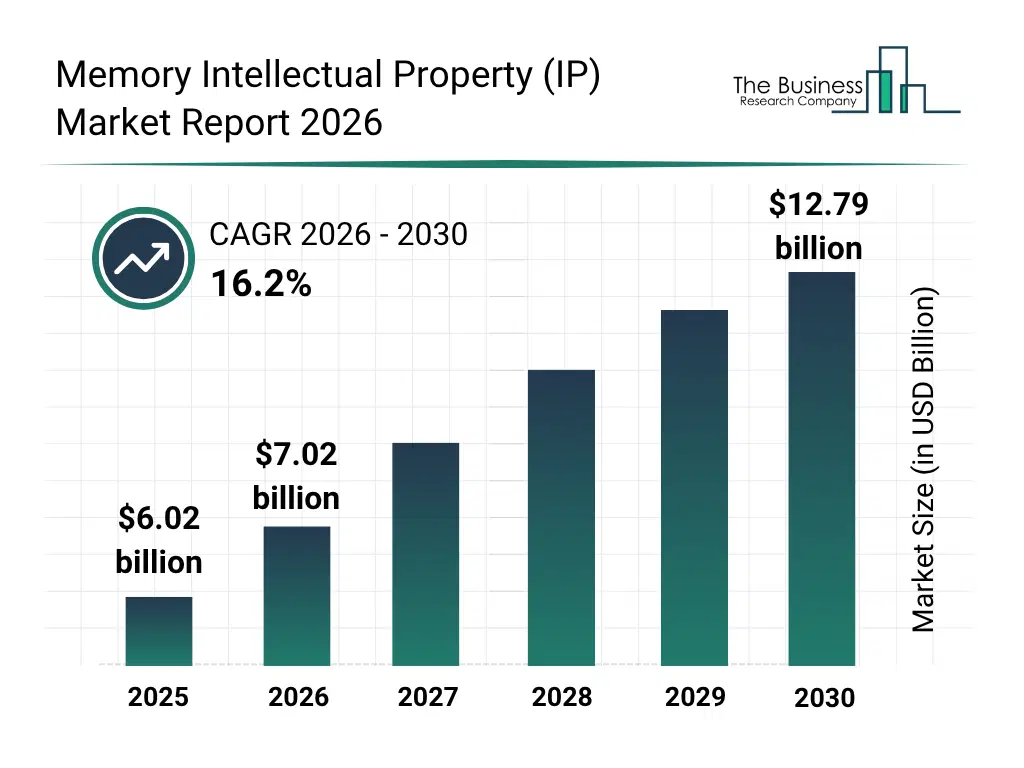
What Is The Memory Intellectual Property (IP) Market Size and Share 2026?
The memory intellectual property (IP) market size has grown rapidly in recent years. It will grow from $6.02 billion in 2025 to $7.02 billion in 2026 at a compound annual growth rate (CAGR) of 16.6%. The growth in the historic period can be attributed to rising demand for semiconductor design reuse, increasing adoption of system-on-chip architectures, growing complexity of integrated circuit designs, increasing need to reduce semiconductor development time, rising demand for validated semiconductor IP solutions.What Is The Memory Intellectual Property (IP) Market Growth Forecast?
The memory intellectual property (IP) market size is expected to see rapid growth in the next few years. It will grow to $12.79 billion in 2030 at a compound annual growth rate (CAGR) of 16.2%. The growth in the forecast period can be attributed to growing demand for advanced memory architectures, increasing adoption of chiplet-based semiconductor designs, rising demand for customized memory IP solutions, growing integration of high-bandwidth memory technologies, increasing demand for power-efficient memory architectures. Major trends in the forecast period include increasing adoption of reusable memory IP designs, growing demand for advanced memory architecture IP, rising development of low-power memory IP solutions, increasing demand for high-performance memory IP, growing adoption of validated memory IP for SoC designs.
Global Memory Intellectual Property (IP) Market Segmentation
1)By Memory Type: Dynamic Random Access Memory (DRAM) Intellectual Property, Static Random Access Memory (SRAM) Intellectual Property, Read Only Memory (ROM) Intellectual Property, Flash Memory Intellectual Property, Embedded Memory Intellectual Property 2) By Fabrication Process Node: Advanced Nodes, Mainstream Nodes, Legacy Nodes 3) By Deployment: On-Premises IP Licensing, Cloud-Based IP Licensing 4) By End User: Semiconductor Companies, Integrated Device Manufacturers, Fabless Semiconductor Companies, Electronic Design Automation Providers, Consumer Electronics Manufacturers, Automotive Electronics Manufacturers Subsegments: 1) By Dynamic Random Access Memory (DRAM) Intellectual Property: Double Data Rate Synchronous Dynamic Random Access Memory (DDR SDRAM) IP, Low Power Double Data Rate (LPDDR) IP, Graphics Double Data Rate (GDDR) IP, High Bandwidth Memory (HBM) IP, Embedded Dynamic Random Access Memory (eDRAM) IP 2) By Static Random Access Memory (SRAM) Intellectual Property: Single Port SRAM IP, Dual Port SRAM IP, Multi Port SRAM IP, Low Power SRAM IP, High Speed SRAM IP 3) By Read Only Memory (ROM) Intellectual Property: Mask ROM IP, One Time Programmable (OTP) ROM IP, Metal Programmable ROM IP, Embedded ROM IP 4) By Flash Memory Intellectual Property: Not OR (NOR) Flash IP, Not AND (NAND) Flash IP, Serial Flash IP, Embedded Flash (eFlash) IP 5) By Embedded Memory Intellectual Property: Embedded SRAM IP, Embedded Dynamic Random Access Memory (eDRAM) IP, Embedded Flash (eFlash) IP, Embedded ROM IP, Embedded Non Volatile Memory (eNVM) IPWhat Is The Driver Of The Memory Intellectual Property (IP) Market?
The increasing adoption of internet of things (IoT) devices is expected to drive the growth of the memory intellectual property (IP) market going forward. Internet of things (IoT) devices are connected electronic devices that collect, process, and exchange data through communication networks, enabling automation, monitoring, and intelligent decision-making. The adoption of IoT devices is increasing due to the growing demand for connected technologies across industries such as consumer electronics, automotive, healthcare, industrial automation, and smart infrastructure, which requires efficient and high-performance memory solutions. The growing adoption of Internet of Things (IoT) devices benefits memory intellectual property (IP) by increasing demand for energy efficient and compact memory designs that enable reliable data storage and processing in resource constrained connected devices. For instance, in July 2025, the European Commission, a Belgium-based governing body, reported that in 2023, the number of installed IoT-connected devices was around 40 billion and is projected to grow to 49 billion by 2026, representing an annual growth rate of 7%. Therefore, the increasing adoption of internet of things (IoT) devices is driving the growth of the memory intellectual property (IP) industry.Key Players In The Global Memory Intellectual Property (IP) Market
Major companies operating in the memory intellectual property (IP) market are Samsung Electronics Co. Ltd., Renesas Electronics Corporation, Synopsys Inc., Cadence Design Systems Inc., Arm Ltd., Rambus Inc., Microchip Technology Inc., Alphawave Semi, Ceva Inc., Faraday Technology Corporation, VeriSilicon Microelectronics (Shanghai) Co. Ltd., eMemory Technology Inc., Innosilicon Technology Ltd., Credo Technology Group Holding Ltd, Andes Technology Corporation, Weebit Nano Limited, Intrinsic ID, Qualitas Semiconductor Private Limited, T2M-IP, Eliyan Corporation, Ceremorphic Inc., Baya Systems Inc., SmartDV Technologies India Private Limited, Chipus Microelectronics Ltda.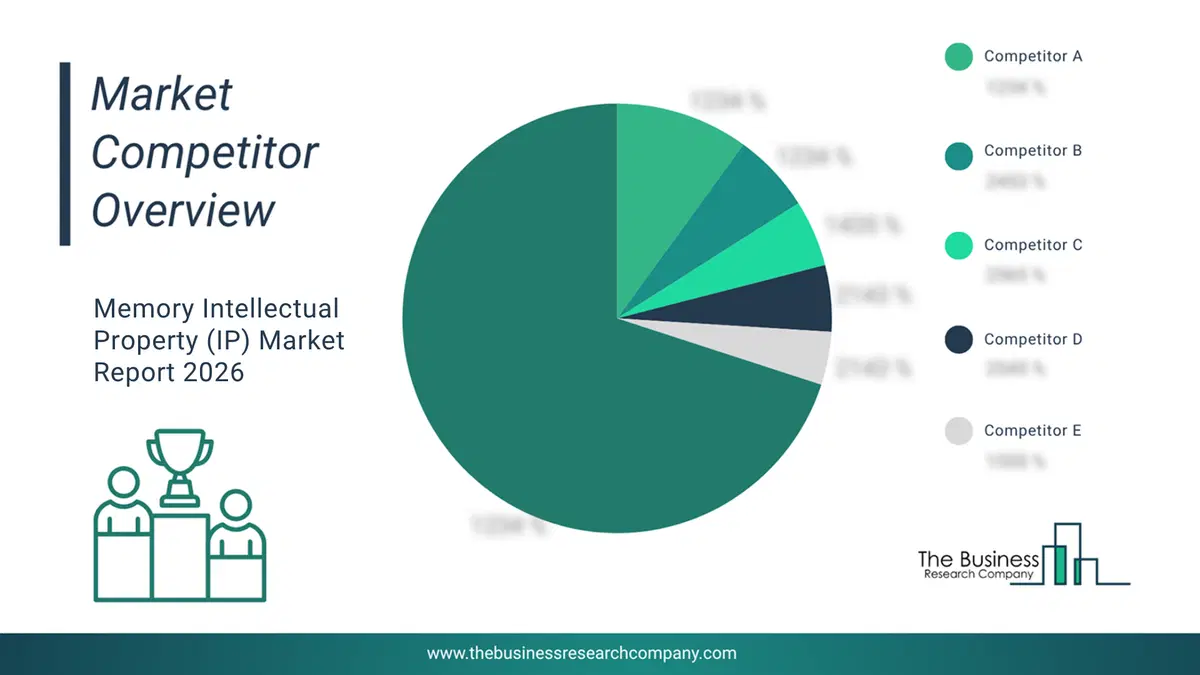
This chart is for illustrative purposes; the full report includes a detailed competitor analysis and comprehensive overview of the top 10 companies in the market.
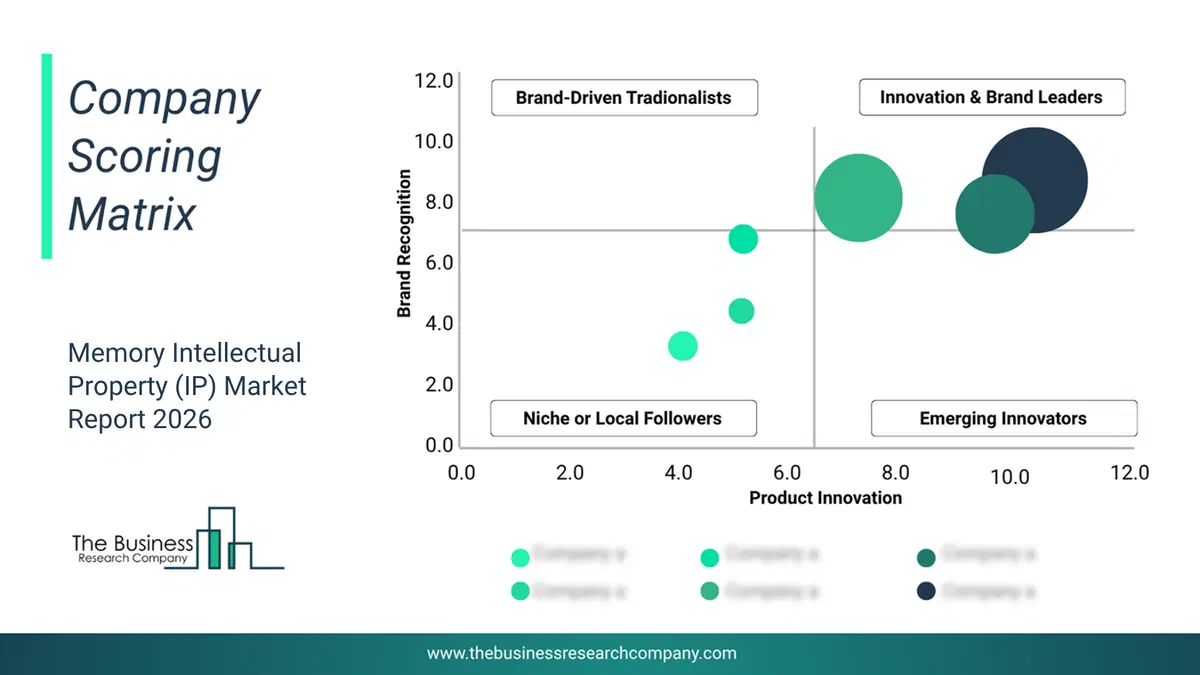
This chart maps companies by product innovation and brand strength, with bubble size indicating relative revenue, helping identify market leaders, challengers, and niche players. This is an illustrative chart; the full report provides a complete and accurate competitive analysis.
Global Memory Intellectual Property (IP) Market Trends and Insights
Major companies operating in the memory intellectual property (IP) market are focusing on developing innovative solutions, such as low-power high-speed memory interface intellectual property (IP) cores to enhance high-performance computing (HPC), artificial intelligence (AI) processing, data transfer efficiency, and power optimization. Low-power high-speed memory interface intellectual property (IP) cores are pre-designed semiconductor building blocks that enable efficient communication between processors and memory components, helping SoC developers integrate faster memory technologies with reduced power consumption, improved data transfer performance, enhanced reliability, and shorter chip development cycles for applications such as AI, data centers, edge computing, and high-performance computing systems. For instance, in June 2024, M31 Technology Corporation, a Taiwan-based silicon intellectual property (IP) provider, launched its advanced LPDDR memory IP solution to support high-performance computing and AI applications. The LPDDR4/4X memory IP provides stable high performance and low power consumption, supporting speeds of up to 4,267 Mbps and incorporating self-training algorithms to optimize performance across different applications. The newly introduced LPDDR5/5X/5T memory IP offers data transfer rates of up to 9,600 Mbps, improved power efficiency with up to 30% lower energy consumption compared with previous generations, and advanced error correction technology to enhance data reliability. These memory IP solutions are designed for applications including data centers, AI workloads, autonomous vehicles, edge computing devices, mobile systems, and other advanced computing environments requiring high-speed processing and energy efficiency.What Are Latest Mergers And Acquisitions In The Memory Intellectual Property (IP) Market?
In September 2023, Cadence Design Systems Inc., a US-based electronic design automation (EDA) and semiconductor software company, acquired the PHY IP assets of Rambus Inc. for an undisclosed amount. With this acquisition, Cadence Design Systems aimed to strengthen its semiconductor intellectual property portfolio by integrating Rambus Inc.’s SerDes and memory interface PHY IP technologies and experienced engineering teams, expanding its capabilities for AI, data center, hyperscale computing, networking, and advanced chip design applications while accelerating its Intelligent System Design strategy. Rambus Inc. is a US-based semiconductor intellectual property company that specializes in providing high-performance SerDes and memory interface PHY solutions.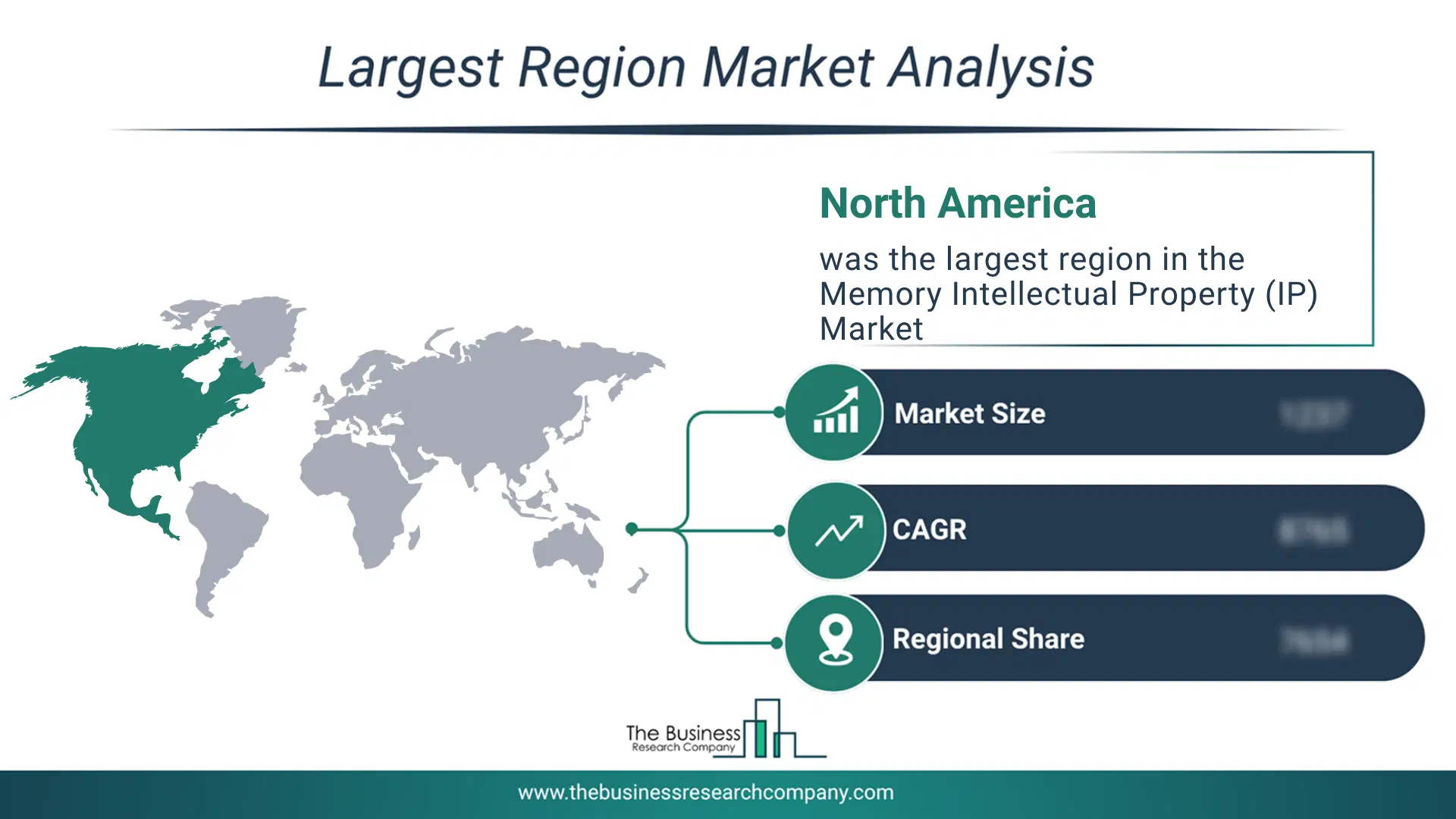
Regional Insights
North America was the largest region in the memory intellectual property (IP) market in 2025. Asia-Pacific is expected to be the fastest-growing region in the forecast period. The regions covered in this market report are Asia-Pacific, South East Asia, Western Europe, Eastern Europe, North America, South America, Middle East, Africa. The countries covered in this market report are Australia, Brazil, China, France, Germany, India, Indonesia, Japan, Taiwan, Russia, South Korea, UK, USA, Canada, Italy, Spain.What Defines the Memory Intellectual Property (IP) Market?
The memory intellectual property (IP) market consists of revenues earned by entities by providing services such as memory IP licensing, customization, integration support, design consultation, verification, testing support, and technical assistance for semiconductor development. The market value includes the value of related goods sold by the service provider or included within the service offering. The memory intellectual property (IP) market also includes sales of memory IP cores, embedded memory solutions, and other semiconductor memory design components. Values in this market are ‘factory gate’ values, that is, the value of goods sold by the manufacturers or creators of the goods, whether to other entities (including downstream manufacturers, wholesalers, distributors, and retailers) or directly to end customers. The value of goods in this market includes related services sold by the creators of the goods.How is Market Value Defined and Measured?
The market value is defined as the revenues that enterprises gain from the sale of goods and/or services within the specified market and geography through sales, grants, or donations in terms of the currency (in USD unless otherwise specified). The revenues for a specified geography are consumption values that are revenues generated by organizations in the specified geography within the market, irrespective of where they are produced. It does not include revenues from resales along the supply chain, either further along the supply chain or as part of other products.
This chart presents market attractiveness based on a quantitative evaluation of growth, competition, strategic alignment, and risk, offering a clear view of opportunity areas for decision-making. This chart is for illustrative purposes; the full report contains the complete analysis.

This chart highlights the Total Addressable Market (TAM) by estimating the maximum revenue opportunity using an assumption-driven approach, supporting strategic planning and opportunity sizing across markets. The chart is illustrative; the full report provides a more comprehensive analysis.
What Key Data and Analysis Are Included in the Memory Intellectual Property (IP) Market Report 2026?
The memory intellectual property (ip) market research report is one of a series of new reports from The Business Research Company that provides market statistics, including industry global market size, regional shares, competitors with the market share, detailed market segments, market trends and opportunities, and any further data you may need to thrive in the memory intellectual property (ip) industry. The market research report delivers a complete perspective of everything you need, with an in-depth analysis of the current and future state of the industry.Memory Intellectual Property (IP) Market Report Forecast Analysis
| Report Attribute | Details |
|---|---|
| Market Size Value In 2026 | $7.02 billion |
| Revenue Forecast In 2030 | $12.79 billion |
| Growth Rate | CAGR of 16.2% from 2026 to 2030 |
| Base Year For Estimation | 2025 |
| Actual Estimates/Historical Data | 2020-2025 |
| Forecast Period | 2026 - 2030 |
| Market Representation | Revenue in USD Billion and CAGR from 2026 to 2030 |
| Segments Covered | Memory Type, Fabrication Process Node, Deployment, End User |
| Regional Scope | Asia-Pacific, Western Europe, Eastern Europe, North America, South America, Middle East, Africa |
| Country Scope | The countries covered in the report are Australia, Brazil, China, France, Germany, India, Indonesia, Japan, Taiwan, Russia, South Korea, UK, USA, Canada, Italy, Spain. |
| Key Companies Profiled | Samsung Electronics Co. Ltd., Renesas Electronics Corporation, Synopsys Inc., Cadence Design Systems Inc., Arm Ltd., Rambus Inc., Microchip Technology Inc., Alphawave Semi, Ceva Inc., Faraday Technology Corporation, VeriSilicon Microelectronics (Shanghai) Co. Ltd., eMemory Technology Inc., Innosilicon Technology Ltd., Credo Technology Group Holding Ltd, Andes Technology Corporation, Weebit Nano Limited, Intrinsic ID, Qualitas Semiconductor Private Limited, T2M-IP, Eliyan Corporation, Ceremorphic Inc., Baya Systems Inc., SmartDV Technologies India Private Limited, Chipus Microelectronics Ltda. |
| Customization Scope | Request for Customization |
| Pricing And Purchase Options | Explore Purchase Options |