
Memory Test Equipment Market Report 2026
Global Outlook – By Product (Automated Test Equipment (ATE), Burn-In Test Systems, System-Level Test (SLT) Equipment, Wafer Probe Test Systems, High-Bandwidth Memory (HBM) Test Equipment ), By Memory Type (Dynamic Random Access Memory (DRAM), Static Random Access Memory (SRAM), Not AND Flash Memory (NAND) Flash, Not OR Flash Memory (NOR) Flash, Emerging Memory ), By Application (Consumer Electronics, Automotive, Telecommunications, Industrial, Other Application ), By End User (Semiconductor Manufacturers, Research And Development, Other End-Users ) – Market Size, Trends, Strategies, and Forecast to 2030
Memory Test Equipment Market Overview
• Memory Test Equipment market size has reached to $2.15 billion in 2025 • Expected to grow to $3.2 billion in 2030 at a compound annual growth rate (CAGR) of 8.2% • Growth Driver: Growing Adoption Of Consumer Electronics Is Fueling The Growth Of The Market Due To Increasing Demand For High-Quality Memory Chip Validation • Market Trend: Innovations In Next-Generation Memory Testers Enhance Testing Accuracy And Manufacturing Efficiency • North America was the largest region in 2025 and Asia-Pacific is the fastest growing region.What Is Covered Under Memory Test Equipment Market?
Memory test equipment is specialized systems designed to evaluate the functionality, performance, and reliability of semiconductor memory devices. Its primary purpose is to identify manufacturing defects, confirm compliance with performance and quality standards, and ensure memory chips deliver reliable operation before being integrated into electronic products. The main products of memory test equipment include automated test equipment (ATE), burn-in test systems, system-level test (SLT) equipment, wafer probe test systems, and high-bandwidth memory (HBM) test equipment. Automated test equipment (ATE) refers to computer-controlled systems used to automatically evaluate the electrical performance, functionality, reliability, and quality of memory devices during manufacturing and testing processes. These systems are used for testing dynamic random access memory (DRAM), static random access memory (SRAM), not AND flash memory (NAND) flash, not OR flash memory (NOR) flash, and emerging memory technologies. They find application in consumer electronics, automotive, telecommunications, industrial, and others, serving end users including semiconductor manufacturers, research and development, and others.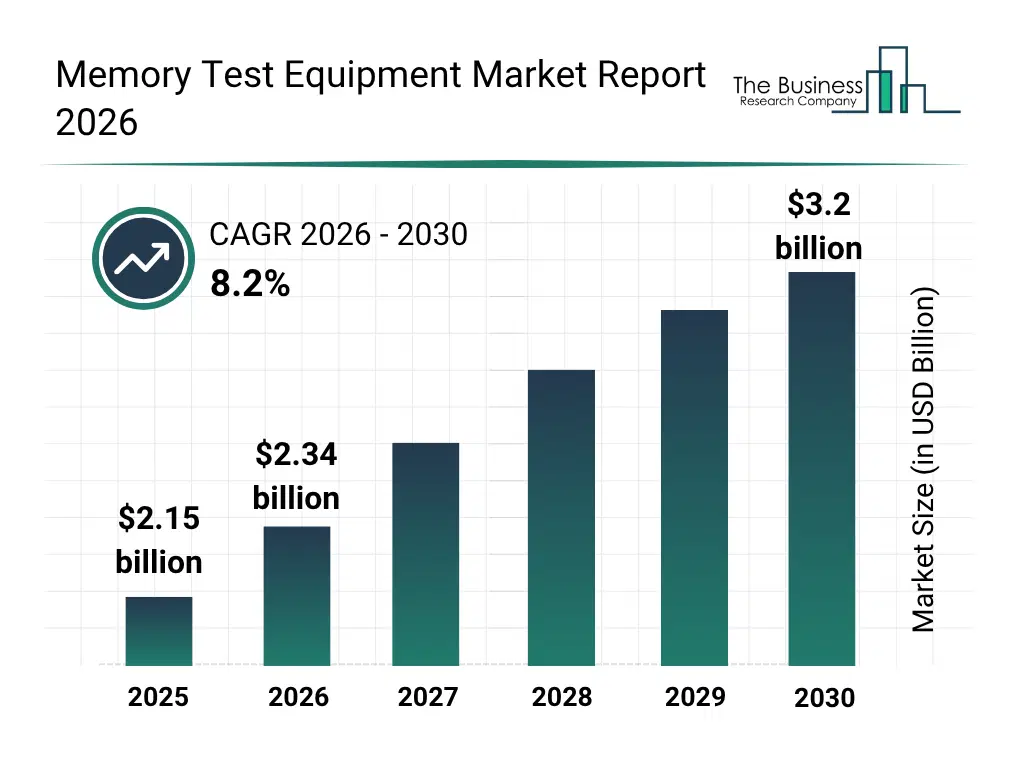
What Is The Memory Test Equipment Market Size and Share 2026?
The memory test equipment market size has grown strongly in recent years. It will grow from $2.15 billion in 2025 to $2.34 billion in 2026 at a compound annual growth rate (CAGR) of 8.6%. The growth in the historic period can be attributed to rising semiconductor memory production, increasing demand for quality assurance in memory manufacturing, growing complexity of memory devices, increasing adoption of automated semiconductor testing, rising demand for reliable memory components.What Is The Memory Test Equipment Market Growth Forecast?
The memory test equipment market size is expected to see strong growth in the next few years. It will grow to $3.2 billion in 2030 at a compound annual growth rate (CAGR) of 8.2%. The growth in the forecast period can be attributed to growing production of high-bandwidth memory devices, increasing adoption of advanced memory architectures, rising demand for higher-speed memory testing, growing complexity of semiconductor packaging technologies, increasing demand for intelligent and flexible test equipment. Major trends in the forecast period include increasing adoption of automated memory testing systems, growing demand for high-speed memory testing solutions, rising integration of advanced defect detection capabilities, increasing demand for precision memory characterization equipment, growing adoption of automated test data analysis.
Global Memory Test Equipment Market Segmentation
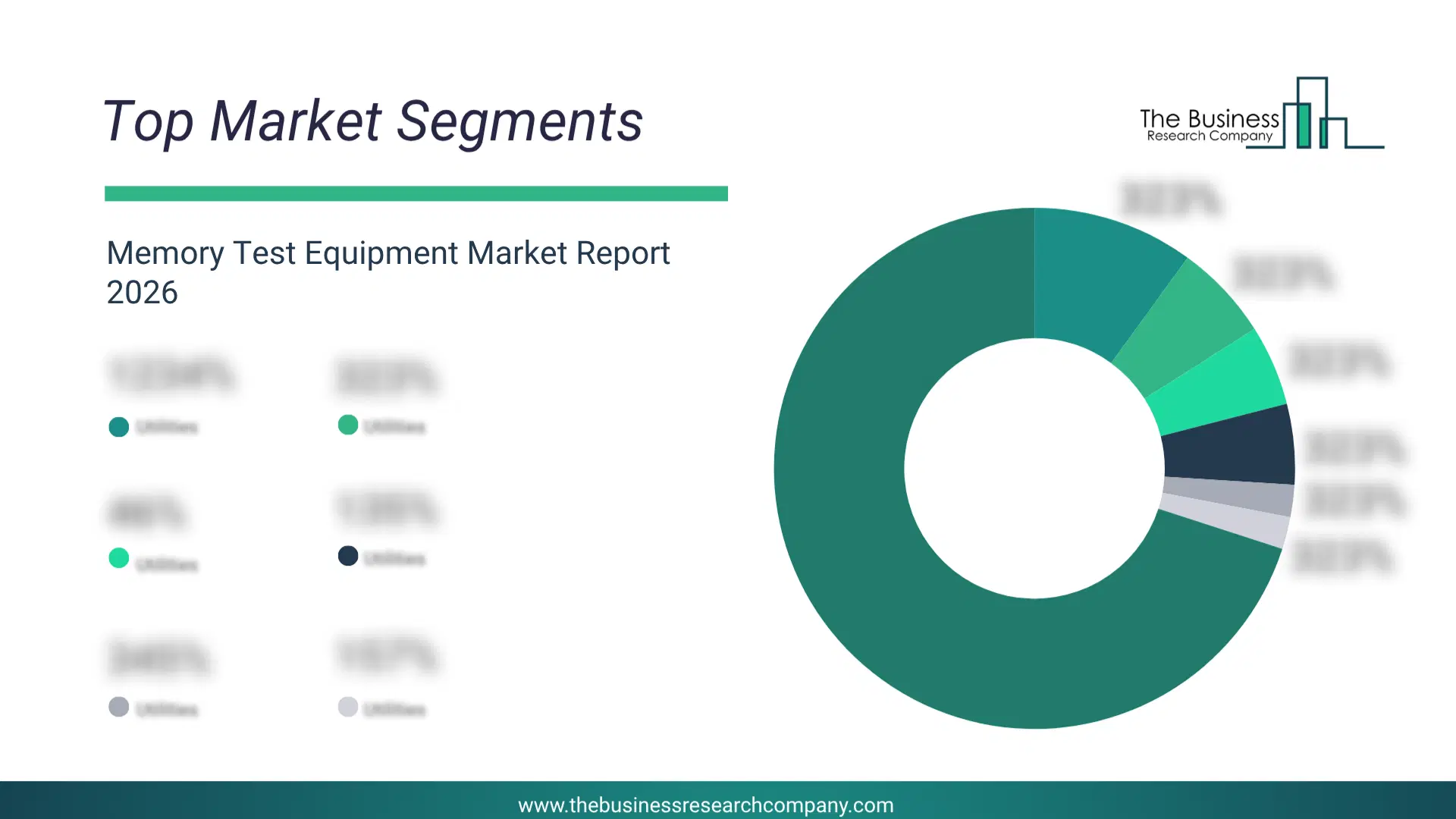
1) By Product: Automated Test Equipment (ATE), Burn-In Test Systems, System-Level Test (SLT) Equipment, Wafer Probe Test Systems, High-Bandwidth Memory (HBM) Test Equipment 2) By Memory Type: Dynamic Random Access Memory (DRAM), Static Random Access Memory (SRAM), Not AND Flash Memory (NAND) Flash, Not OR Flash Memory (NOR) Flash, Emerging Memory 3) By Application: Consumer Electronics, Automotive, Telecommunications, Industrial, Other Application 4) By End User: Semiconductor Manufacturers, Research And Development, Other End-Users Subsegments: 1) By Automated Test Equipment: Memory Production Testers, Memory Characterization Testers, Memory Engineering Testers, Memory Device Handlers 2) By Burn-In Test Systems: Static Burn-In Systems, Dynamic Burn-In Systems, Parallel Burn-In Systems, High Temperature Burn-In Systems 3) By System-Level Test Equipment: Board Level Test Systems, Module Level Test Systems, Solid State Drive Test Systems, Memory Card Test Systems 4) By Wafer Probe Test Systems: Manual Wafer Probe Systems, Semi-Automatic Wafer Probe Systems, Fully Automatic Wafer Probe Systems, Advanced Packaging Wafer Probe Systems 5) By High-Bandwidth Memory Test Equipment: High-Bandwidth Memory (HBM) Wafer Test Systems, High-Bandwidth Memory (HBM) Known Good Die Test Systems, High-Bandwidth Memory (HBM) Package Test Systems, High-Bandwidth Memory (HBM) Final Test SystemsWhat Is The Driver Of The Memory Test Equipment Market?
The growing adoption of consumer electronics is expected to propel the growth of the memory test equipment market going forward. Consumer electronics refers to electronic devices designed for everyday personal use, including smartphones, laptops, tablets, wearables, and smart home devices. The rising adoption of consumer electronics is largely driven by rapid digital transformation, as the increasing integration of technology into daily life continues to encourage consumers to upgrade and expand their personal device portfolios. The growing use of consumer electronics directly elevates demand for memory chips and integrated circuits embedded in these devices, necessitating the use of advanced testing equipment to ensure the performance, reliability, and quality of these memory components. For instance, in May 2023, according to the Japan Electronics and Information Technology Industries Association, a Japan-based trade association, the total consumer electronic equipment production in Japan reached $209.16 million (¥32,099 million), compared to $164.65 million (¥25,268 million) in May 2022. Therefore, the growing adoption of consumer electronics is driving the growth of the memory test equipment industry.Key Players In The Global Memory Test Equipment Market
Major companies operating in the memory test equipment market are Advantest Corporation, Teradyne Inc., Tokyo Electron Limited, Keysight Technologies Inc., FormFactor Inc., Cohu Inc., Chroma ATE Inc., MPI Corporation, Hangzhou Changchuan Technology Co. Ltd., SPEA S.p.A., Beijing Huafeng Test & Control Technology Co. Ltd., UniTest Inc., Semics Inc., Neosem Inc., TESEC Corporation, Micro Control Company, EPM Test Technology Co. Ltd., YC Corporation, KingTiger Technology Inc., Hontech Global Co. Ltd., TBS Test Technology Co. Ltd., Macrotest Semiconductor Equipment Co. Ltd., Seiko Epson Corporation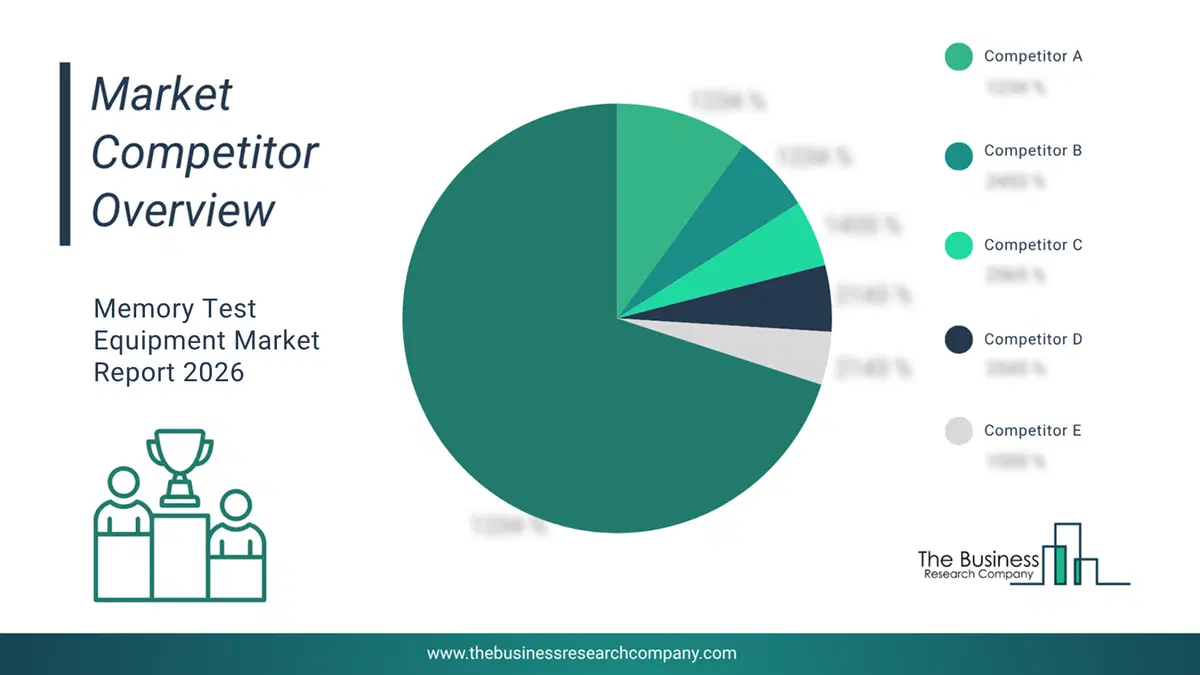
This chart is for illustrative purposes; the full report includes a detailed competitor analysis and comprehensive overview of the top 10 companies in the market.
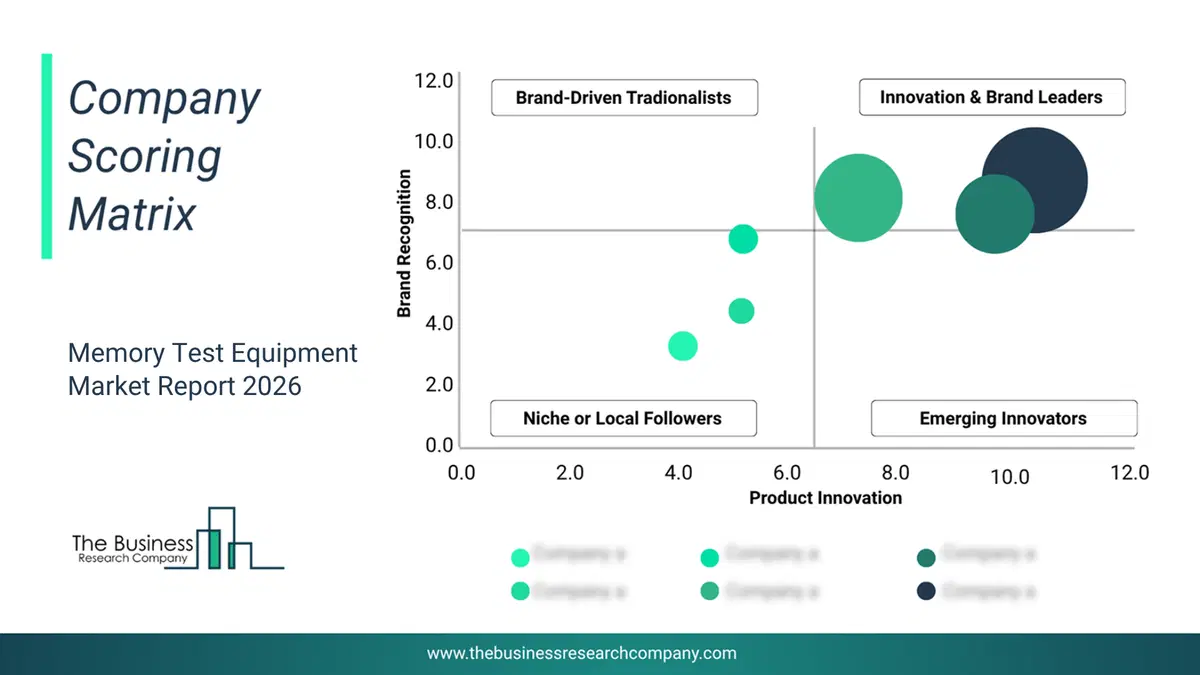
This chart maps companies by product innovation and brand strength, with bubble size indicating relative revenue, helping identify market leaders, challengers, and niche players. This is an illustrative chart; the full report provides a complete and accurate competitive analysis.
Global Memory Test Equipment Market Trends and Insights
Major companies operating in the memory test equipment market are focusing on developing next-generation memory testers to improve testing accuracy, throughput, and manufacturing efficiency. Next-generation memory testers are advanced systems designed to validate the performance, reliability, and functionality of emerging high-speed and high-density memory devices with greater accuracy and testing efficiency. For instance, in August 2025, Teradyne Inc., a US-based provider of automated test equipment, launched the Magnum 7H, a next-generation memory tester specifically designed for high-bandwidth memory (HBM) devices. The platform delivers increased test capacity, advanced performance capabilities, and scalable architecture to support the evolving requirements of AI and high-performance computing applications. It enables faster, more accurate, and high-volume testing of advanced HBM devices. The Magnum 7H helps memory manufacturers improve production efficiency, reduce testing costs, and accelerate the commercialization of next-generation memory technologies.What Are Latest Mergers And Acquisitions In The Memory Test Equipment Market?
In June 2025, Teradyne Inc., a US-based provider of automated test equipment, entered into a strategic partnership with Acroview Technology Co., Ltd. to strengthen China's memory testing ecosystem through advanced testing technologies and localized engineering expertise. The partnership aims to combine Teradyne's advanced memory test equipment with Acroview's local engineering capabilities to deliver high-performance memory testing solutions. It also seeks to accelerate innovation, enhance customer support, and expand the adoption of memory test equipment across China's semiconductor industry. Acroview Technology Co., Ltd. is a China-based company that develops semiconductor test equipment specifically for memory devices.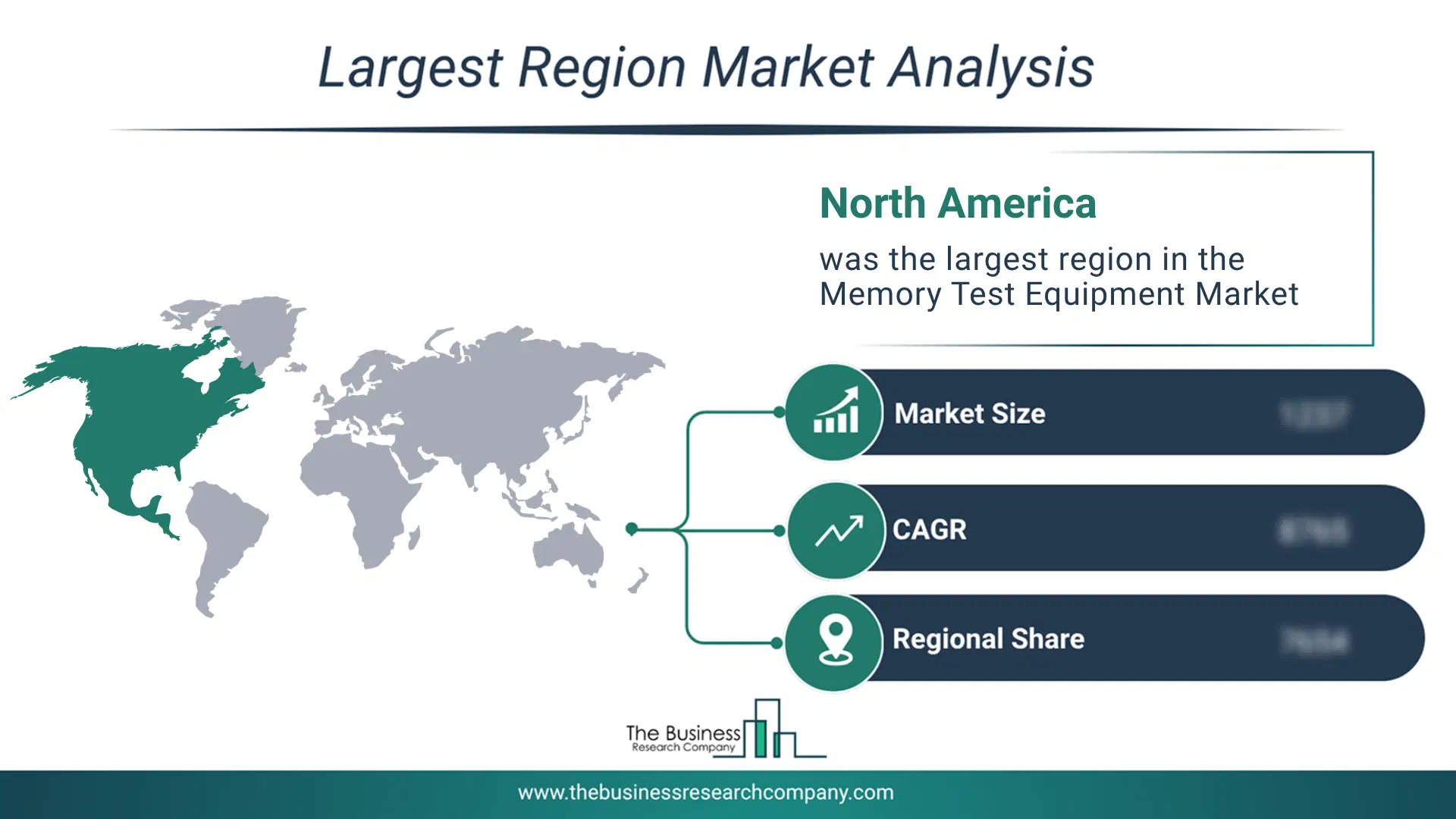
Regional Insights
North America was the largest region in the memory test equipment market in 2025. Asia-Pacific is expected to be the fastest-growing region in the forecast period. The regions covered in this market report are Asia-Pacific, South East Asia, Western Europe, Eastern Europe, North America, South America, Middle East, Africa. The countries covered in this market report are Australia, Brazil, China, France, Germany, India, Indonesia, Japan, Taiwan, Russia, South Korea, UK, USA, Canada, Italy, Spain.What Defines the Memory Test Equipment Market?
The memory test equipment market consists of sales of cooling units, handler accessories, probe needles, and calibration kits. Values in this market are ‘factory gate’ values, that is, the value of goods sold by the manufacturers or creators of the goods, whether to other entities (including downstream manufacturers, wholesalers, distributors, and retailers) or directly to end customers. The value of goods in this market includes related services sold by the creators of the goods.How is Market Value Defined and Measured?
The market value is defined as the revenues that enterprises gain from the sale of goods and/or services within the specified market and geography through sales, grants, or donations in terms of the currency (in USD unless otherwise specified). The revenues for a specified geography are consumption values that are revenues generated by organizations in the specified geography within the market, irrespective of where they are produced. It does not include revenues from resales along the supply chain, either further along the supply chain or as part of other products.
This chart presents market attractiveness based on a quantitative evaluation of growth, competition, strategic alignment, and risk, offering a clear view of opportunity areas for decision-making. This chart is for illustrative purposes; the full report contains the complete analysis.

This chart highlights the Total Addressable Market (TAM) by estimating the maximum revenue opportunity using an assumption-driven approach, supporting strategic planning and opportunity sizing across markets. The chart is illustrative; the full report provides a more comprehensive analysis.
What Key Data and Analysis Are Included in the Memory Test Equipment Market Report 2026?
The memory test equipment market research report is one of a series of new reports from The Business Research Company that provides market statistics, including industry global market size, regional shares, competitors with the market share, detailed market segments, market trends and opportunities, and any further data you may need to thrive in the memory test equipment industry. The market research report delivers a complete perspective of everything you need, with an in-depth analysis of the current and future state of the industry.Memory Test Equipment Market Report Forecast Analysis
| Report Attribute | Details |
|---|---|
| Market Size Value In 2026 | $2.34 billion |
| Revenue Forecast In 2030 | $3.2 billion |
| Growth Rate | CAGR of 8.2% from 2026 to 2030 |
| Base Year For Estimation | 2025 |
| Actual Estimates/Historical Data | 2020-2025 |
| Forecast Period | 2026 - 2030 |
| Market Representation | Revenue in USD Billion and CAGR from 2026 to 2030 |
| Segments Covered | Product, Memory Type, Application, End User |
| Regional Scope | Asia-Pacific, Western Europe, Eastern Europe, North America, South America, Middle East, Africa |
| Country Scope | The countries covered in the report are Australia, Brazil, China, France, Germany, India, Indonesia, Japan, Taiwan, Russia, South Korea, UK, USA, Canada, Italy, Spain. |
| Key Companies Profiled | Advantest Corporation, Teradyne Inc., Tokyo Electron Limited, Keysight Technologies Inc., FormFactor Inc., Cohu Inc., Chroma ATE Inc., MPI Corporation, Hangzhou Changchuan Technology Co. Ltd., SPEA S.p.A., Beijing Huafeng Test & Control Technology Co. Ltd., UniTest Inc., Semics Inc., Neosem Inc., TESEC Corporation, Micro Control Company, EPM Test Technology Co. Ltd., YC Corporation, KingTiger Technology Inc., Hontech Global Co. Ltd., TBS Test Technology Co. Ltd., Macrotest Semiconductor Equipment Co. Ltd., Seiko Epson Corporation |
| Customization Scope | Request for Customization |
| Pricing And Purchase Options | Explore Purchase Options |