
Merchant Embedded Computing Market Report 2026
Global Outlook – By Product Type (Single Board Computers, Computer-on-Modules, Systems on Chip), By Connectivity (Wired Connectivity, Wireless Connectivity, Hybrid Solutions, Operating System, Processor Type), By Application (Checkout And Billing, Self-Service, Advertising And Display, Automated Retail, Payment Processing, Inventory And Stock Management), By End-Use (Industrial Automation, Telecommunications, Healthcare, Transportation And Automotive, Defense And Aerospace) – Market Size, Trends, Strategies, and Forecast to 2030
Merchant Embedded Computing Market Overview
• Merchant Embedded Computing market size has reached to $6.88 billion in 2025 • Expected to grow to $10.92 billion in 2030 at a compound annual growth rate (CAGR) of 9.7% • Growth Driver: Increasing Adoption Of Digital And Contactless Payment Methods Driving Market Growth Due To Consumer Demand For Faster, Convenient, And Secure Transactions • Market Trend: Advancements In Edge AI Computing Modules Driving Real-Time Intelligent Processing • North America was the largest region in 2025 and Asia-Pacific is the fastest growing region.What Is Covered Under Merchant Embedded Computing Market?
Merchant embedded computing refers to pre-designed, commercially available computing platforms that can be integrated directly into devices or systems. These solutions provide standardized hardware and software components, reducing the need for custom development. They enable faster deployment and reliable performance for specialized applications. The main product types of merchant embedded computing include single board computers, computer-on-modules, and systems on chip. Single board computers refer to compact, fully integrated computing systems designed for specialized embedded applications, enabling efficient processing and control in merchant environments. These solutions are available with wired connectivity, wireless connectivity, hybrid solutions, operating system, and processor type options. The key applications of checkout and billing, self-service, advertising and display, automated retail, payment processing, and inventory and stock management, while the end-users include industrial automation, telecommunications, healthcare, transportation and automotive, and defense and aerospace.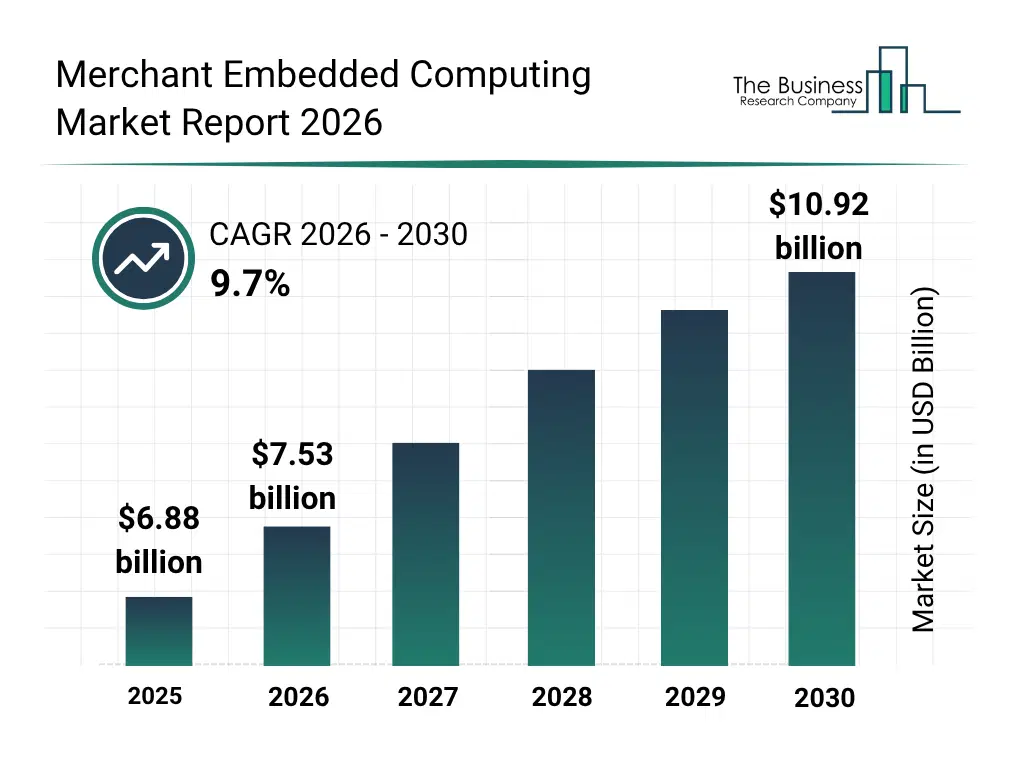
What Is The Merchant Embedded Computing Market Size and Share 2026?
The merchant embedded computing market size has grown strongly in recent years. It will grow from $6.88 billion in 2025 to $7.53 billion in 2026 at a compound annual growth rate (CAGR) of 9.5%. The growth in the historic period can be attributed to growth of industrial automation systems, rising demand for compact embedded hardware, expansion of telecommunications infrastructure, increasing adoption of digital payment systems, advancements in system on chip technologies.What Is The Merchant Embedded Computing Market Growth Forecast?
The merchant embedded computing market size is expected to see strong growth in the next few years. It will grow to $10.92 billion in 2030 at a compound annual growth rate (CAGR) of 9.7%. The growth in the forecast period can be attributed to growing deployment of smart factories, increasing need for edge AI processing, rising demand for connected retail systems, expansion of autonomous vehicle electronics, increasing focus on low power and high performance embedded processors. Major trends in the forecast period include increasing adoption of modular computer-on-modules architectures, rising demand for rugged and fanless single board computers, growing integration of edge computing capabilities, expansion of arm-based embedded platforms, rising preference for standardized off-the-shelf embedded solutions.
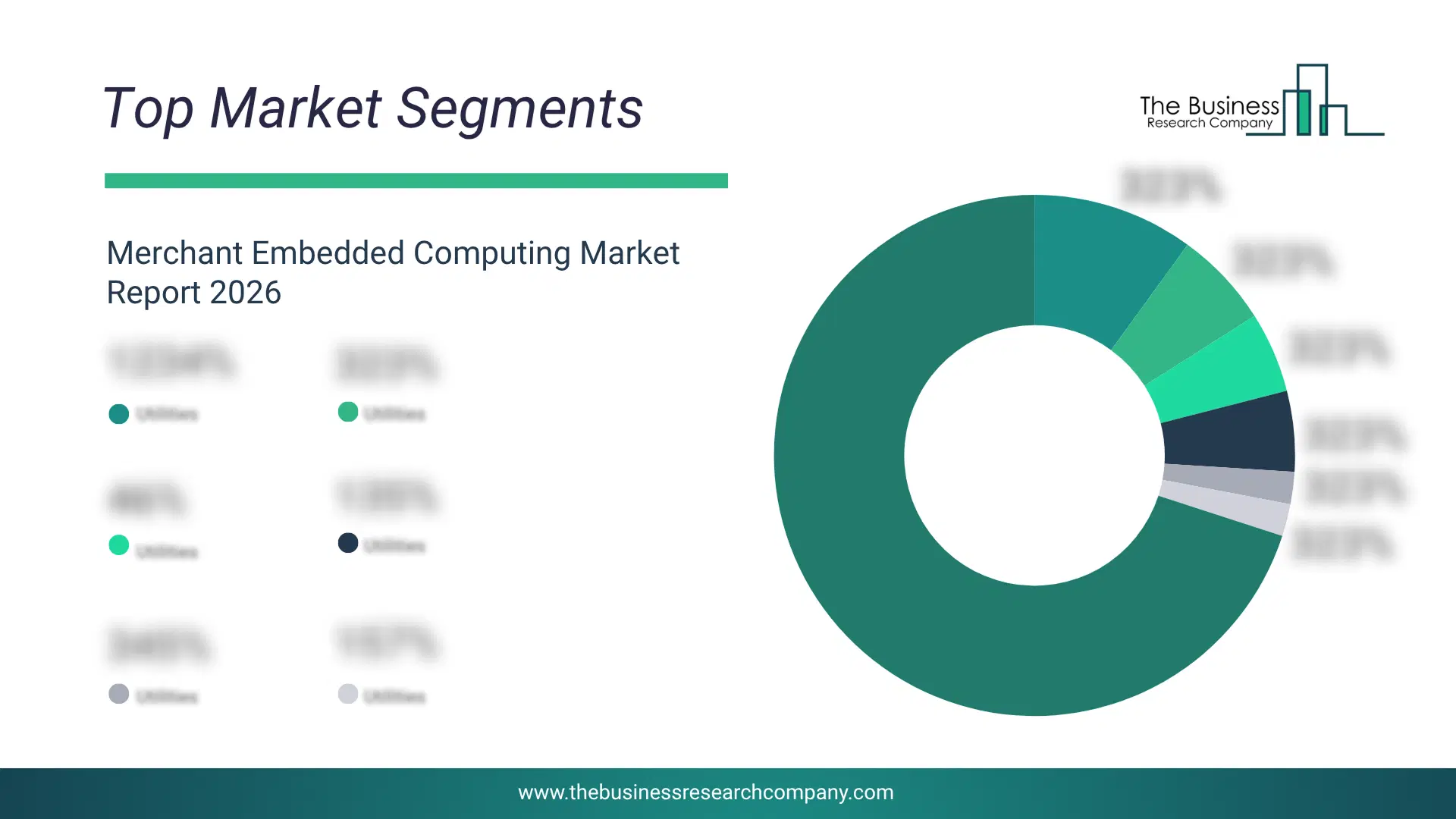
Global Merchant Embedded Computing Market Segmentation
1) By Product Type: Single Board Computers, Computer-on-Modules, Systems on Chip 2) By Connectivity: Wired Connectivity, Wireless Connectivity, Hybrid Solutions, Operating System, Processor Type 3) By Application: Checkout And Billing, Self-Service, Advertising And Display, Automated Retail, Payment Processing, Inventory And Stock Management 4) By End-Use: Industrial Automation, Telecommunications, Healthcare, Transportation And Automotive, Defense And Aerospace Subsegments: 1) By Single Board Computers: Industrial Single Board Computers, Rugged Single Board Computers, Fanless Single Board Computers, Compact Single Board Computers 2) By Computer-on-Modules: Embedded Computer-on-Modules, Industrial Computer-on-Modules, System-on-Modules, Arm-Based Computer-on-Modules 3) By Systems on Chip: Application Specific Systems on Chip, Digital Signal Processing Systems on Chip, Graphics Processing Systems on Chip, General Purpose Systems on ChipWhat Is The Driver Of The Merchant Embedded Computing Market?
The increasing adoption of digital and contactless payment methods is expected to propel the growth of the merchant-embedded computing market going forward. Digital and contactless payments are electronic payment methods that allow consumers to make transactions using mobile devices, contactless cards, or digital wallets without physical cash or traditional card insertion. Adoption of digital and contactless payments is rising due to urbanization, as urban consumers increasingly prefer faster, convenient, and seamless payment experiences with modern point-of-sale systems. Merchant embedded computing enables digital and contactless payments by providing reliable, secure, and high-performance hardware and software platforms that seamlessly integrate with modern point-of-sale systems, support real-time transaction processing, and ensure a smooth, efficient, and convenient payment experience for both merchants and consumers. For instance, in July 2024, according to a report published by UK Finance Limited, a UK-based trade association, in 2023, over four in ten adults (42%) were registered for at least one mobile payment service, up from 30% in 2022, and of these, 98% made payments during the year, with more than eight in ten (82%) transacting monthly, up from 76% the previous year. Therefore, increasing adoption of digital and contactless payment methods is driving the growth of the merchant-embedded computing market.Key Players In The Global Merchant Embedded Computing Market
Major companies operating in the merchant embedded computing market are Qualcomm Technologies Inc., Microchip Technology Inc., Curtiss‑Wright Controls Inc., Advantech Co. Ltd., Digi International Inc., ADLINK Technology Inc., Data Modul AG, NEXCOM International Co. Ltd., IEI Integration Corp., Axiomtek Co. Ltd., AAEON Technology Inc., Congatec AG, Portwell Inc., One Stop Systems Inc., DFI Inc., Mercury Systems Inc., ARBOR Technology Corporation, Trenton Systems Inc., Fastwel Group Co. Ltd., Avalue Technology Inc., and EVOC Intelligent Technology Co. Ltd.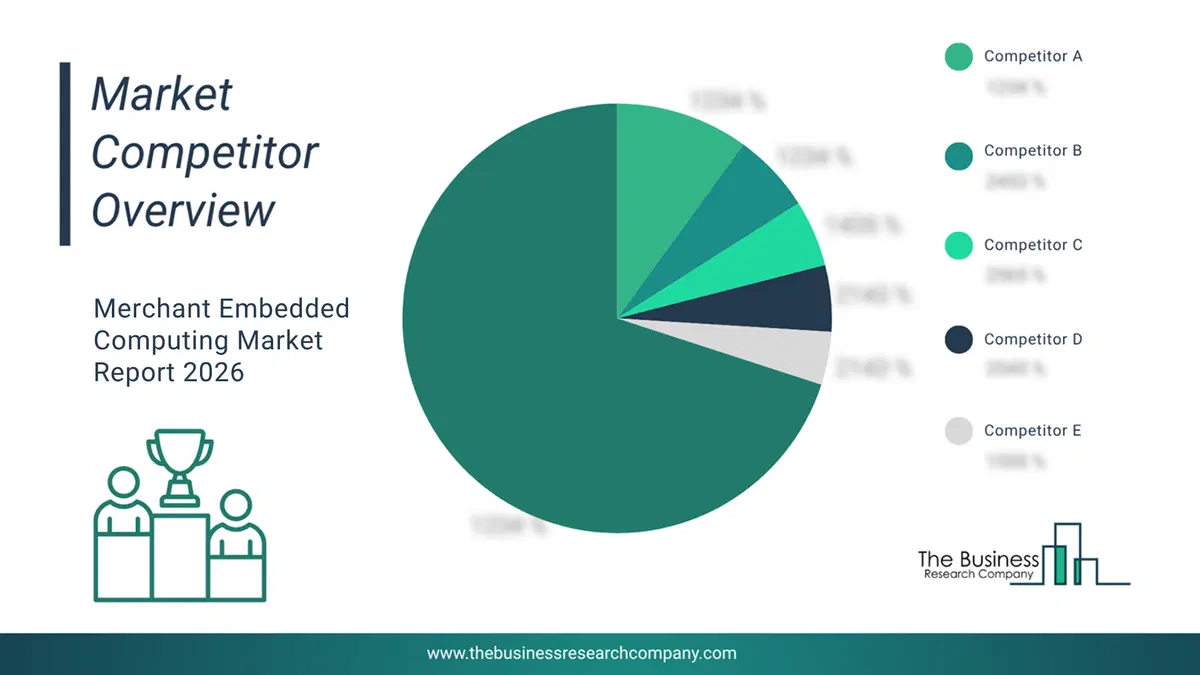
This chart is for illustrative purposes; the full report includes a detailed competitor analysis and comprehensive overview of the top 10 companies in the market.
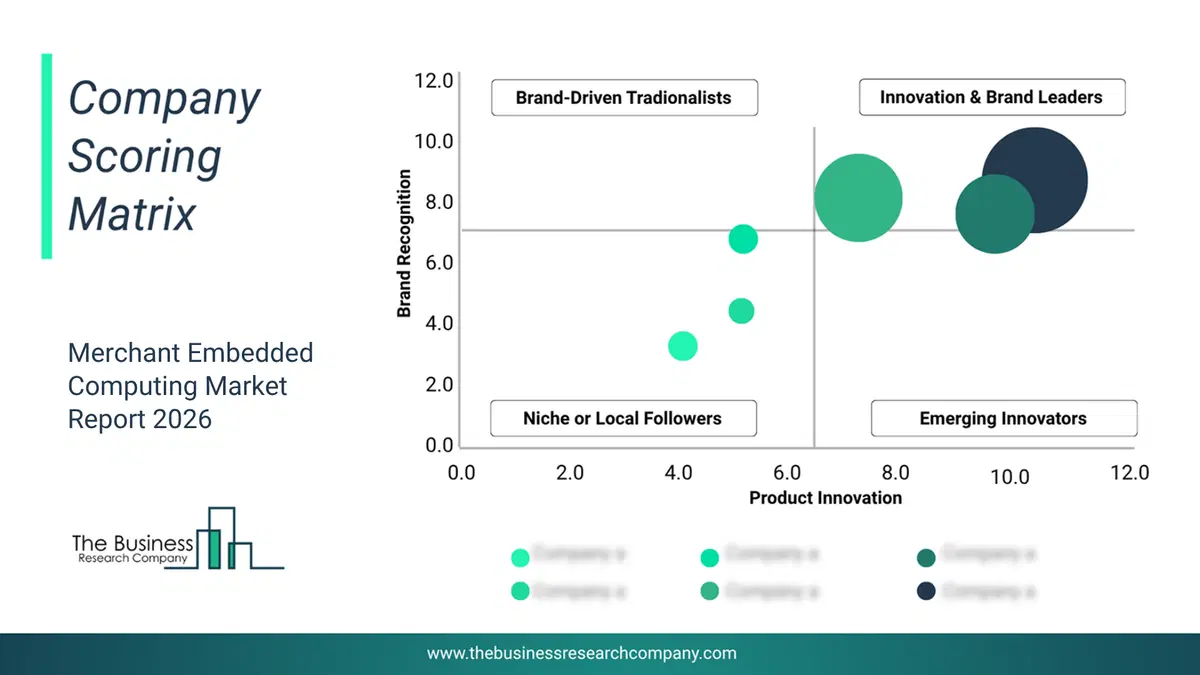
This chart maps companies by product innovation and brand strength, with bubble size indicating relative revenue, helping identify market leaders, challengers, and niche players. This is an illustrative chart; the full report provides a complete and accurate competitive analysis.
Global Merchant Embedded Computing Market Trends and Insights
Major companies operating in the merchant embedded computing market are focusing on developing innovative solutions such as, edge artificial intelligence (AI) computing modules to enable real-time data processing and intelligent decision-making at the edge. Edge artificial intelligence (AI) computing modules are compact hardware systems that run AI workloads locally on devices, helping process data in real time, reduce latency, and enable intelligent decision-making without relying on the cloud. For instance, in November 2025, ADLINK Technology, a Taiwan-based computing company, launched the i-MX95 Modules for Edge AI Systems, an innovative series designed to enhance edge computing capabilities in industrial and commercial environments. The i-MX95 modules feature a powerful ARM Cortex-A55 CPU, integrated neural processing units (NPUs) for AI inference, high-bandwidth memory interfaces, and flexible I/O options for seamless integration into diverse devices. These modules support real-time data processing, reduce latency, improve energy efficiency, and enable sophisticated AI applications directly on edge devices, offering a significant advancement over conventional embedded boards.What Are Latest Mergers And Acquisitions In The Merchant Embedded Computing Market?
In December 2024, Virtium Technology LLC, a US-based technology company, acquired Embedded Artists AB for an undisclosed amount. With this acquisition, Virtium Technology aims to expand its capabilities in edge computing, artificial intelligence, and high-performance industrial computing markets. Embedded Artists AB is a Sweden-based technology company that specializes in providing system-on-module (SOM) designs, AI accelerator modules, and connectivity solutions such as wi-fi and bluetooth for industrial and edge AI applications.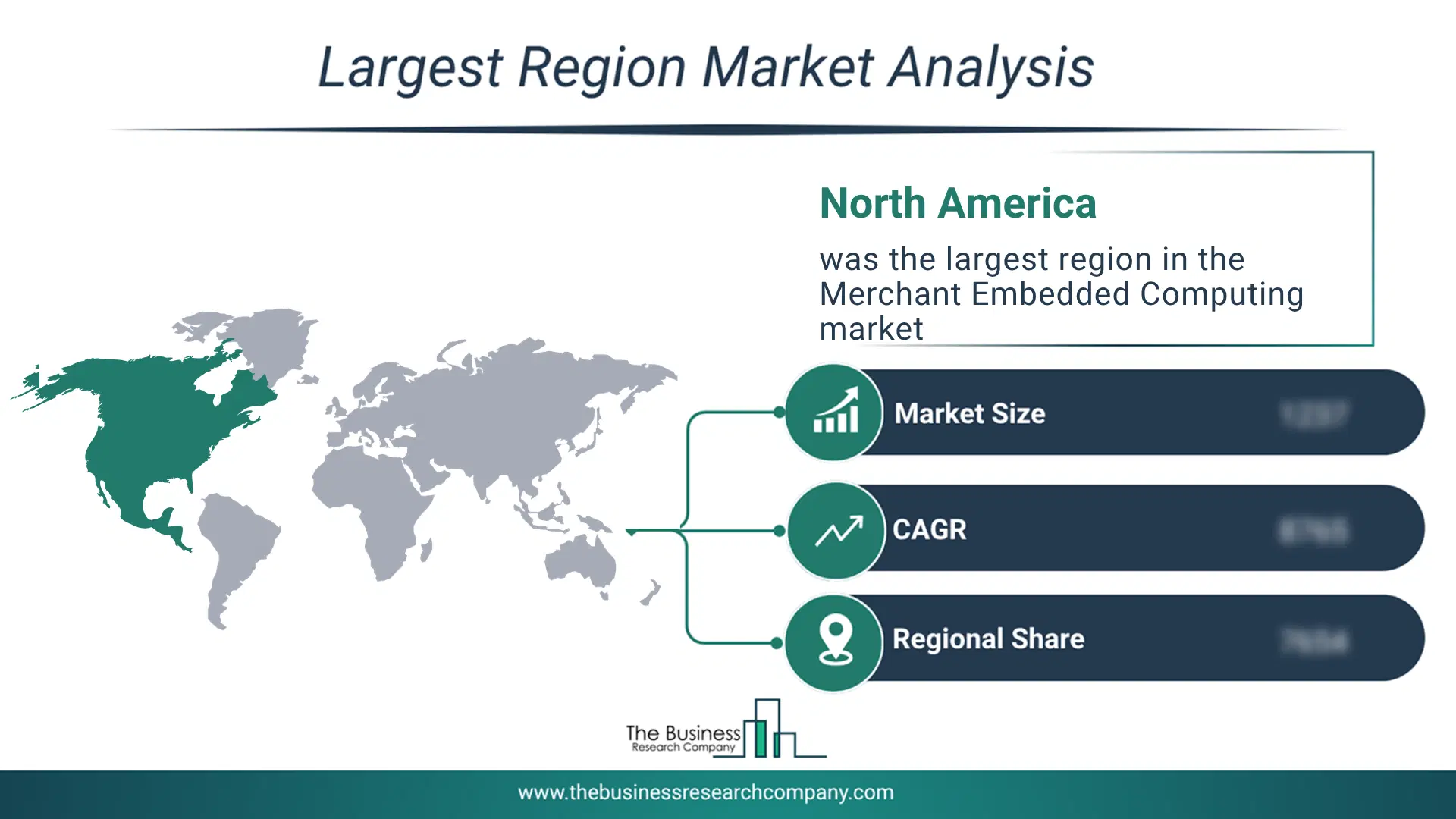
Regional Insights
North America was the largest region in the merchant embedded computing market in 2025. Asia-Pacific is expected to be the fastest-growing region in the forecast period. The regions covered in this market report are Asia-Pacific, South East Asia, Western Europe, Eastern Europe, North America, South America, Middle East, Africa. The countries covered in this market report are Australia, Brazil, China, France, Germany, India, Indonesia, Japan, Taiwan, Russia, South Korea, UK, USA, Canada, Italy, Spain.What Defines the Merchant Embedded Computing Market?
The merchant embedded computing market includes of revenues earned by entities by providing services such as payment processing, inventory management, customer relationship management, reporting and analytics. The market value includes the value of related goods sold by the service provider or included within the service offering. Only goods and services traded between entities or sold to end consumers are included. The merchant embedded computing market consists of sales of smart point of sale (PoS) terminals, self-service kiosks, smart vending machines, digital payment terminals and automated checkout systems. Values in this market are ‘factory gate’ values, that is the value of goods sold by the manufacturers or creators of the goods, whether to other entities (including downstream manufacturers, wholesalers, distributors and retailers) or directly to end customers. The value of goods in this market includes related services sold by the creators of the goods.How is Market Value Defined and Measured?
The market value is defined as the revenues that enterprises gain from the sale of goods and/or services within the specified market and geography through sales, grants, or donations in terms of the currency (in USD unless otherwise specified). The revenues for a specified geography are consumption values that are revenues generated by organizations in the specified geography within the market, irrespective of where they are produced. It does not include revenues from resales along the supply chain, either further along the supply chain or as part of other products.
This chart presents market attractiveness based on a quantitative evaluation of growth, competition, strategic alignment, and risk, offering a clear view of opportunity areas for decision-making. This chart is for illustrative purposes; the full report contains the complete analysis.

This chart highlights the Total Addressable Market (TAM) by estimating the maximum revenue opportunity using an assumption-driven approach, supporting strategic planning and opportunity sizing across markets. The chart is illustrative; the full report provides a more comprehensive analysis.
What Key Data And Analysis Are Included In The Merchant Embedded Computing Market Report 2026?
The merchant embedded computing market research report is one of a series of new reports from The Business Research Company that provides market statistics, including industry global market size, regional shares, competitors with the market share, detailed market segments, market trends and opportunities, and any further data you may need to thrive in the merchant embedded computing industry. The market research report delivers a complete perspective of everything you need, with an in-depth analysis of the current and future state of the industry.Merchant Embedded Computing Market Report Forecast Analysis
| Report Attribute | Details |
|---|---|
| Market Size Value In 2026 | $7.53 billion |
| Revenue Forecast In 2030 | $10.92 billion |
| Growth Rate | CAGR of 9.7% from 2026 to 2030 |
| Base Year For Estimation | 2025 |
| Actual Estimates/Historical Data | 2020-2025 |
| Forecast Period | 2026 - 2030 |
| Market Representation | Revenue in USD Billion and CAGR from 2026 to 2030 |
| Segments Covered | Product Type, Connectivity, Application, End-Use |
| Regional Scope | Asia-Pacific, Western Europe, Eastern Europe, North America, South America, Middle East, Africa |
| Country Scope | The Countries Covered In This Market Report Are Australia, Brazil, China, France, Germany, India, Indonesia, Japan, Taiwan, Russia, South Korea, Uk, Usa, Canada, Italy, Spain. |
| Key Companies Profiled | Qualcomm Technologies Inc., Microchip Technology Inc., Curtiss‑Wright Controls Inc., Advantech Co. Ltd., Digi International Inc., ADLINK Technology Inc., Data Modul AG, NEXCOM International Co. Ltd., IEI Integration Corp., Axiomtek Co. Ltd., AAEON Technology Inc., Congatec AG, Portwell Inc., One Stop Systems Inc., DFI Inc., Mercury Systems Inc., ARBOR Technology Corporation, Trenton Systems Inc., Fastwel Group Co. Ltd., Avalue Technology Inc., and EVOC Intelligent Technology Co. Ltd. |
| Customization Scope | Request for Customization |
| Pricing And Purchase Options | Explore Purchase Options |