
Metal 3D Printing Market Report 2026
Global Outlook – By Component (Hardware, Software, Services), By Printer Type (Industrial, Desktop Or Benchtop), By Technology (Powder Bed Fusion, Directed Energy Deposition, Binder Jetting, Bound-Metal Fused Filament (FDM-metal), Hybrid Machining-Additive Manufacturing Systems, Other Technologies), By Application (Prototyping, Tooling, Functional Parts), By End-User Industry (Aerospace And Defense, Automotive And Motorsports, Healthcare, Oil Gas And Energy, Industrial Machinery And Tooling, Electronics And Semiconductors, Construction And Architecture, Other End-User Industries) – Market Size, Trends, Strategies, and Forecast to 2030
Metal 3D Printing Market Overview
• Metal 3D Printing market size has reached to $11.71 billion in 2025 • Expected to grow to $36.94 billion in 2030 at a compound annual growth rate (CAGR) of 25.8% • Growth Driver: Surge In Demand From The Aerospace Industry Fueling The Growth Of The Market Due To Need For Lightweight, High-Performance Components • Market Trend: Multi-Laser Large-Format Systems Revolutionize High-Speed Metal Part Production • North America was the largest region in 2025 and Asia-Pacific is the fastest growing region.What Is Covered Under Metal 3D Printing Market?
Metal 3D printing is an additive manufacturing process that creates three-dimensional metal parts by fusing or sintering metal powders layer by layer based on a digital design. It enables the production of complex geometries, customized components, and lightweight structures that are difficult or impossible to achieve with traditional manufacturing methods. It helps to enhance design flexibility, reduce material waste, and accelerate prototyping and production across various industries. The main components of metal 3D printing are hardware, software, and services. Hardware refers to the physical equipment and machinery used to manufacture metal parts through additive manufacturing processes. It includes different printer types such as industrial, desktop, or benchtop models, and it utilizes different technologies, including powder bed fusion, directed energy deposition, binder jetting, bound-metal fused filament (FDM-metal), hybrid machining-additive manufacturing systems, and others. It is applied for prototyping, tooling, and functional parts, serving a wide array of end-user industries such as aerospace and defense, automotive and motorsports, healthcare, oil and gas and energy, industrial machinery and tooling, electronics and semiconductors, construction and architecture, and others.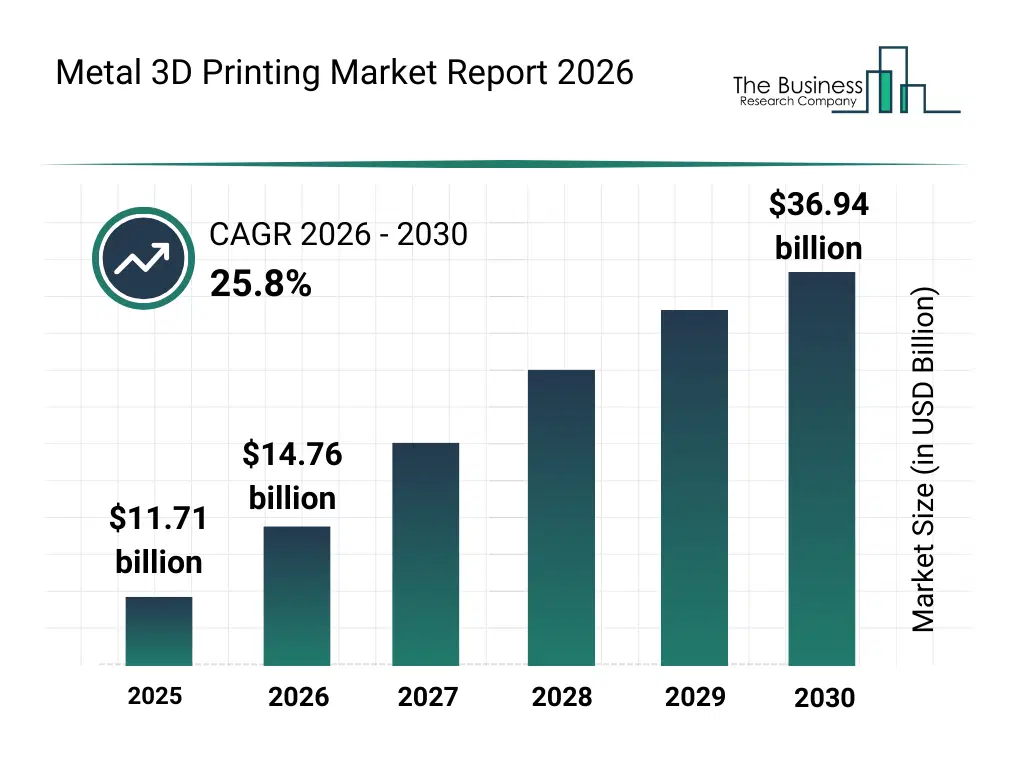
What Is The Metal 3D Printing Market Size and Share 2026?
The metal 3d printing market size has grown exponentially in recent years. It will grow from $11.71 billion in 2025 to $14.76 billion in 2026 at a compound annual growth rate (CAGR) of 26.0%. The growth in the historic period can be attributed to need for complex part manufacturing, aerospace lightweighting demand, prototyping acceleration, reduction of material waste, advancement in additive manufacturing systems.What Is The Metal 3D Printing Market Growth Forecast?
The metal 3d printing market size is expected to see exponential growth in the next few years. It will grow to $36.94 billion in 2030 at a compound annual growth rate (CAGR) of 25.8%. The growth in the forecast period can be attributed to mass customization demand, expansion of metal additive manufacturing in automotive, supply chain localization, growth of digital manufacturing, adoption of hybrid manufacturing systems. Major trends in the forecast period include adoption of powder bed fusion technologies, growth of lightweight metal component production, expansion of on demand manufacturing services, integration of simulation and design software, rising use in functional end use parts.Tariff Impact On Metal 3D Printing Market
Tariffs have impacted the metal 3d printing market by increasing costs of metal powders, laser systems, and precision components. Industrial printers are most affected, particularly from asia pacific suppliers. Higher equipment prices have influenced adoption rates. At the same time, tariffs are driving local material sourcing and printer manufacturing.
Global Metal 3D Printing Market Segmentation
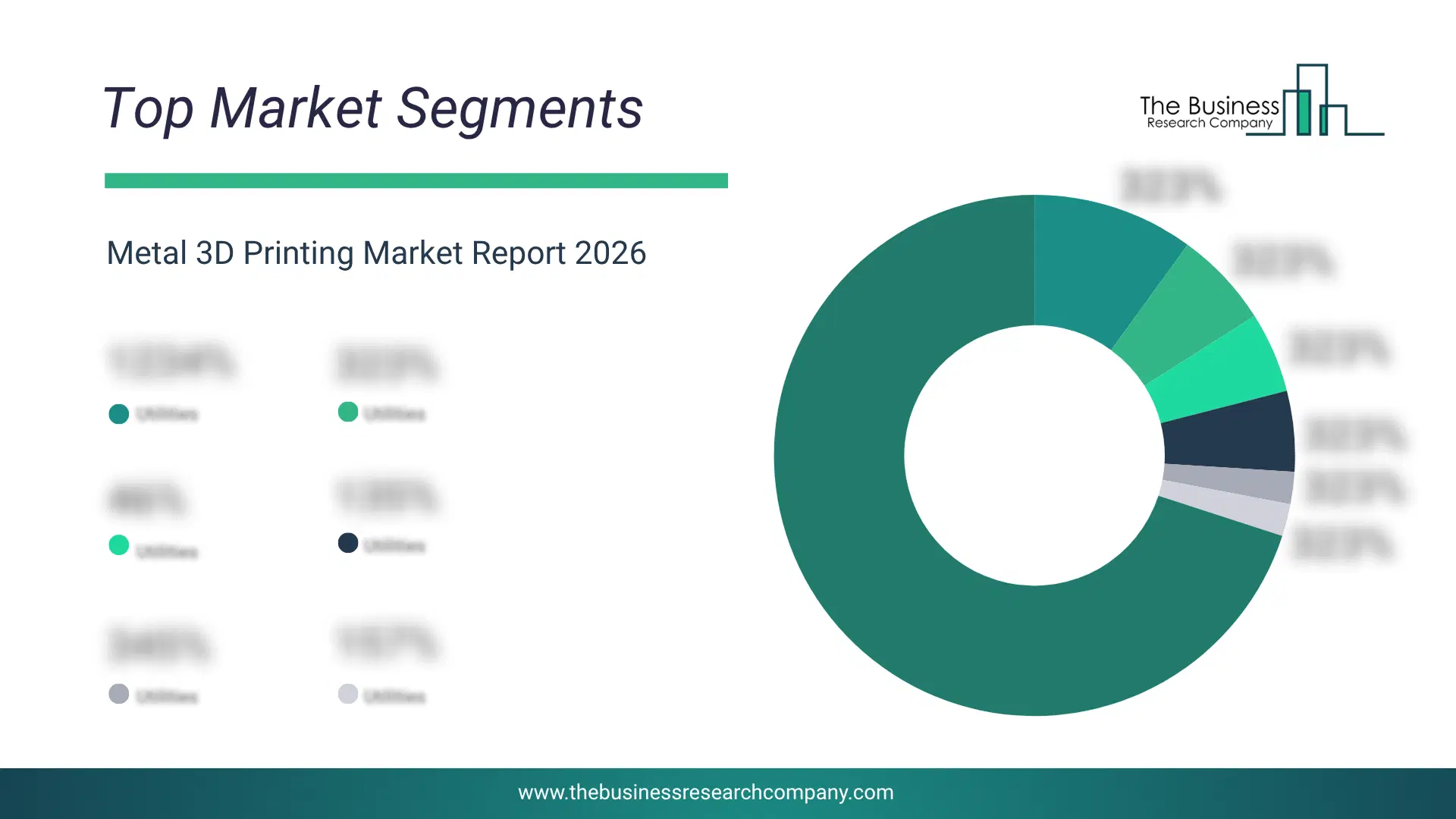
1) By Component: Hardware, Software, Services 2) By Printer Type: Industrial, Desktop Or Benchtop 3) By Technology: Powder Bed Fusion, Directed Energy Deposition, Binder Jetting, Bound-Metal Fused Filament (FDM-metal), Hybrid Machining-Additive Manufacturing Systems, Other Technologies 4) By Application: Prototyping, Tooling, Functional Parts 5) By End-User Industry: Aerospace And Defense, Automotive And Motorsports, Healthcare, Oil Gas And Energy, Industrial Machinery And Tooling, Electronics And Semiconductors, Construction And Architecture, Other End-User Industries Subsegments: 1) By Hardware: 3D Printers, Laser Systems, Electron Beam Systems, Nozzles And Print Heads, Powder Feeders 2) By Software: Design Software, Simulation Software, Slicing Software, Workflow And Management Software 3) By Services: Consulting And Training, Maintenance And Support, Prototyping Services, Custom Manufacturing Or On-Demand Production, Material Supply ServicesWhat Is The Driver Of The Metal 3D Printing Market?
The surge in demand from the aerospace industry is expected to propel the growth of the metal 3D printing market going forward. The aerospace industry refers to the sector that designs, develops, manufactures, and maintains aircraft, spacecraft, and related systems and equipment for commercial, military, and space applications. The surge in demand from the aerospace industry is due to the growing need for advanced aircraft that offer improved efficiency, safety, and performance. Metal 3D printing helps the aerospace industry by enabling the production of lightweight, complex, and high-strength components, making it ideal for aircraft and spacecraft manufacturing. It reduces material waste and shortens production cycles, improving efficiency, performance, and cost-effectiveness in aerospace applications. For instance, in August 2025, according to the International Trade Administration, a US-based government agency, the revenue of the German aerospace industry reached EUR 52 billion ($56.3 billion) in 2024, an increase of 13% compared to 2023. Therefore, the surge in demand from the aerospace industry is driving the growth of the metal 3D printing industry.Key Players In The Global Metal 3D Printing Market
Major companies operating in the metal 3d printing market are Trumpf GmbH + Co. KG, Carpenter Technology Corporation, Renishaw plc, 3D Systems Corporation, EOS GmbH, Markforged Holding Corporation, SLM Solutions Group AG, Velo3D Inc., ExOne Company, AddUp SAS, Optomec Inc., Additive Industries B.V., SPEE3D Pty Ltd, XJet Ltd., Meltio Technologies SL, GE Additive, FormAlloy Technologies Inc., Xact Metal Inc., Aurora Labs Limited, BeAM Machines SAS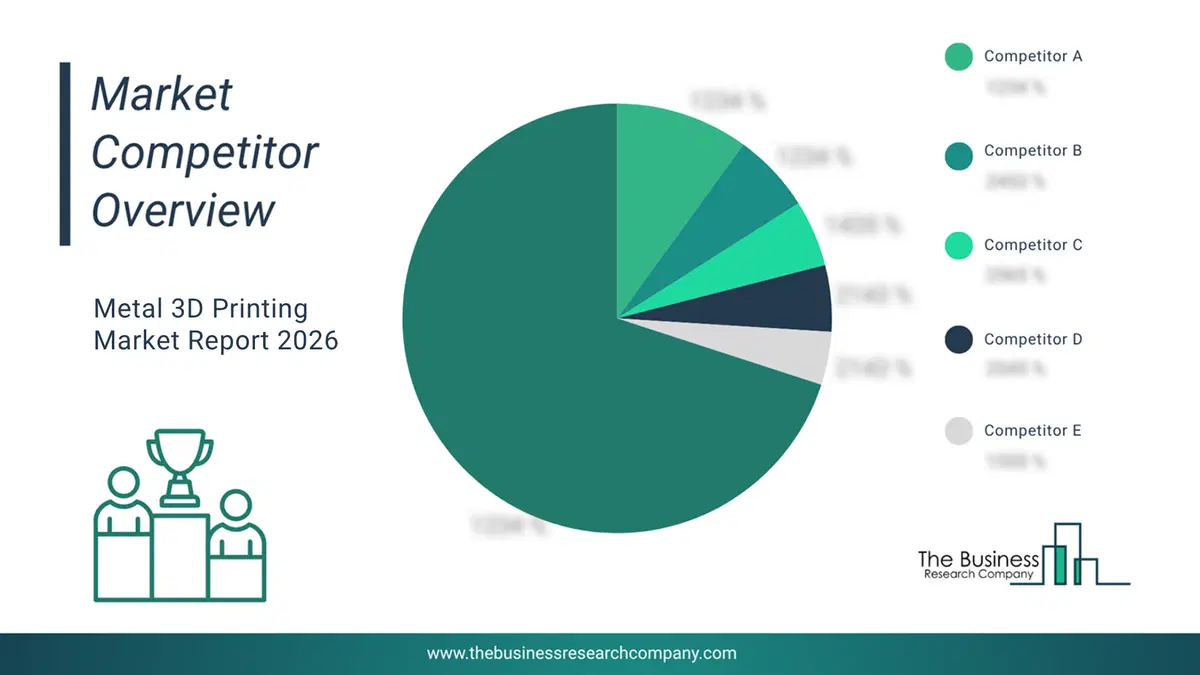
This chart is for illustrative purposes; the full report includes a detailed competitor analysis and comprehensive overview of the top 10 companies in the market.
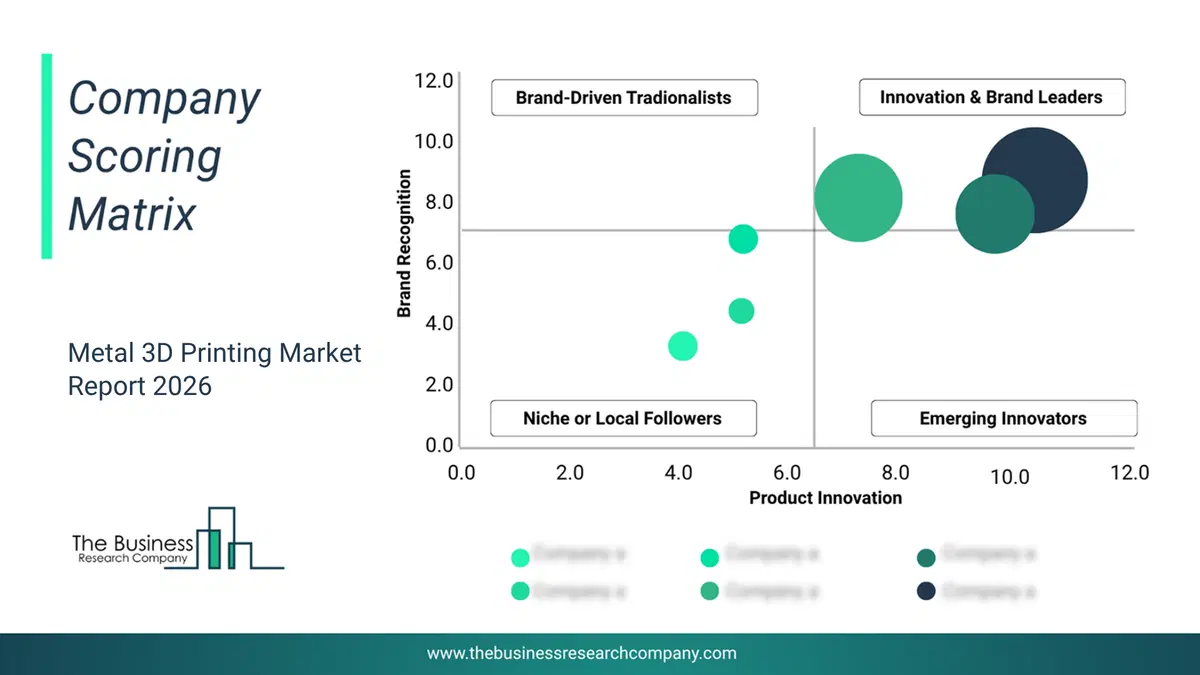
This chart maps companies by product innovation and brand strength, with bubble size indicating relative revenue, helping identify market leaders, challengers, and niche players. This is an illustrative chart; the full report provides a complete and accurate competitive analysis.
Global Metal 3D Printing Market Trends and Insights
Major companies operating in the metal 3D printing market are focusing on developing advanced products, such as multi-laser large-format systems, to enable high-speed, high-precision production of large metal parts. Multi-laser large-format systems are metal 3D printers that use multiple lasers simultaneously to build very large parts faster and more accurately than single-laser machines. For instance, in March 2025, Farsoon Technologies Co. Ltd., a China-based machine industry company, launched the 32-laser FS1521M-U, marking a breakthrough in large-format metal 3D printing for the rapid, precise production of sizable metal components. The printer is equipped with up to 32 powerful 500 W fiber lasers and offers a massive 3,862-liter build volume, supporting industrial-scale, high-speed manufacturing. Its sophisticated multi-laser algorithms, adaptable cartridge setups, and efficient powder handling system ensure exceptional productivity, quality, and operational efficiency, catering to demanding industries such as aerospace and energy.What Are Latest Mergers And Acquisitions In The Metal 3D Printing Market?
In April 2025, Nano Dimension Ltd., an Israel-based machinery industry company, acquired Desktop Metal Inc. for $179.3 million. With this acquisition, Nano Dimension aims to become a global leader in additive manufacturing by combining advanced 3D printing systems, software, and materials to deliver high-performance solutions across electronics, mechanical, and medical sectors. Desktop Metal Inc. is a US-based manufacturing company specializing in metal 3D printing solutions.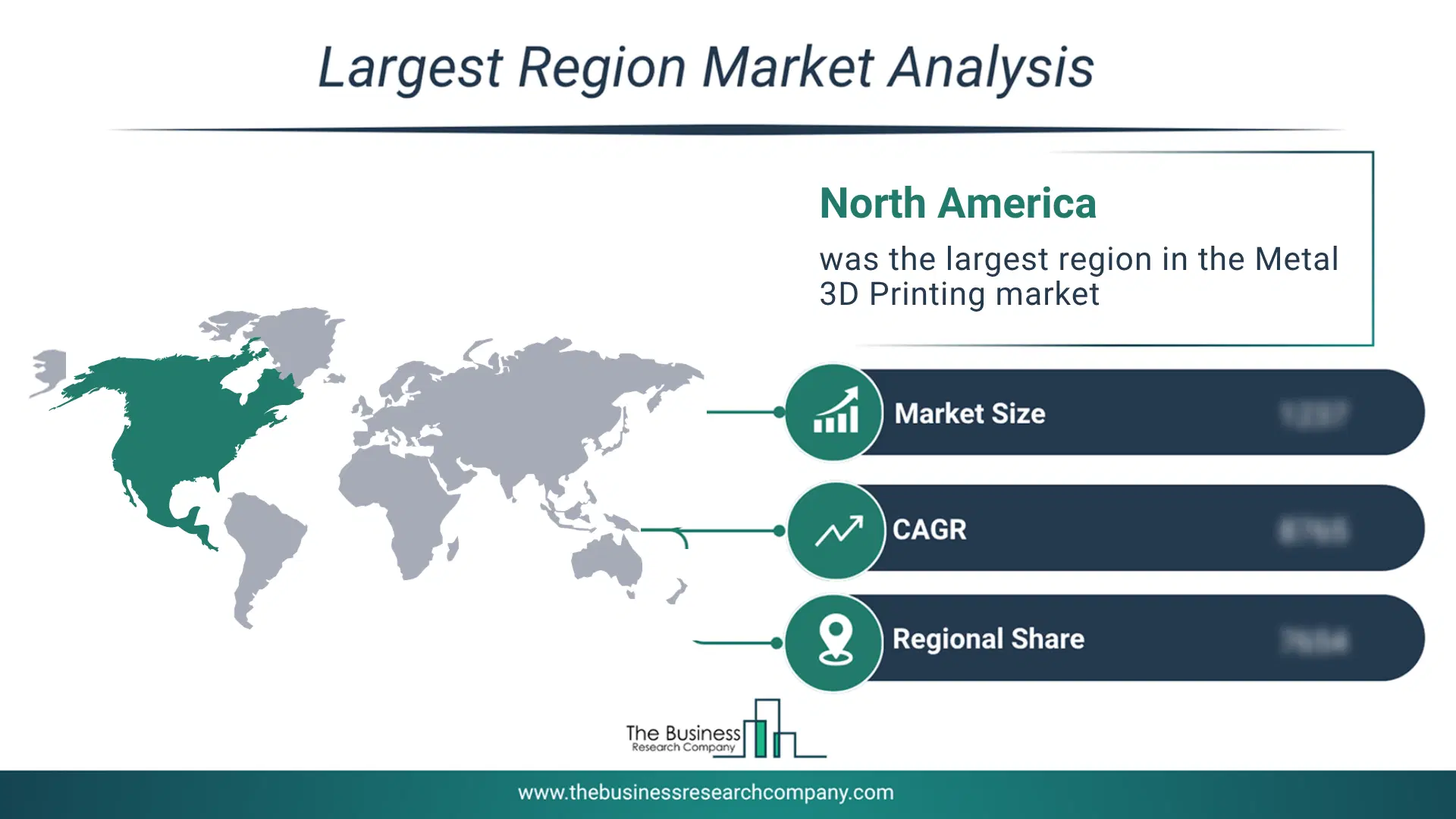
Regional Outlook
North America was the largest region in the metal 3D printing market in 2025. Asia-Pacific is expected to be the fastest-growing region in the forecast period. The regions covered in this market report are Asia-Pacific, South East Asia, Western Europe, Eastern Europe, North America, South America, Middle East, Africa The countries covered in this market report are Australia, Brazil, China, France, Germany, India, Indonesia, Japan, Taiwan, Russia, South Korea, UK, USA, Canada, Italy, Spain.What Defines the Metal 3D Printing Market?
The metal 3D printing market consists of revenues earned by entities by providing services such as design for additive manufacturing, custom tooling and fixtures, reverse engineering, post-processing services, and simulation and process optimization. The market value includes the value of related goods sold by the service provider or included within the service offering. The metal 3D printing market also includes sales of metal powders, slicing software for metal printing, powder handling and recycling systems, and post-processing machines. Values in this market are ‘factory gate’ values, that is the value of goods sold by the manufacturers or creators of the goods, whether to other entities (including downstream manufacturers, wholesalers, distributors and retailers) or directly to end customers. The value of goods in this market includes related services sold by the creators of the goods.How is Market Value Defined and Measured?
The market value is defined as the revenues that enterprises gain from the sale of goods and/or services within the specified market and geography through sales, grants, or donations in terms of the currency (in USD unless otherwise specified). The revenues for a specified geography are consumption values that are revenues generated by organizations in the specified geography within the market, irrespective of where they are produced. It does not include revenues from resales along the supply chain, either further along the supply chain or as part of other products.
This chart presents market attractiveness based on a quantitative evaluation of growth, competition, strategic alignment, and risk, offering a clear view of opportunity areas for decision-making. This chart is for illustrative purposes; the full report contains the complete analysis.

This chart highlights the Total Addressable Market (TAM) by estimating the maximum revenue opportunity using an assumption-driven approach, supporting strategic planning and opportunity sizing across markets. The chart is illustrative; the full report provides a more comprehensive analysis.
What Key Data and Analysis Are Included in the Metal 3D Printing Market Report 2026?
The metal 3d printing market research report is one of a series of new reports from The Business Research Company that provides market statistics, including industry global market size, regional shares, competitors with the market share, detailed market segments, market trends and opportunities, and any further data you may need to thrive in the metal 3d printing industry. The market research report delivers a complete perspective of everything you need, with an in-depth analysis of the current and future state of the industry.Metal 3D Printing Market Report Forecast Analysis
| Report Attribute | Details |
|---|---|
| Market Size Value In 2026 | $14.76 billion |
| Revenue Forecast In 2030 | $36.94 billion |
| Growth Rate | CAGR of 25.8% from 2026 to 2030 |
| Base Year For Estimation | 2025 |
| Actual Estimates/Historical Data | 2020-2025 |
| Forecast Period | 2026 - 2030 |
| Market Representation | Revenue in USD Billion and CAGR from 2026 to 2030 |
| Segments Covered | Component, Printer Type, Technology, Application, End-User Industry |
| Regional Scope | Asia-Pacific, Western Europe, Eastern Europe, North America, South America, Middle East, Africa |
| Key Companies Profiled | Trumpf GmbH + Co. KG, Carpenter Technology Corporation, Renishaw plc, 3D Systems Corporation, EOS GmbH, Markforged Holding Corporation, SLM Solutions Group AG, Velo3D Inc., ExOne Company, AddUp SAS, Optomec Inc., Additive Industries B.V., SPEE3D Pty Ltd, XJet Ltd., Meltio Technologies SL, GE Additive, FormAlloy Technologies Inc., Xact Metal Inc., Aurora Labs Limited, BeAM Machines SAS |
| Customization Scope | Request for Customization |
| Pricing And Purchase Options | Explore Purchase Options |