
Metal Matrix Composite Market Report 2026
Global Outlook – By Matrix Type (Aluminum MMC, Magnesium MMC, Copper MMC, Super Alloys MMC, Other Matrix Types), By Production Technology (Liquid Metal Infiltration, Powder Metallurgy, Casting, Deposition Techniques), By End-Use Industry (Automotive And Transportation, Aerospace And Defense, Electrical And Electronics, Industrial, Other End-User Industries) – Market Size, Trends, Strategies, and Forecast to 2030
Metal Matrix Composite Market Overview
• Metal Matrix Composite market size has reached to $0.62 billion in 2025 • Expected to grow to $0.84 billion in 2030 at a compound annual growth rate (CAGR) of 6.2% • Growth Driver: Rising Automotive Industry Production Drives Growth In The Metal Matrix Composite Market • Market Trend: Advancements In Metal Matrix Composites Drive Innovation In Additive Manufacturing Technologies • North America was the largest region in 2025 and Asia-Pacific is the fastest growing region.What Is Covered Under Metal Matrix Composite Market?
Metal matrix composites (MMCs) are a class of materials (metals, alloys, or intermetallic compounds) that have been reinforced with particles, whiskers, or continuous fibers. MMCs are excellent substitutes for conventional materials owing to their hardness, specific strength, and creep resistance. The main types of metal matrix composites are aluminum MMC, magnesium MMC, copper MMC, superalloys MMC, and others. Aluminum is a chemical compound that is a light, silver-colored metal that is mostly utilized in the manufacture of cooking equipment and aircraft components. Aluminum metal matrix composites (AlMMCs) are a type of material that has been shown to fulfill the majority of the stringent requirements in applications requiring lightweight, high stiffness, and moderate strength. Magnesium-matrix composites have been developed for the space industry thanks to the low density of magnesium and its alloys. Copper-matrix composites are superior compared to other MMCs. Some equipment in particle accelerators, such as Radio Frequency Quadrupoles (RFQs) or electron targets, uses copper MMC compounds such as Glidcop to retain the material properties of copper at high temperatures and radiation levels. Superalloys are commonly used as candidate materials for manufacturing gas turbine blades, where they operate at higher temperatures and speeds. The various production technologies include liquid metal infiltration, powder metallurgy, casting, and deposition techniques. Metal matrix composites are used in various sectors, such as automotive and transportation, aerospace and defense, electrical and electronics, and industrial, among others.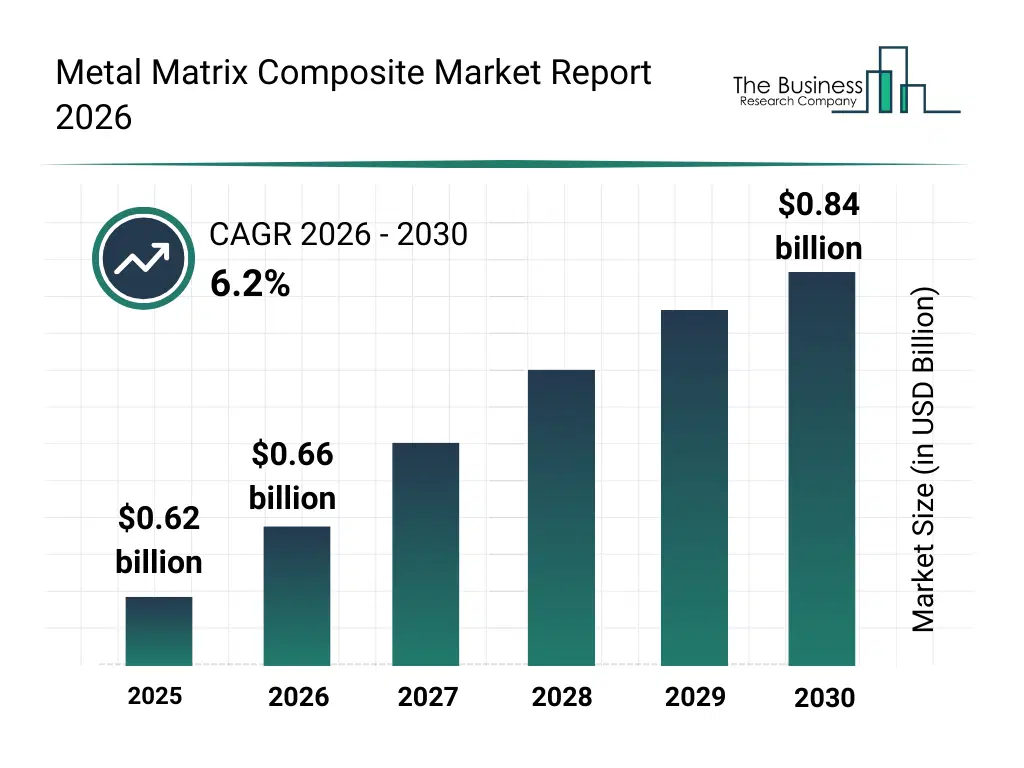
What Is The Metal Matrix Composite Market Size and Share 2026?
The metal matrix composite market size has grown strongly in recent years. It will grow from $0.62 billion in 2025 to $0.66 billion in 2026 at a compound annual growth rate (CAGR) of 6.6%. The growth in the historic period can be attributed to growth in aerospace lightweight material demand, increased use of wear resistant materials in automotive, advancements in powder metallurgy processes, rising defense spending on advanced materials, demand for high strength metal components.What Is The Metal Matrix Composite Market Growth Forecast?
The metal matrix composite market size is expected to see strong growth in the next few years. It will grow to $0.84 billion in 2030 at a compound annual growth rate (CAGR) of 6.2%. The growth in the forecast period can be attributed to expansion of electric vehicle production, increasing adoption in thermal management systems, growth in advanced manufacturing technologies, rising demand for fuel efficient aircraft, increasing industrial automation requirements. Major trends in the forecast period include increasing use of aluminum mmcs for lightweight structures, growing adoption of mmcs in high temperature and high wear applications, rising demand for materials with enhanced thermal conductivity, expansion of mmcs in automotive brake and engine systems, focus on improved creep and fatigue resistance.
Global Metal Matrix Composite Market Segmentation
1) By Matrix Type: Aluminum MMC, Magnesium MMC, Copper MMC, Super Alloys MMC, Other Matrix Types 2) By Production Technology: Liquid Metal Infiltration, Powder Metallurgy, Casting, Deposition Techniques 3) By End-Use Industry: Automotive And Transportation, Aerospace And Defense, Electrical And Electronics, Industrial, Other End-User Industries Subsegments: 1) By Aluminum MMC: Aluminum-Silicon Composites, Aluminum-Copper Composites, Aluminum-Zinc Composites 2) By Magnesium MMC: Magnesium-Aluminum Composites, Magnesium-Lithium Composites, Magnesium-Zinc Composites 3) By Copper MMC: Copper-Aluminum Composites, Copper-Graphite Composites, Copper-Ceramic Composites 4) By Super Alloys MMC: Nickel-Based Super Alloys, Cobalt-Based Super Alloys, Iron-Based Super Alloys 5) By Other Matrix Types: Titanium MMC, Zirconium MMC, Other Metal CompositesWhat Are The Drivers Of The Metal Matrix Composite Market?
The growth of the automotive industry is expected to fuel the growth of the metal matrix composite market in the coming years. The automotive industry is made up of a diverse group of businesses and organizations that are involved in the design development, production, marketing, and sale of automobiles. Metal matrix composites are used to lower vehicle weight and enhance the efficiency of automobiles. For instance, in January 2024, according to the Society of Motor Manufacturers and Traders (SMMT), a UK-based trade association, in 2023, total vehicle production in the UK (cars + commercial vehicles) reached about 1,025,474 units, up 17% from the year before. Therefore, the expansion of the automotive industry propels the growth of the metal matrix composite industry. The increasing demand from the manufacturing sector is expected to propel the growth of the metal matrix composite market. The manufacturing sector is a critical segment of the economy involved in transforming raw materials and components into finished products that can be sold to consumers or used in other industries. The manufacturing sector is beneficial for Metal Matrix Composites (MMCs) in various ways, contributing to the development, production, and application of these advanced materials. For instance, in December 2024, according to Statistics Canada, a Canada-based government agency, the Canadian manufacturing sector grew for the third consecutive year, with total revenue up 1.7% year over year to $935.6 billion in 2023. Therefore, increasing demand from the manufacturing sector is driving the growth of the metal matrix composite industry.Key Players In The Global Metal Matrix Composite Market
Major companies operating in the metal matrix composite market are Materion Corporation, CPS Technologies Corporation, DWA Aluminum Composites USA, Plansee SE, Sandvik AB, Sumitomo Electric Industries, Ltd., Kennametal Inc., DAT Alloytech Company Limited, Deutsche Edelstahlwerke GmbH, TISIC Metal Composites, Metal Matrix Cast Composites LLC, MMC Group, AAT Composites, Ferrotec Holdings Corporation, GKN Powder Metallurgy, ADMA Products Inc., Alvant Limited, H.C. Starck Solutions GmbH, Ultramet Inc., Thermal Transfer Composites Ltd.
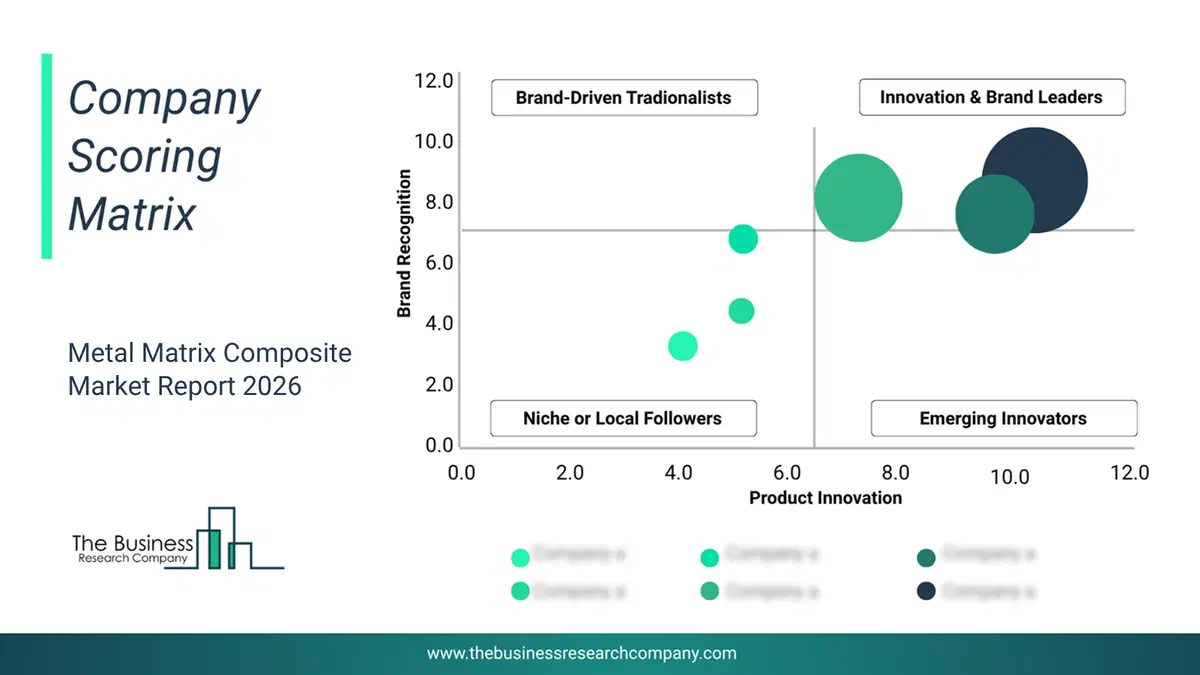
This chart maps companies by product innovation and brand strength, with bubble size indicating relative revenue, helping identify market leaders, challengers, and niche players. This is an illustrative chart; the full report provides a complete and accurate competitive analysis.
This chart maps companies by product innovation and brand strength, with bubble size indicating relative revenue, helping identify market leaders, challengers, and niche players. This is an illustrative chart; the full report provides a complete and accurate competitive analysis.
Global Metal Matrix Composite Market Trends and Insights
Major institutes and companies operating in the advanced composite materials and additive manufacturing market are focusing on developing innovative metal materials to enhance performance, reliability, and efficiency in industrial manufacturing. Advanced aluminum alloys engineered for laser powder bed fusion (LPBF) additive manufacturing are high-performance materials designed to deliver superior printability, enhanced mechanical strength, and consistent material properties while reducing the need for post-processing treatments. For instance, in May 2023, Elementum 3D, a US-based manufacturer of metal additive materials, launched A5083-RAM5, an aluminum alloy developed using its patented reactive additive manufacturing (RAM) technology. This advanced material offers excellent printability, up to 2.9 times higher yield strength than conventional 5083 alloys, and consistent properties without requiring heat treatment, making it suitable for demanding aerospace, marine, and energy applications while also supporting supply chain stability and reducing manufacturing time and costs.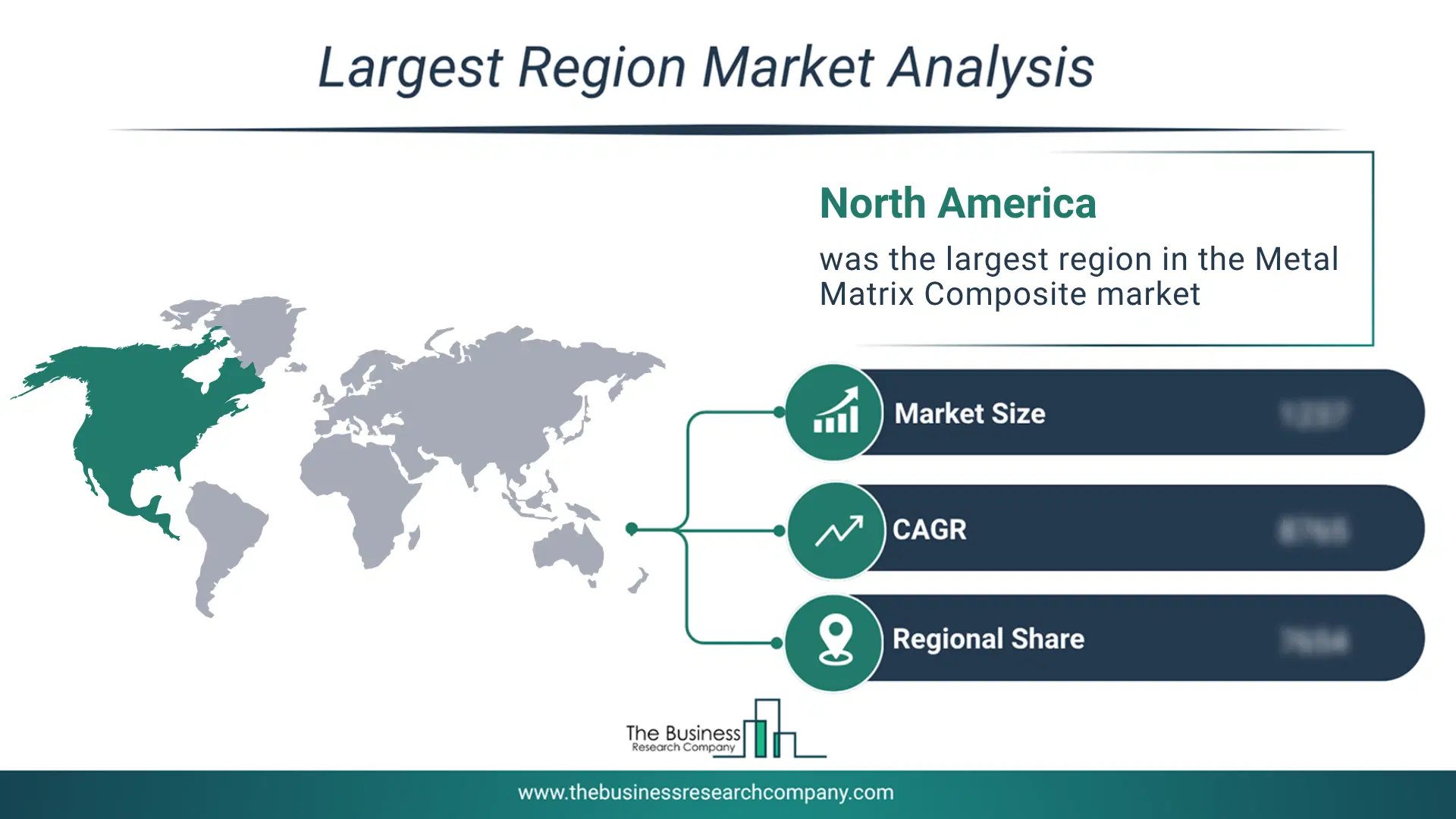
Regional Insights
North America was the largest region in the metal matrix composite market in 2025. Asia-Pacific was expected to be the fastest region in the forecast period. The regions covered in this market report are Asia-Pacific, South East Asia, Western Europe, Eastern Europe, North America, South America, Middle East, Africa The countries covered in this market report are Australia, Brazil, China, France, Germany, India, Indonesia, Japan, Taiwan, Russia, South Korea, UK, USA, Canada, Italy, SpainWhat Defines the Metal Matrix Composite Market?
The metal matrix composite market consists of sales of titanium MMC and cobalt MMC. Values in this market are ‘factory gate’ values, that is, the value of goods sold by the manufacturers or creators of the goods, whether to other entities (including downstream manufacturers, wholesalers, distributors, and retailers) or directly to end customers. The value of goods in this market includes related services sold by the creators of the goods.How is Market Value Defined and Measured?
The market value is defined as the revenues that enterprises gain from the sale of goods and/or services within the specified market and geography through sales, grants, or donations in terms of the currency (in USD unless otherwise specified). The revenues for a specified geography are consumption values that are revenues generated by organizations in the specified geography within the market, irrespective of where they are produced. It does not include revenues from resales along the supply chain, either further along the supply chain or as part of other products.
This chart presents market attractiveness based on a quantitative evaluation of growth, competition, strategic alignment, and risk, offering a clear view of opportunity areas for decision-making. This chart is for illustrative purposes; the full report contains the complete analysis.

This chart highlights the Total Addressable Market (TAM) by estimating the maximum revenue opportunity using an assumption-driven approach, supporting strategic planning and opportunity sizing across markets. The chart is illustrative; the full report provides a more comprehensive analysis.
What Key Data and Analysis Are Included in the Metal Matrix Composite Market Report 2026?
The metal matrix composite market research report is one of a series of new reports from The Business Research Company that provides market statistics, including industry global market size, regional shares, competitors with the market share, detailed market segments, market trends and opportunities, and any further data you may need to thrive in the metal matrix composite industry. The market research report delivers a complete perspective of everything you need, with an in-depth analysis of the current and future state of the industry.Metal Matrix Composite Market Report Forecast Analysis
| Report Attribute | Details |
|---|---|
| Market Size Value In 2026 | $0.66 billion |
| Revenue Forecast In 2030 | $0.84 billion |
| Growth Rate | CAGR of 6.6% from 2026 to 2030 |
| Base Year For Estimation | 2025 |
| Actual Estimates/Historical Data | 2020-2025 |
| Forecast Period | 2026 - 2030 |
| Market Representation | Revenue in USD Billion and CAGR from 2026 to 2030 |
| Segments Covered | Matrix Type, Production Technology, End-Use Industry |
| Regional Scope | Asia-Pacific, Western Europe, Eastern Europe, North America, South America, Middle East, Africa |
| Country Scope | The countries covered in this market report are Australia, Brazil, China, France, Germany, India, Indonesia, Japan, Taiwan, Russia, South Korea, UK, USA, Canada, Italy, Spain |
| Key Companies Profiled | Materion Corporation, CPS Technologies Corporation, DWA Aluminum Composites USA, Plansee SE, Sandvik AB, Sumitomo Electric Industries, Ltd., Kennametal Inc., DAT Alloytech Company Limited, Deutsche Edelstahlwerke GmbH, TISIC Metal Composites, Metal Matrix Cast Composites LLC, MMC Group, AAT Composites, Ferrotec Holdings Corporation, GKN Powder Metallurgy, ADMA Products Inc., Alvant Limited, H.C. Starck Solutions GmbH, Ultramet Inc., Thermal Transfer Composites Ltd. |
| Customization Scope | Request for Customization |
| Pricing And Purchase Options | Explore Purchase Options |