
Meteorological Satellite Market Report 2026
Global Outlook – By Satellite Type (Geostationary, Polar-Orbiting), By Payload Type (Imaging, Sounder, Data Relay, Other Payload Types), By Application (Weather Forecasting, Climate Monitoring, Environmental Monitoring, Disaster Management, Other Applications), By End-User (Government And Defense, Commercial, Research And Academia, Other End-Users) – Market Size, Trends, Strategies, and Forecast to 2035
Meteorological Satellite Market Overview
• Meteorological Satellite market size has reached to $3.77 billion in 2025 • Expected to grow to $5.72 billion in 2030 at a compound annual growth rate (CAGR) of 8.6% • Growth Driver: Growing Frequency Of Extreme Weather Events Is Driving The Market Due To Rising Demand For Accurate Forecasting, Continuous Monitoring, And Timely Disaster Preparedness • Market Trend: Advancing High-Resolution Weather Monitoring Through Next-Generation Polar Satellite Technology • North America was the largest region in 2025 and Asia-Pacific is the fastest growing region.What Is Covered Under Meteorological Satellite Market?
A meteorological satellite is an Earth-orbiting spacecraft specifically designed to observe, measure, and transmit atmospheric, oceanic, and land surface data through advanced remote sensing instruments, enabling continuous monitoring of weather systems, climate conditions, cloud dynamics, precipitation patterns, and other environmental parameters across regional and global scales. Its collected information supports weather forecasting, climate research, environmental monitoring, disaster preparedness, atmospheric analysis, and the long-term assessment of changing Earth system processes to improve scientific understanding and operational decision-making. The main satellite types of meteorological satellites include geostationary and polar orbiting satellites. Geostationary refer to satellites positioned in an orbit that allows them to remain above approximately the same location on Earth, enabling continuous observation of atmospheric and weather conditions. These satellites use imaging, sounder, data relay, and other payload types. The key applications include weather forecasting, climate monitoring, environmental monitoring, disaster management, and others, while the end-users include government and defense, commercial, research and academia, and others.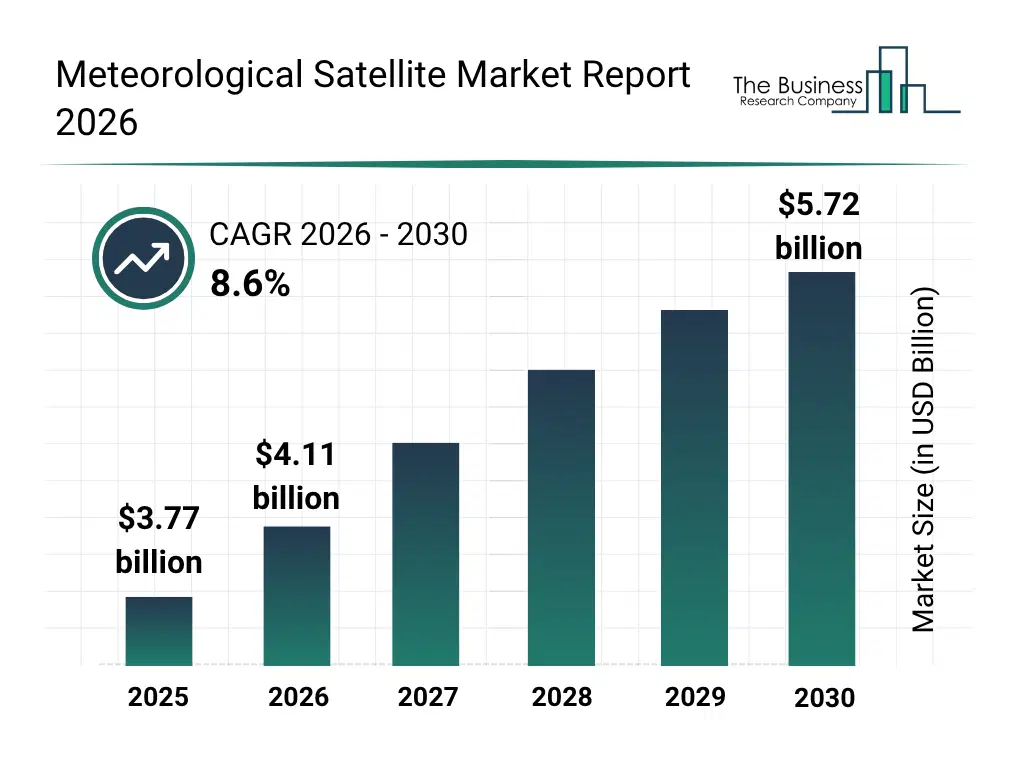
What Is The Meteorological Satellite Market Size and Share 2026?
The meteorological satellite market size has grown strongly in recent years. It will grow from $3.77 billion in 2025 to $4.11 billion in 2026 at a compound annual growth rate (CAGR) of 9.0%. The growth in the historic period can be attributed to increasing demand for accurate weather forecasting, rising frequency of severe weather events, growing need for continuous atmospheric monitoring, increasing government spending on meteorological observation infrastructure, expanding use of satellite data for climate research.What Is The Meteorological Satellite Market Growth Forecast?
The meteorological satellite market size is expected to see strong growth in the next few years. It will grow to $5.72 billion in 2030 at a compound annual growth rate (CAGR) of 8.6%. The growth in the forecast period can be attributed to increasing demand for high-resolution weather observations, rising need for rapid disaster prediction and response, growing demand for advanced atmospheric sounding capabilities, increasing use of meteorological satellite data for climate modeling, expanding demand for real-time environmental monitoring. Major trends in the forecast period include increasing adoption of high-resolution meteorological imaging, rising demand for real-time weather data transmission, growing deployment of advanced atmospheric sounding systems, increasing demand for continuous severe weather monitoring, rising preference for multi-parameter environmental observation.Tariff Impact On Meteorological Satellite Market
Tariffs are impacting the meteorological satellite market by increasing the cost of imported satellite components, remote sensing instruments, semiconductor devices, optical systems, and specialized ground equipment required for satellite development and operations. This is increasing project costs and potentially delaying satellite manufacturing and deployment, particularly in regions dependent on imported aerospace and electronic components such as Asia-Pacific and Europe. Hardware-intensive segments such as imaging payloads, sounders, and data relay systems are most affected due to global supply chain dependencies. However, tariffs are also encouraging domestic component production, regional supplier diversification, and increased investment in local aerospace and satellite manufacturing ecosystems, creating greater long-term resilience in the market.
Global Meteorological Satellite Market Segmentation
2) By Payload Type: Imaging, Sounder, Data Relay, Other Payload Types 3) By Application: Weather Forecasting, Climate Monitoring, Environmental Monitoring, Disaster Management, Other Applications 4) By End-User: Government And Defense, Commercial, Research And Academia, Other End-Users Subsegments: 1) By Geostationary: Infrared Observation Satellites, Visible Light Observation Satellites, Multispectral Observation Satellites, Atmospheric Monitoring Satellites, Ocean Monitoring Satellites, Storm Tracking Satellites 2) By Polar-Orbiting: Sun Synchronous Satellites, Low Earth Orbit Satellites, Microwave Observation Satellites, High Resolution Earth Observation Satellites, Atmospheric Sounding Satellites, Ocean Surface Monitoring SatellitesWhat Are The Drivers Of The Meteorological Satellite Market?
The growing frequency of extreme weather events is expected to propel the growth of the meteorological satellite market going forward. Extreme weather events are severe atmospheric phenomena, such as hurricanes, floods, droughts, heatwaves, and storms, that cause significant environmental, economic, and social impacts. The growing frequency of extreme weather events is due to increasing climate variability, resulting in more frequent and intense atmospheric disturbances. The growing frequency of extreme weather events drives demand for meteorological satellites by increasing the need for continuous, high resolution atmospheric monitoring that enables earlier detection, more accurate forecasting, and timely disaster warnings, helping governments and emergency agencies reduce risks to lives, infrastructure, and economic activities. For instance, in January 2026, according to Climate Central, a US-based independent nonprofit organization, the United States experienced 23 billion-dollar weather and climate disasters in 2025. Therefore, the growing frequency of extreme weather events is driving the growth of the meteorological satellite industry. The expansion of renewable energy deployment is expected to propel the growth of the meteorological satellite market going forward. Renewable energy deployment refers to the installation and expansion of energy-generation systems that produce electricity or heat from renewable sources such as solar, wind, hydropower, biomass, and geothermal energy. Renewable energy deployment is rising due to increasing government support and incentives for clean energy to reduce greenhouse-gas emissions and dependence on fossil fuels. The expansion of renewable energy deployment increases the need for accurate wind and solar forecasts, encouraging greater use of meteorological satellite data for efficient power generation and grid planning. For instance, in April 2026, according to the International Renewable Energy Agency (IRENA), a United Arab Emirates-based intergovernmental organization, global renewable power capacity increased by 692 GW in 2025, reaching 5,149 GW, representing a 15.5% annual increase, while renewables accounted for 85.6% of total power-capacity additions. Therefore, the expansion of renewable energy deployment is driving the growth of the meteorological satellite industry.Key Players In The Global Meteorological Satellite Market
Major companies operating in the meteorological satellite market are The Boeing Company, Lockheed Martin Corporation, Airbus SE, Northrop Grumman Corporation, BAE Systems plc, Thales Group, L3Harris Technologies Inc., Mitsubishi Electric Corporation, OHB SE, Kongsberg Gruppen ASA, QinetiQ Group plc, Planet Labs PBC, MDA Space Ltd., Sierra Nevada Corporation, Spire Global Inc., Loft Orbital Solutions Inc., GomSpace A/S, AAC Clyde Space AB, ISISPACE Group B.V., EnduroSat AD, SITAEL S.p.A., Plan-S Satellite and Space Technologies Inc., Argotec S.r.l.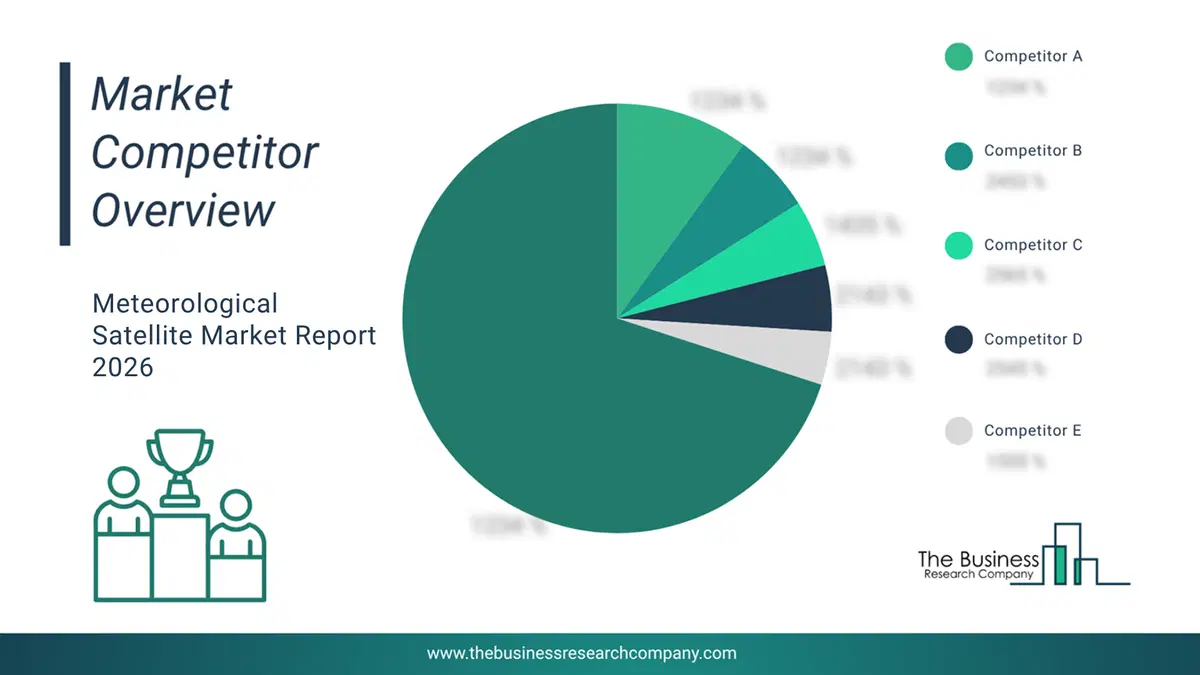
This chart is for illustrative purposes; the full report includes a detailed competitor analysis and comprehensive overview of the top 10 companies in the market.
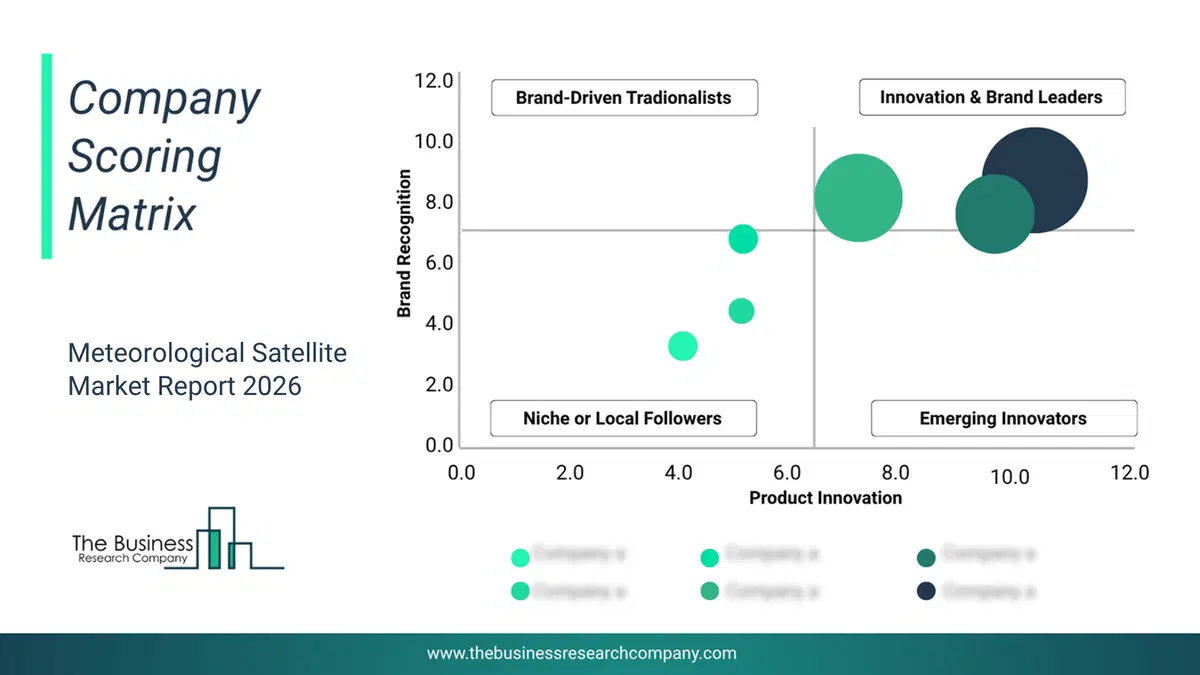
This chart maps companies by product innovation and brand strength, with bubble size indicating relative revenue, helping identify market leaders, challengers, and niche players. This is an illustrative chart; the full report provides a complete and accurate competitive analysis.
Global Meteorological Satellite Market Trends and Insights
Major companies operating in the meteorological satellite market are focusing on developing advanced solutions, such as polar weather satellites to enhance weather forecasting accuracy and climate monitoring capabilities. A polar weather satellite is a meteorological satellite that orbits Earth from pole to pole, collecting high-resolution global atmospheric, oceanic, and environmental data for weather forecasting and climate monitoring. For instance, in August 2025, Arianespace, a France-based launch service provider, launched Metop-SGA1, a polar weather satellite. The satellite incorporates advanced optical, infrared, and microwave instruments that deliver high-resolution observations of atmospheric, oceanic, and environmental conditions while supporting the Copernicus Sentinel-5 atmospheric monitoring mission. Its enhanced sensing capabilities improve the accuracy of weather forecasting, climate monitoring, and environmental analysis, reinforcing Europe's next-generation meteorological observation infrastructure.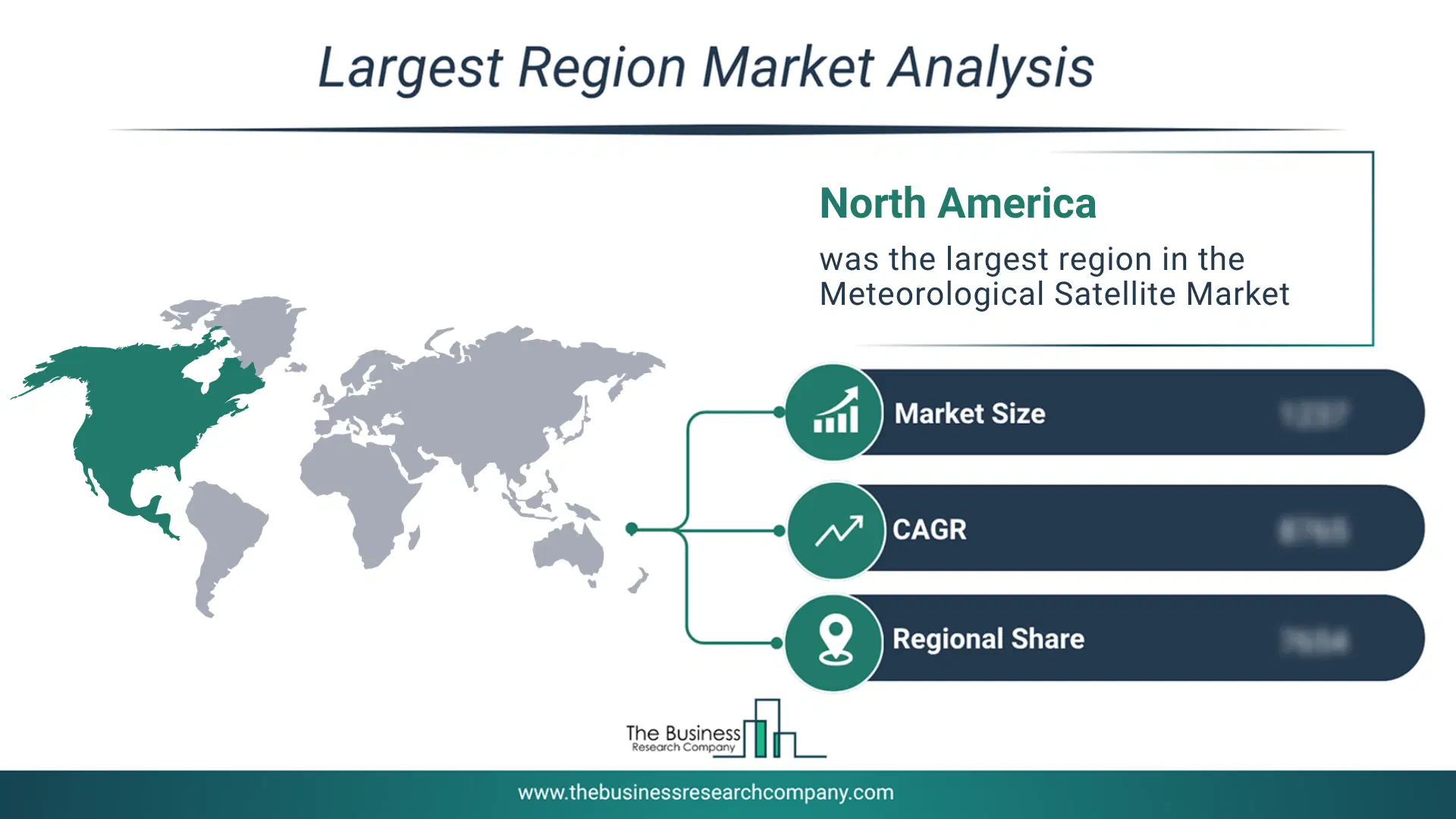
Regional Outlook/Insights
North America was the largest region in the meteorological satellite market in 2025. Asia-Pacific is expected to be the fastest-growing region in the forecast period. The regions covered in this market report are Asia-Pacific, South East Asia, Western Europe, Eastern Europe, North America, South America, Middle East, Africa. The countries covered in this market report are Australia, Brazil, China, France, Germany, India, Indonesia, Japan, Taiwan, Russia, South Korea, UK, USA, Canada, Italy, Spain.What Defines the Meteorological Satellite Market?
The meteorological satellite market consists of sales of weather satellites, Earth-observation weather satellites, infrared sensors, microwave radiometers, cloud profiling instruments, lightning detection sensors, spaceborne weather cameras, atmospheric spectrometers, and weather-monitoring payloads. Values in this market are ‘factory gate’ values, that is the value of goods sold by the manufacturers or creators of the goods, whether to other entities (including downstream manufacturers, wholesalers, distributors and retailers) or directly to end customers. The value of goods in this market includes related services sold by the creators of the goods.How is Market Value Defined and Measured?
The market value is defined as the revenues that enterprises gain from the sale of goods and/or services within the specified market and geography through sales, grants, or donations in terms of the currency (in USD unless otherwise specified). The revenues for a specified geography are consumption values that are revenues generated by organizations in the specified geography within the market, irrespective of where they are produced. It does not include revenues from resales along the supply chain, either further along the supply chain or as part of other products.
This chart presents market attractiveness based on a quantitative evaluation of growth, competition, strategic alignment, and risk, offering a clear view of opportunity areas for decision-making. This chart is for illustrative purposes; the full report contains the complete analysis.

This chart highlights the Total Addressable Market (TAM) by estimating the maximum revenue opportunity using an assumption-driven approach, supporting strategic planning and opportunity sizing across markets. The chart is illustrative; the full report provides a more comprehensive analysis.
What Key Data and Analysis Are Included in the Meteorological Satellite Market Report 2026?
The meteorological satellite market research report is one of a series of new reports from The Business Research Company that provides market statistics, including industry global market size, regional shares, competitors with the market share, detailed market segments, market trends and opportunities, and any further data you may need to thrive in the meteorological satellite industry. The market research report delivers a complete perspective of everything you need, with an in-depth analysis of the current and future state of the industry.Meteorological Satellite Market Report Forecast Analysis
| Report Attribute | Details |
|---|---|
| Market Size Value In 2026 | $4.11 billion |
| Revenue Forecast In 2030 | $5.72 billion |
| Growth Rate | CAGR of 8.6% from 2026 to 2035 |
| Base Year For Estimation | 2025 |
| Actual Estimates/Historical Data | 2020-2025 |
| Forecast Period | 2026 - 2030 |
| Market Representation | Revenue in USD Billion and CAGR from 2026 to 2030 |
| Segments Covered | Satellite Type, Payload Type, Application, End-User |
| Regional Scope | Asia-Pacific, Western Europe, Eastern Europe, North America, South America, Middle East, Africa |
| Country Scope | The countries covered in the report are Australia, Brazil, China, France, Germany, India, Indonesia, Japan, Taiwan, Russia, South Korea, UK, USA, Canada, Italy, Spain. |
| Customization Scope | Request for Customization |
| Pricing And Purchase Options | Explore Purchase Options |