
Methanol Fuel Cell Market Report 2026
Global Outlook – By Type (Direct Methanol Fuel Cell, Reformed Methanol Fuel Cell, Passive Direct Methanol Fuel Cell, Active Direct Methanol Fuel Cell), By Power Output (Below One Hundred Watts, One Hundred Watts To One Kilowatt, One Kilowatt To Ten Kilowatts, Above Ten Kilowatts), By Fuel Type (Conventional Methanol, Green Methanol, Bio Methanol, Renewable Methanol), By Distribution Channel (Direct Sales, Distributors And Integrators, Original Equipment Manufacturer Partnerships, Online Sales), By End User (Telecommunications, Defense And Aerospace, Industrial, Energy And Utilities, Transportation And Mobility, Consumer Electronics) – Market Size, Trends, Strategies, and Forecast to 2030
Methanol Fuel Cell Market Overview
• Methanol Fuel Cell market size has reached to $3.35 billion in 2025 • Expected to grow to $5.57 billion in 2030 at a compound annual growth rate (CAGR) of 10.6% • Growth Driver: The Growing Demand For Clean Energy Solutions Driving The Growth Of The Market Due To Increasing Concerns Over Climate Change And Greenhouse Gas Emissions • Market Trend: Scaling Clean, Off-Grid Energy Solutions To Support Decarbonization And Energy Independence • Asia-Pacific was the largest region and fastest growing region.What Is Covered Under Methanol Fuel Cell Market?
A methanol fuel cell is an electrochemical device that converts the chemical energy of methanol directly into electricity through a reaction with oxygen, typically using a proton exchange membrane. It produces electrical power along with water and carbon dioxide as byproducts, and is commonly used in portable and low-power applications. The main types of methanol fuel cell include direct methanol fuel cell, reformed methanol fuel cell, passive direct methanol fuel cell, and active direct methanol fuel cell. Direct methanol fuel cell refers to a fuel cell that generates electricity by directly converting methanol into electrical energy through an electrochemical reaction without the need for an external fuel reformer. These fuel cells are available in power outputs including below one hundred watts, one hundred watts to one kilowatt, one kilowatt to ten kilowatts, and above ten kilowatts and operate using conventional methanol, green methanol, bio methanol, and renewable methanol. They are distributed through direct sales, distributors and integrators, original equipment manufacturer partnerships, and online sales and are utilized by end users including telecommunications, defense and aerospace, industrial, energy and utilities, transportation and mobility, and consumer electronics.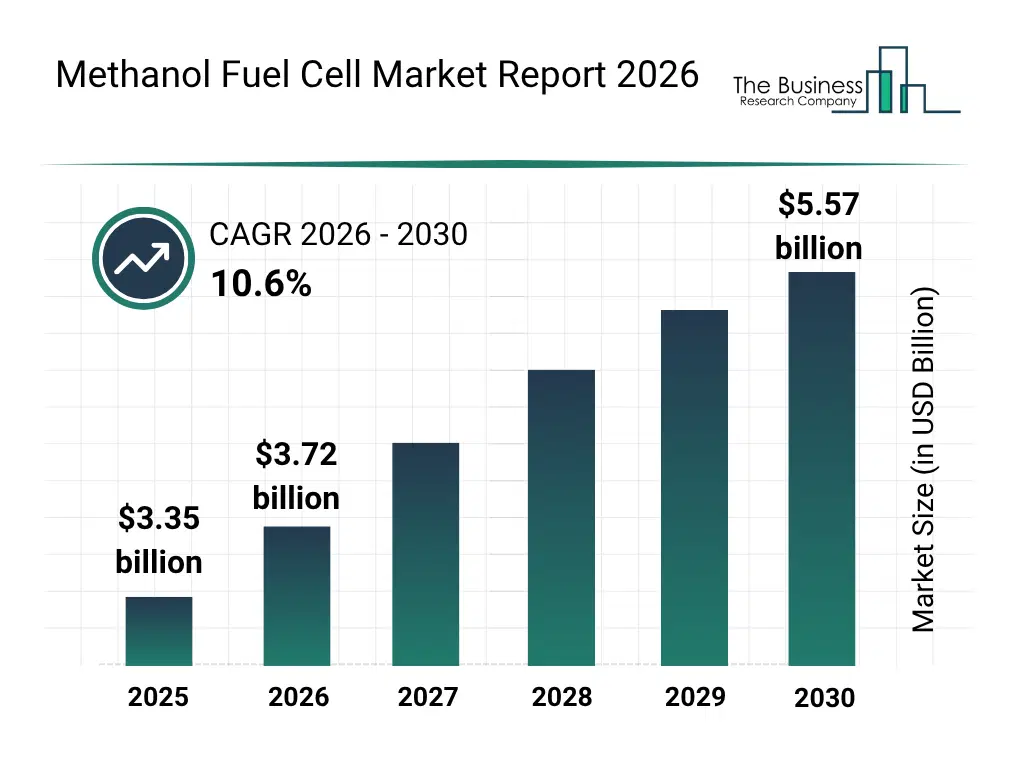
What Is The Methanol Fuel Cell Market Size and Share 2026?
The methanol fuel cell market size has grown rapidly in recent years. It will grow from $3.35 billion in 2025 to $3.72 billion in 2026 at a compound annual growth rate (CAGR) of 11.0%. The growth in the historic period can be attributed to growing demand for reliable portable power solutions, increasing adoption of backup power systems, rising requirement for off grid electricity generation, expanding use of fuel cells in telecommunications infrastructure, increasing demand for compact energy storage alternatives.What Is The Methanol Fuel Cell Market Growth Forecast?
The methanol fuel cell market size is expected to see rapid growth in the next few years. It will grow to $5.57 billion in 2030 at a compound annual growth rate (CAGR) of 10.6%. The growth in the forecast period can be attributed to increasing adoption of green and renewable methanol fuels, rising deployment of fuel cells in electric mobility applications, growing demand for low carbon distributed energy systems, increasing investment in advanced fuel cell technologies, expanding integration of methanol fuel cells in autonomous and remote systems. Major trends in the forecast period include increasing demand for portable methanol fuel cell power solutions, growing adoption of methanol fuel cells for backup power applications, rising development of high efficiency direct methanol fuel cell systems, increasing integration of methanol fuel cells in remote and off grid power applications, growing focus on low emission alternative energy sources.
Global Methanol Fuel Cell Market Segmentation
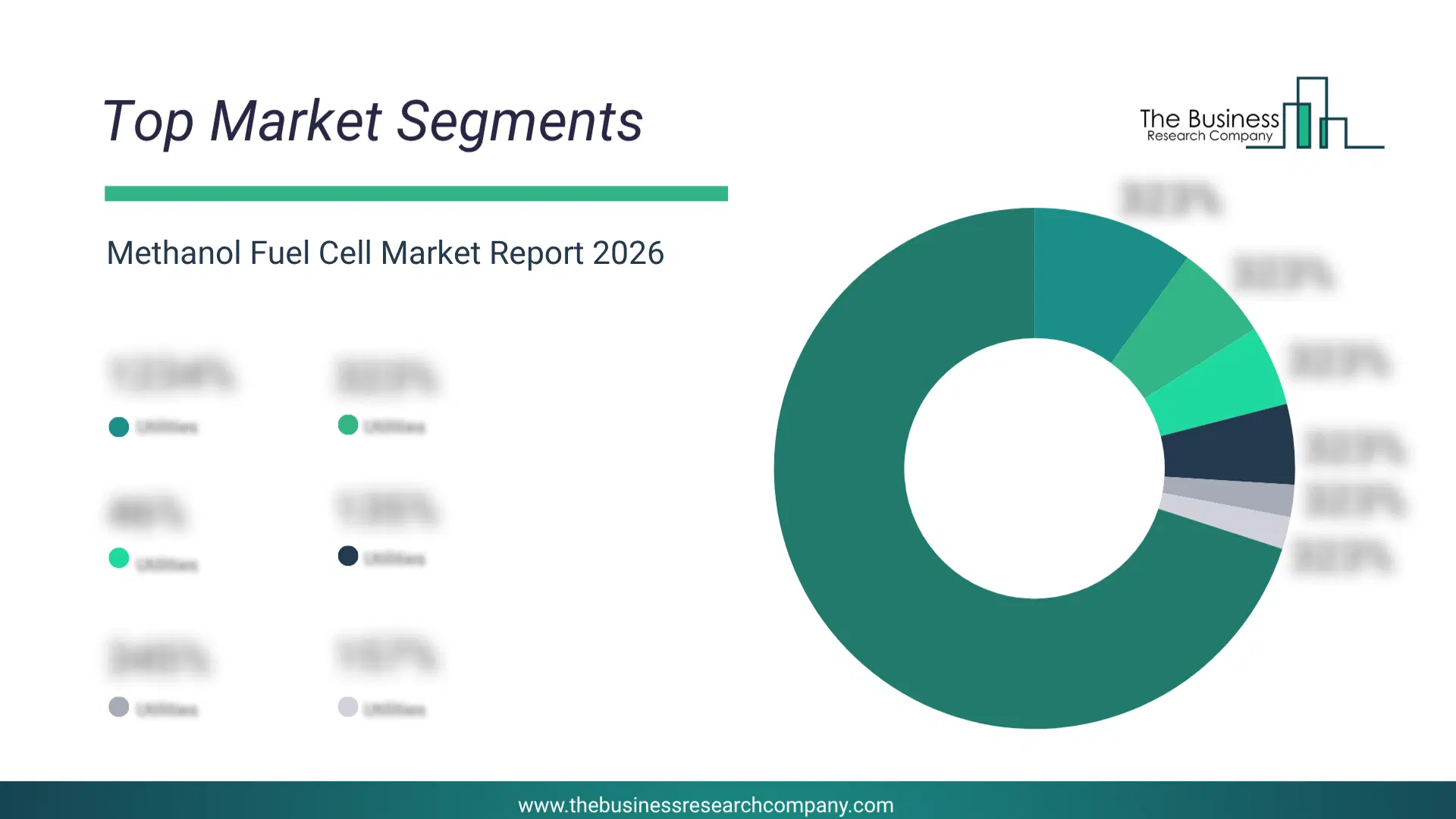
2) By Power Output: Below One Hundred Watts, One Hundred Watts To One Kilowatt, One Kilowatt To Ten Kilowatts, Above Ten Kilowatts 3) By Fuel Type: Conventional Methanol, Green Methanol, Bio Methanol, Renewable Methanol 4) By Distribution Channel: Direct Sales, Distributors And Integrators, Original Equipment Manufacturer Partnerships, Online Sales 5) By End User: Telecommunications, Defense And Aerospace, Industrial, Energy And Utilities, Transportation And Mobility, Consumer Electronics Subsegments: 1) By Direct Methanol Fuel Cell: Portable Power Systems, Backup Power Systems, Remote Monitoring Systems, Military Power Systems, Consumer Electronics Power Systems 2) By Reformed Methanol Fuel Cell: Stationary Power Generation Systems, Distributed Energy Systems, Combined Heat And Power Systems, Industrial Power Systems, Transportation Power Systems 3) By Passive Direct Methanol Fuel Cell: Portable Electronic Devices, Emergency Power Units, Wearable Power Systems, Sensor Power Systems, Low Power Communication Devices 4) By Active Direct Methanol Fuel Cell: High Power Portable Systems, Telecommunications Backup Systems, Industrial Backup Systems, Autonomous Vehicle Power Systems, Continuous Monitoring Power SystemsWhat Is The Driver Of The Methanol Fuel Cell Market?
The growing demand for clean energy solutions is expected to propel the growth of the methanol fuel cell market going forward. Clean energy solutions refer to energy technologies and systems that generate power with low or zero greenhouse gas emissions while improving energy efficiency and reducing environmental impact. Growing demand for clean energy solutions is due to increasing concerns over climate change and greenhouse gas emissions, as governments, industries, and consumers seek low-carbon and sustainable energy alternatives to reduce environmental impact and achieve decarbonization goals. Methanol fuel cell technology supports clean energy by generating electricity through the electrochemical conversion of methanol with higher efficiency and lower greenhouse gas emissions than conventional fossil fuel-based power systems. For instance, in June 2025, according to the International Energy Agency (IEA), a France-based autonomous intergovernmental organization, global energy investment is set to increase to $3.3 trillion in 2025, while clean energy investment is projected to reach a record $2.2 trillion. Therefore, the growing demand for clean energy solutions is driving the growth of the methanol fuel cell industry.Key Players In The Global Methanol Fuel Cell Market
Major companies operating in the methanol fuel cell market are Advent Technologies Holdings Inc, AVL List GmbH, Ballard Power Systems Inc, Blue World Technologies Holding ApS, Bloom Energy Corporation, Chung-Hsin Electric And Machinery Mfg. Corp, Doosan Fuel Cell Co Ltd, Ensol Systems Inc., FC TecNrgy Pvt Ltd, Fujikura Ltd., Horizon Fuel Cell Technologies Pte Ltd., Johnson Matthey Public Limited Company, Kaori Heat Treatment Co Ltd, Mitsubishi Gas Chemical Company Inc, Plug Power Inc., PowerCell Group, ReCatalyst d.o.o., SFC Energy AG, Siqens GmbH, TreadStone Technologies Inc.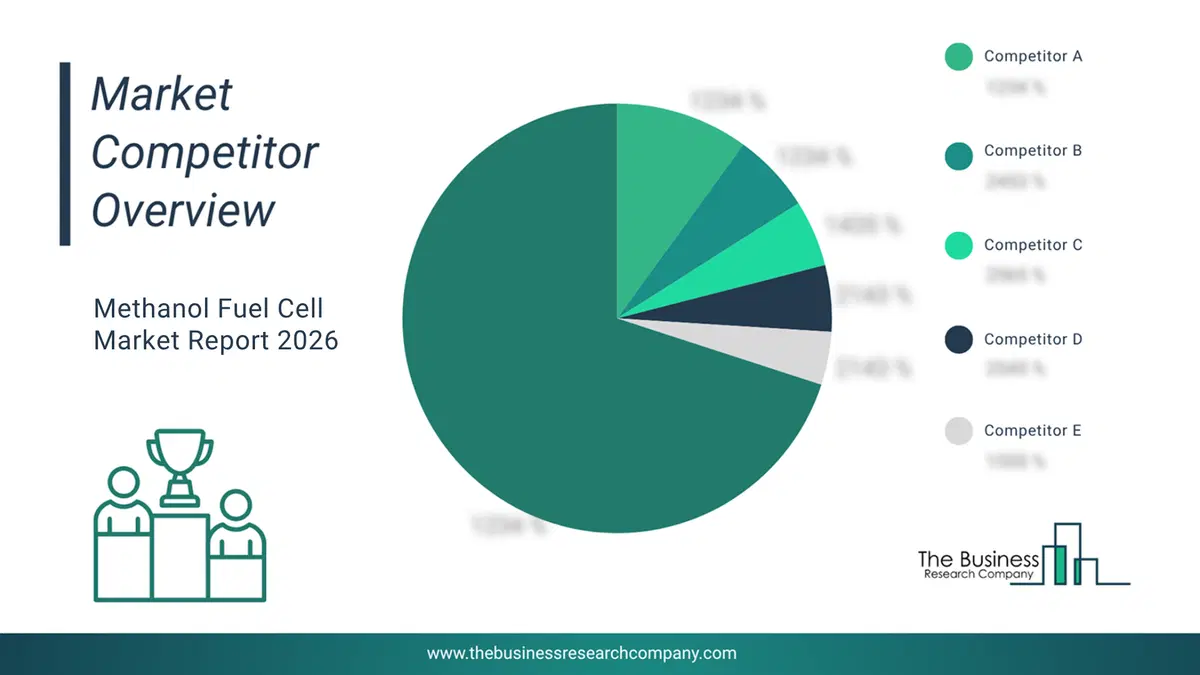
This chart is for illustrative purposes; the full report includes a detailed competitor analysis and comprehensive overview of the top 10 companies in the market.
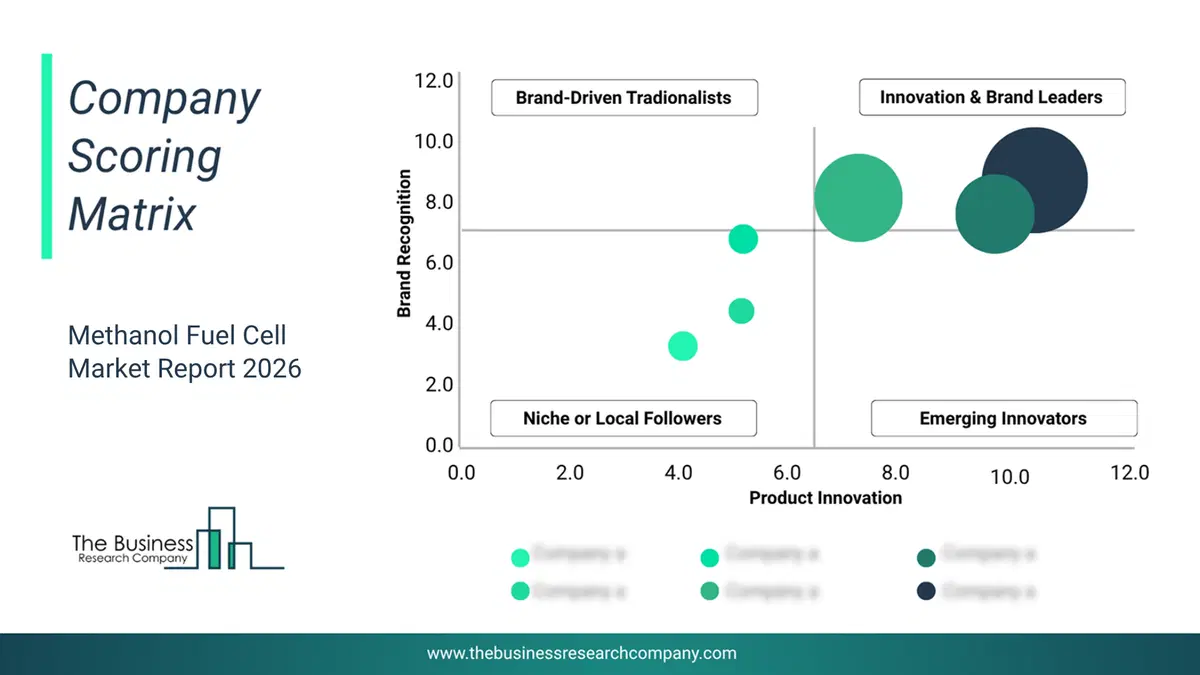
This chart maps companies by product innovation and brand strength, with bubble size indicating relative revenue, helping identify market leaders, challengers, and niche players. This is an illustrative chart; the full report provides a complete and accurate competitive analysis.
Global Methanol Fuel Cell Market Trends and Insights
Major companies operating in the methanol fuel cell market are focusing on developing innovative solutions, such as clean, off-grid, and backup power solutions, to reduce carbon emissions while providing reliable, portable, and decentralized energy for remote, critical, and grid-independent applications. Clean, off-grid, and backup power solutions are energy systems that provide low-emission electricity independently of the main grid and supply power during outages or in remote areas. For instance, in July 2023, SFC Energy AG, a Germany-based provider of hydrogen and methanol fuel cell solutions, partnered with FCTecNrgy Pvt. Ltd., an India-based clean energy tech company, and launched production of hydrogen and methanol fuel cells at its New Delhi/Gurgaon facility. The manufacturing setup was established in line with India’s Make in India initiative and aims to support the country’s transition toward cleaner energy systems by replacing diesel generators with emission-free fuel cell technologies across sectors such as railways, military applications, and critical infrastructure. The initiative aligns with India’s National Green Hydrogen Mission and broader 2030 renewable energy targets, which focus on scaling green hydrogen adoption and reducing carbon emissions from conventional energy systems.What Are Latest Mergers And Acquisitions In The Methanol Fuel Cell Market?
In April 2023, SFC Energy AG, a Germany-based provider of hydrogen and direct methanol fuel cell solutions, expanded its strategic partnership with Johnson Matthey Plc to focus on hydrogen fuel cells and complete the technology transfer of direct methanol fuel cell (DMFC) systems. Through this partnership, SFC Energy AG and Johnson Matthey Plc aim to strengthen the development and commercialisation of hydrogen and methanol fuel cell technologies by combining SFC Energy's fuel cell manufacturing expertise with Johnson Matthey's DMFC intellectual property and technological capabilities. Johnson Matthey Plc is a UK-based company specialising in sustainable technologies, catalyst manufacturing, and fuel cell components.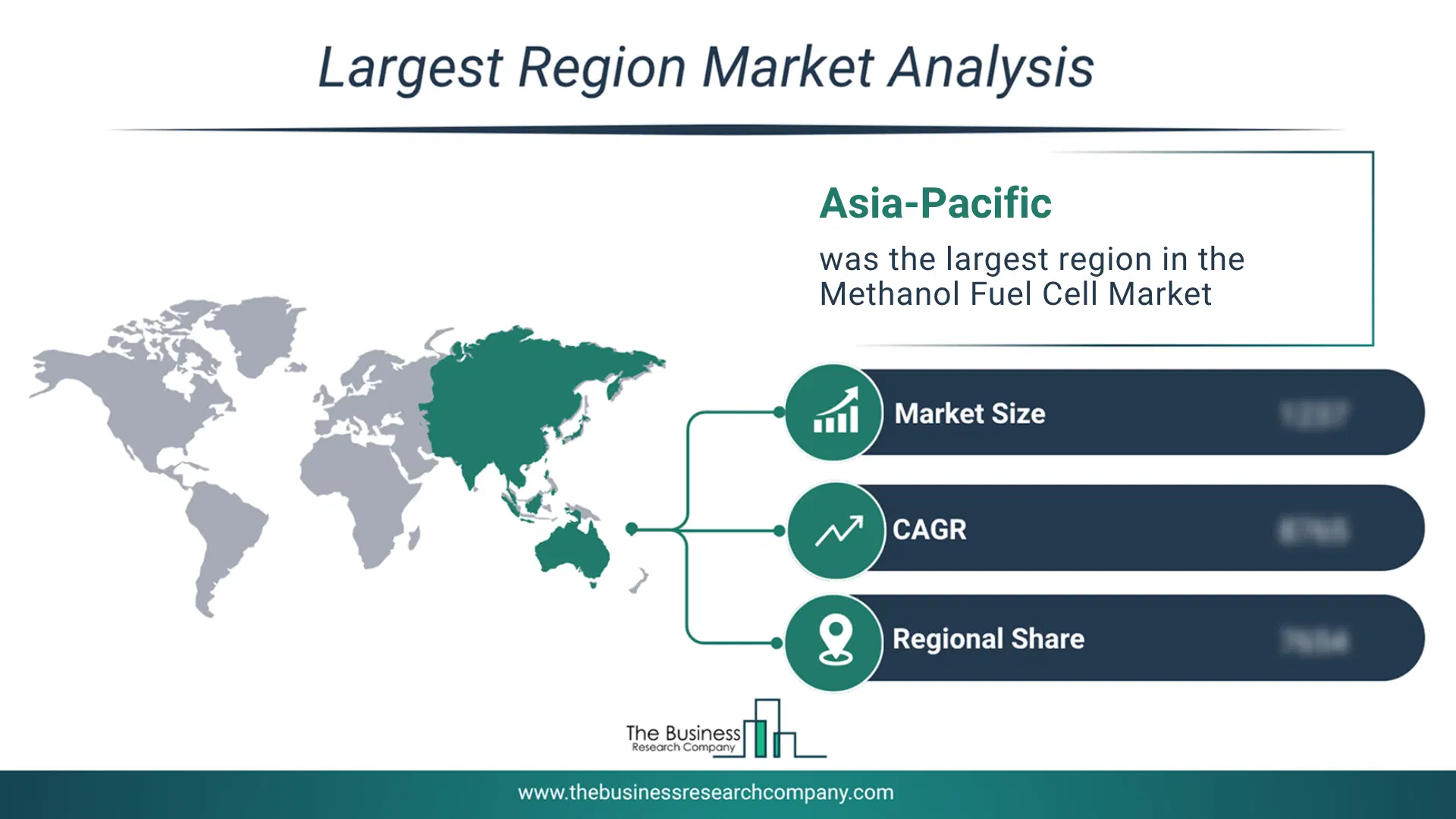
Regional Outlook/Insights
Asia-Pacific was the largest region in the methanol fuel cell market in 2025. Asia-Pacific is expected to be the fastest-growing region in the forecast period. The regions covered in this market report are Asia-Pacific, South East Asia, Western Europe, Eastern Europe, North America, South America, Middle East, Africa. The countries covered in this market report are Australia, Brazil, China, France, Germany, India, Indonesia, Japan, Taiwan, Russia, South Korea, UK, USA, Canada, Italy, Spain.What Defines the Methanol Fuel Cell Market?
The methanol fuel cell market consists of sales of direct methanol fuel cell (DMFC) stacks, fuel cell power modules, methanol fuel cartridges, membrane electrode assemblies (MEAs), and fuel cell system components. Values in this market are ‘factory gate’ values, that is the value of goods sold by the manufacturers or creators of the goods, whether to other entities (including downstream manufacturers, wholesalers, distributors and retailers) or directly to end customers. The value of goods in this market includes related services sold by the creators of the goods.How is Market Value Defined and Measured?
The market value is defined as the revenues that enterprises gain from the sale of goods and/or services within the specified market and geography through sales, grants, or donations in terms of the currency (in USD unless otherwise specified). The revenues for a specified geography are consumption values that are revenues generated by organizations in the specified geography within the market, irrespective of where they are produced. It does not include revenues from resales along the supply chain, either further along the supply chain or as part of other products.
This chart presents market attractiveness based on a quantitative evaluation of growth, competition, strategic alignment, and risk, offering a clear view of opportunity areas for decision-making. This chart is for illustrative purposes; the full report contains the complete analysis.

This chart highlights the Total Addressable Market (TAM) by estimating the maximum revenue opportunity using an assumption-driven approach, supporting strategic planning and opportunity sizing across markets. The chart is illustrative; the full report provides a more comprehensive analysis.
What Key Data and Analysis Are Included in the Methanol Fuel Cell Market Report 2026?
The methanol fuel cell market research report is one of a series of new reports from The Business Research Company that provides methanol fuel cell market statistics, including methanol fuel cell industry global market size, regional shares, competitors with a methanol fuel cell market share, detailed methanol fuel cell market segments, market trends and opportunities, and any further data you may need to thrive in the methanol fuel cell industry. This methanol fuel cell market research report delivers a complete perspective of everything you need, with an in-depth analysis of the current and future scenario of the industry.Methanol Fuel Cell Market Report Forecast Analysis
| Report Attribute | Details |
|---|---|
| Market Size Value In 2026 | $3.72 billion |
| Revenue Forecast In 2030 | $5.57 billion |
| Growth Rate | CAGR of 10.6% from 2026 to 2030 |
| Base Year For Estimation | 2025 |
| Actual Estimates/Historical Data | 2020-2025 |
| Forecast Period | 2026 - 2030 |
| Market Representation | Revenue in USD Billion and CAGR from 2026 to 2030 |
| Segments Covered | Type, Power Output, Fuel Type, Distribution Channel, End User |
| Regional Scope | Asia-Pacific, Western Europe, Eastern Europe, North America, South America, Middle East, Africa |
| Country Scope | The countries covered in the report are Australia, Brazil, China, France, Germany, India, Indonesia, Japan, Taiwan, Russia, South Korea, UK, USA, Canada, Italy, Spain. |
| Key Companies Profiled | Advent Technologies Holdings Inc, AVL List GmbH, Ballard Power Systems Inc, Blue World Technologies Holding ApS, Bloom Energy Corporation, Chung-Hsin Electric And Machinery Mfg. Corp, Doosan Fuel Cell Co Ltd, Ensol Systems Inc., FC TecNrgy Pvt Ltd, Fujikura Ltd., Horizon Fuel Cell Technologies Pte Ltd., Johnson Matthey Public Limited Company, Kaori Heat Treatment Co Ltd, Mitsubishi Gas Chemical Company Inc, Plug Power Inc., PowerCell Group, ReCatalyst d.o.o., SFC Energy AG, Siqens GmbH, TreadStone Technologies Inc. |
| Customization Scope | Request for Customization |
| Pricing And Purchase Options | Explore Purchase Options |