
Micro Combined Heat And Power (CHP) Market Report 2026
Global Outlook – By Type (Engine-Based, Fuel Cell-Based), By Prime Mover (Stirling Engine, Internal Combustion Engine, Fuel Cell), By Fuel (Natural Gas And Liquefied Petroleum Gas (LPG), Coal, Renewable Resources, Oil), By Application (Residential, Commercial) – Market Size, Trends, Strategies, and Forecast to 2030
Micro Combined Heat And Power (CHP) Market Overview
• Micro Combined Heat And Power (CHP) market size has reached to $4.55 billion in 2025 • Expected to grow to $7.65 billion in 2030 at a compound annual growth rate (CAGR) of 10.9% • Growth Driver: Growing Demand For Clean Energy Fuels Expansion In Micro CHP Market • Market Trend: Technological Advancements In Micro Combined Heat And Power (CHP) • Asia-Pacific was the largest region in 2025.What Is Covered Under Micro Combined Heat And Power (CHP) Market?
Micro combined heat and power (CHP) systems are small-scale energy systems that generate electricity and heat for residential and small commercial buildings. These systems are highly efficient, capturing and utilizing the waste heat produced during electricity generation, reducing energy costs and carbon emissions. Micro CHP units are powered by natural gas, but some models can use renewable fuels, making them a flexible option for distributed energy production. The main types of micro combined heat and power (CHP) are engine-based and fuel cell-based. Engine-based micro CHP systems use small engines, such as internal combustion engines, to generate electricity and capture the heat produced in the process for heating purposes. The prime mover includes a stirling engine, internal combustion engine, and fuel cell, and the fuels used are natural gas and liquefied petroleum gas (LPG), coal, renewable resources, and oil. It is used in various applications, such as residential and commercial.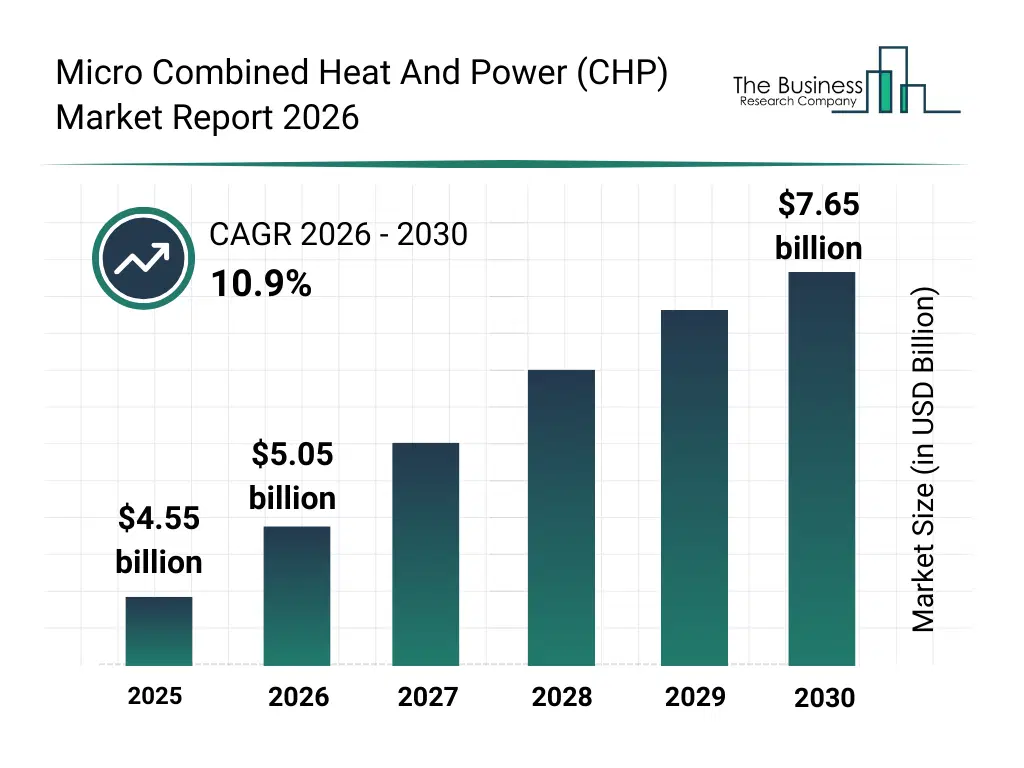
What Is The Micro Combined Heat And Power (CHP) Market Size and Share 2026?
The micro combined heat and power (chp) market size has grown rapidly in recent years. It will grow from $4.55 billion in 2025 to $5.05 billion in 2026 at a compound annual growth rate (CAGR) of 11.2%. The growth in the historic period can be attributed to increasing deployment of internal combustion engine-based micro chp, rising adoption of gas engine micro chp units, growing residential electricity and heat demand, increasing natural gas consumption for distributed energy, rising awareness of energy efficiency benefits.What Is The Micro Combined Heat And Power (CHP) Market Growth Forecast?
The micro combined heat and power (chp) market size is expected to see rapid growth in the next few years. It will grow to $7.65 billion in 2030 at a compound annual growth rate (CAGR) of 10.9%. The growth in the forecast period can be attributed to increasing development of fuel cell-based micro chp systems, rising integration of renewable fuels in micro chp units, growing commercial sector adoption, increasing technological advancements in stirling engine micro chp, rising focus on carbon emission reduction through distributed energy. Major trends in the forecast period include increasing adoption of engine-based micro chp systems, rising deployment of fuel cell-based micro chp units, growing use of natural gas and renewable fuel options, expansion of residential micro chp installations, increasing efficiency through stirling and internal combustion engines.
Global Micro Combined Heat And Power (CHP) Market Segmentation
1) By Type: Engine-Based, Fuel Cell-Based 2) By Prime Mover: Stirling Engine, Internal Combustion Engine, Fuel Cell 3) By Fuel: Natural Gas And Liquefied Petroleum Gas (LPG), Coal, Renewable Resources, Oil 4) By Application: Residential, Commercial Subsegments: 1) By Engine-Based Micro CHP: Internal Combustion Engine (ICE)-Based Micro CHP, Gas Engine-Based Micro CHP, Diesel Engine-Based Micro CHP, Stirling Engine-Based Micro CHP, Combined Heat And Power Systems with Gas Turbine Engines 2) By Fuel Cell-Based Micro CHP: Proton Exchange Membrane (PEM) Fuel Cell-Based Micro CHP, Solid Oxide Fuel Cell (SOFC)-Based Micro CHP, Molten Carbonate Fuel Cell (MCFC)-Based Micro CHP, Alkaline Fuel Cell (AFC)-Based Micro CHP, Direct Methanol Fuel Cell (DMFC)-Based Micro CHPWhat Is The Driver Of The Micro Combined Heat And Power (CHP) Market?
The growing demand for clean energy solutions is expected to propel the growth of the micro combined heat and power (CHP) market going forward. Clean energy refers to energy derived from renewable, zero-emission sources that do not pollute the atmosphere, such as solar, wind, and hydropower. Clean energy growth is attributed to innovations in renewable technologies, supportive policies, declining costs, and rising demand for sustainable solutions. Clean energy enhances micro CHP systems by providing renewable, low-emission fuel sources, which further reduce the carbon footprint and increase the sustainability of combined heat and power generation. For instance, in March 2025, according to Eurostat, a Luxembourg-based government statistics source, in 2024, the share of net electricity generated from renewable energy sources in the EU increased from 44.3% in 2023 to 46.9% in 2024, marking a 2.6 percentage point rise compared to the previous year. Therefore, the growing demand for clean energy solutions is driving the micro combined heat and power (CHP) industry.Key Players In The Global Micro Combined Heat And Power (CHP) Market
Major companies operating in the micro combined heat and power (chp) market are Honda Motor Co. Ltd., Robert Bosch GmbH, Siemens AG, Caterpillar Inc., Aisin Corporation, Ceres Power Holdings plc, Alfa Laval AB, BDR Thermea Group B.V., Bloom Energy Corporation, Vaillant Group, 2G Energy AG, Viessmann Manufacturing Company Inc., Yanmar Co. Ltd., Capstone Green Energy Corporation, Lochinvar, Centrica plc, Enexor Energy LLC, Solid Power Inc., Samad Power Ltd, Axiom Energy Group LLC, EC POWER A/S, GreenWatt
This chart is for illustrative purposes; the full report includes a detailed competitor analysis and comprehensive overview of the top 10 companies in the market.
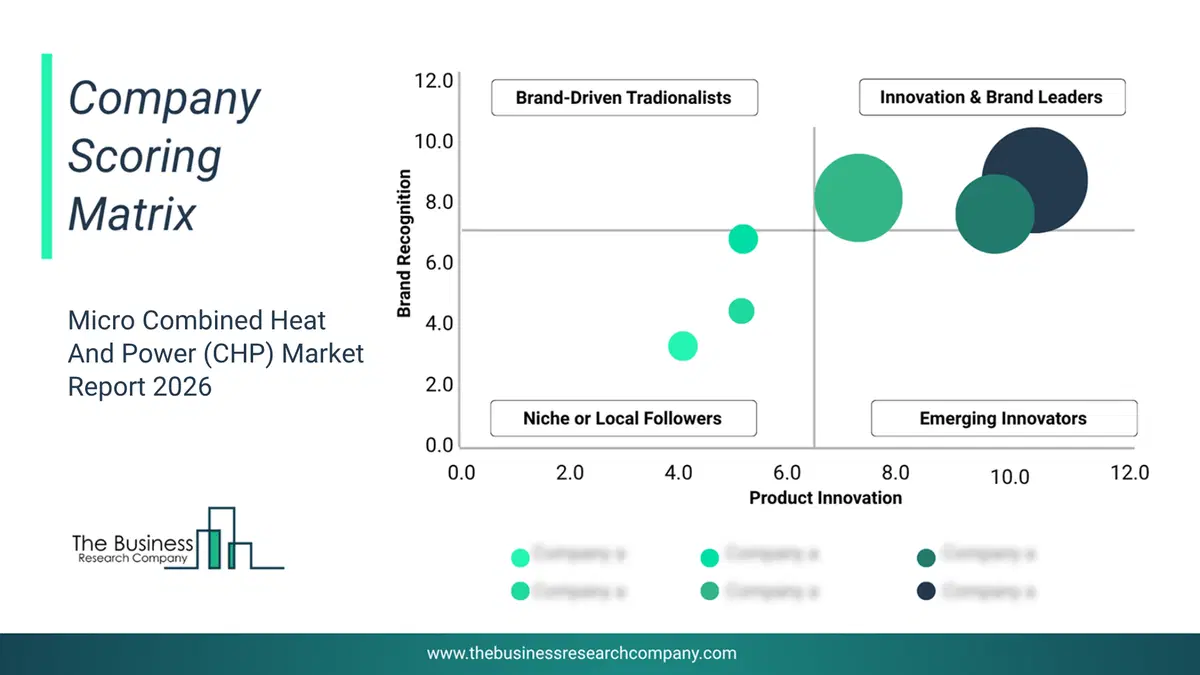
This chart maps companies by product innovation and brand strength, with bubble size indicating relative revenue, helping identify market leaders, challengers, and niche players. This is an illustrative chart; the full report provides a complete and accurate competitive analysis.
Global Micro Combined Heat And Power (CHP) Market Trends and Insights
Major companies operating in the micro combined heat and power (CHP) market are focusing on technological advancements such as developing energy-efficient CHP solutions to reduce carbon emissions, enhance system reliability, and optimize energy savings for residential and commercial applications. An energy-efficient CHP system produces both electricity and heat from a single energy source, optimizing fuel use and reducing energy waste. For instance, in August 2023, Bloom Energy Corporation, a US-based green energy company, launched the Bloom Energy Server, an advanced combined heat and power (CHP) solution designed to achieve net-zero heating and cooling. The Bloom Energy Server boasts over 50% electrical efficiency and can achieve more than 90% combined efficiency when fully utilized. This system stands out by producing high-temperature steam without additional fuel input, significantly lowering operating costs and reducing carbon emissions. This advancement represents a substantial improvement over older CHP technologies, which struggle to achieve both high electrical and thermal efficiencies simultaneously.What Are Latest Mergers And Acquisitions In The Micro Combined Heat And Power (CHP) Market?
In November 2024, Yanmar Holdings Co. Ltd., a Japan-based manufacturing company, acquired TEDOM for an undisclosed amount. With this acquisition, Yanmar aims to strengthen its distributed energy solutions portfolio and expand its presence in the European market by enhancing capabilities in combined heat and power (CHP) systems that support energy efficiency and decarbonization goals. TEDOM A.S. is a Czech Republic-based manufacturing company that provides micro combined heat and power (micro-CHP) systems.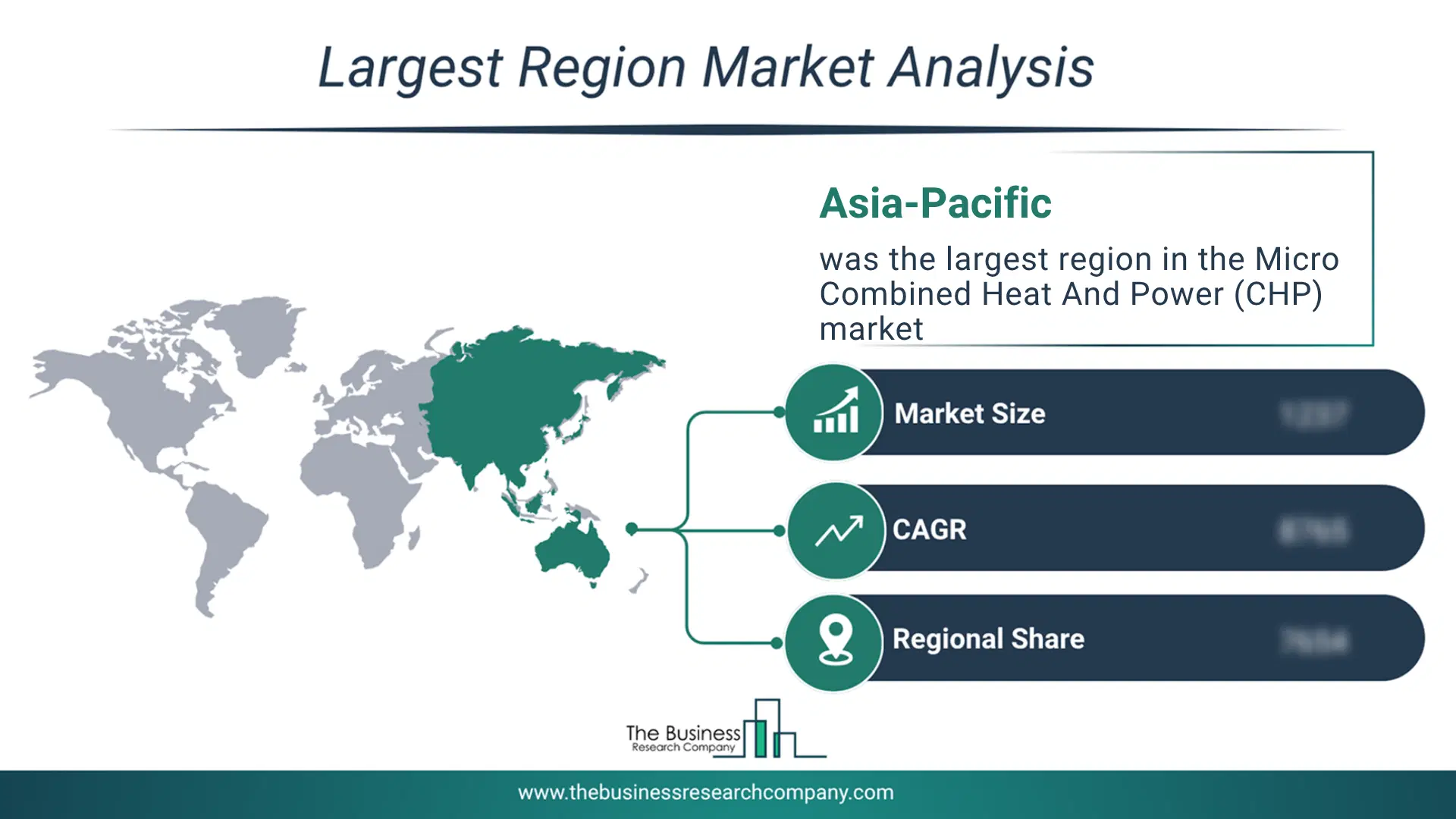
Regional Outlook
Asia-Pacific was the largest region in the micro combined heat and power (CHP) market in 2025. The regions covered in this market report are Asia-Pacific, South East Asia, Western Europe, Eastern Europe, North America, South America, Middle East, Africa. The countries covered in this market report are Australia, Brazil, China, France, Germany, India, Indonesia, Japan, Taiwan, Russia, South Korea, UK, USA, Canada, Italy, SpainWhat Defines the Micro Combined Heat And Power (CHP) Market?
The micro combined heat and power (CHP) market consists of sales of microturbines, fuel cells, internal combustion engines, heat recovery units, and integrated control systems. Values in this market are ‘factory gate’ values, that is the value of goods sold by the manufacturers or creators of the goods, whether to other entities (including downstream manufacturers, wholesalers, distributors, and retailers) or directly to end customers. The value of goods in this market includes related services sold by the creators of the goods.How is Market Value Defined and Measured?
The market value is defined as the revenues that enterprises gain from the sale of goods and/or services within the specified market and geography through sales, grants, or donations in terms of the currency (in USD unless otherwise specified). The revenues for a specified geography are consumption values that are revenues generated by organizations in the specified geography within the market, irrespective of where they are produced. It does not include revenues from resales along the supply chain, either further along the supply chain or as part of other products.
This chart presents market attractiveness based on a quantitative evaluation of growth, competition, strategic alignment, and risk, offering a clear view of opportunity areas for decision-making. This chart is for illustrative purposes; the full report contains the complete analysis.

This chart highlights the Total Addressable Market (TAM) by estimating the maximum revenue opportunity using an assumption-driven approach, supporting strategic planning and opportunity sizing across markets. The chart is illustrative; the full report provides a more comprehensive analysis.
What Key Data and Analysis Are Included in the Micro Combined Heat And Power (CHP) Market Report 2026?
The micro combined heat and power (chp) market research report is one of a series of new reports from The Business Research Company that provides market statistics, including Market Report 2026?global market size, regional shares, competitors with the market share, detailed market segments, market trends and opportunities, and any further data you may need to thrive in the micro combined heat and power (chp) Market Report 2026? The market research report delivers a complete perspective of everything you need, with an in-depth analysis of the current and future state of the Market Report 2026?Micro Combined Heat And Power (CHP) Market Report Forecast Analysis
| Report Attribute | Details |
|---|---|
| Market Size Value In 2026 | $5.05 billion |
| Revenue Forecast In 2030 | $7.65 billion |
| Growth Rate | CAGR of 11.2% from 2026 to 2030 |
| Base Year For Estimation | 2025 |
| Actual Estimates/Historical Data | 2020-2025 |
| Forecast Period | 2026 - 2030 - 2030 |
| Market Representation | Revenue in USD Billion and CAGR from 2026 to 2030 |
| Segments Covered | Type, Prime Mover, Fuel, Application |
| Regional Scope | Asia-Pacific, Western Europe, Eastern Europe, North America, South America, Middle East, Africa |
| Country Scope | The countries covered in the report are Australia, Brazil, China, France, Germany, India, Indonesia, Japan, Taiwan, Russia, South Korea, UK, USA, Canada, Italy, Spain. |
| Key Companies Profiled | Honda Motor Co. Ltd., Robert Bosch GmbH, Siemens AG, Caterpillar Inc., Aisin Corporation, Ceres Power Holdings plc, Alfa Laval AB, BDR Thermea Group B.V., Bloom Energy Corporation, Vaillant Group, 2G Energy AG, Viessmann Manufacturing Company Inc., Yanmar Co. Ltd., Capstone Green Energy Corporation, Lochinvar, Centrica plc, Enexor Energy LLC, Solid Power Inc., Samad Power Ltd, Axiom Energy Group LLC, EC POWER A/S, GreenWatt |
| Customization Scope | Request for Customization |
| Pricing And Purchase Options | Explore Purchase Options |