

Micro-Compact Cars Market Report 2026
Global Outlook – By Propulsion Type (Electric, Petrol, Diesel, Hybrid), By Seating Capacity (Single Seater, Two Seater, Four Seater), By Sales Channel (Direct Sales, Dealerships, Online Sales, Other Sales Channels), By Application (Personal Transportation, Commercial Transportation, Last Mile Delivery And Logistics, Shared Mobility) – Market Size, Trends, Strategies, and Forecast to 2030
Micro-Compact Cars Market Overview
• Micro-Compact Cars market size has reached to $2.69 billion in 2025 • Expected to grow to $3.28 billion in 2030 at a compound annual growth rate (CAGR) of 4% • Growth Driver: Increasing Preference For Fuel-Efficient Vehicles Fueling Growth Of The Market Due To Rising Demand For Cost-Effective Urban Mobility • Market Trend: Innovations In Electric And Digital Technology Enhance Urban Mobility And Driving Convenience • Asia-Pacific was the largest region and fastest growing region.What Is Covered Under Micro-Compact Cars Market?
The micro-compact cars are ultra-small passenger vehicles designed to provide efficient urban transportation while occupying minimal road and parking space. They feature compact dimensions, lightweight construction, and fuel-efficient or electric powertrains that support economical operation and easy maneuverability in congested city environments. These vehicles emphasize affordability, practicality, and reduced environmental impact while meeting essential mobility requirements for short-distance travel. The main propulsion types of micro-compact cars include electric, petrol, diesel, and hybrid. Electric micro-compact cars refer to small passenger vehicles powered by electric motors and rechargeable battery systems, designed for efficient and convenient urban transportation. These cars are available with single seater, two seater, and four seater configurations. They are sold through direct sales, dealerships, online sales, and others and find application in personal transportation, commercial transportation, last mile delivery and logistics, and shared mobility.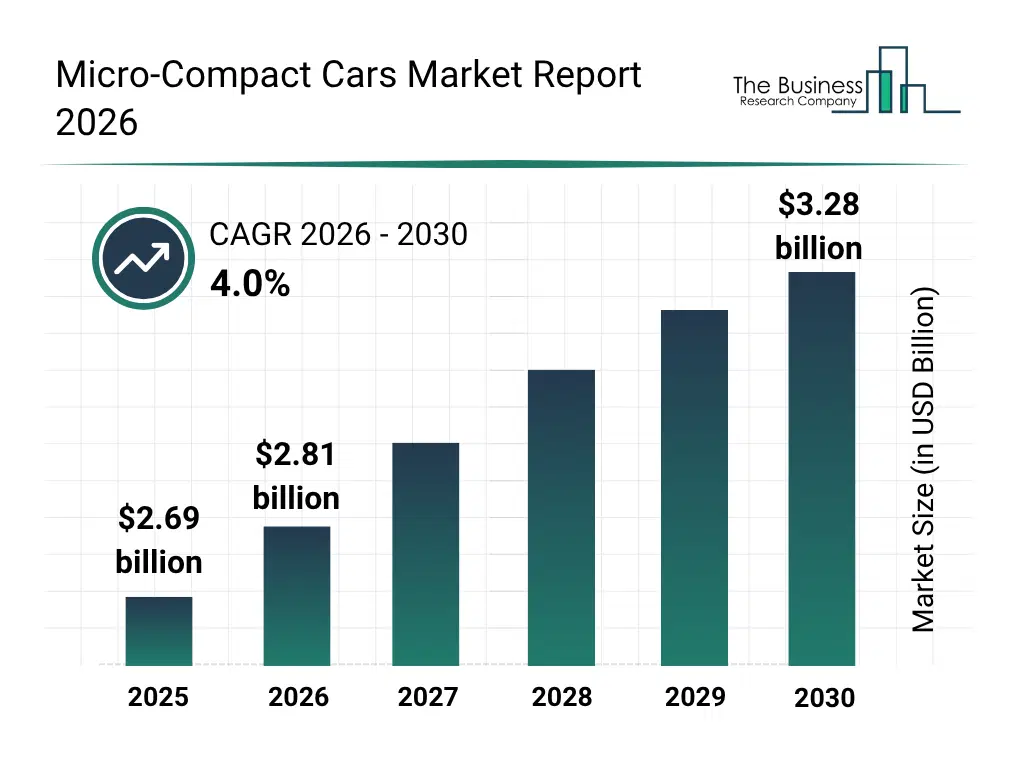
What Is The Micro-Compact Cars Market Size and Share 2026?
The micro-compact cars market size has grown steadily in recent years. It will grow from $2.69 billion in 2025 to $2.81 billion in 2026 at a compound annual growth rate (CAGR) of 4.4%. The growth in the historic period can be attributed to increasing urban population density, rising traffic congestion, growing demand for affordable personal transportation, limited availability of urban parking spaces, increasing fuel cost sensitivity.What Is The Micro-Compact Cars Market Growth Forecast?
The micro-compact cars market size is expected to see steady growth in the next few years. It will grow to $3.28 billion in 2030 at a compound annual growth rate (CAGR) of 4.0%. The growth in the forecast period can be attributed to expansion of urban mobility infrastructure, growing demand for low-emission transportation, increasing adoption of last-mile delivery solutions, rising demand for shared mobility services, supportive government policies for compact electric vehicles. Major trends in the forecast period include increasing adoption of lightweight micro-compact vehicle designs, rising demand for affordable urban mobility solutions, growing development of ultra-compact electric quadricycles, expansion of short-distance personal transportation applications, increasing focus on compact vehicle safety and occupant protection.Tariff Impact On Micro-Compact Cars Market
Tariffs are impacting the micro-compact cars market by increasing the cost of imported vehicle components, batteries, electric motors, semiconductors, and other automotive parts required for production. This is slowing the expansion of micro-compact cars, particularly in regions dependent on imported automotive components such as Asia-Pacific, Europe, and North America. Component-intensive segments such as electric micro-compact cars and urban electric quadricycles are most affected due to higher battery and electronic component costs. However, tariffs are also encouraging local component manufacturing, regional supplier diversification, and increased investment in domestic vehicle production, creating long-term resilience in the market.
Global Micro Compact Cars Market Segmentation
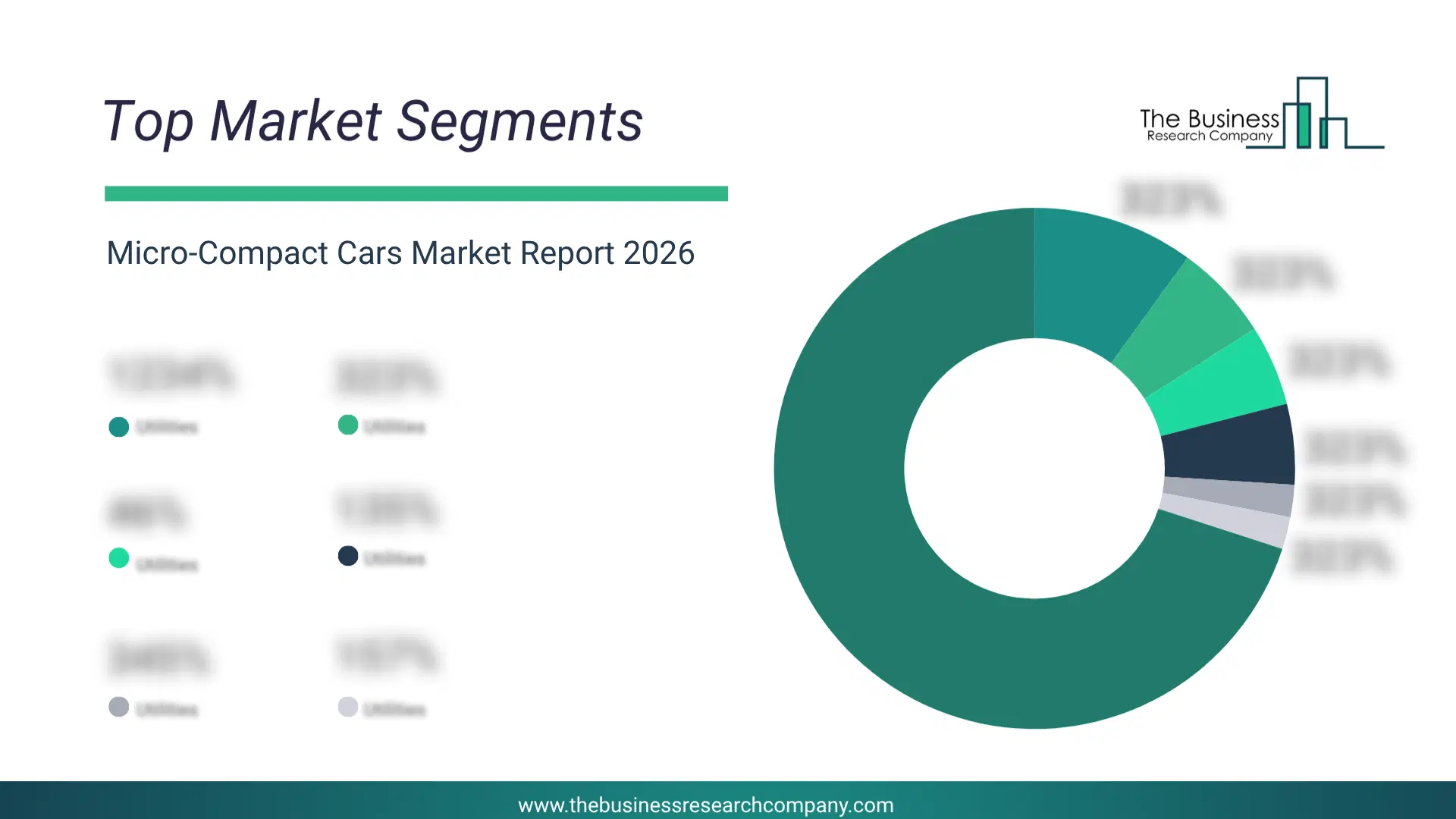
1) By Propulsion Type: Electric, Petrol, Diesel, Hybrid 2) By Seating Capacity: Single Seater, Two Seater, Four Seater 3) By Sales Channel: Direct Sales, Dealerships, Online Sales, Other Sales Channels 4) By Application: Personal Transportation, Commercial Transportation, Last Mile Delivery And Logistics, Shared Mobility Subsegments: 1) By Electric: Battery Electric, Neighborhood Electric, Urban Electric Quadricycles 2) By Petrol: Naturally Aspirated Petrol, Turbocharged Petrol 3) By Diesel: Naturally Aspirated Diesel, Turbocharged Diesel 4) By Hybrid: Mild Hybrid, Full Hybrid, Plug In HybridWhat Is The Driver Of The Micro-Compact Cars Market?
The increasing preference for fuel-efficient vehicles is expected to propel the growth of the microcompact car market going forward. Fuel-efficient vehicles are automobiles that consume less fuel to travel a given distance by using efficient powertrains, lightweight designs, and advanced energy management technologies. The preference for fuel-efficient vehicles is increasing as consumers want to reduce fuel expenses, as fuel costs and daily commuting requirements continue to influence vehicle purchasing decisions. Fuel-efficient vehicles help micro-compact cars by increasing consumer preference for small, lightweight vehicles that deliver higher fuel economy, lower fuel expenses, and reduced emissions, making them a cost-effective and practical transportation choice. For instance, in April 2026, according to the U.S. Energy Information Administration (EIA), a U.S.-based government agency, vehicle miles traveled increased by 1.2% over 2024, while the estimated vehicle fleet fuel economy, measured in miles per gallon, improved by 1.9% during the same period. Therefore, the increasing preference for fuel-efficient vehicles is driving the growth of the microcompact car market.Key Players In The Global Micro-Compact Cars Market
Major companies operating in the micro-compact cars market are Toyota Motor Corporation, Stellantis N.V., General Motors Company, Honda Motor Co. Ltd., Nissan Motor Co. Ltd., BYD Company Limited, SAIC Motor Corporation Limited, Hyundai Motor Company, Renault S.A., Geely Automobile Holdings Limited, Suzuki Motor Corporation, China FAW Group Co. Ltd., Chongqing Changan Automobile Co. Ltd., Mahindra & Mahindra Limited, Beijing Automotive Group Co. Ltd., Chery Automobile Co. Ltd., Mazda Motor Corporation, Mitsubishi Motors Corporation, Anhui Jianghuai Automobile Group Corp. Ltd., Zhejiang Leapmotor Technology Co. Ltd., Jiangsu Lingbox Automobile Co. Ltd., Zhidou Electric Vehicle Co. Ltd., Micro Mobility Systems AG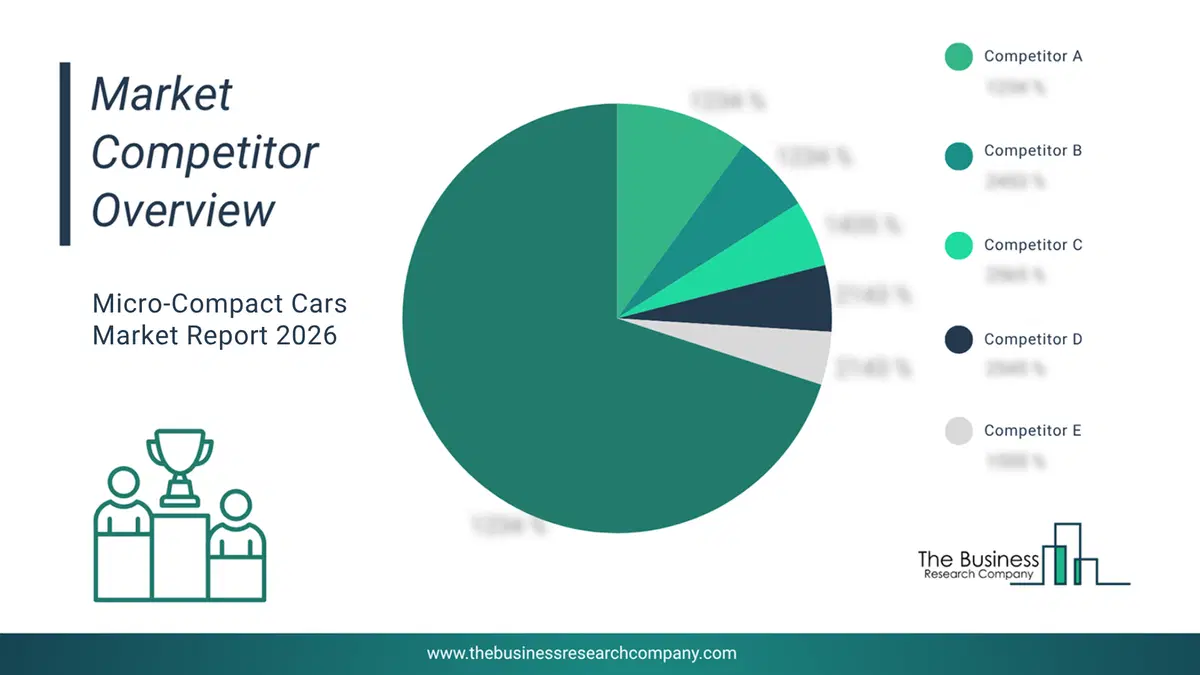
This chart is for illustrative purposes; the full report includes a detailed competitor analysis and comprehensive overview of the top 10 companies in the market.
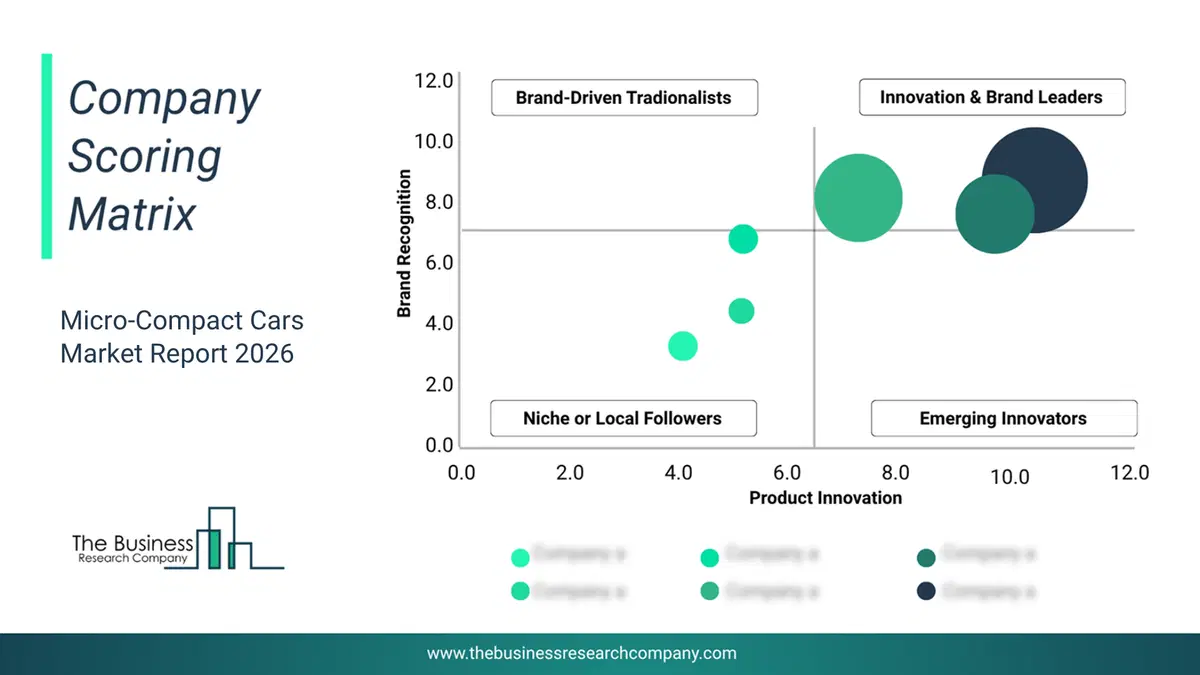
This chart maps companies by product innovation and brand strength, with bubble size indicating relative revenue, helping identify market leaders, challengers, and niche players. This is an illustrative chart; the full report provides a complete and accurate competitive analysis.
Global Micro-Compact Cars Market Trends and Insights
Major companies operating in the micro-compact cars market are focusing on developing advanced electric and digital solutions, such as ultra-compact electric vehicles with enhanced digital displays, to improve urban mobility, maneuverability, driving convenience, and user experience. Ultra-compact electric vehicles refer to small battery-powered vehicles designed for short-distance urban transportation, offering simple parking, low running costs, and efficient mobility in congested city environments. For instance, in February 2026, FIAT, an Italy-based automotive company, launched the new Topolino Corallo, an updated electric quadricycle featuring a new Corallo color and an all-new digital cluster that increased in size from 3.5 inches to 5.7 inches. It is designed for urban mobility and has a maximum speed of 45 km/h and provides up to 75 km of range from a 5.4 kWh battery, supporting easy driving, effortless parking, and convenient daily transportation.What Are Latest Mergers And Acquisitions In The Micro-Compact Cars Market?
In January 2025, Hyundai Motor Company, a South Korea-based automotive manufacturer, partnered with TVS Motor Company to explore the development of electric micro four-wheelers and three-wheelers for last-mile mobility in India. Through this partnership, the companies aimed to combine Hyundai's design, engineering, and technology expertise with TVS Motor's manufacturing and marketing capabilities to develop next-generation micro-mobility solutions tailored to India's urban transportation needs. The companies unveiled a micro four-wheeler concept at the Bharat Mobility Global Expo 2025, with the four-wheeler under evaluation for potential global applications. TVS Motor Company is an India-based manufacturer of two-wheelers and three-wheelers, including electric mobility solutions.
Regional Outlook
Asia-Pacific was the largest region in the micro-compact cars market in 2025. Asia-Pacific is expected to be the fastest-growing region in the forecast period. The regions covered in this market report are Asia-Pacific, South East Asia, Western Europe, Eastern Europe, North America, South America, Middle East, Africa. The countries covered in this market report are Australia, Brazil, China, France, Germany, India, Indonesia, Japan, Taiwan, Russia, South Korea, UK, USA, Canada, Italy, Spain.What Defines the Micro-Compact Cars Market?
The micro-compact cars market consists of sales of micro-compact car bodies, micro-compact car chassis, micro-compact car steering systems, micro-compact car suspension systems, micro-compact car braking systems, and micro-compact car lighting systems. Values in this market are ‘factory gate’ values, that is the value of goods sold by the manufacturers or creators of the goods, whether to other entities (including downstream manufacturers, wholesalers, distributors and retailers) or directly to end customers. The value of goods in this market includes related services sold by the creators of the goods.How is Market Value Defined and Measured?
The market value is defined as the revenues that enterprises gain from the sale of goods and/or services within the specified market and geography through sales, grants, or donations in terms of the currency (in USD unless otherwise specified). The revenues for a specified geography are consumption values that are revenues generated by organizations in the specified geography within the market, irrespective of where they are produced. It does not include revenues from resales along the supply chain, either further along the supply chain or as part of other products.
This chart presents market attractiveness based on a quantitative evaluation of growth, competition, strategic alignment, and risk, offering a clear view of opportunity areas for decision-making. This chart is for illustrative purposes; the full report contains the complete analysis.

This chart highlights the Total Addressable Market (TAM) by estimating the maximum revenue opportunity using an assumption-driven approach, supporting strategic planning and opportunity sizing across markets. The chart is illustrative; the full report provides a more comprehensive analysis.
What Key Data and Analysis Are Included in the Micro-Compact Cars Market Report 2026?
The micro-compact cars market research report is one of a series of new reports from The Business Research Company that provides market statistics, including industry global market size, regional shares, competitors with the market share, detailed market segments, market trends and opportunities, and any further data you may need to thrive in the micro-compact cars industry. The market research report delivers a complete perspective of everything you need, with an in-depth analysis of the current and future state of the industry.Micro-Compact Cars Market Report Forecast Analysis
| Report Attribute | Details |
|---|---|
| Market Size Value In 2026 | $2.81 billion |
| Revenue Forecast In 2030 | $3.28 billion |
| Growth Rate | CAGR of 4.0% from 2026 to 2030 |
| Base Year For Estimation | 2025 |
| Actual Estimates/Historical Data | 2020-2025 |
| Forecast Period | 2026 - 2030 |
| Market Representation | Revenue in USD Billion and CAGR from 2026 to 2030 |
| Segments Covered | Propulsion Type, Seating Capacity, Sales Channel, Application |
| Regional Scope | Asia-Pacific, Western Europe, Eastern Europe, North America, South America, Middle East, Africa |
| Country Scope | The countries covered in the report are Australia, Brazil, China, France, Germany, India, Indonesia, Japan, Taiwan, Russia, South Korea, UK, USA, Canada, Italy, Spain. |
| Key Companies Profiled | Toyota Motor Corporation, Stellantis N.V., General Motors Company, Honda Motor Co. Ltd., Nissan Motor Co. Ltd., BYD Company Limited, SAIC Motor Corporation Limited, Hyundai Motor Company, Renault S.A., Geely Automobile Holdings Limited, Suzuki Motor Corporation, China FAW Group Co. Ltd., Chongqing Changan Automobile Co. Ltd., Mahindra & Mahindra Limited, Beijing Automotive Group Co. Ltd., Chery Automobile Co. Ltd., Mazda Motor Corporation, Mitsubishi Motors Corporation, Anhui Jianghuai Automobile Group Corp. Ltd., Zhejiang Leapmotor Technology Co. Ltd., Jiangsu Lingbox Automobile Co. Ltd., Zhidou Electric Vehicle Co. Ltd., Micro Mobility Systems AG |
| Customization Scope | Request for Customization |
| Pricing And Purchase Options | Explore Purchase Options |