

Micro-Factory Market Report 2026
Global Outlook – By Type (Fixed Type, Removable Type), By Scale (Small-Scale, Medium-Scale, Large-Scale), By End-User Industry (Manufacturing Industry, Healthcare Industry, Automotive Industry, Consumer Goods Industry, Aerospace Industry, Other End-User Industries) – Market Size, Trends, Strategies, and Forecast to 2030
Micro-Factory Market Overview
• Micro-Factory market size has reached to $6.61 billion in 2025 • Expected to grow to $17.18 billion in 2030 at a compound annual growth rate (CAGR) of 21% • Growth Driver: Rising Adoption Of Automation Fueling The Growth Of The Market Due To Increasing Demand For Efficiency • Market Trend: Technological Breakthroughs Propel Micro-Factory Market Into Space And Artificial Intelligence (AI) Integration • Asia-Pacific was the largest region in 2025 and North America is the fastest growing region.What Is Covered Under Micro-Factory Market?
A micro-factory is a compact, highly automated manufacturing facility designed to produce small to medium volumes of products efficiently. It integrates advanced technologies such as robotics, internet of things (IoT), and artificial intelligence (AI) to enable flexible production, rapid prototyping, and real-time process monitoring. Micro-factories optimize space, reduce operational costs, and enhance productivity by streamlining workflows and minimizing human intervention. The main types of micro-factories include fixed and removable. A fixed-type micro factory is a small-scale, stationary manufacturing unit designed to produce limited volumes of products with high efficiency and localized production capabilities. The multiple scales are small-scale, medium-scale, and large-scale. They are used by several end-users, such as the manufacturing industry, healthcare industry, automotive industry, consumer goods industry, aerospace industry, and others.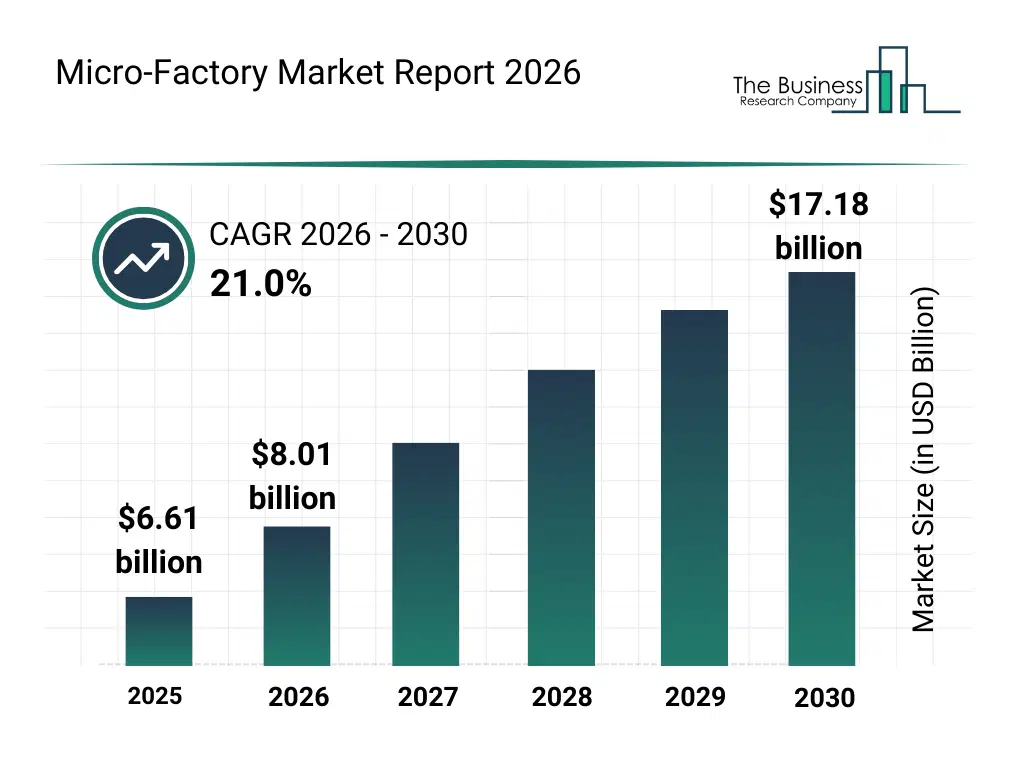
What Is The Micro-Factory Market Size and Share 2026?
The micro-factory market size has grown exponentially in recent years. It will grow from $6.61 billion in 2025 to $8.01 billion in 2026 at a compound annual growth rate (CAGR) of 21.2%. The growth in the historic period can be attributed to growth in automation technologies, rising manufacturing space costs, demand for flexible production, adoption of robotics in factories, need for faster product development.What Is The Micro-Factory Market Growth Forecast?
The micro-factory market size is expected to see exponential growth in the next few years. It will grow to $17.18 billion in 2030 at a compound annual growth rate (CAGR) of 21.0%. The growth in the forecast period can be attributed to reshoring of manufacturing, demand for customized products, advancement in AI driven production, expansion of smart factories, focus on cost optimized manufacturing. Major trends in the forecast period include expansion of compact automated manufacturing units, rising adoption of modular production setups, growing demand for rapid prototyping facilities, increased use of robotics in small batch manufacturing, shift toward localized manufacturing models.Tariff Impact On Micro-Factory Market
Tariffs have influenced the micro-factory market by increasing costs of industrial robots, sensors, and automation components. Fixed and modular micro-factories are most affected, particularly in Asia Pacific and Europe. Higher equipment costs have impacted capital investments. However, tariffs have encouraged localized production and regional supply chain development.

Global Micro-Factory Market Segmentation
1) By Type: Fixed Type, Removable Type 2) By Scale: Small-Scale, Medium-Scale, Large-Scale 3) By End-User Industry: Manufacturing Industry, Healthcare Industry, Automotive Industry, Consumer Goods Industry, Aerospace Industry, Other End-User Industries Subsegments: 1) By Fixed Type: Assembly Line Micro Factories, Additive Manufacturing Micro Factories, Hybrid Manufacturing Micro Factories, Continuous Flow Micro Factories 2) By Removable Type: Modular Micro Factories, Portable Micro Factories, Containerized Micro Factories, Mobile Micro FactoriesWhat Is The Driver Of The Micro-Factory Market?
The increasing adoption of automation is expected to propel the growth of the micro-factory market going forward. Automation is the process of using machines or technology to carry out tasks automatically, reducing the need for human involvement. The demand for automation is rising due to the need for higher efficiency, as businesses can complete tasks faster and more accurately while reducing human error and operational costs. Automation helps microfactories achieve efficient, high-quality production, allowing them to produce goods quickly and consistently, even within a small space. For instance, in November 2024, according to the International Federation of Robotics, a Germany-based non-profit organization, the worldwide average robot density rose to 162 units per 10,000 workers in 2023, more than doubling from 74 units reported seven years prior. Therefore, the increasing adoption of automation is driving the growth of the micro-factory industry.Key Players In The Global Micro-Factory Market
Major companies operating in the micro-factory market are Siemens AG, Bright Machines Inc., Divergent Technologies Inc., Local Motors Inc., Plant Prefab Inc., BLOX, Project Frog Inc., Rapid Robotics, Modular Arts, Giant Containers, FullStack Modular, Boxman Studios, Kuka AG, Festo AG & Co. KG, FANUC Corporation, Universal Robots A/S, Additive Industries B.V., Xometry Inc., Vention Inc., Tulip Interfaces Inc., Formlabs
This chart is for illustrative purposes; the full report includes a detailed competitor analysis and comprehensive overview of the top 10 companies in the market.
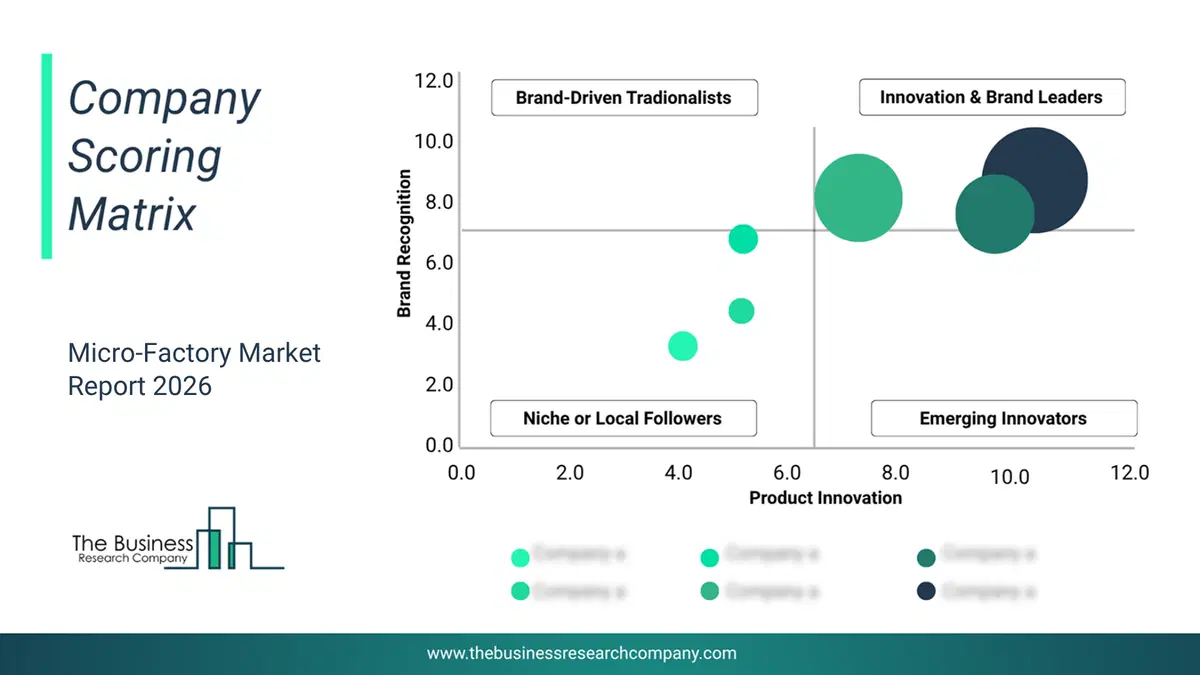
This chart maps companies by product innovation and brand strength, with bubble size indicating relative revenue, helping identify market leaders, challengers, and niche players. This is an illustrative chart; the full report provides a complete and accurate competitive analysis.
Global Micro-Factory Market Trends and Insights
Major companies operating in the micro-factory market are focusing on developing advanced approaches, such as vacuum-condition manufacturing, to develop compact, highly automated production facilities that enable advanced manufacturing, improve efficiency, and support flexible production in both terrestrial and space environments. Vacuum-condition manufacturing is a process that utilizes the low-pressure environment of a vacuum to perform advanced manufacturing with enhanced precision, reduced contamination, and improved material properties. For instance, in March 2025, a Welsh startup, a US-based pioneering in-space manufacturing company, launched a zero-gravity micro-factory into space. The company aims to utilize the unique conditions of space, such as microgravity, vacuum, and sub-zero temperatures, to manufacture advanced materials and alloys that are challenging to produce on Earth. The microfactory will autonomously operate in orbit, producing high-quality metals and semiconductors, and will return to Earth after several months to deliver its manufactured products. This initiative represents a significant step toward leveraging space environments for innovative manufacturing processes.What Are Latest Mergers And Acquisitions In The Micro-Factory Market?
In October 2024, ABB Robotics, a Switzerland-based company that manufactures robotics and machine automation solutions, partnered with Molg Inc. to develop e-waste micro-factories. Through this partnership, ABB Robotics aims to expand its automation capabilities, enhance e-waste recycling solutions, and accelerate the development of robotic micro-factories for sustainable electronic waste management. Molg Inc. is a US-based company that develops robotic micro-factories designed to autonomously assemble and disassemble complex electronic devices such as laptops, servers, and industrial electronics.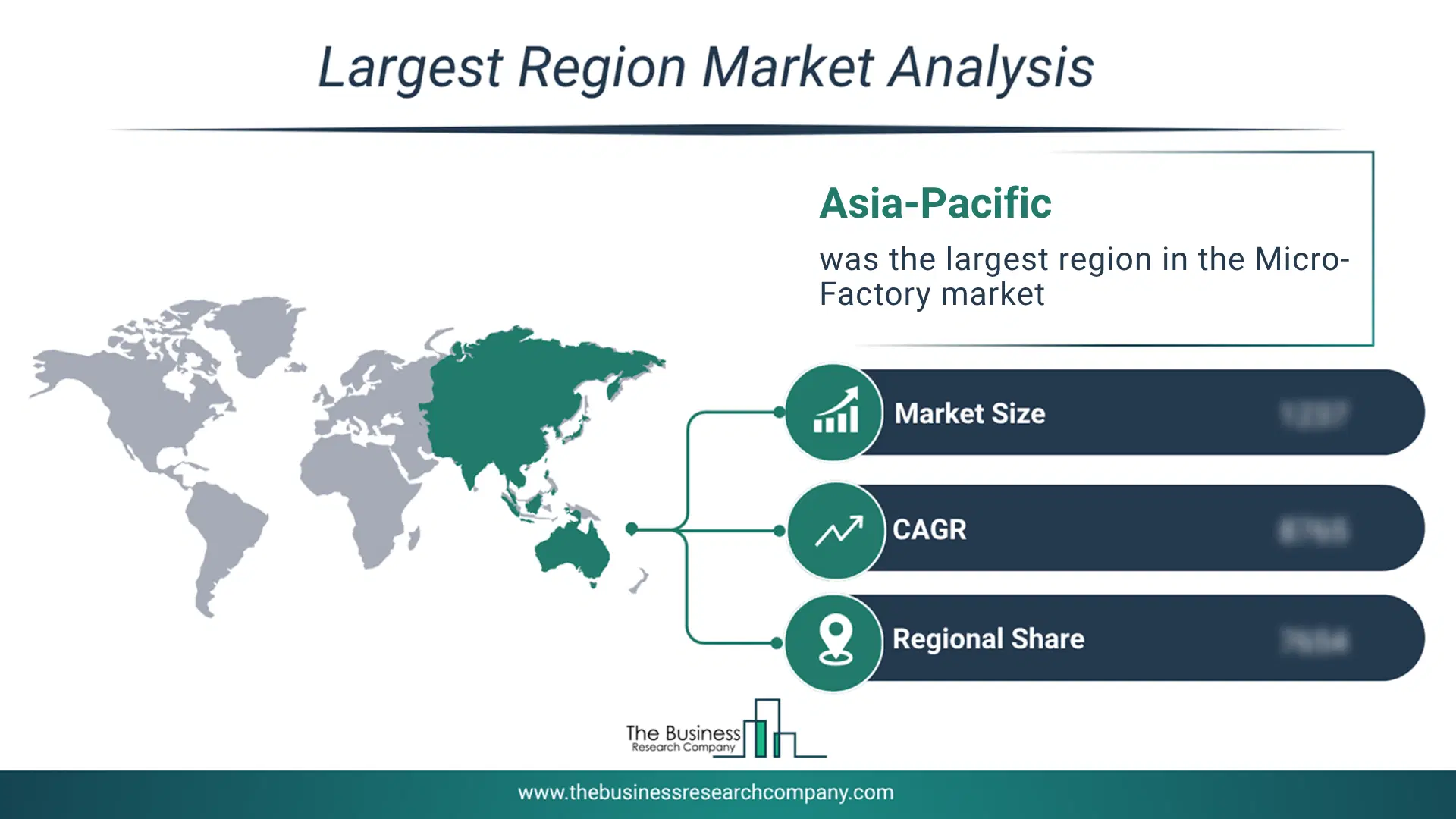
Regional Outlook
Asia-Pacific was the largest region in the micro-factory market in 2025. North America is expected to be the fastest-growing region in the forecast period. The regions covered in this market report are Asia-Pacific, South East Asia, Western Europe, Eastern Europe, North America, South America, Middle East, Africa The countries covered in this market report are Australia, Brazil, China, France, Germany, India, Indonesia, Japan, Taiwan, Russia, South Korea, UK, USA, Canada, Italy, Spain.What Defines the Micro-Factory Market?
The micro-factory market consists of sales of compact manufacturing units, automated robotic systems, internet of things (IoT)-enabled monitoring devices, and advanced additive manufacturing equipment. Values in this market are ‘factory gate’ values, that is, the value of goods sold by the manufacturers or creators of the goods, whether to other entities (including downstream manufacturers, wholesalers, distributors, and retailers) or directly to end customers.How is Market Value Defined and Measured?
The market value is defined as the revenues that enterprises gain from the sale of goods and/or services within the specified market and geography through sales, grants, or donations in terms of the currency (in USD unless otherwise specified). The revenues for a specified geography are consumption values that are revenues generated by organizations in the specified geography within the market, irrespective of where they are produced. It does not include revenues from resales along the supply chain, either further along the supply chain or as part of other products.
This chart presents market attractiveness based on a quantitative evaluation of growth, competition, strategic alignment, and risk, offering a clear view of opportunity areas for decision-making. This chart is for illustrative purposes; the full report contains the complete analysis.

This chart highlights the Total Addressable Market (TAM) by estimating the maximum revenue opportunity using an assumption-driven approach, supporting strategic planning and opportunity sizing across markets. The chart is illustrative; the full report provides a more comprehensive analysis.
What Key Data and Analysis Are Included in the Micro-Factory Market Report 2026?
The micro-factory market research report is one of a series of new reports from The Business Research Company that provides market statistics, including industry global market size, regional shares, competitors with the market share, detailed market segments, market trends and opportunities, and any further data you may need to thrive in the micro-factory industry. The market research report delivers a complete perspective of everything you need, with an in-depth analysis of the current and future state of the industry.Micro Factory Market Report Forecast Analysis
| Report Attribute | Details |
|---|---|
| Market Size Value In 2026 | $8.01 billion |
| Revenue Forecast In 2030 | $17.18 billion |
| Base Year For Estimation | 2025 |
| Actual Estimates/Historical Data | 2020-2025 |
| Forecast Period | 2026 - 2030 |
| Market Representation | Revenue in USD Billion and CAGR from 2026 to 2030 |
| Segments Covered | Type, Scale, End-User Industry |
| Regional Scope | Asia-Pacific, Western Europe, Eastern Europe, North America, South America, Middle East, Africa |
| Key Companies Profiled | Siemens AG, Bright Machines Inc., Divergent Technologies Inc., Local Motors Inc., Plant Prefab Inc., BLOX, Project Frog Inc., Rapid Robotics, Modular Arts, Giant Containers, FullStack Modular, Boxman Studios, Kuka AG, Festo AG & Co. KG, FANUC Corporation, Universal Robots A/S, Additive Industries B.V., Xometry Inc., Vention Inc., Tulip Interfaces Inc., Formlabs |
| Customization Scope | Request for Customization |
| Pricing And Purchase Options | Explore Purchase Options |