
Micro-Location Technology Market Report 2026
Global Outlook – By Component (Hardware, Software, Services), By Technology (Bluetooth Low Energy, Wi-Fi, Near Field Communication, Beacons, Other Technologies), By Application (Proximity Marketing, Asset Management), By End Use (Healthcare, Transportation And Logistics, BFSI, Sports And Entertainment, Commercial) – Market Size, Trends, Strategies, and Forecast to 2030
Micro-Location Technology Market Overview
• Micro-Location Technology market size has reached to $34.74 billion in 2025 • Expected to grow to $73.04 billion in 2030 at a compound annual growth rate (CAGR) of 15.8% • Growth Driver: Impact Of Growing E-Commerce On The Micro-Location Technology Market • Market Trend: Innovative Location Platforms Transforming The Micro-Location Technology Landscape • North America was the largest region in 2025 and Asia-Pacific is the fastest growing region.What Is Covered Under Micro-Location Technology Market?
Micro location technology refers to the process of locating an individual's placement within a few inches or feet using numerous technologies. It is used to determine the location accurately, both indoors and outdoors individual's placement. The main components of micro-location technology are hardware, software, and services. Hardware refers to the computer's tangible components or delivery systems that will store and run the written instructions provided by the software. The technologies used are bluetooth low energy, Wi-Fi, near-field communication, beacons, and others, thar are applied in proximity marketing and asset management. The various end-users included are healthcare, transportation and logistics, BFSI, sports and entertainment, and commercial.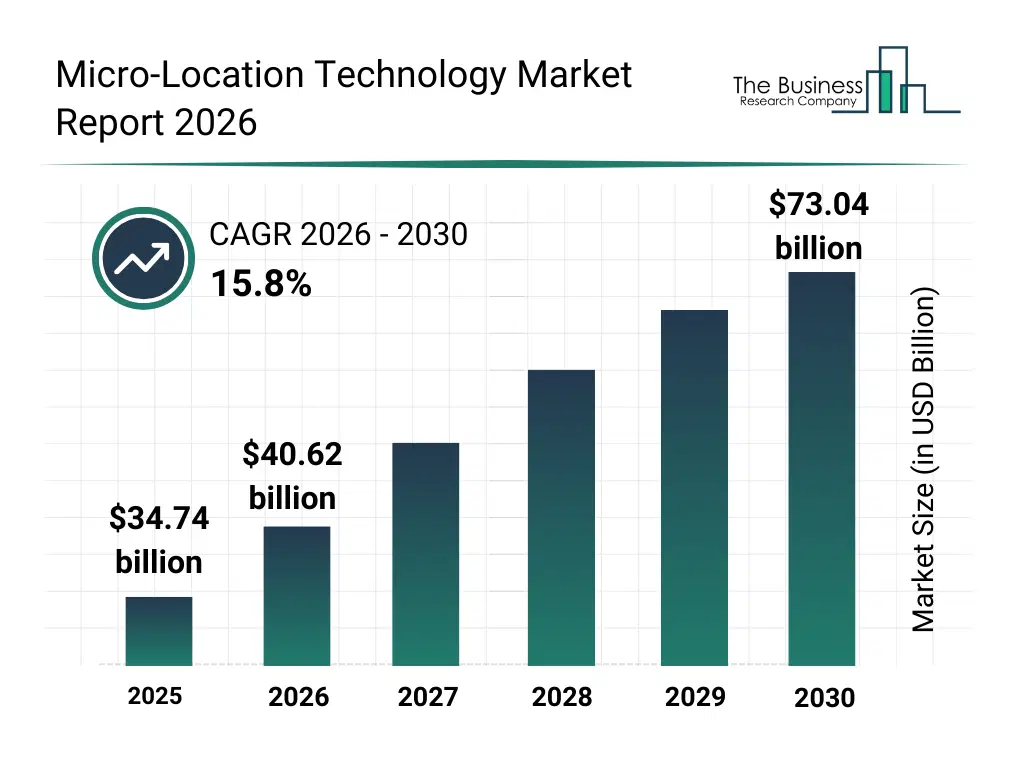
What Is The Micro-Location Technology Market Size and Share 2026?
The micro-location technology market size has grown rapidly in recent years. It will grow from $34.74 billion in 2025 to $40.62 billion in 2026 at a compound annual growth rate (CAGR) of 16.9%. The growth in the historic period can be attributed to increasing smartphone penetration, adoption of bluetooth beacon technology, growth of indoor navigation use cases, rising demand for location-based services, expansion of enterprise mobility solutions.What Is The Micro-Location Technology Market Growth Forecast?
The micro-location technology market size is expected to see rapid growth in the next few years. It will grow to $73.04 billion in 2030 at a compound annual growth rate (CAGR) of 15.8%. The growth in the forecast period can be attributed to increasing investments in smart infrastructure projects, rising adoption of ai-based location analytics, expansion of asset management automation, growing use of micro-location in healthcare and logistics, increasing demand for hyper-personalized customer engagement. Major trends in the forecast period include increasing deployment of indoor positioning systems, rising adoption of proximity-based marketing solutions, growing use of real-time asset tracking platforms, expansion of location analytics applications, enhanced integration with mobile and cloud platforms.
Global Micro-Location Technology Market Segmentation
1) By Component: Hardware, Software, Services 2) By Technology: Bluetooth Low Energy, Wi-Fi, Near Field Communication, Beacons, Other Technologies 3) By Application: Proximity Marketing, Asset Management 4) By End Use: Healthcare, Transportation And Logistics, BFSI, Sports And Entertainment, Commercial Subsegments: 1) By Hardware: Beacons (Bluetooth, Wi-Fi), Sensors (RFID, NFC), Location Tags, Mobile Devices, Other Tracking Devices 2) By Software: Location Analytics Software, Mapping And Navigation Software, Asset Management Software, Mobile Applications, Cloud-Based Solutions 3) By Services: Consulting Services, Installation And Integration Services, Maintenance And Support Services, Data Management Services, Training And Education ServicesWhat Is The Driver Of The Micro-Location Technology Market?
The growing e-commerce industry is expected to boost the growth of the micro-location technology market going forward. E-commerce entails the exchange of goods and services through the Internet or other electronic networks. The growing e-commerce industry benefits from the implementation of micro-location technology, which, in turn, helps enhance operational efficiency, customer experiences, and overall competitiveness in the market. For instance, in August 2024, according to United States Census Bureau, a US-based government agency, U.S. retail e-commerce sales for the second quarter of 2024 reached an estimated $282.3 billion, marking a 5.3% increase compared to the first quarter of 2023. Therefore, the growing e-commerce industry is driving the growth of the micro-location technology industry.Key Players In The Global Micro-Location Technology Market
Major companies operating in the micro-location technology market are Apple Inc.; Cisco Systems Inc.; Google LLC; CenTrak Inc.; Humatics Corporation; Hewlett Packard Enterprise Development LP; Sewio Networks; Siemens AG; Zebra Technologies; Ubisense Group; Aruba Networks; Kontakt.io; Ruckus Networks; Estimote Inc.; Quuppa Intelligent Locating System; Mist Systems, Inc.; DecaWave Limited; Redpine Signals; Visible Assets Inc.; Gimbal Inc.; Bluvision; Pole Star; Inpixon; Pointr; IndoorAtlas Oy; KIO RTLS; Locatify; MERIDIAN; sensewhere Ltd.; Hexagon AB
This chart is for illustrative purposes; the full report includes a detailed competitor analysis and comprehensive overview of the top 10 companies in the market.
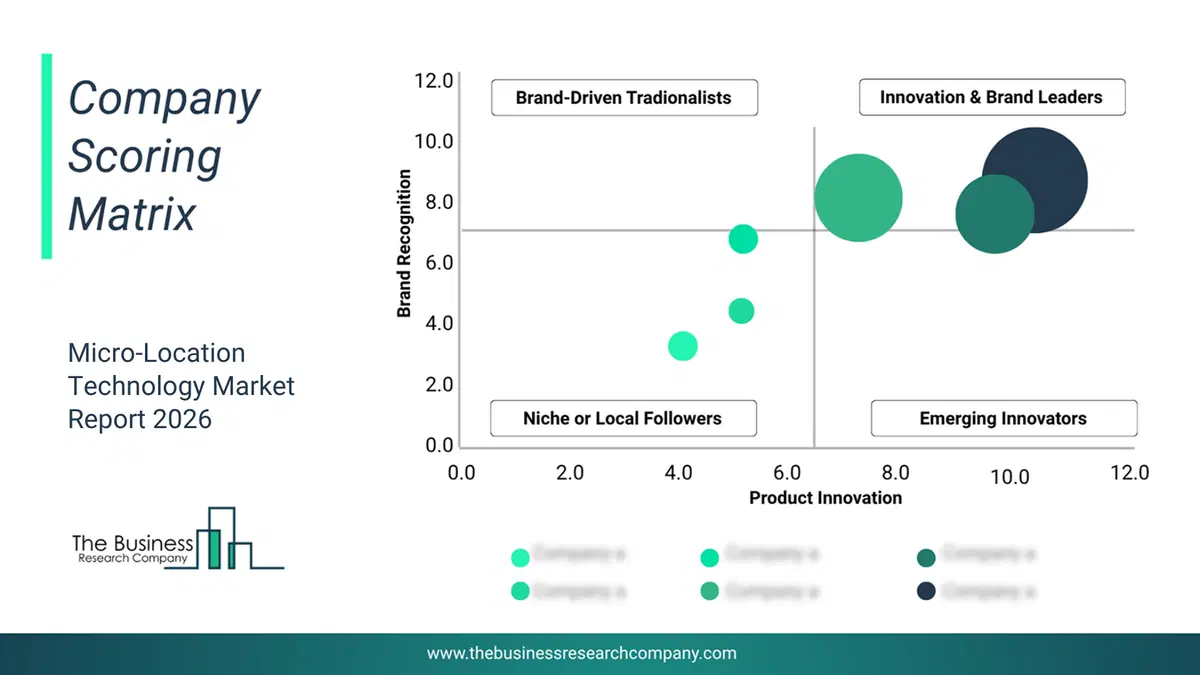
This chart maps companies by product innovation and brand strength, with bubble size indicating relative revenue, helping identify market leaders, challengers, and niche players. This is an illustrative chart; the full report provides a complete and accurate competitive analysis.
Global Micro-Location Technology Market Trends and Insights
Major companies operating in the micro-location technology market are developing advanced technologies such as location platforms to meet larger customer bases, more sales, and increase revenue. Location platforms are technology frameworks or systems designed to manage and provide location-based services and information. For instance, in January 2023, Here Technologies, a Netherlands-based location technology company, launched UniMap, an innovative and extensively automated mapping technology that facilitates the swift generation of digital maps and location-based products. UniMap stands out by offering unparalleled map freshness, quality, and coverage within the HERE platform. This advanced technology not only generates the comprehensive HERE map but empowers users to swiftly generate their private maps and tailor location services. The platform excels in automating map data processing and creation, merging diverse data types to form a unified map. Its distinctive capability lies in rendering changes observed in the physical environment visible on the map within a remarkable 24-hour timeframe. Moreover, it maintains all data in a singular environment, ensuring continuous accessibility for customers around the clock.What Are Latest Mergers And Acquisitions In The Micro-Location Technology Market?
In October 2023, Infineon Technologies, a Germany-based semiconductor manufacturer, acquired 3db Access AG for an undisclosed amount. As a result of the acquisition, Infineon has expanded its portfolio to include secured smart access, precise localization, and advanced sensing capabilities. The addition of ultra-wideband (UWB) technology complements its existing connectivity offerings, which include Wi-Fi, Bluetooth/Bluetooth Low Energy, and NFC solutions. 3db Access AG is a Switzerland-based company specializing in micro-location technology.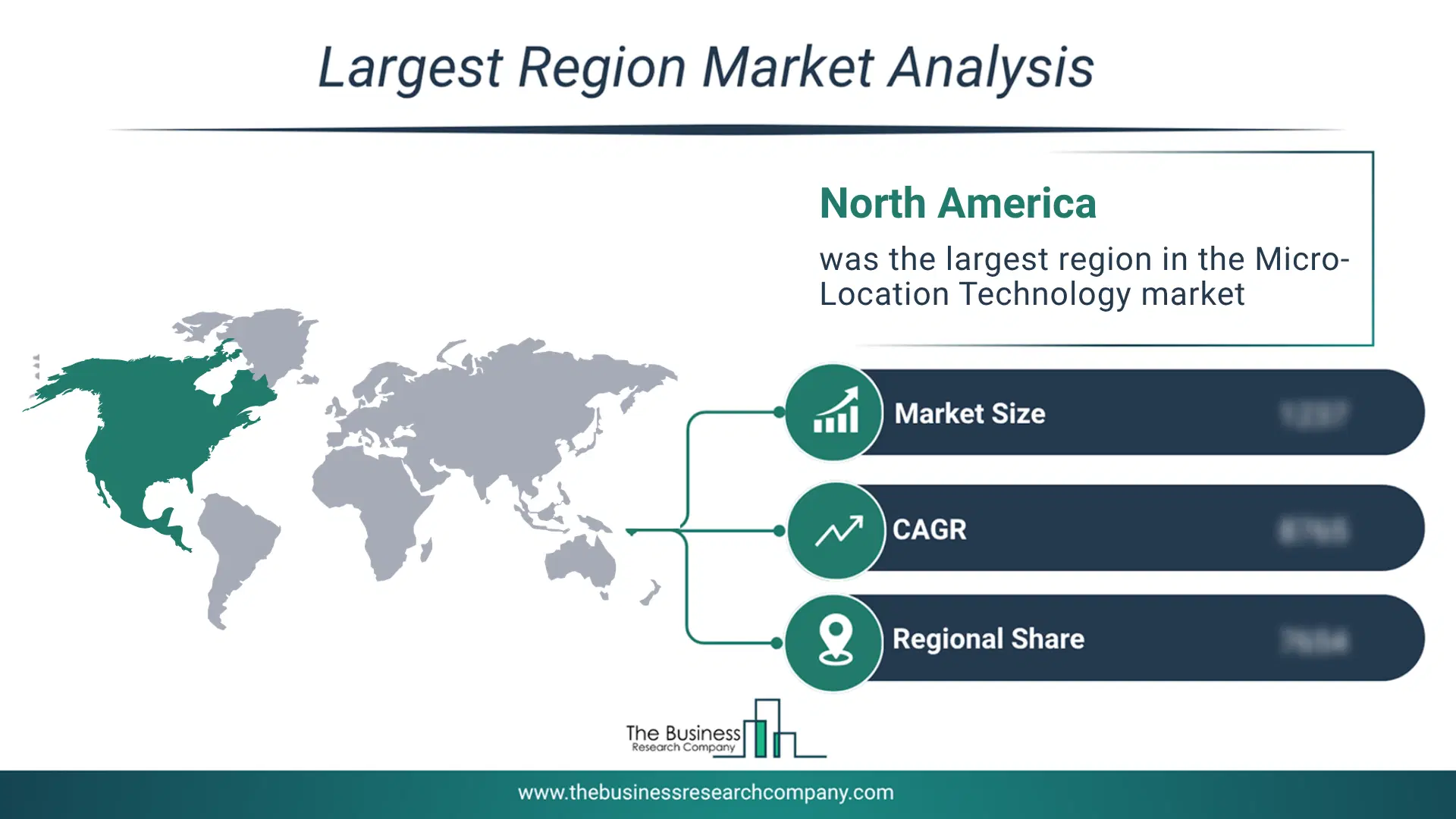
Regional Insights
North America was the largest region in the micro-location technology market share in 2025. Asia-Pacific is expected to be the fastest-growing region in the forecast period. The regions covered in this market report are Asia-Pacific, South East Asia, Western Europe, Eastern Europe, North America, South America, Middle East, Africa. The countries covered in this market report are Australia, Brazil, China, France, Germany, India, Indonesia, Japan, Taiwan, Russia, South Korea, UK, USA, Canada, Italy, SpainWhat Defines the Micro-Location Technology Market?
The micro-location technology market consists of revenues earned by entities providing services such as indoor positioning, streamlining manufacturing, tracking services, remote controlling, and preventing accidents. The market value includes the value of related goods sold by the service provider or included within the service offering. The micro-location technology market also includes sales of auto-follow video cameras, high-end drones, connected lightbulbs, sono speakers, and connected vehicles. Values in this market are ‘factory gate’ values, that is the value of goods sold by the manufacturers or creators of the goods, whether to other entities (including downstream manufacturers, wholesalers, distributors, and retailers) or directly to end customers. The value of goods in this market includes related services sold by the creators of the goods.How is Market Value Defined and Measured?
The market value is defined as the revenues that enterprises gain from the sale of goods and/or services within the specified market and geography through sales, grants, or donations in terms of the currency (in USD unless otherwise specified). The revenues for a specified geography are consumption values that are revenues generated by organizations in the specified geography within the market, irrespective of where they are produced. It does not include revenues from resales along the supply chain, either further along the supply chain or as part of other products.
This chart presents market attractiveness based on a quantitative evaluation of growth, competition, strategic alignment, and risk, offering a clear view of opportunity areas for decision-making. This chart is for illustrative purposes; the full report contains the complete analysis.

This chart highlights the Total Addressable Market (TAM) by estimating the maximum revenue opportunity using an assumption-driven approach, supporting strategic planning and opportunity sizing across markets. The chart is illustrative; the full report provides a more comprehensive analysis.
What Key Data and Analysis Are Included in the Micro-Location Technology Market Report 2026?
The micro-location technology market research report is one of a series of new reports from The Business Research Company that provides market statistics, including industry global market size, regional shares, competitors with the market share, detailed market segments, market trends and opportunities, and any further data you may need to thrive in the micro-location technology industry. The market research report delivers a complete perspective of everything you need, with an in-depth analysis of the current and future state of the industry.Micro-Location Technology Market Report Forecast Analysis
| Report Attribute | Details |
|---|---|
| Market Size Value In 2026 | $40.62 billion |
| Revenue Forecast In 2030 | $73.04 billion |
| Growth Rate | CAGR of 15.8% from 2026 to 2030 |
| Base Year For Estimation | 2025 |
| Actual Estimates/Historical Data | 2020-2025 |
| Forecast Period | 2026 - 2030 |
| Market Representation | Revenue in USD Billion and CAGR from 2026 to 2030 |
| Segments Covered | Component, Technology, Application, End Use |
| Regional Scope | Asia-Pacific, Western Europe, Eastern Europe, North America, South America, Middle East, Africa |
| Country Scope | The Countries Covered In This Market Report Are Australia, Brazil, China, France, Germany, India, Indonesia, Japan, Taiwan, Russia, South Korea, Uk, Usa, Canada, Italy, Spain. |
| Key Companies Profiled | Apple Inc., Cisco Systems Inc., Google LLC, CenTrak Inc., Humatics Corporation, Hewlett Packard Enterprise Development LP, Sewio Networks, Siemens AG, Zebra Technologies, Ubisense Group, Aruba Networks, Kontakt.io, Ruckus Networks, Estimote Inc., Quuppa Intelligent Locating System, Mist Systems, Inc., DecaWave Limited, Redpine Signals, Visible Assets Inc., Gimbal Inc., Bluvision, Pole Star, Inpixon, Pointr, IndoorAtlas Oy, KIO RTLS, Locatify, MERIDIAN, sensewhere Ltd., Hexagon AB |
| Customization Scope | Request for Customization |
| Pricing And Purchase Options | Explore Purchase Options |