

Micro-mobility Charging Infrastructure Market Report 2026
Global Outlook – By Type (Wired, Wireless), By Vehicle Type (E-Scooters, E-Bikes, E-Unicycles, E-Skateboards), By Source (Solar Powered, Battery Powered), By End-Users (Residential, Commercial) – Market Size, Trends, Strategies, and Forecast to 2030
Micro-mobility Charging Infrastructure Market Overview
• Micro-mobility Charging Infrastructure market size has reached to $8.52 billion in 2025 • Expected to grow to $22.92 billion in 2030 at a compound annual growth rate (CAGR) of 21.8% • Growth Driver: Surge In E-Scooter And E-Bike Adoption Accelerating Micro-Mobility Charging Infrastructure Market • Market Trend: Ai-Enabled Platforms Redefining Micro Mobility Charging Infrastructure • Asia-Pacific was the largest region in 2025 and North America is the fastest growing region.What Is Covered Under Micro-mobility Charging Infrastructure Market?
Micro-mobility charging infrastructure refers to a micro-mobility charging infrastructure used to charge category of transportation vehicles, that offer an alternative to traditional modes of transportation. The primary purpose of the charging infrastructure is to provide electrical energy to the micro-mobility vehicle battery for recharging purposes while also utilizing intelligent communication and protection technologies to assure the safe flow of electricity. The main types of micro-mobility charging infrastructure are wired and wireless. The wired infrastructure refers to wired mobility charging infrastructure cable made for manually connecting a conductor between a charging station and a vehicle. Wired micro mobility charging infrastructure allows micro mobility automobiles to recharge from an energy supply. The vehicle types included are e-scooters, e-bikes, e-unicycles, e-skateboards, that are generally sourced through solar powered and battery powered medium. These are used for residential and commercial purposes.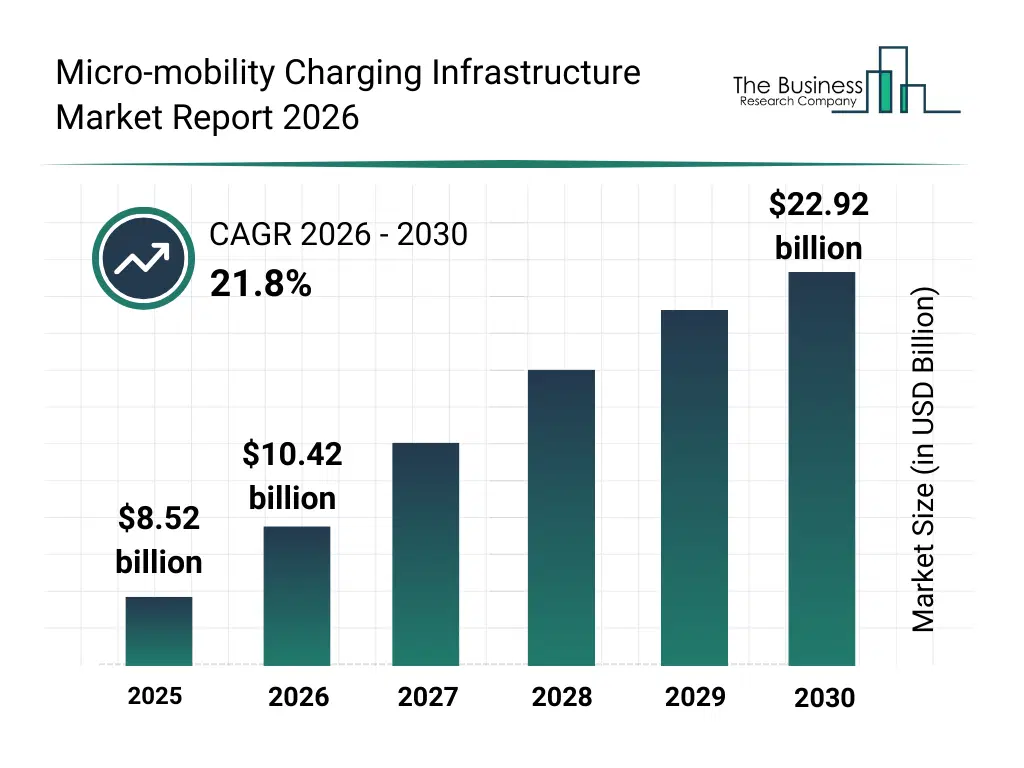
What Is The Micro-mobility Charging Infrastructure Market Size and Share 2026?
The micro-mobility charging infrastructure market size has grown exponentially in recent years. It will grow from $8.52 billion in 2025 to $10.42 billion in 2026 at a compound annual growth rate (CAGR) of 22.4%. The growth in the historic period can be attributed to rise in electric scooter usage, early public charging pilots, growth of shared mobility fleets, urban electrification initiatives, declining battery costs.What Is The Micro-mobility Charging Infrastructure Market Growth Forecast?
The micro-mobility charging infrastructure market size is expected to see exponential growth in the next few years. It will grow to $22.92 billion in 2030 at a compound annual growth rate (CAGR) of 21.8%. The growth in the forecast period can be attributed to large scale micro mobility adoption, smart city charging investments, demand for fast charging solutions, growth of solar powered charging, regulatory support for EV infrastructure. Major trends in the forecast period include deployment of smart charging stations, growth of wireless charging solutions, integration with renewable energy sources, expansion of public charging networks, focus on safe and standardized charging.
Global Micro-mobility Charging Infrastructure Market Segmentation
1) By Type: Wired, Wireless 2) By Vehicle Type: E-Scooters, E-Bikes, E-Unicycles, E-Skateboards 3) By Source: Solar Powered, Battery Powered 4) By End-Users: Residential, Commercial Subsegments: 1) By Wired: AC Charging Stations, DC Fast Charging Stations, Standard Charging Outlets, Smart Charging Solutions 2) By Wireless: Inductive Charging Pads, Resonant Charging Systems, Dynamic Wireless Charging SolutionsWhat Is The Driver Of The Micro-mobility Charging Infrastructure Market?
The rising adoption of e-scooters and e-bikes is expected to propel the micro-mobility charging infrastructure market going forward. An electric bike or e-scooter is a conventional bike with an electric motor to assist the action of the pedals, making cycling less stressful or replacing pedaling. The social distancing being the best line of defense against COVID-19, there has recently been a sudden increased demand for personal e-mobility. Furthermore, Climate change and the need to attain net-zero emissions are pushing the global shift to emission-free transportation. These adoptions result in greater production of e-vehicle, thus increasing the demand for micro-mobility charging infrastructure. For instance, in May 2025, according to the International Energy Agency (IEA), a France-based autonomous intergovernmental organisation, in 2024, China, the world’s largest 2W market, recorded electric two-wheeler sales totalling about 7 million units. Southeast Asia also made notable progress on 2W electrification in 2024, particularly in Viet Nam, which recorded around 250,000 sales (a sales share close to 10%), in Indonesia, with about 105,000 sales, and in the Philippines, with more than 25,000 electric two-wheelers sold. Therefore, the rising adoption of e-scooters and e-bikes will drive the micro-mobility charging infrastructure industry.Key Players In The Global Micro-mobility Charging Infrastructure Market
Major companies operating in the micro-mobility charging infrastructure market report include Ather Energy Private Limited, Bike-energy GmbH, Bikeep Inc., Flower Turbines Inc., Giulio Barbieri SRL, Ground Control Systems Inc., Magment GmbH, Perch Mobility Inc., Robert Bosch GmbH, Solum PV S.L., Swiftmile Inc., The Mobility House GmbH, GetCharged Inc., Charge-e Inc., Greenspot EV Charging, Tritium Pty Ltd., Webasto SE, ABL Group B.V., Alfen N.V., Ampcontrol Pty Ltd, Blink Charging Co., ChargeLab Ltd., CIRCONTROL S.A., Delta-Q Technologies Corporation, Ekoenergetyka-Polska Sp. z o.o., EVoCharge B.V., FLO Services Inc., GreenFlux B.V., innogy SE, KEBA AG, Leviton Manufacturing Company Inc.
This chart is for illustrative purposes; the full report includes a detailed competitor analysis and comprehensive overview of the top 10 companies in the market.
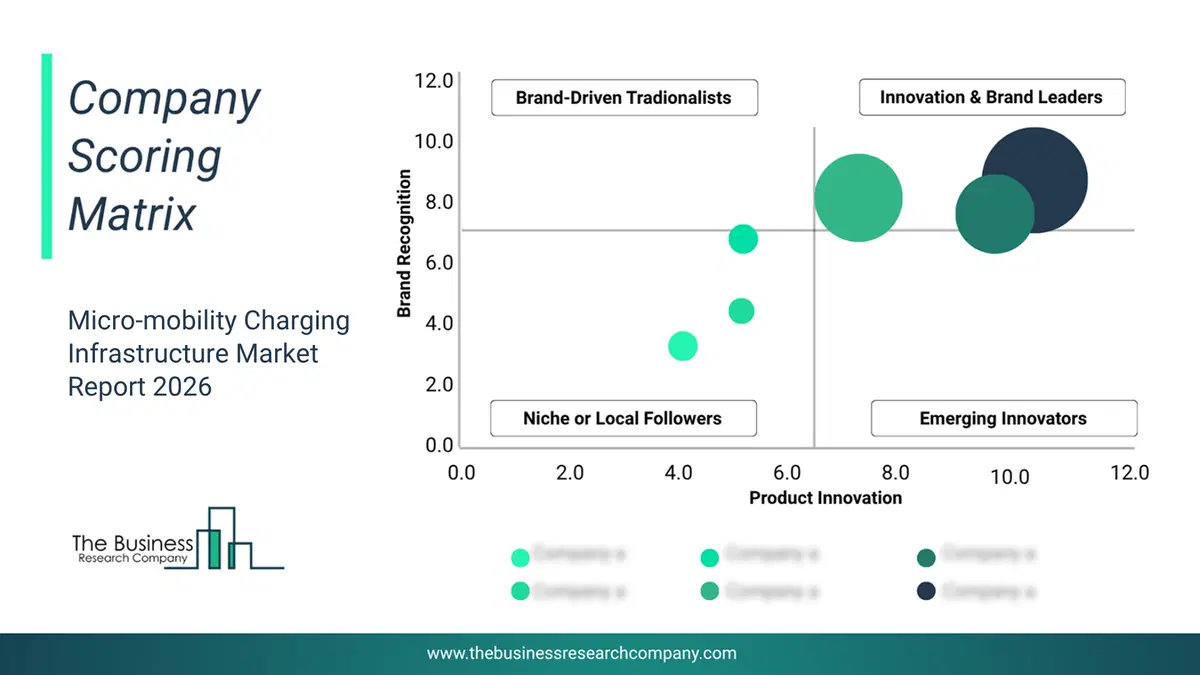
This chart maps companies by product innovation and brand strength, with bubble size indicating relative revenue, helping identify market leaders, challengers, and niche players. This is an illustrative chart; the full report provides a complete and accurate competitive analysis.
Global Micro-mobility Charging Infrastructure Market Trends and Insights
Major companies operating in the micro-mobility charging infrastructure market are developing innovative products such as AI-enabled platforms to meet larger customer bases, more sales, and increase revenue. An AI-enabled platform refers to a software or hardware system that integrates artificial intelligence (AI) capabilities and features into its core functionality. For instance, in August 2023, Cardio Diagnostics Holdings Inc., a US-based provider of electric vehicle (EV) charging stations integrated with battery technology, and comprehensive energy management solutions, launched Mobilyze Pro. Distinguishing itself with unique features, the platform introduces new tools such as a utilization prediction engine, a tariff recommendation engine, and a profitability calculator. These tools harness the power of AI to analyze both public and proprietary datasets, enabling the prediction of optimal locations for deploying high-speed electric vehicle (EV) charging stations. Mobilyze Pro is crafted to assist site hosts in addressing the surging demand for charging infrastructure. By delivering precise utilization and profitability forecasts, these tools empower owners of charging infrastructure to effectively compare site locations and hardware solutions. This, in turn, instills confidence in the business case for electric vehicle (EV) charging, overcoming a significant obstacle and expediting the deployment and accessibility of charging options for drivers.What Are Latest Mergers And Acquisitions In The Micro-mobility Charging Infrastructure Market?
In September 2023, Bird Global Inc., a US-based micromobility technology company, acquired Spin Operations LLC for US$ 19 million. With this acquisition, Bird Global, Inc. aimed to expand its geographic footprint and fleet capacity across North America to strengthen its competitive position and market share in shared electric mobility services. Spin Operations LLC is a US-based micromobility company that specializes in providing shared electric scooter and e-bike.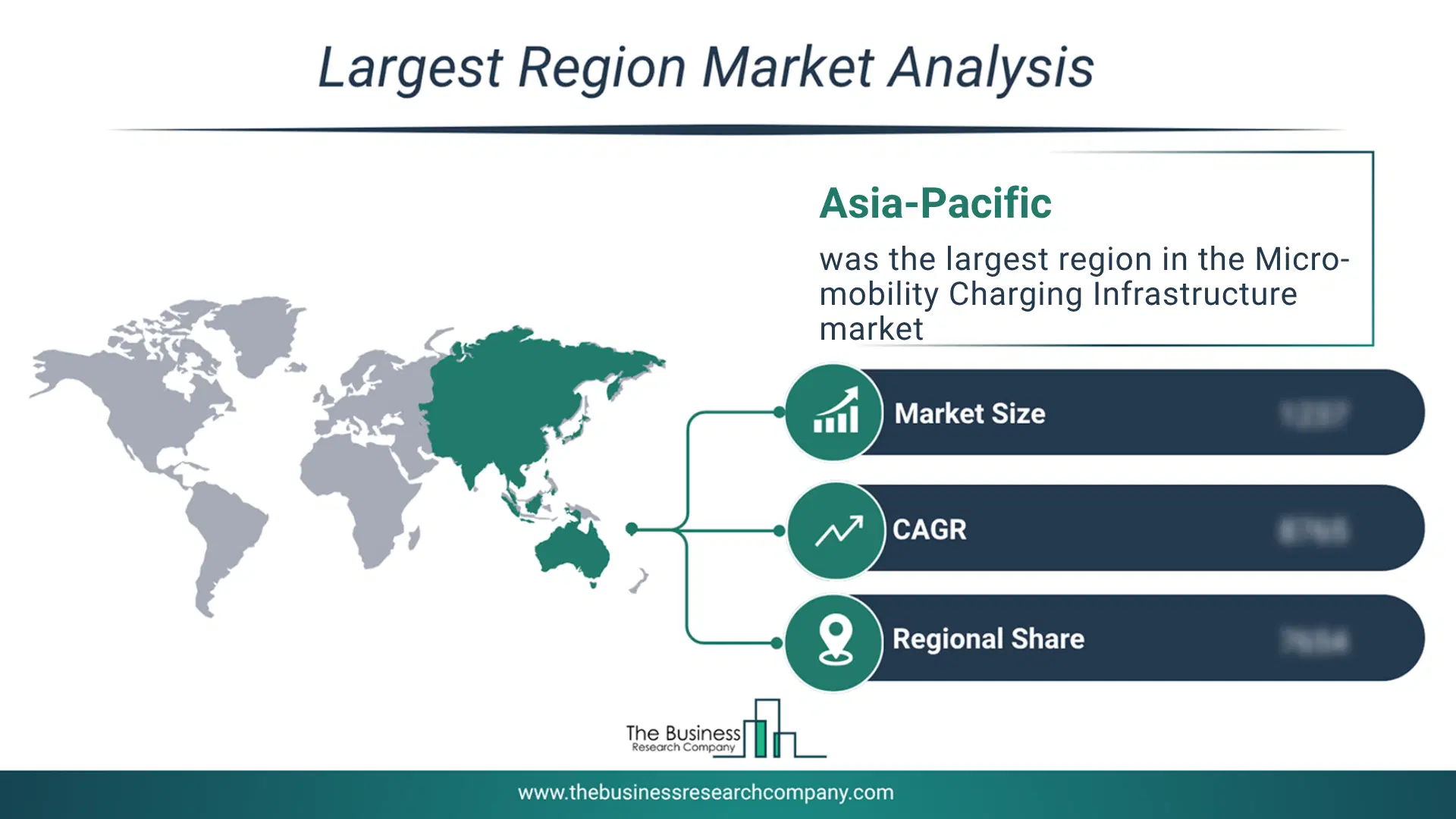
Regional Outlook
Asia-Pacific was the largest region in the micro-mobility charging infrastructure market share in 2025. North America is expected to be the fastest-growing region in the forecast period. The regions covered in this market report include Asia-Pacific, South East Asia, Western Europe, Eastern Europe, North America, South America, Middle East, Africa. The countries covered in this market report include Australia, Brazil, China, France, Germany, India, Indonesia, Japan, Taiwan, Russia, South Korea, UK, USA, Canada, Italy, SpainWhat Defines the Micro-mobility Charging Infrastructure Market?
The micro-mobility charging infrastructure market consists of revenues earned by entities by providing services such as charging solution, vehicle maintenance, intelligent transport systems (ITS). The market value includes the value of related goods sold by the service provider or included within the service offering. The micro-mobility charging infrastructure market also includes sales of power sources, three-phase electric power, charging points, equipment which are used in providing micro-mobility charging infrastructure services. Values in this market are ‘factory gate’ values, that is the value of goods sold by the manufacturers or creators of the goods, whether to other entities (including downstream manufacturers, wholesalers, distributors and retailers) or directly to end customers. The value of goods in this market includes related services sold by the creators of the goods.How is Market Value Defined and Measured?
The market value is defined as the revenues that enterprises gain from the sale of goods and/or services within the specified market and geography through sales, grants, or donations in terms of the currency (in USD unless otherwise specified). The revenues for a specified geography are consumption values that are revenues generated by organizations in the specified geography within the market, irrespective of where they are produced. It does not include revenues from resales along the supply chain, either further along the supply chain or as part of other products.
This chart presents market attractiveness based on a quantitative evaluation of growth, competition, strategic alignment, and risk, offering a clear view of opportunity areas for decision-making. This chart is for illustrative purposes; the full report contains the complete analysis.

This chart highlights the Total Addressable Market (TAM) by estimating the maximum revenue opportunity using an assumption-driven approach, supporting strategic planning and opportunity sizing across markets. The chart is illustrative; the full report provides a more comprehensive analysis.
What Key Data and Analysis Are Included in the Micro-mobility Charging Infrastructure Market Report 2026?
The micro-mobility charging infrastructure market research report is one of a series of new reports from The Business Research Company that provides market statistics, including industry global market size, regional shares, competitors with the market share, detailed market segments, market trends and opportunities, and any further data you may need to thrive in the micro-mobility charging infrastructure industry. The market research report delivers a complete perspective of everything you need, with an in-depth analysis of the current and future state of the industry.Micro-mobility Charging Infrastructure Market Report Forecast Analysis
| Report Attribute | Details |
|---|---|
| Market Size Value In 2026 | $10.42 billion |
| Revenue Forecast In 2030 | $22.92 billion |
| Growth Rate | CAGR of 22.4% from 2026 to 2030 |
| Base Year For Estimation | 2025 |
| Actual Estimates/Historical Data | 2020-2025 |
| Forecast Period | 2026 - 2030 - 2030 |
| Market Representation | Revenue in USD Billion and CAGR from 2026 to 2030 |
| Segments Covered | Type, Vehicle Type, Source, End-Users |
| Regional Scope | Asia-Pacific, Western Europe, Eastern Europe, North America, South America, Middle East, Africa |
| Country Scope | The countries covered in the report are Australia, Brazil, China, France, Germany, India, Indonesia, Japan, Taiwan, Russia, South Korea, UK, USA, Canada, Italy, Spain. |
| Key Companies Profiled | Ather Energy Private Limited, Bike-energy GmbH, Bikeep Inc., Flower Turbines Inc., Giulio Barbieri SRL, Ground Control Systems Inc., Magment GmbH, Perch Mobility Inc., Robert Bosch GmbH, Solum PV S.L., Swiftmile Inc., The Mobility House GmbH, GetCharged Inc., Charge-e Inc., Greenspot EV Charging, Tritium Pty Ltd., Webasto SE, ABL Group B.V., Alfen N.V., Ampcontrol Pty Ltd, Blink Charging Co., ChargeLab Ltd., CIRCONTROL S.A., Delta-Q Technologies Corporation, Ekoenergetyka-Polska Sp. z o.o., EVoCharge B.V., FLO Services Inc., GreenFlux B.V., innogy SE, KEBA AG, Leviton Manufacturing Company Inc. |
| Customization Scope | Request for Customization |
| Pricing And Purchase Options | Explore Purchase Options |