

Microalgae Market 2025
By Type (Spirulina, Chlorella, Dunaliella Salina, Haematococcus Pluvialis, Other Microalgae), By Distribution Channel (Business Channel, Consumer Channel), By Application (Food And Beverage, Dietary Supplements, Pharmaceuticals, Cosmetics And Personal Care, Bio-Fuel, Inks, Animal Feed, Other Applications), And By Region, Opportunities And Strategies – Global Forecast To 2035
Microalgae Market Definition
Microalgae are microscopic, photosynthetic organisms found in freshwater and marine environments that convert sunlight, carbon dioxide and nutrients into biomass. They are rich in proteins, lipids, carbohydrates, vitamins and bioactive compounds, making them valuable for applications in food, feed, biofuels, pharmaceuticals and cosmetics. The primary purpose of microalgae is to serve as a sustainable source of nutrients, bioactive compounds and bioenergy. They are used for producing health supplements, functional foods, animal feed, biofuels and environmental applications such as carbon capture and wastewater treatment. The microalgae market consists of sales, by entities (organizations, sole traders and partnerships), of microalgae that are used depending on cultivation cycles and demand across applications, particularly for their protein, vitamins, pigments, antioxidants and fatty acids.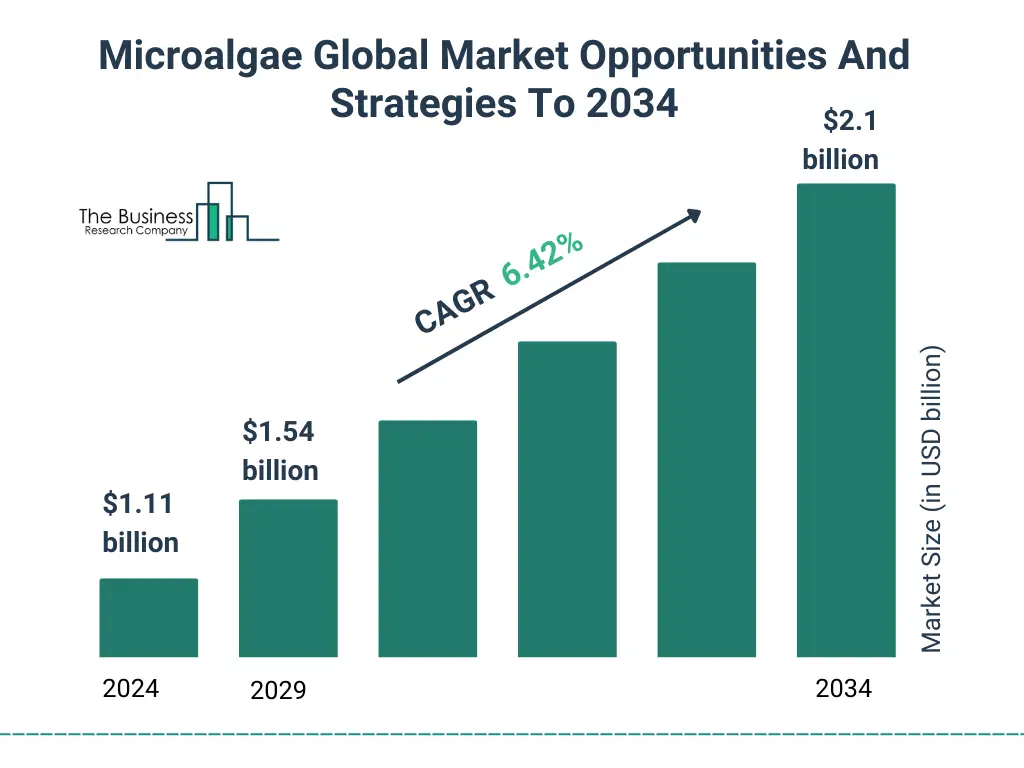
Microalgae Market Size
The global microalgae market reached a value of nearly $1,107.25 million in 2024, having grown at a compound annual growth rate (CAGR) of 5.41% since 2019. The market is expected to grow from $1,107.25 million in 2024 to $1,542.28 million in 2029 at a rate of 6.85%. The market is then expected to grow at a CAGR of 6.42% from 2029 and reach $2,104.96 million in 2034. Growth in the historic period resulted from shift towards plant-based products, rising health and wellness concerns, growing prevalence in functional foods and growing potential in biofuel production. Factors that negatively affected growth in the historic period were high production costs and competition from substitutes. Going forward, growth in the pharmaceutical industry, expansion of the cosmetic and personal care industry, growing demand for dietary supplements and growth in aquaculture and animal feed will drive growth. Factors that could hinder the growth of the microalgae market in the future include stringent regulations, taste, odor and texture challenges and impact of trade war and tariff.Microalgae Market Drivers
The key drivers of the microalgae market include: Growing Demand For Dietary Supplements During the forecast period, rising demand for dietary supplements is expected to be a key driver of growth in the microalgae market. Microalgae are rich in essential nutrients, bioactive compounds and antioxidants, making them highly attractive for use in supplements that support overall health, boost immunity and aid various physiological functions. The global dietary supplement market has seen strong growth in recent years, with projections pointing to continued expansion, fueled by increasing consumer awareness around health and wellness, along with the rising incidence of chronic diseases. Microalgae-based supplements—such as spirulina and chlorella—are becoming increasingly popular due to their high nutrient content and potential health benefits. As consumers shift toward natural and sustainable alternatives to synthetic supplements, demand for microalgae-derived ingredients is expected to surge, thereby contributing significantly to the growth of the microalgae market throughout the forecast period. The growing demand for dietary supplements contribution during the forecast period in 2024 is 1.50%.Microalgae Market Restraints
The key restraints on the microalgae market include: Stringent Regulations Stringent regulations are expected to hinder the growth of the microalgae market during the forecast period. In many developed countries, regulatory frameworks require microalgae species and their derived products to undergo extensive approvals such as novel food or food safety authorizations before they can be brought to market. For species not widely consumed before specific regulatory cut-off dates, legal status must be established, comprehensive safety assessments conducted and health claims substantiated. Additionally, strict limits on contaminants such as heavy metals, pathogens and residual pollutants further raise the bar for compliance, increasing production and testing costs. Regulations also impose rigorous standards on public health, labeling and manufacturing practices, including hygiene and adherence to Good Manufacturing Practices (GMP). These challenges not only delay product development and commercialization but also restrict the variety of microalgae species and extracts that can be used. As a result, regulatory barriers particularly impact smaller companies, raising entry costs and limiting market competitiveness. Growth affected by stringent regulations during the forecast period in 2024 is -1.30%.Microalgae Market Trends
Major trends shaping the microalgae market include: Sustainable Protein Source Developed From Chlorella Family Of Microalgae Major players in the microalgae market are developing sustainable protein source developed from chlorella family of microalgae. The emphasis on non-genetically modified organism (non-GMO) protein powder reflects the growing consumer demand for clean-label and natural ingredients. Protein derived from chlorella aligns with these preferences, making it particularly appealing to health-conscious consumers and environmentally aware markets. For instance, in June 2024, Brevel Ltd., an Israel-based company specializing in climate technology product manufacturing, inaugurated its first commercial microalgae protein production facility in Kiryat Gat, Israel. The 27,000-square-foot (2,500-square-meter) plant is designed to produce hundreds of tons of non-genetically modified organism (non-GMO) microalgae protein powder annually. Extracted from the chlorella family of microalgae, the protein is neutral in flavor and color, offering a sustainable, highly nutritious and market-ready alternative for use in plant-based food and dairy substitute applications. The company expects the first product rollouts from this facility by the first quarter of 2025, with the announcement highlighting chlorella as the core innovation driver and supported by multiple industry and press reports. Expansion Of Astaxanthin Production And R&D At BGG To Strengthen Supply And Quality Key companies in the microalgae market are investing heavily in expanding production capacity and in-house R&D to enhance product quality, traceability and speed to market. These initiatives focus on optimizing the production-to-extraction value chain under certified organic conditions, reducing carbon footprint and enabling integrated processes (cultivation, extraction, drying, packaging) to ensure greater control over product consistency and regulatory compliance. For instance, in May 2025, BGG (Beijing Gingko Group Biological Technology Co., Ltd.) announced a significant expansion of its astaxanthin manufacturing facilities in Yunnan Province, China. This expansion consolidates the entire value chain, including farming, extraction, drying, packaging and research and development, within a 20 km area to improve operational efficiency and reduce the carbon footprint. Additionally, BGG is establishing a new cutting-edge research laboratory and more than doubling its on-site R&D team, focusing on microalgae innovation and advancing ingredient quality, in collaboration with regional and global institutes. This facility houses the world's largest 100% glass-tube photobioreactor microalgae platform for producing natural astaxanthin (product line named AstaZine), derived from certified organic Haematococcus pluvialis microalgae.Opportunities And Recommendations In The Microalgae Market
Opportunities – The top opportunities in the microalgae market segmented by type will arise in the spirulina segment, which will gain $191.15 million of global annual sales by 2029. The top opportunities in the microalgae market segmented by distribution channel will arise in the business channel segment, which will gain $271.40 million of global annual sales by 2029. The top opportunities in the microalgae market segmented by application will arise in the food and beverages segment, which will gain $116.48 million of global annual sales by 2029. The microalgae market size will gain the most in the USA at $113.64 million. Recommendations- To take advantage of the opportunities, The Business Research Company recommends the microalgae companies to focus on developing spirulina-based alternative protein products, focus on scaling chlorella-based protein production, focus on integrating production and r&d for operational efficiency, focus on developing algae-derived omega-3 for sustainable feed, focus on adopting flexible and sustainable cultivation systems, focus on haematococcus pluvialis for growth, expand in emerging markets, focus on expanding strategic distribution channels, focus on optimizing pricing strategies for market competitiveness, focus on strengthening brand awareness and market education, focus on expanding strategic partnerships for market reach, focus on consumer channel for market expansion, focus on pharmaceuticals for high-value growth.
Microalgae Market Segmentation
The microalgae market is segmented by type, by distribution channel and by application.By Type –
The c market is segmented by type into:
- a) Spirulina
- b) Chlorella
- c) Dunaliella Salina
- d) Haematococcus Pluvialis
- e) Other Microalgae
By Distribution Channel –
The microalgae market is segmented by distribution channel into:
- a) Business Channel
- b) Consumer Channel
By Application –
The microalgae market is segmented by application into:
- a) Food And Beverage
- b) Dietary Supplements
- c) Pharmaceuticals
- c) Cosmetics And Personal Care
- c) Bio-Fuel
- c) Inks
- c) Animal Feed
- c) Other Applications
By Geography - The microalgae market is segmented by geography into:
- • China
- • India
- • Japan
- • Australia
- • Indonesia
- • South Korea
- • USA
- • Canada
- • Brazil
- • France
- • Germany
- • UK
- • Italy
- • Spain
- • Russia
-
o Asia Pacific
o Africa