

Microchannel Heat Exchanger Market Report 2026
Global Outlook – By Type (Air Handling Units, Heat Pumps, Fan Coil Units, Chillers), By Material Type (Metal, Ceramic), By Fluid Mechanism (Single Coil, Dual Coil, Multi Coil), By End-Use Industry (Automotive, Heating, Ventilation, And Air Conditioning (HVAC), Commercial Refrigeration, Other End-Use Industries) – Market Size, Trends, Strategies, and Forecast to 2030
Microchannel Heat Exchanger Market Overview
• Microchannel Heat Exchanger market size has reached to $15.25 billion in 2025 • Expected to grow to $23.47 billion in 2030 at a compound annual growth rate (CAGR) of 9.1% • Growth Driver: Impact Of Construction Industry Growth On Microchannel Heat Exchanger Market • Market Trend: Advanced Product Development In Compact Microchannel Heat Exchangers • North America was the largest region in 2025 and Asia-Pacific is the fastest growing region.Market Gains By 2030 – Top Opportunities By Segment
Market Gain identifies the most promising market opportunities by highlighting the segments or products expected to generate the highest incremental revenue growth over the next five years.
What Is Covered Under Microchannel Heat Exchanger Market?
A microchannel heat exchanger (MCHE) is a compact heat transfer device with numerous small fluid channels designed to enhance efficiency in various applications, including HVAC (heating, ventilation, and air conditioning) systems, automotive cooling, and industrial refrigeration. MCHEs achieve high thermal performance by maximizing surface-area contact between fluids, making them ideal for environments where space and energy efficiency are critical considerations. The main types of microchannel heat exchangers are air handling units, heat pumps, fan coil units, and chillers. Air handling units (AHUs) are devices used to circulate and condition air within HVAC systems. They incorporate microchannel heat exchangers to transfer heat between incoming and outgoing air streams efficiently, maintaining desired indoor temperatures and air quality in buildings. Various materials are used, such as metal and ceramic, and various mechanisms are used, including single coil, dual coil, and multi coil. These are used by several end-use industries, including automotive, heating, ventilation, and air conditioning (HVAC), commercial refrigeration, and others.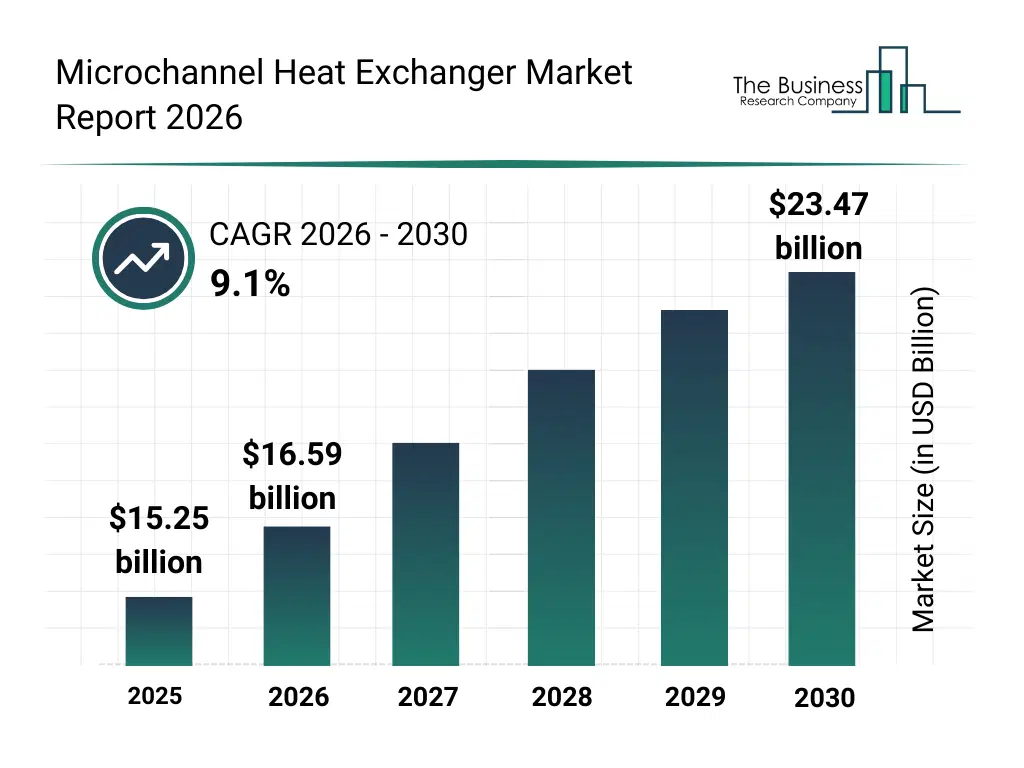
What Is The Microchannel Heat Exchanger Market Size and Share 2026?
The microchannel heat exchanger market size has grown strongly in recent years. It will grow from $15.25 billion in 2025 to $16.59 billion in 2026 at a compound annual growth rate (CAGR) of 8.8%. The growth in the historic period can be attributed to increasing demand for energy efficient HVAC systems, growth of automotive production volumes, rising adoption of compact thermal management solutions, need for reduced refrigerant charge levels, expansion of commercial refrigeration infrastructure.What Is The Microchannel Heat Exchanger Market Growth Forecast?
The microchannel heat exchanger market size is expected to see strong growth in the next few years. It will grow to $23.47 billion in 2030 at a compound annual growth rate (CAGR) of 9.1%. The growth in the forecast period can be attributed to increasing electric vehicle production requirements, stricter energy efficiency regulations, rising demand for advanced heat pumps, growth in data center cooling applications, technological advancements in microchannel manufacturing processes. Major trends in the forecast period include rising adoption of compact heat exchangers in HVAC systems, growing demand for high efficiency automotive cooling solutions, increased use of aluminum microchannel designs, shift toward lightweight and space saving thermal components, expansion of microchannel heat exchangers in commercial refrigeration.
Global Microchannel Heat Exchanger Market Segmentation
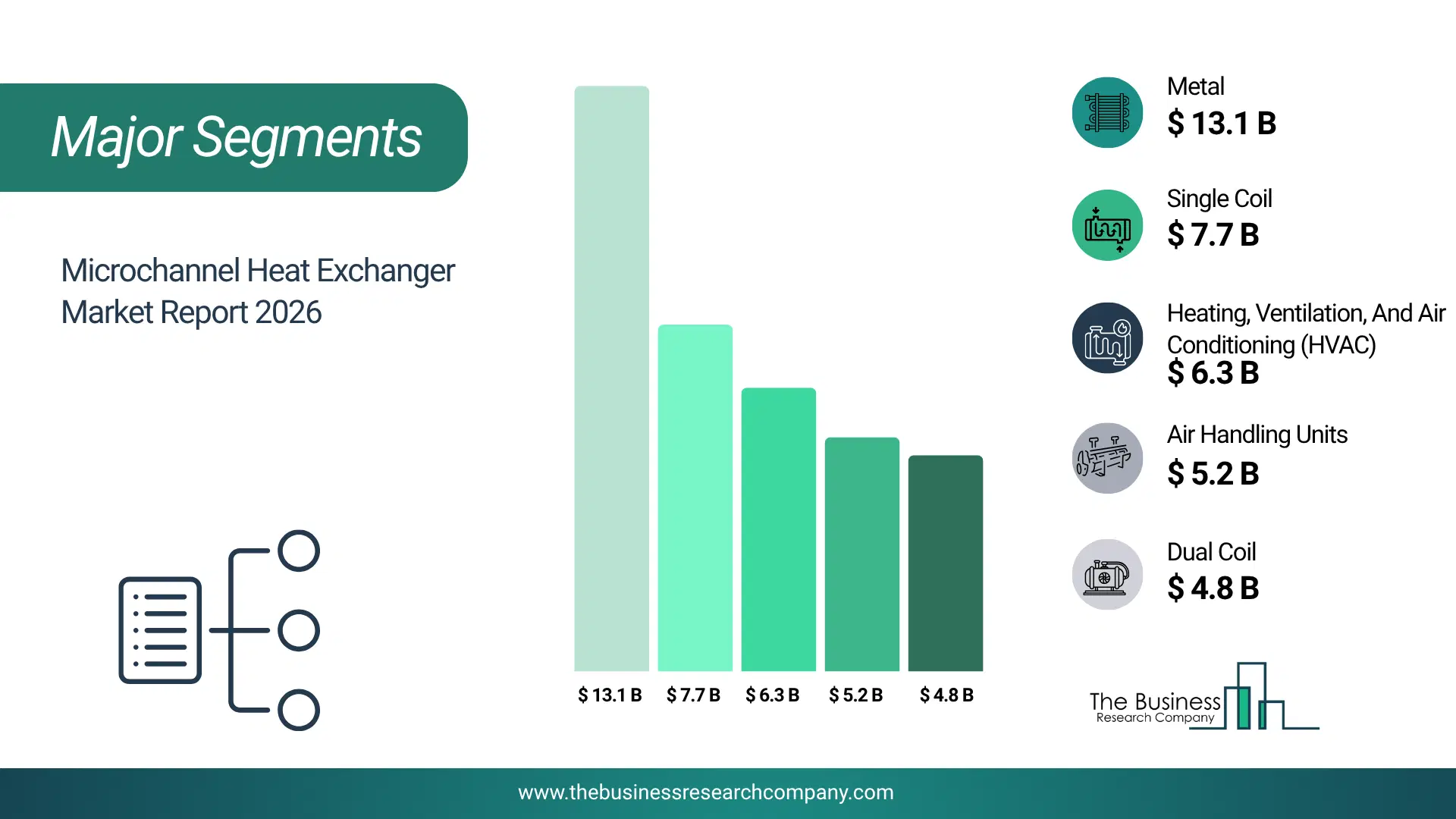
1) By Type: Air Handling Units, Heat Pumps, Fan Coil Units, Chillers 2) By Material Type: Metal, Ceramic 3) By Fluid Mechanism: Single Coil, Dual Coil, Multi Coil 4) By End-Use Industry: Automotive, Heating, Ventilation, And Air Conditioning (HVAC), Commercial Refrigeration, Other End-Use Industries Subsegments: 1) By Air Handling Units: HVAC Air Handling Units, Industrial Air Handling Units 2) By Heat Pumps: Air Source Heat Pumps, Ground Source Heat Pumps 3) By Fan Coil Units: Ceiling Mounted Fan Coil Units, Floor Mounted Fan Coil Units 4) By Chillers: Air-Cooled Chillers, Water-Cooled Chillers The top segments in the microchannel heat exchanger market will be: • Metal will reach $13158.67 Million by 2025. • Single Coil will reach $7711.49 Million by 2025. • Heating, Ventilation, And Air Conditioning (HVAC) will reach $6333.29 Million by 2025. • Air Handling Units will reach $5274.29 Million by 2025. • Dual Coil will reach $4886.77 Million by 2025.What Is The Driver Of The Microchannel Heat Exchanger Market?
The growing construction industry is expected to propel the growth of the microchannel heat exchanger market going forward. The construction industry encompasses the processes involved in creating infrastructure and buildings, including residential, commercial, and industrial projects. The construction industry is expanding due to increased urbanization and infrastructure development demands driven by population growth and economic development. Microchannel heat exchangers are used in the construction industry for efficient heating, ventilation, and air conditioning (HVAC) systems due to their compact size and superior heat transfer capabilities. For instance, in July 2023, according to Australian Bureau of Statistics, an Australian-based government administration, during the March quarter of 2023, there were 240,813 dwellings under construction, an increase from 240,065 in 2022. Of this total, 103,778 were new houses, up from 101,240 in 2022. Therefore, the growing construction industry is driving the growth of the microchannel heat exchanger industry.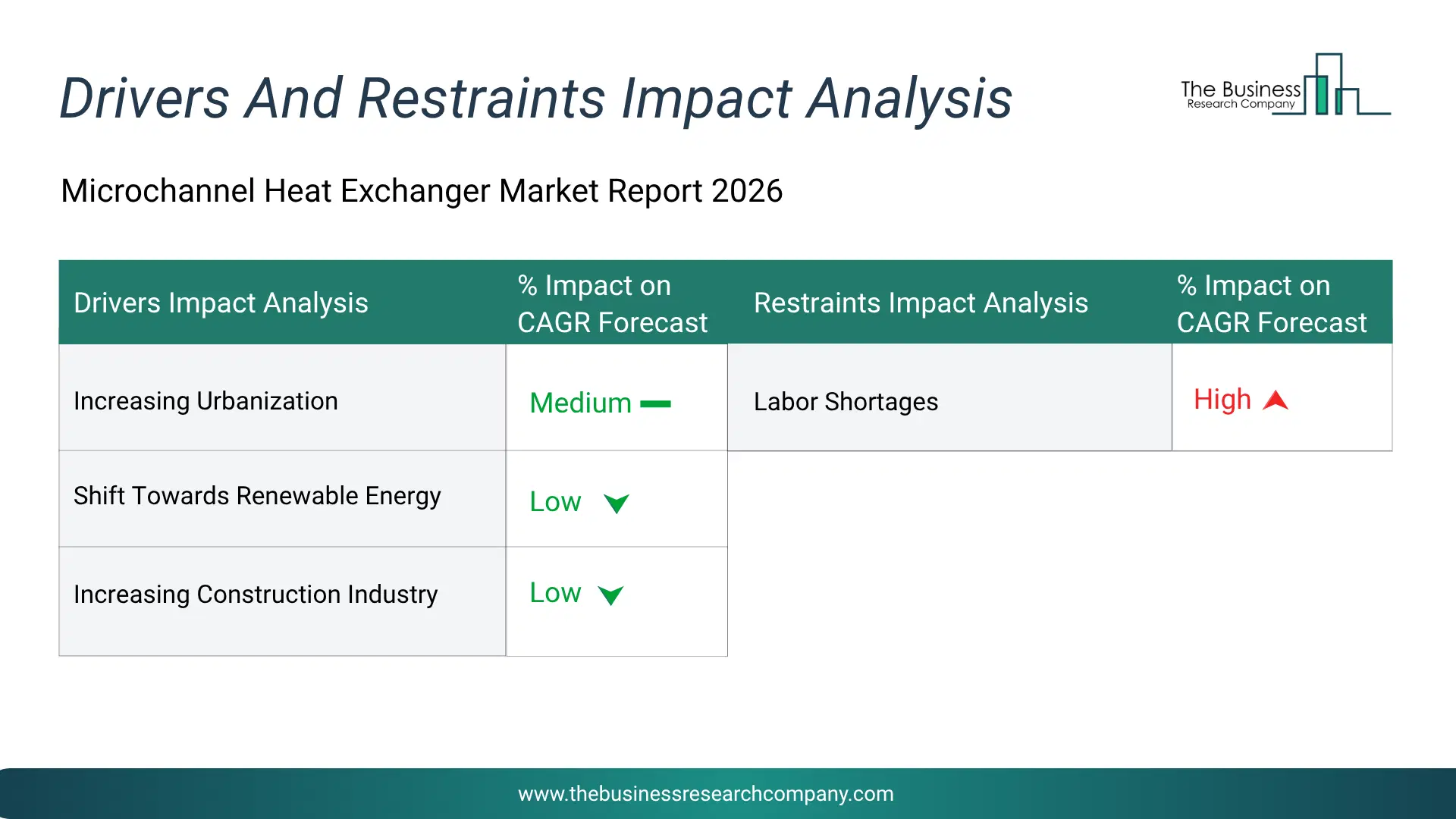
Infographic Chart Showing Key Market Drivers Analysis And Restraints For Microchannel Heat Exchanger Market
The chart presents an impact analysis of key drivers and restraints, quantifying their relative influence on the market's growth rate and helping assess the balance between growth enablers and limiting factors. This chart offers a high-level perspective; the full report contains more detailed insights.
How Will The Drivers Impact Growth In The Global Microchannel Heat Exchanger Market?
• Increasing Urbanization (Medium) – The increasing urbanization will become a key driver of growth in the microchannel heat exchanger market by 2030. Urbanization positively influences microchannel heat exchangers by driving the demand for energy-efficient, space-saving cooling solutions in densely populated areas with high industrial and residential needs. • Shift Towards Renewable Energy (Low) – The shift towards renewable energy will emerge as a major factor driving the expansion of the microchannel heat exchanger market by 2030. Renewable energy positively impacts microchannel heat exchangers by increasing the demand for energy-efficient cooling systems in sustainable energy applications, such as solar-powered HVAC (heating, ventilation and air conditioning) and industrial processes. • Increasing Construction Industry (Low) – The increasing construction industry will serve as a key growth catalyst for the microchannel heat exchanger market by 2030. The construction industry requires microchannel heat exchangers for their energy-efficient, space-saving cooling solutions, which are ideal for HVAC (heating, ventola systems and other building applications that demand compact and effective thermal management. • Growth In Data Centers (Low) – The growth in data centers will become a significant driver contributing to the growth of the microchannel heat exchanger market by 2030. Data centers are specialized facilities used to house and manage large amounts of computer servers, storage systems, and networking equipment for processing, storing and transmitting data. Data centers require microchannel heat exchangers for efficient, space-saving thermal management to effectively cool high-density server equipment and maintain optimal performance.How Will The Restraints Impact Growth In The Global Microchannel Heat Exchanger Market?
• Labor Shortages (Medium) – Labor Shortages will restrict the growth of the Microchannel Heat Exchanger market during the forecast period. The manufacturing and installation of microchannel heat exchangers require skilled technical personnel with specialized knowledge in brazing, assembly, and quality control. Labor shortages in manufacturing and HVAC installation sectors limit production capacity and project execution. The skill gap can lead to production delays, quality issues, and increased labor costs, affecting market growth and profitability.Key Players In The Global Microchannel Heat Exchanger Market
Major companies operating in the microchannel heat exchanger market are DENSO Corporation, DAIKIN INDUSTRIES Ltd, Johnson Controls plc, Danfoss Industries Pvt. Ltd., Hanon Systems, Alfa Laval, Modine Manufacturing, Greenheck Group, MAHLE GmbH, Evapco Inc., API Heat Transfer Inc., Vahterus, Thermofin, Climetal S.L., Mikros Technologies, Goldstone HVACR Inc., Sanhua Holding Group Co., Kaltra GmbH, Kangsheng Group, MSD Technologies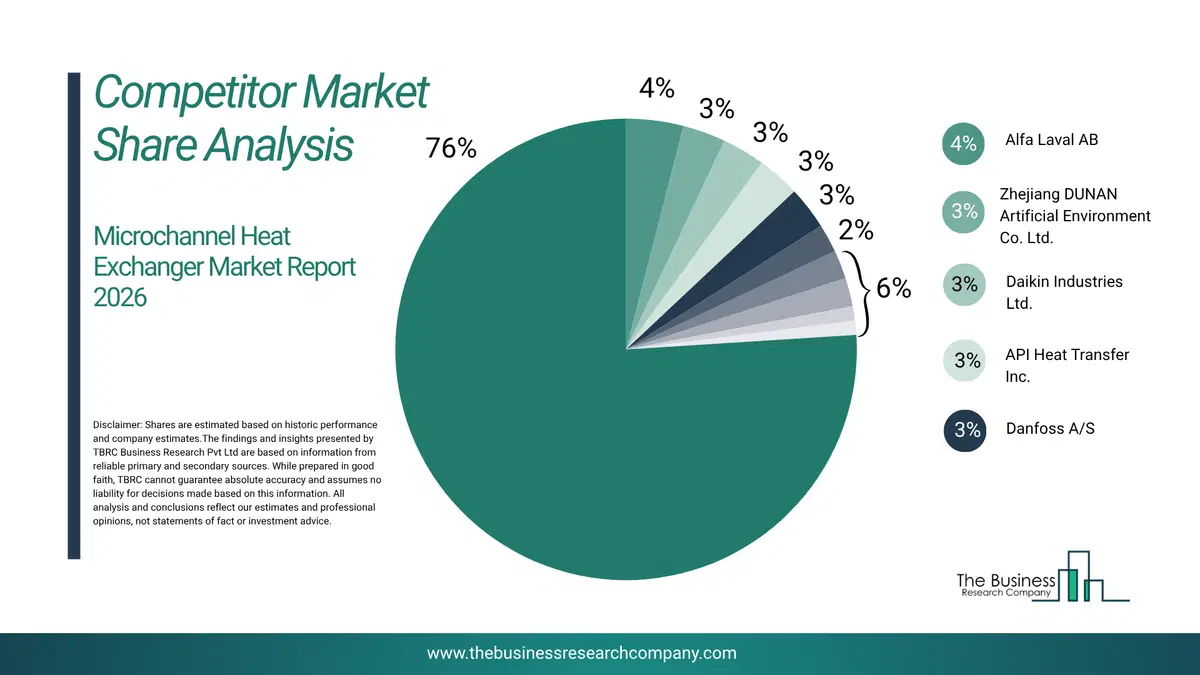
This chart is for illustrative purposes; the full report includes a detailed competitor analysis and comprehensive overview of the top 10 companies in the market.
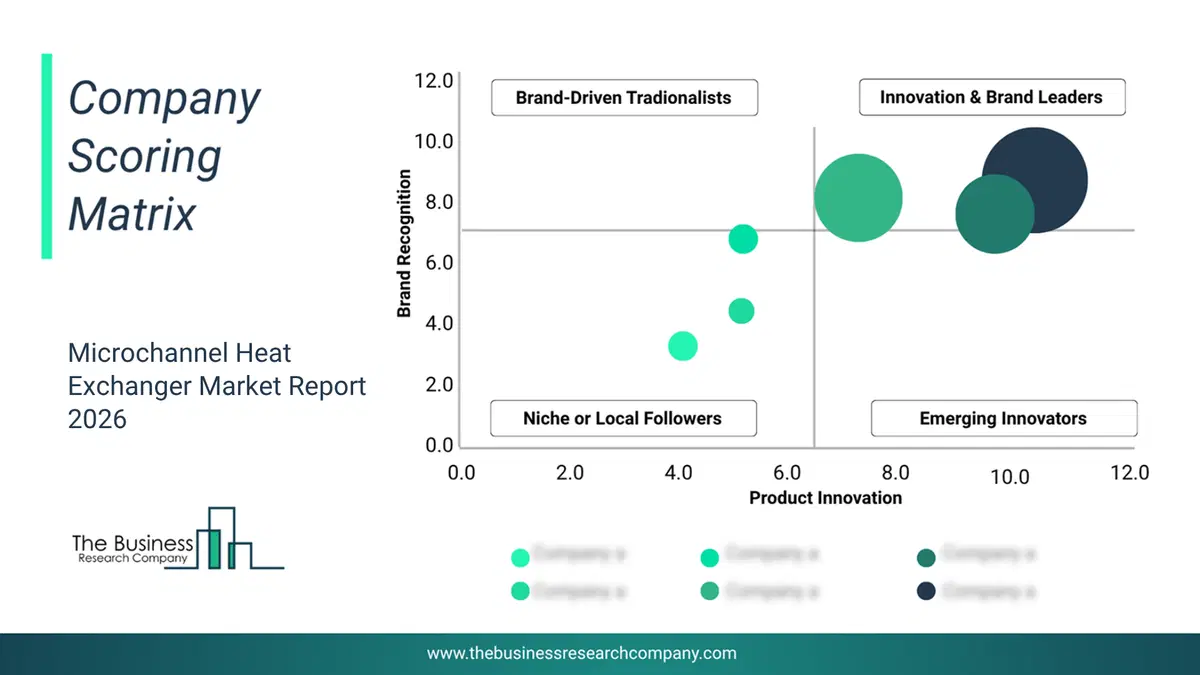
This chart maps companies by product innovation and brand strength, with bubble size indicating relative revenue, helping identify market leaders, challengers, and niche players. This is an illustrative chart; the full report provides a complete and accurate competitive analysis.
Global Microchannel Heat Exchanger Market Trends and Insights
Major companies operating in the microchannel heat exchanger market are focusing on developing advanced products, such as compact microchannel heat exchangers, to gain a competitive edge in the market. A compact microchannel heat exchanger refers to a type of heat exchanger designed with multiple small channels or passages through which fluids flow. For instance, in February 2024, Danfoss India, an India-based technology company, launched microchannel heat exchanger (MCHE) technology. This technology reduces refrigerant consumption by up to 60% and improves efficiency by 30%, in line with industry environmental, social, and governance (ESG) commitments. The patented distribution design optimizes refrigerant flow and improves heat transfer rates, resulting in cost savings and quicker installation. The compact design, lightweight, and sustainable materials make the MCHE suitable for use in residential and commercial air conditioning systems, as well as in energy-efficient refrigeration equipment, aimed at reducing the refrigerant charge.What Are Latest Mergers And Acquisitions In The Microchannel Heat Exchanger Market?
In March 2024, Nexson Group, a France-based manufacturer of heat exchangers and pressure vessels, acquired Thermowave GmbH for an undisclosed amount. The acquisition is expected to strengthen and complement Nexson Group's portfolio of plate heat exchangers. Thermowave GmbH is a Germany-based company that offers microchannel heat exchangers as part of its product portfolio.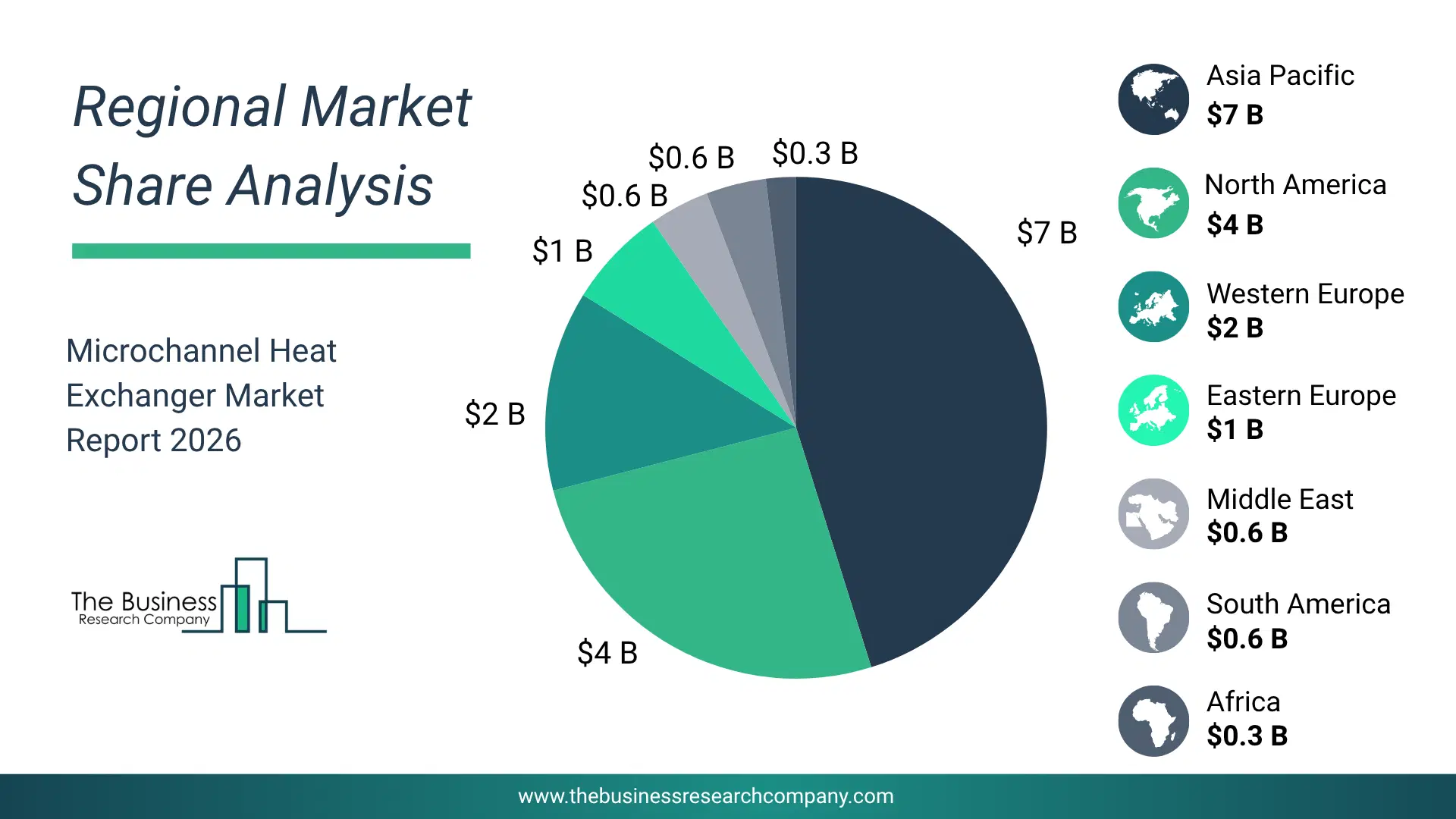
Regional Outlook
North America was the largest region in the microchannel heat exchanger market in 2025. Asia-Pacific is expected to be the fastest-growing region in the forecast period. The regions covered in this market report are Asia-Pacific, South East Asia, Western Europe, Eastern Europe, North America, South America, Middle East, Africa The countries covered in this market report are Australia, Brazil, China, France, Germany, India, Indonesia, Japan, Taiwan, Russia, South Korea, UK, USA, Canada, Italy, Spain.What Defines the Microchannel Heat Exchanger Market?
The microchannel heat exchanger market consists of sales of heat exchangers, cooling units, and heat recovery systems. Values in this market are ‘factory gate’ values, that is the value of goods sold by the manufacturers or creators of the goods, whether to other entities (including downstream manufacturers, wholesalers, distributors and retailers) or directly to end customers. The value of goods in this market includes related services sold by the creators of the goods.How is Market Value Defined and Measured?
The market value is defined as the revenues that enterprises gain from the sale of goods and/or services within the specified market and geography through sales, grants, or donations in terms of the currency (in USD unless otherwise specified). The revenues for a specified geography are consumption values that are revenues generated by organizations in the specified geography within the market, irrespective of where they are produced. It does not include revenues from resales along the supply chain, either further along the supply chain or as part of other products.
This chart presents market attractiveness based on a quantitative evaluation of growth, competition, strategic alignment, and risk, offering a clear view of opportunity areas for decision-making. This chart is for illustrative purposes; the full report contains the complete analysis.

This chart highlights the Total Addressable Market (TAM) by estimating the maximum revenue opportunity using an assumption-driven approach, supporting strategic planning and opportunity sizing across markets. The chart is illustrative; the full report provides a more comprehensive analysis.
What Key Data and Analysis Are Included in the Microchannel Heat Exchanger Market Report 2026?
The microchannel heat exchanger market research report is one of a series of new reports from The Business Research Company that provides market statistics, including industry global market size, regional shares, competitors with the market share, detailed market segments, market trends and opportunities, and any further data you may need to thrive in the microchannel heat exchanger industry. The market research report delivers a complete perspective of everything you need, with an in-depth analysis of the current and future state of the industry.Microchannel Heat Exchanger Market Report Forecast Analysis
| Report Attribute | Details |
|---|---|
| Market Size Value In 2026 | $16.59 billion |
| Revenue Forecast In 2030 | $23.47 billion |
| Growth Rate | CAGR of 8.8% from 2026 to 2030 |
| Base Year For Estimation | 2025 |
| Actual Estimates/Historical Data | 2020-2025 |
| Forecast Period | 2026 - 2030 |
| Market Representation | Revenue in USD Billion and CAGR from 2026 to 2030 |
| Segments Covered | Type, Material Type, Fluid Mechanism, End-Use Industry |
| Regional Scope | Asia-Pacific, Western Europe, Eastern Europe, North America, South America, Middle East, Africa |
| Country Scope | The countries covered in the report are Australia, Brazil, China, France, Germany, India, Indonesia, Japan, Taiwan, Russia, South Korea, UK, USA, Canada, Italy, Spain. |
| Key Companies Profiled | DENSO Corporation, DAIKIN INDUSTRIES Ltd, Johnson Controls plc, Danfoss Industries Pvt. Ltd., Hanon Systems, Alfa Laval, Modine Manufacturing, Greenheck Group, MAHLE GmbH, Evapco Inc., API Heat Transfer Inc., Vahterus, Thermofin, Climetal S.L., Mikros Technologies, Goldstone HVACR Inc., Sanhua Holding Group Co., Kaltra GmbH, Kangsheng Group, MSD Technologies |
| Customization Scope | Request for Customization |
| Pricing And Purchase Options | Explore Purchase Options |