

Microgravity Research Market Report 2026
Global Outlook – By Platform (International Space Station, Parabolic Flights, Drop Towers, Ground-Based Facilities, Other Platforms), By Application (Space Exploration, Material Science, Biotechnology, Combustion Science, Fluid Dynamics, Other Applications), By End-User (Government Agencies, Commercial Space Companies, Research Institutions, Other End-Users) – Market Size, Trends, Strategies, and Forecast to 2030
Microgravity Research Market Overview
• Microgravity Research market size has reached to $3.64 billion in 2025 • Expected to grow to $5.83 billion in 2030 at a compound annual growth rate (CAGR) of 9.8% • Growth Driver: Rising Investment In Space Exploration Fueling The Growth Of The Market Due To Expanded Opportunities For Low-Gravity Scientific Experiments • Market Trend: Advancements In End-To-End Microgravity Solutions Driving Innovation In Space-Based Research • North America was the largest region in 2025.What Is Covered Under Microgravity Research Market?
Microgravity research refers to the scientific study of physical, chemical, and biological processes in environments where the force of gravity is significantly reduced compared to Earth's surface. In these low-gravity conditions, phenomena such as fluid dynamics, combustion, material behavior, and biological development can behave differently, offering unique insights into fundamental principles of nature. The main platforms of microgravity research include international space station, parabolic flights, drop towers, ground-based facilities, and others. The international space station is a large spacecraft orbiting Earth where scientists conduct experiments in a stable microgravity environment. It is applied for space exploration, material science, biotechnology, combustion science, fluid dynamics, and others by several end-users, including government agencies, commercial space companies, research institutions, and others.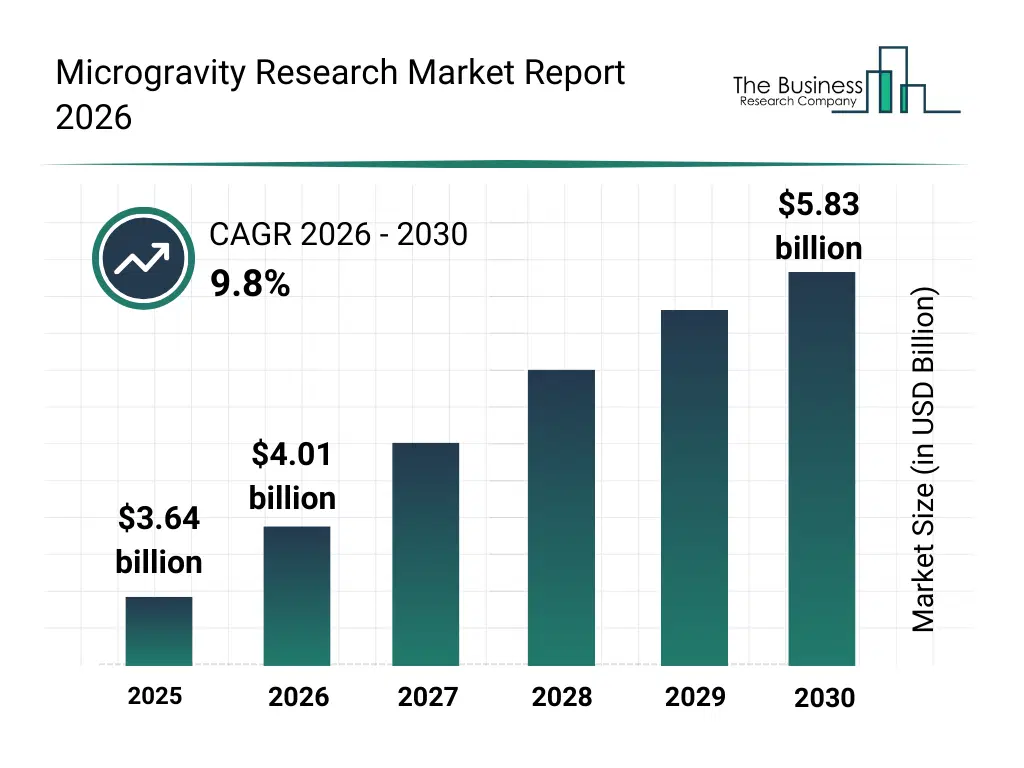
What Is The Microgravity Research Market Size and Share 2026?
The microgravity research market size has grown rapidly in recent years. It will grow from $3.64 billion in 2025 to $4.01 billion in 2026 at a compound annual growth rate (CAGR) of 10.2%. The growth in the historic period can be attributed to increasing government and space-agency funding for orbital microgravity experiments, growth in international space station utilization for scientific research, advancements in payload integration technologies enabling more complex experiments, rising demand for microgravity insights in pharmaceuticals and material sciences, expansion of ground-based microgravity simulation capabilities supporting pre-flight testing.What Is The Microgravity Research Market Growth Forecast?
The microgravity research market size is expected to see strong growth in the next few years. It will grow to $5.83 billion in 2030 at a compound annual growth rate (CAGR) of 9.8%. The growth in the forecast period can be attributed to growing commercialization of space-based research platforms enabling broader access, rising demand for microgravity data to support space manufacturing and biopharmaceutical innovation, increasing availability of private spaceflight services offering experiment deployment opportunities, development of next-generation microgravity instrumentation with higher precision, expanding partnerships between research institutions and space companies to scale microgravity experimentation. Major trends in the forecast period include commercialization of microgravity research services and platforms, expansion of private space stations and suborbital research opportunities, standardization and modularization of microgravity payloads and interfaces, growth of international collaborations and public–private research consortia, increasing use of microgravity test campaigns for pre-spaceflight technology validation.
Global Microgravity Research Market Segmentation
1) By Platform: International Space Station, Parabolic Flights, Drop Towers, Ground-Based Facilities, Other Platforms 2) By Application: Space Exploration, Material Science, Biotechnology, Combustion Science, Fluid Dynamics, Other Applications 3) By End-User: Government Agencies, Commercial Space Companies, Research Institutions, Other End-Users Subsegments: 1) By International Space Station: U.S. National Laboratory Experiments, Commercial Module Services, Academic Research Programs, Pharmaceutical And Biotech Research, Government-Funded Experiments 2) By Parabolic Flights: Commercial Parabolic Flight Providers, Government And Military Research Missions, Academic Microgravity Experiments, Short-Term Biological Studies, Equipment and Payload Testing 3) By Drop Towers: Ultra-Short Duration Experiments, Material Science Research, Fluid Dynamics Studies, Educational Demonstrations, Pre-Spaceflight Experiment Validation 4) By Ground-Based Facilities: Clinostats And Random Positioning Machines, Magnetic Levitation Systems, Simulated Microgravity Bioreactors, Hypergravity And Rotating Wall Vessels, Analog Environment Research 5) By Other Platforms: Suborbital Rockets, CubeSat-Based Experiments, High-Altitude Balloons, Lunar and Martian Analog Missions, Commercial Space StationsWhat Is Driver Of The Microgravity Research Market?
The increasing investment in space exploration is expected to propel the growth of the microgravity research market going forward. Space exploration refers to the scientific investigation and discovery of outer space using advanced technology to study celestial objects and cosmic phenomena beyond Earth. Investment in space exploration is rising due to growing commercial opportunities, as private companies increasingly see space-based technologies and services as profitable ventures with long-term returns. Increasing investment in space exploration supports the demand for microgravity research as it expands access to orbital and suborbital platforms, enabling more frequent and diverse scientific experiments in low-gravity environments to advance knowledge across various disciplines. For instance, in March 2025, according to the House of Commons Library, a UK-based library and information resource of the lower house of the British Parliament, the UK government announced that contracts worth a total of $1,135 million (£844 million) were awarded to the country between 2022 and 2024 via the European Space Agency (ESA). Therefore, the increasing investment in space exploration will boost the growth of the microgravity research industry.Key Players In The Global Microgravity Research Market
Major companies operating in the microgravity research market are Airbus SE, Northrop Grumman Corporation, National Aeronautics and Space Administration (NASA), Thales Group, SpaceX Corp., Blue Origin LLC, ESA, Sierra Space Corp., JAXA, Axiom Space Inc., Rocket Lab Ltd., Roscosmos, Made In Space Inc., NanoRacks LLC, Space Tango Inc., Virgin Galactic, CNSA, ISS National Lab, SpacePharma, Space Life Sciences Lab.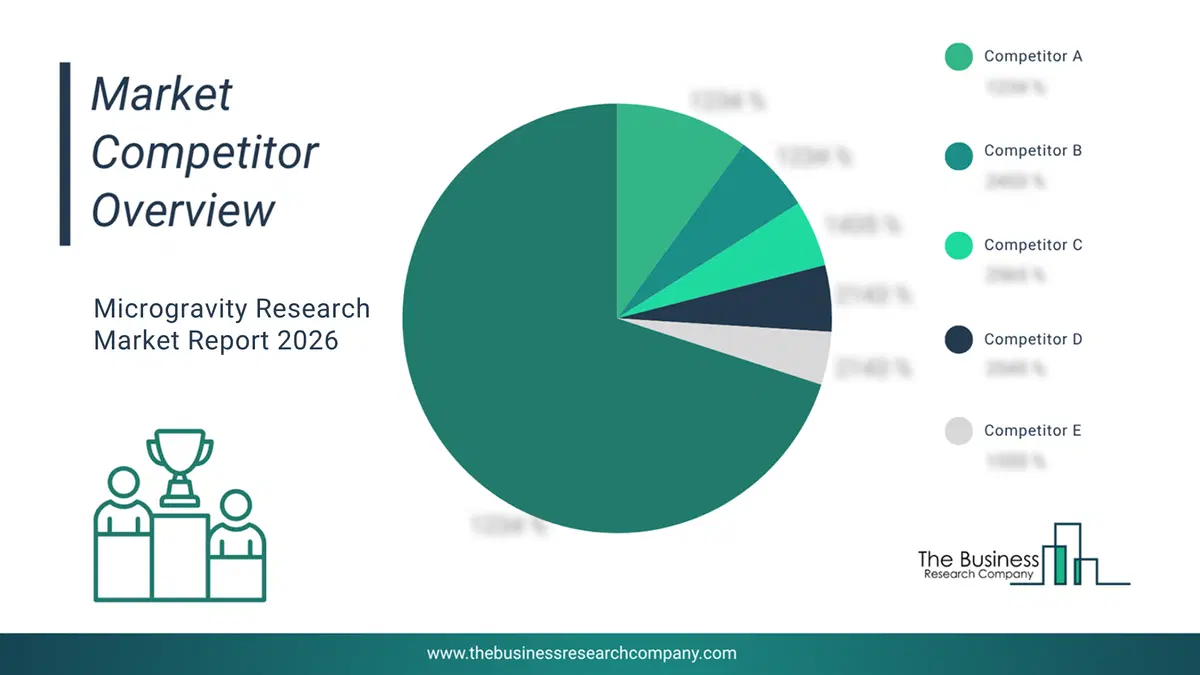
This chart is for illustrative purposes; the full report includes a detailed competitor analysis and comprehensive overview of the top 10 companies in the market.
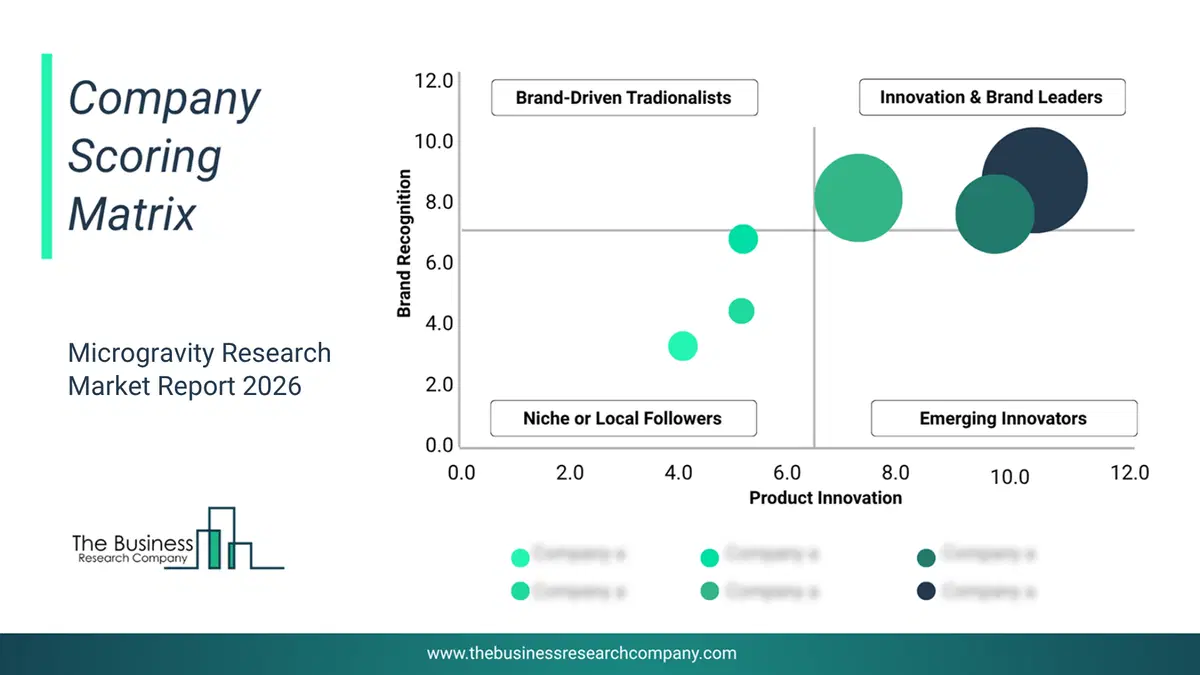
This chart maps companies by product innovation and brand strength, with bubble size indicating relative revenue, helping identify market leaders, challengers, and niche players. This is an illustrative chart; the full report provides a complete and accurate competitive analysis.
Global Microgravity Research Market Trends and Insights
Major companies operating in the microgravity research market are focusing on developing advanced technology solutions, such as end-to-end commercial microgravity, to gain a competitive edge in the market. End-to-end commercial microgravity services are fully integrated offerings that cover every stage of a microgravity research project, including planning, hardware development, mission execution, and post-experiment analysis. For instance, in October 2023, Rocket Factory Augsburg, Yuri, and ATMOS Space Cargo, a Germany-based space technology companies, launched Eva, an end-to-end commercial microgravity service. Eva introduces a distinct global service aimed at generating transformative insights in biotechnology and product innovation. It brings together the specialized knowledge of three domain experts to deliver a fully integrated solution. This setup allows clients to prioritize their main business activities while relying on streamlined research support. The ability to cover the entire value chain within Germany showcases the strength and maturity of the country's NewSpace sector.What Are Latest Mergers And Acquisitions In The Microgravity Research Market? Helogen Corporation Acquires Vellon Space To Strengthen Presence In India’s Space And Biotechnology Sectors
In May 2025, Helogen Corporation, a US-based provider of space biology solutions and orbital infrastructure technologies, acquired Vellon Space for an undisclosed amount. With this acquisition, Helogen aims to expand its presence in India’s rapidly growing space and biotechnology sectors by leveraging Vellon’s local expertise and strategic partnerships with key research and government institutions. Vellon Space is an India-based provider of space technology solutions specializing in microgravity research and development for scientific and industrial applications.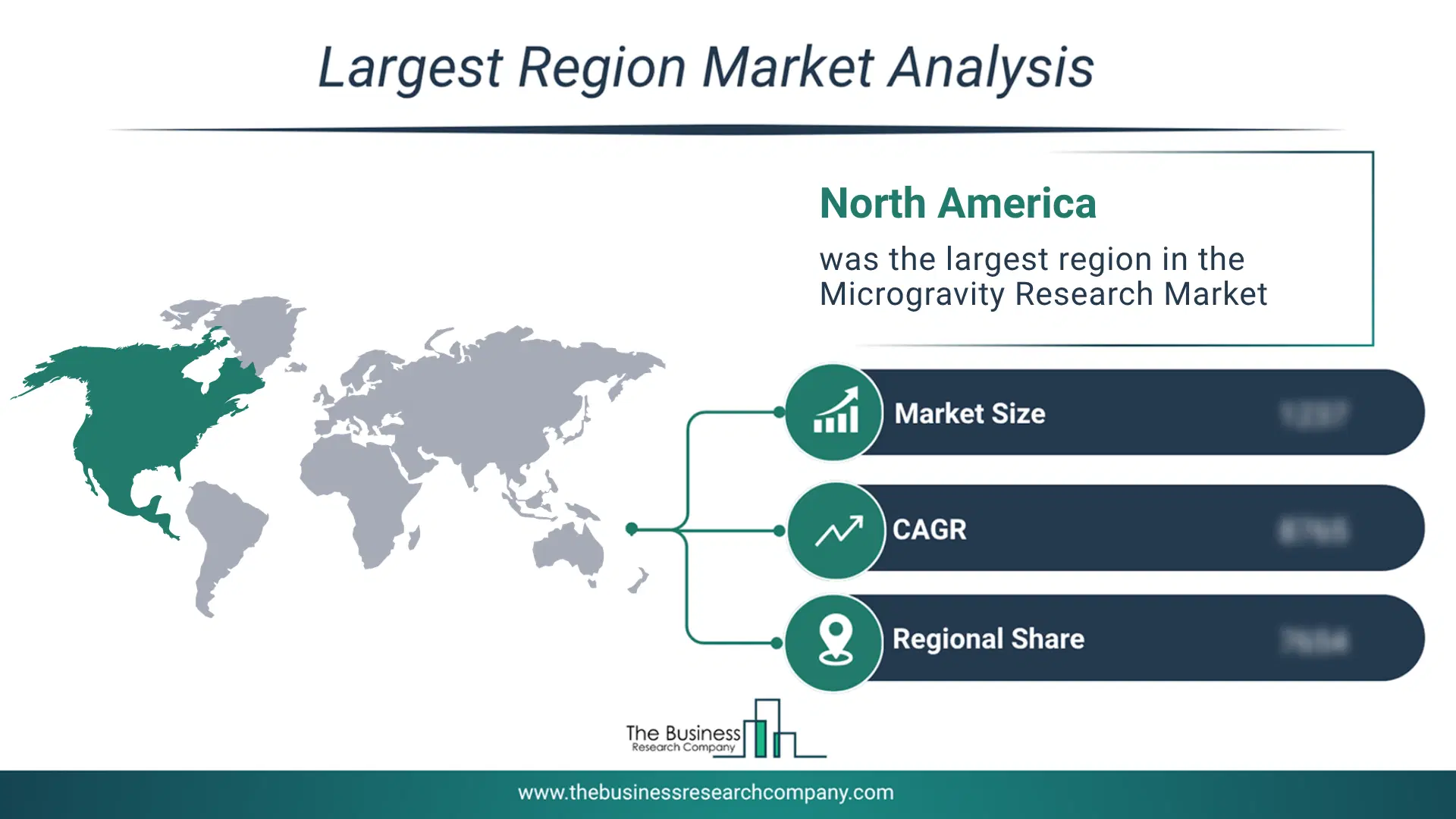
Regional Insights
North America was the largest region in the microgravity research market in 2025. The regions covered in this market report are Asia-Pacific, South East Asia, Western Europe, Eastern Europe, North America, South America, Middle East, Africa. The countries covered in this market report are Australia, Brazil, China, France, Germany, India, Indonesia, Japan, Taiwan, Russia, South Korea, UK, USA, Canada, Italy, SpainWhat Defines the Microgravity Research Market?
The microgravity research market consists of revenues earned by entities by providing services such as microgravity experiment design, payload integration, flight operations support, and ground-based simulation services. The market value includes the value of related goods sold by the service provider or included within the service offering. The microgravity research market also includes sales of fluid handling systems, thermal control units, telemetry systems, and microgravity simulation devices. Values in this market are ‘factory gate’ values, that is the value of goods sold by the manufacturers or creators of the goods, whether to other entities (including downstream manufacturers, wholesalers, distributors and retailers) or directly to end customers. The value of goods in this market includes related services sold by the creators of the goods.How is Market Value Defined and Measured?
The market value is defined as the revenues that enterprises gain from the sale of goods and/or services within the specified market and geography through sales, grants, or donations in terms of the currency (in USD unless otherwise specified). The revenues for a specified geography are consumption values that are revenues generated by organizations in the specified geography within the market, irrespective of where they are produced. It does not include revenues from resales along the supply chain, either further along the supply chain or as part of other products.
This chart presents market attractiveness based on a quantitative evaluation of growth, competition, strategic alignment, and risk, offering a clear view of opportunity areas for decision-making. This chart is for illustrative purposes; the full report contains the complete analysis.

This chart highlights the Total Addressable Market (TAM) by estimating the maximum revenue opportunity using an assumption-driven approach, supporting strategic planning and opportunity sizing across markets. The chart is illustrative; the full report provides a more comprehensive analysis.
What Key Data and Analysis Are Included in the Microgravity Research Market Report 2026?
The microgravity research market research report is one of a series of new reports from The Business Research Company that provides market statistics, including industry global market size, regional shares, competitors with the market share, detailed market segments, market trends and opportunities, and any further data you may need to thrive in the microgravity research industry. The market research report delivers a complete perspective of everything you need, with an in-depth analysis of the current and future state of the industry.Microgravity Research Market Report Forecast Analysis
| Report Attribute | Details |
|---|---|
| Market Size Value In 2026 | $4.01 billion |
| Revenue Forecast In 2030 | $5.83 billion |
| Growth Rate | CAGR of 9.8% from 2026 to 2030 |
| Base Year For Estimation | 2025 |
| Actual Estimates/Historical Data | 2020-2025 |
| Forecast Period | 2026 - 2030 |
| Market Representation | Revenue in USD Billion and CAGR from 2026 to 2030 |
| Segments Covered | Platform, Application, End-User |
| Regional Scope | Asia-Pacific, Western Europe, Eastern Europe, North America, South America, Middle East, Africa |
| Country Scope | The countries covered in the microgravity research market report are Australia, Brazil, China, France, Germany, India, Indonesia, Japan, Taiwan, Russia, South Korea, UK, USA, Canada, Italy, Spain |
| Key Companies Profiled | Airbus SE, Northrop Grumman Corporation, National Aeronautics and Space Administration (NASA), Thales Group, SpaceX Corp., Blue Origin LLC, ESA, Sierra Space Corp., JAXA, Axiom Space Inc., Rocket Lab Ltd., Roscosmos, Made In Space Inc., NanoRacks LLC, Space Tango Inc., Virgin Galactic, CNSA, ISS National Lab, SpacePharma, Space Life Sciences Lab. |
| Customization Scope | Request for Customization |
| Pricing And Purchase Options | Explore Purchase Options |